Experimentation

All the artists you will encounter in the exhibition Experimentation – from the 17th century to now – have one thing in common, they experimented without holding back. By trying out different techniques and materials, they continually discovered something new. And they approached the same theme over and over with a fresh perspective. Thanks to these experiments, they developed their craftsmanship into mastery. Discover artworks from the Rembrandt House Museum collection by Rembrandt, Geertruydt Roghman, Glenn Brown, Erik Desmazières, Gérard de Palézieux, Reinder Homan and Willem den Ouden, amongst many others.

In this exhibition you’ll also have the opportunity to make a drawing yourself, right in the middle of the gallery! Try out different types of paper and drawing materials. Just like the artists around you – each and every one of them a source of inspiration.

Experimenting with trees
If Rembrandt were to have a motto, it would have been ‘work from life’. In other words: observe your subject very carefully. This way he was able to very convincingly depict a group of lonely trees on a hill. You can almost hear the approaching wind rustling through the leaves. But Rembrandt was certainly not the only one with strong observation skills. In this exhibition you will see prints by artists from the 17th to the 20th century, who all put their own spin on the same subject. Every print includes a tree, yet it is never the same.

Experimenting with Rembrandt
Tronies were very popular in the 17th century. They are portraits of models that portray a specific type or an emotion. Rembrandt was a master at making tronies. Contemporary artist Glenn Brown (1966) took Rembrandt’s tronies as the basis for his own series. On his iPad he transformed Rembrandt’s artworks into a wild interplay of lines. He then made an etching of the new tronie. Finally, he superimposed two etchings and made the prints that are shown in this exhibition.

Experimenting with the art room
Erik Desmazières (1948) is fascinated by spaces that house collections, like libraries and wunderkammers. In 2007 he visited the Rembrandt House Museum to study Rembrandt’s art room. He made a series of prints based on it. It’s the same arrangement every time, but with some subtle changes. He printed the copper plate several times, adjusting the image slightly between each printing. Sometimes he added more shadows, sometimes some objects. He also experimented with various types of paper.

Experimenting with lines
Willem den Ouden (1928) has lived on the Waal River and studied the landscape for over fifty years. He looks at how he can capture the atmosphere of the river. With just a few lines he depicted the flowing water, the reflections of clouds and low-hanging mist. He prints his lithographs on thin Chinese paper that is glued to a sturdy sheet of paper. There is a French term for this: chine collé. This technique causes the paper to protrude slightly, creating a shimmering effect.

Etched Denim

Invited by the Rembrandt House Museum, another famous Amsterdam creative brand steps into the footsteps of Rembrandt. Following the immense success of the temporary tattoo workshop by Schiffmacher & Veldhoen in 2023, fashion brand G-STAR is innovatively translating Rembrandt’s craftsmanship into Denim. Inspired by Rembrandt’s etching technique and his iconic self-portrait from the museum collection, the G-STAR design team has combined the latest laser technologies with experiments on various types of Denim. This is G-STAR’s tribute to ancient craftsmanship in a modern way.

Rembrandt was not only a great painter, he was also a phenomenal etcher. For example, he not only printed his prints on regular paper, but also experimented with other materials, such as parchment and Japanese paper. This was the reason for G-STAR to give a modern interpretation to his innovative way of experimenting. The designers chose Rembrandt’s self-portrait from 1639 as a basis and investigated with the latest laser technology which types of denim, washings and coatings yielded the best results. In addition, the artworks were adjusted a little bit. Sometimes with the help of AI. The Etched Denim exhibition shows some of Rembrandt’s famous prints and also shows the research into the denim collection.

At the same time as the exhibition, G-STAR is launching a capsule collection. It consists of two denim jackets, two jeans, a shirt and a parka. The unisex collection is available from 31 October in selected G-STAR stores and on g-star.com.

ETCHING ON DENIM
Family workshop

During the Christmas holidays, you can print your own etching on denim. Get started with Rembrandt’s etching technique and discover how you can print your own drawing on denim.
These family workshops are organized daily during the Christmas holidays (closed on Christmas Day), costs €7.50, museum entrance not included. Suitable for everyone from 8 years and up. With a Stadspas, the workshop and museum entrance are free. Maximum 15 participants. 

Book your tickets here: Museum Rembrandthuis – online tickets

Rembrandt Open Studio 2024

Rembrandt Open Studio 

This autumn, you can meet two contemporary artists at the Rembrandt House Museum! For two months, from 5. October until 1. December 2024, Rens Krikhaar (1982) and Neda Mirhosseini (1995) will set up their studios in one of the museum galleries and create their art, live. As early as the seventeenth century, Rembrandt’s house was a creative hub. A place where Rembrandt and his pupils made art every day. Now, 400 years later, we are bringing back this practice with Rembrandt Open Studio. Each autumn, a new generation of artists is invited to create new work at Rembrandt’s home.    

Krikhaar and Mirhosseini share Rembrandt’s rich imagination. Also, like Rembrandt, both artists have a penchant for working on paper. Mirhosseini creates portraits of friends and captures their shared moments in still lifes of tables that have not yet been cleared. These drawings allow her to make any place that’s new to her familiar, and tell stories about her own life. Krikhaar, on the other hand, seeks out the unknown in his artworks. In his drawings and graphic work, we follow a seventeenth-century explorer, who sometimes encounters very unexpected things on their adventures. Krikhaar and Mirhosseini, both in their own way, invite you to explore their paper worlds.  


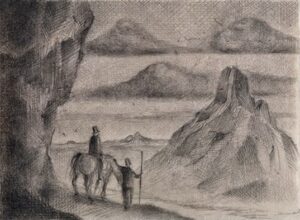
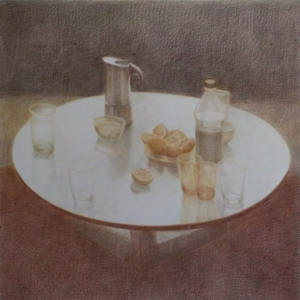
Left: Rens Krikhaar, M’asaaf Riss expedition journal | Right: Neda Mirhosseini, Late Night Early Morning

Rens Krikhaar  

The world of Rens Krikhaar (1982) consists of an archipelago with many islands. His work features giant animals, menacing mountainous regions and hallucinatory scenes, ready to be discovered. Krikhaar paints, draws and etches in dramatic light-dark contrasts an ever-growing ‘Terra Incognita’. Man is but a small shadow. Krikhaar: ‘During my working period at the Rembrandt House Museum, I hope to take visitors into my process, and further develop my own work in this special environment.’    

Neda Mirhosseini  

Neda Mirhosseini (born 1995) documents her daily life through drawings. She shows friendship and intimacy by zooming in on the moments and ways people come together. Portraits of her friends are accompanied by still lifes of tables that have not yet been cleared. The empty wine glasses, coffee mugs, food leftovers, plates and cutlery are the remnants of shared moments, of social connections. According to Mirhosseini, these objects possess a hushed poetry: ‘They are subtle references to the lives that take place behind closed doors.’  

Rembrandt Open Studio with Rens Krikhaar and Neda Mirhosseini is on view from 5. October to 1. December 2024 in the Rembrandt House Museum.  

Rembrandt & the world

Typically Dutch – that’s how many people see Rembrandt and his work. Unlike many artists of his era, Rembrandt never travelled abroad. But make no mistake. A lot of the world is reflected in his etchings, from lions, exotic shells and turbans, to mountainous landscapes and Italian buildings.

The Rembrandt & the world exhibition will take you on a journey past more than forty of Rembrandt’s etchings from the Rembrandt House Museum collection, etchings that always reveal something that is not typically Dutch. Discover where Rembrandt got his knowledge and inspiration, and how worldly-wise (or unworldly?) he really was. 

Room texts

Fantasy world

If Rembrandt had a motto, it would have undoubtedly been ‘work from life’. Show what you see: just as it is. Yet he often gave free rein to his imagination. Surprisingly enough, this was also the case with some of his self-portraits.

Stuff

Every 17th-century Amsterdammer knew that the world was bigger than their own neighbourhood. Sea trade was booming business. And through the port, things from all over the world came into the city, some bought, others plundered. Rembrandt enjoyed collecting these new, inspiring things. You regularly see these objects in his etchings.

People

In Amsterdam there was a great diversity of people to be seen on the streets: foreign visitors, international theatre companies, traders passing through and of course immigrants from different countries who had made the city their new home. Rembrandt was often inspired by them.

Clothes

Certain items of clothing and accessories can give a character a little more personality or flair. But Rembrandt could also make many things clear with clothing. What era a scene takes place in, how rich or poor people are, what country or continent they come from and sometimes what their religion is.

Landscapes

High peaks, deep valleys – you see both in Rembrandt’s etchings. But he will never have seen them himself. Mountainous landscapes do not exist in the Netherlands. And unlike many artists of his time, Rembrandt never travelled abroad. He would have had to use his imagination for such etchings.

Buildings

To make stories believable and convincing, the setting must be right. Biblical stories are set in the Middle East. That environment looks different from Rembrandt’s neighbourhood. Rembrandt had to use his imagination for this. Or copy from his more travel-loving fellow artists.

Animals

There are many exotic animals in Rembrandt’s etchings, lions, snakes and elephants. He was able to study some of these in real life, during the annual autumn fair in Amsterdam. For others he had to be creative, not always completely successfully.


In the first room, you can go to work yourself. You will find some  exotic shells like Rembrandt has drawn, and drawing materials. And a few practical drawing instructions! Make a drawing of Rembrandt’s shell, or something else that reminds you of the big wide world.

Workshop

In Museum Rembrandthuis you can make your own etching during the summer holidays! In this workshop, give your own twist to an etching from the exhibition Rembrandt & the world. The museum teacher will teach you how you can easily recreate Rembrandt’s etchings with, for example, shells, lions, or his own self-portrait with turban and sword. Experiment with Rembrandt’s drypoint technique and print two prints on the large etching press. You can take these home afterwards. Book your tickets here


Rembrandt of the Neighbourhood

In October 2023, we launched the ‘Rembrandt of the neighbourhood’ project. Young Amsterdammers aged between 16 and 24 learned more about and from Rembrandt and Sumibu, at three locations in Amsterdam: districts Noord, Zuidoost and Nieuw-West. This was reflected in self-made etchings and then T-shirt designs. Each design has its own personal story. All etching designs hang in the museum’s Open Studio until 4 February. Georgy Dendoe, founder Sumibu, chose a winner from each district of the city – their etchings have been given an extra-large frame and can only be bought as T-shirt designs in the Museum shop. Proceeds from the T-Shirts will go towards the next edition of this project.

Directed by: Rembrandt

Rembrandt as director in the spotlights

Rembrandt was a master storyteller, not with words but with images. To tell stories, he made use of techniques that were also used in the theatre, such as facial expressions, gestures, lighting, costumes, and accessories. In addition, he chose the best moment to depict: the moment of greatest tension, of ultimate suspense. The exhibition Directed by: Rembrandt highlights, for the first time, Rembrandt’s role as a director of his own artworks. And it reveals how 17th-century painters and theatre-makers were inspired by each other.

A number of masterpieces are coming to Museum Rembrandthuis for the exhibition, from the Staatliche Museen zu Berlin, Mauritshuis and The Kremer Collection, among others.

Seven Directing Techniques


Just like theatre directors, Rembrandt manipulated all elements in his artworks at his discretion, aiming to depict a story as captivatingly and convincingly as possible. The main directing techniques he used are:

  • Choosing the Right Moment
  • Facial Expression
  • Hand Gestures
  • Costumes and Accessories
  • Posture
  • Lighting
  • Composition

A painter can use the expression on a figure’s face to tell an important part of a story. For this, Rembrandt studied actors in the theatre. He also acted himself in front of the mirror in his studio.

The Scandal


Rembrandt, Susanna (detail), 1636. Collection Mauritshuis, The Hague

The biblical character Susanna is about to take a bath. Two important men, elders, spy on her from the bushes. They whisper that they want to have sex with her. Susanna is startled. Rembrandt shows the ‘peripety’ of the moment: the turning point in the story is represented by Susanna turning away. Her eyes meet ours, and through that gaze, Rembrandt involves us in her predicament. The directing here is masterful because it does not get much more uncomfortable than this.

Terrible lie


Rembrandt, Potiphar’s Wife Accuses Joseph (detail), 1655. Collection Staatliche Museen zu Berlin, Gemäldegalerie / Christoph Schmidt; Public Domain Mark 1.0
 

This painting is about a terrible lie. On the right is Potiphar, a courtier to the pharaoh. He listens to his wife telling him that she was almost raped by Joseph. In reality, however, she herself accosted him. The shock on the face of Joseph–on the left–speaks volumes. In the Bible story, Joseph is not featured in this scene, but Rembrandt, as director of his own story, added him to clarify that a great injustice is being done.

This painting was created by Rembrandt in the Rembrandt House and is returning for the first time to the place where it was made almost 400 years ago.

The Perfect Turban


Rembrandt, Study of an old man with turban (detail), 1626/27. The Kremer Collection, Amsterdam.

According to several of Rembrandt’s pupils, he could spend two days winding a turban. Apparently, he took time to assemble various parts of a costume before beginning to paint or draw them. He probably took similar care to prepare this study of an old man. Rembrandt made this study in preparation for depicting the high priests in his painting Judas Repentant (1629). He wanted to know exactly how the light falls on the back of the head of a man wearing a turban.

Four stories, One image


Rembrandt, Christ preaching (The Hundred Guilder Print) (detail), ca. 1648. Collection Museum Rembrandthuis, Amsterdam

Usually, artworks depict a single moment, a single scene. This is the same in theatre, where the unity of time, place, and action is a golden rule. But, in this etching, Rembrandt brought together four moments from a single Bible story as if they had taken place at the same time. Like a director, he placed his figures in a well-balanced troep (group), alternated their height (sprong), and added plenty of verscheydenheydt (variety). The image is also full of drama and reminds us of the tableaux vivants that were popular in the Schouwburg theatre.


Exhibition at the Stadsarchief Amsterdam

Concurrently with the exhibition Regie: Rembrandt, the Stadsarchief Amsterdam is organising a treasury exhibition highlighting the broader context of the Amsterdam Schouwburg, its playwrights and actors, and its role in the city.

The exhibition Directed by: Rembrandt will take place from 2 March to 26 May 2024 at Museum Rembrandthuis. 

With thanks to: Mastercard, het Cultuurfonds, Rijksdienst voor het Cultureel Erfgoed, Huysgenoten van Museum Rembrandthuis, Kikkoman, Blockbusterfonds: Extra, Vrienden van Museum het Rembrandthuis, De Gijselaar-Hintzenfonds.


Rembrandt’s Peacocks

01.07.23- 15.10.23 

Rembrandt painted two peacocks – dead peacocks to be specific. It is a very special work of art. There is only a single other painting by him in which a dead bird plays the leading role (The Bittern Hunter, 1639). The picture with the peacocks has the character of a decorative piece, a work of art meant to enliven an interior. These were often hung up high, for example above a door. Peacocks are suitable subject matter for such a decorative piece, because it conjures the atmosphere of the countryside.

Coincidence or not, Rembrandt painted the peacocks around the time that he came to live in this house on the Jodenbreestraat. Perhaps he even made it for his own new house. In this way he could bring a piece of idyllic country life into his residence in the busy city.

In the multimedia tour you can find two ways of looking at and experiencing Rembrandts Still Life with Peacocks, much like a guided meditation.

The Poor Man’s Rembrandt Project

Van 17 t/m 25 juni 2023 houden Henk Schiffmacher en zijn tatoeëerders atelier bij Rembrandt thuis. Gedurende een week kun je een originele Rembrandt-tattoo laten zetten door het wereldberoemde team.

Wil je zeker zijn van een meesterwerk? Reserveer dan nu een tijdslot bij je favoriete tattoo artist via rembrandthuis.nl.

Rembrandt Forever
Rembrandt en Schiffmacher & Veldhoen hebben veel gemeen: ze zijn wereldberoemd, grootmeesters in hun vak en diepgeworteld in het DNA van Amsterdam. Ook hun kunst kent belangrijke overeenkomsten: bij zowel etsen als tatoeages begint het met een tekening, die vervolgens met inkt en naald op het medium wordt aangebracht. Waar Rembrandt een koperplaat en vel papier gebruikte om zijn compositie tot een ets te maken, brengen tatoeëerders hun tekening aan op de menselijke huid; een kunstwerk dat je levenslang altijd bij je draagt.

Schiffmacher en zijn team zullen hun atelier opzetten in de moderne museumvleugel. In de zeventiende eeuw was het pand aan de Jodenbreestraat een cultural hub, waar Rembrandt, zijn assistenten en zijn leerlingen samenwerkten aan hun kunstwerken. Nu gaat een nieuwe generatie 21ste-eeuwse kunstenaars hier aan het werk. Het museum blijft zo een plek waar het bruist van vernieuwing en experiment. Tegelijkertijd wordt de eeuwenoude kunst van etsen en inkttekeningen in ere gehouden.

Meld je aan
Tijdens hun residency in Museum Rembrandthuis biedt het team van Schiffmacher & Veldhoen Tattooing een aantal tattoo-ontwerpen aan, waaronder originele etsen van Rembrandt, Rembrandts handtekening en zijn monogram. Op rembrandthuis.nl/thepoormansrembrandtproject kun je vooraf de beschikbare tatoeages bekijken. Ook kun je hier een tijdslot reserveren om de tatoeage te laten zetten in het museum. De prijzen van de tatoeages variëren van 100 tot 250 euro. Bij het reserveren wordt om een aanbetaling van 50 euro gevraagd. We houden per dag een aantal plekken beschikbaar voor spontane inloop, maar wil je zeker zijn van een plekje, reserveer dan vooraf een tijdslot. Er zijn in totaal XX tijdslots beschikbaar.

Ontmoet het team

Henk Schiffmacher is sinds 45 jaar een begrip in de tatoeagewereld. De Amsterdamse tattookoning organiseerde de eerste grote tattooconventies in Europa, publiceerde ruim 20 boeken en exposeerde in diverse musea, waaronder Musée du Quai Branly in Parijs en het Royal Ontario Museum in Toronto. Hij beschouwt de samenwerking met Museum Rembrandthuis als een hoogtepunt in zijn carrière.

Tycho Veldhoen groeide op in de kunstwereld, als jongste zoon van de bekende Amsterdamse kunstenaar Aat Veldoen. Van hem leerde hij schilderen, tekenen en etsen. Het tatoeëren werd hem bijgebracht door Henk en Louise Schiffmacher, waarna hij aan het werk ging bij verschillende tattoogrootheden in de Verenigde Staten. Sinds 16 jaar is hij officieel partner van Schiffmacher & Veldhoen Tattooing.

Rupa van Teylingen is kunstschilder en tatoeëerder. Ook hij groeide op omringd door kunst: zijn vader was schrijver, zijn stiefvader specialist op het gebied van zeventiende-eeuwse stillevens. Hij studeerde af aan de Ruud Wackers Academie in Amsterdam als klassiek tekenaar, waarna hij bij Schiffmacher en Veldhoen in leer ging. De afgelopen tien jaar is hij afwisselend in de tattooshop en in zijn eigen atelier te vinden.

Framing Rembrandt

November 4, 2023 – February 5, 2024

Rembrandt has many faces: the genius, the miller’s son, the rebel. All of these labels were pasted onto the famous artist over the centuries. In the exhibition Framing Rembrandt, The Rembrandt House Museum will take you on a journey along four centuries of imaging, through art, documents and surprising objects. Additionally, one of the exhibition rooms will be converted into a cinema, where fragments from biopics (biographical fiction films) about Rembrandt will be shown; from the earliest film from 1920 and a Nazi propaganda film from 1942, to the latest film adaptation of Rembrandt’s life made in 2006.

Rembrandt Open Studio

After a successful first edition of Rembrandt Open Studio in 2020, with artists Iriée Zamblé (1995, Amsterdam) and Timothy Voges (1993, Curacao), and this summer’s temporary tattoo studio which was run by Henk Schiffmacher (1952, Harderwijk) and Tycho Veldhoen, two contemporary artists will again work at Rembrandt’s home this autumn. Abul Hisham (1987) and Guy Vording (1985) will work in a studio in the Rembrandt House Museum for a month and a half. Hisham and Vording, just like Rembrandt himself, have their own styles and idiosyncratic views of the world.  They also share Rembrandt’s talent for telling stories, managing to capture a memory, social criticism, situation, or character sketch all in a single image.

With its Rembrandt Open Studio initiative, The Rembrandt House Museum repeats its own history. Rembrandt’s house was already a creative hub back in the seventeenth century, a place where Rembrandt and his students created art every day. Now, 400 years later, artists once again have the opportunity to work in Rembrandt’s house. The studio is inside the museum: it gives visitors an opportunity to see the process of creating contemporary art up close and meet a new generation of talented makers.

Rembrandt Open Studio with Abul Hisham and Guy Vording will take place from 1 October to 15 November 2023 in The Rembrandt House Museum.

Abul Hisham:

‘Being given the opportunity to interact more with the visitors will be a new experience for me, one that I look forward to: I like to meet and talk to people and I’m happy that I’ll be able to show them my practice personally.’


Guy Vording:

‘I really believe that a residency in the Rembrandt House, immersed in its history, its residents and the public, will enhance Rembrandts’ influence on my work. I’m looking forward to this game, this interaction, like a student guided by the master.’


Abul Hisham (1987)  Hisham mainly works with pastels and raw pigments on wood. In this respect, he considers Rembrandt to be a great example: Rembrandt’s method of preparation and application of paint inspires Hisham in his own artistic practice. Many of Hisham’s artworks form a series; together, they reveal a bigger picture that deals with desires, death, religion and socio-political systems. His personal memories of his life and family in India often find their way into his art. Even so, he does not reveal everything; viewers are given the freedom to personally unravel and interpret the layers of symbols and meanings. Hisham completed his master’s degree in Hyderabad, India in 2012, and has been working as a visual artist ever since. In 2021, he moved to the Netherlands to follow a study programme at the Rijksakademie voor Beeldende Kunsten (State Academy of Fine Arts), which he completed this year.

Abul Hisham, Portrait of a Lawyer, 2022


Hisham: ‘As a painter I feel a great kinship with Rembrandt’s works. I still remember how I used Rembrandt’s famous painting of Belsshazar’s Feast as a reference. I have always been fascinated by his use of colour and texture, his experiments and his compositions. It is a rare experience to be working so close to his own studio, printmaking space and the collection of his etchings. I feel that through this residency I can continue my practice, research and experiment in Rembrandt’s footsteps. Being given the opportunity to interact more with the visitors will be a new experience for me, one that I look forward to: I like to meet and talk to people and I’m happy that I’ll be able to show them my practice personally.’

Website: Rijksakademie – Abul Hisham


Guy Vording (1985) Vording is a real disciple of Rembrandt when it comes to knowing what to leave out and what to draw attention to in order to successfully convey a story. His artwork starts with American magazine articles from the 1940s, which he has been collecting in albums for years. After choosing a suitable page, Vording first decides which part of the illustration and text he wants to keep, then fills in the rest with pencil. What remains is a surprising, new visual story, which often deals with people’s inner lives versus social expectations or assumptions. Vording graduated from the HKU (University of the Arts Utrecht) in 2013, and has been working as a visual artist ever since.

Guy Vording, Black Pages: Vanavond niet (Black Pages: Not Tonight), 2020.


Vording: ‘Although it’s in my nature to cling to my own familiar studio, in recent months I’ve started to explore places outside of it. The fact that I now have the opportunity to work in the same house as Rembrandt is a real honour, and couldn’t have come at a better time. Rembrandt’s etchings have always attracted me, and consciously and unconsciously influenced my work, especially in my Black Pages series. I recognise the fine lines that he has placed in a controlled manner and the play of light and shadow. For this reason, I believe that a residency in the Rembrandt House, immersed in its history, its residents and the public, will enhance Rembrandts’ influence on my work. I’m looking forward to this game, this interaction, like a student guided by the master.’

Website: Kunstenaar | Guy Vording | Amsterdam

Sign Up for the Newsletter

Paint
Skip to content