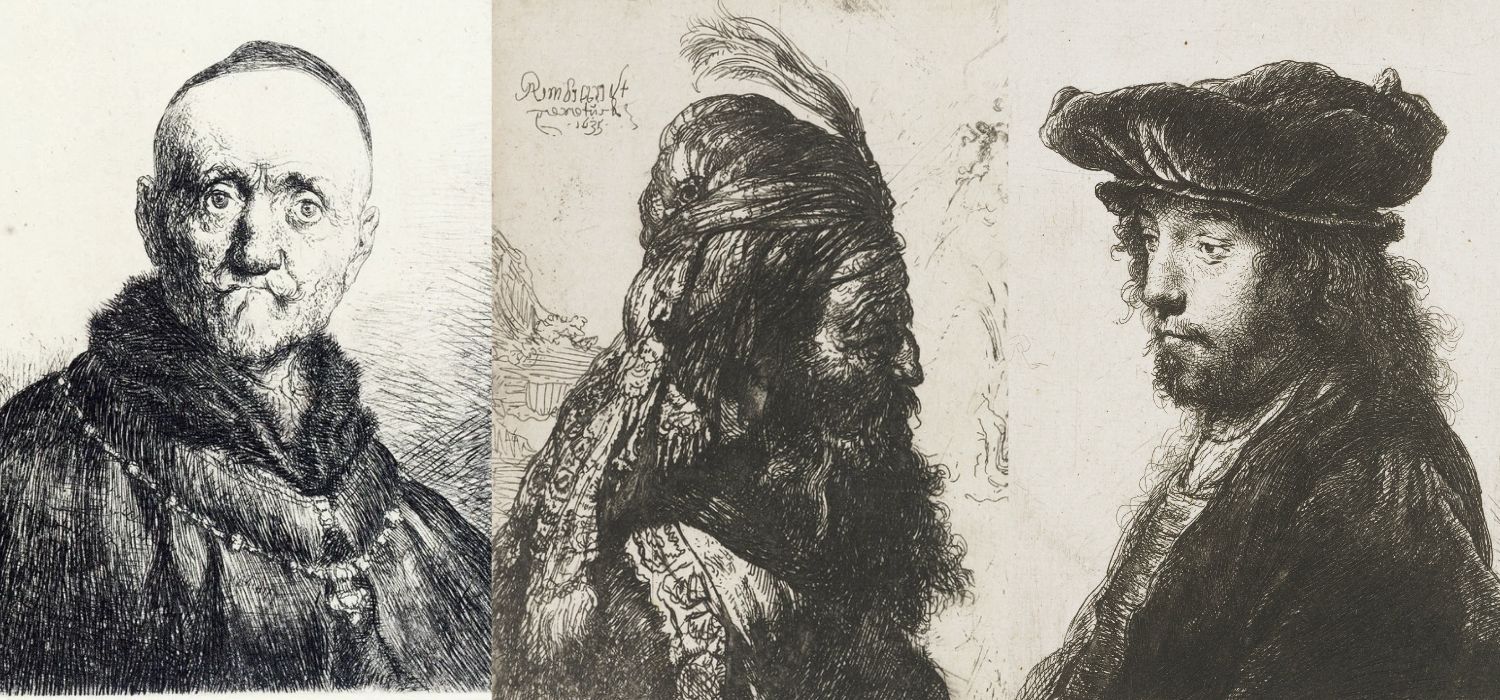
Stephanie Dickey and I began as young scholars and friends with dissertations and then books on related aspects of Rembrandt’s unparalleled exploration of human nature and character. She focused on the portraits and I on the self-portraits, each seeing Rembrandt in his social and cultural context, while resisting the trend to normalize his exceptional talent and production.1 It is thus in the spirit of scholarly friendship that I offer a brief speculation on a subject that Stephanie and I have pondered: the evolving nature of the artistic friendship and rivalry between Rembrandt (July 1606-1669) and Jan Lievens (October 1607-1674).2 Specifically, I look at a group of prints on which we have both commented: The instance in which Rembrandt geretuckert—retouched, or improved upon—four etchings by Lievens to create the Oriental Heads, as they have been titled since 1751, if not before (figs. 1-6).3 Like their models, Rembrandt’s Four Heads, as they are called in this essay, are not portraits but tronies, literally ‘heads’ and the period’s term for expressive character types.4 All four of Rembrandt’s tronies are historicized. Because of their exotic turbans, the Second and Third Heads would have been described as Turcks, or Turkish, a catch-all term used to describe garments and objects from the Ottoman empire that pictorially signified the ancient and Biblical worlds.5 The Fourth Head, a young man wearing a beret and sixteenth-century garb, though not as obviously foreign or exotic as the others, would have nonetheless evoked the past.6
 |  |  |  |
From Lievens’s prototypes Rembrandt etched, on new plates, unusually exact but substantially altered versions, which appear in reverse when printed. Rembrandt at once imitated Lievens’s prints and made a display of emulating—improving upon and surpassing—them by labeling his prints ‘Rembrandt geretuckert.’ The singularity of Rembrandt’s series of retouchings has prompted critics to want to understand his motivation.7 It may be that they arose in part from Rembrandt’s inclination to teach.8 Revisiting Carel Vosmaer’s 1868 assessment of the prints—with their ‘inscriptions énigmatique’—as student work improved by Rembrandt, Erik Hinterding has raised the possibility that they came about as a workshop teaching exercise, perhaps with student assistance.9 Yet, qualitatively and stylistically, their handling and tonality throughout are distinctively Rembrandt’s.10 The Four Heads have also been framed as a critique directed at Lievens and an escalation of the longstanding rivalry between the two; if Rembrandt associated the term ‘geretuckert’ with teaching, perhaps it here cast Lievens as in need of a lesson from the master.11
This essay argues that whatever their initial relation to Lievens, and whether or not a pupil witnessed or participated in their execution, making the prints was a learning experience for Rembrandt. However they came about, the Four Heads was a project in transformative emulation driven by Rembrandt’s artistic ambitions, and growing recognition, as a history painter.
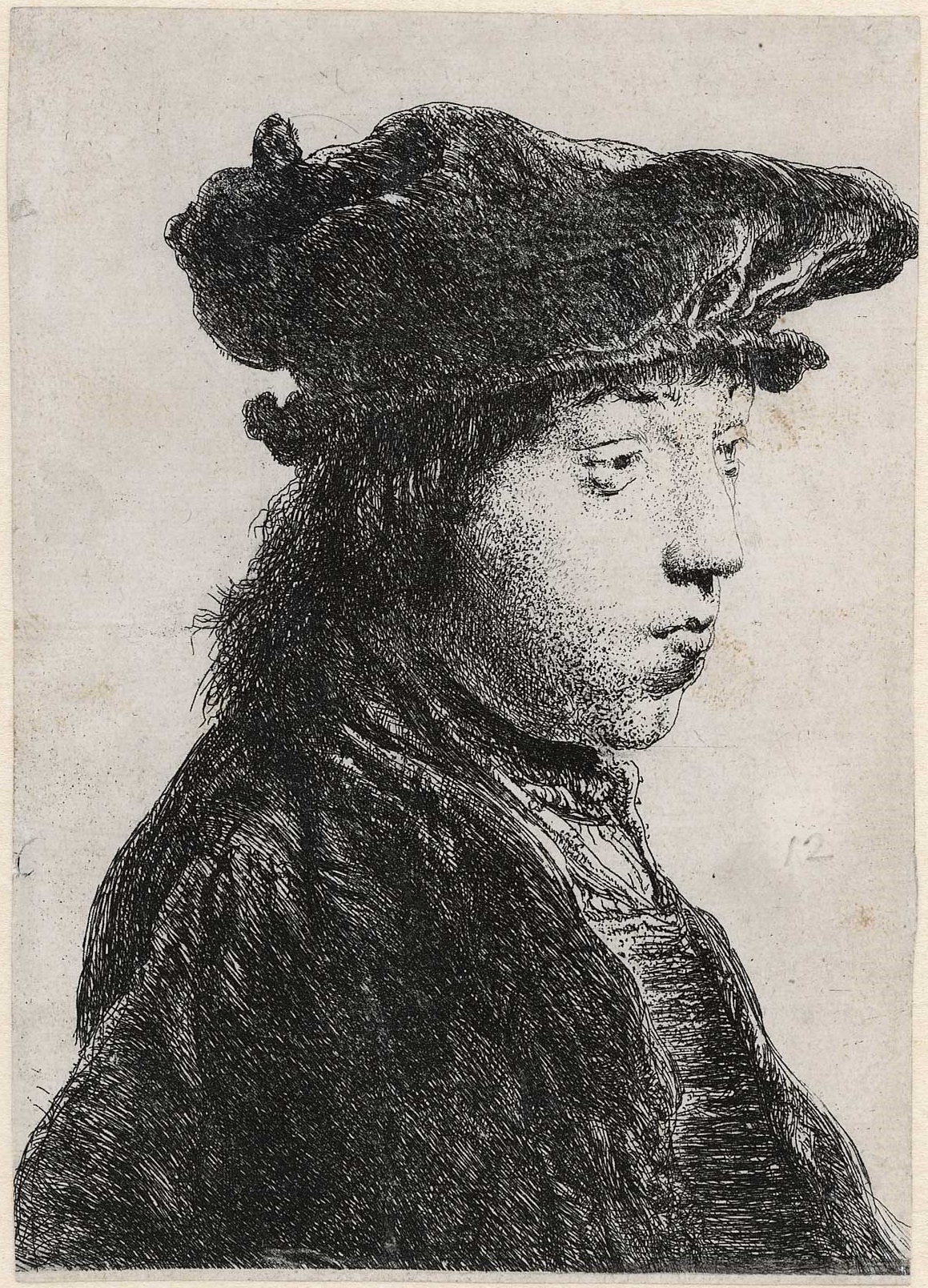 | 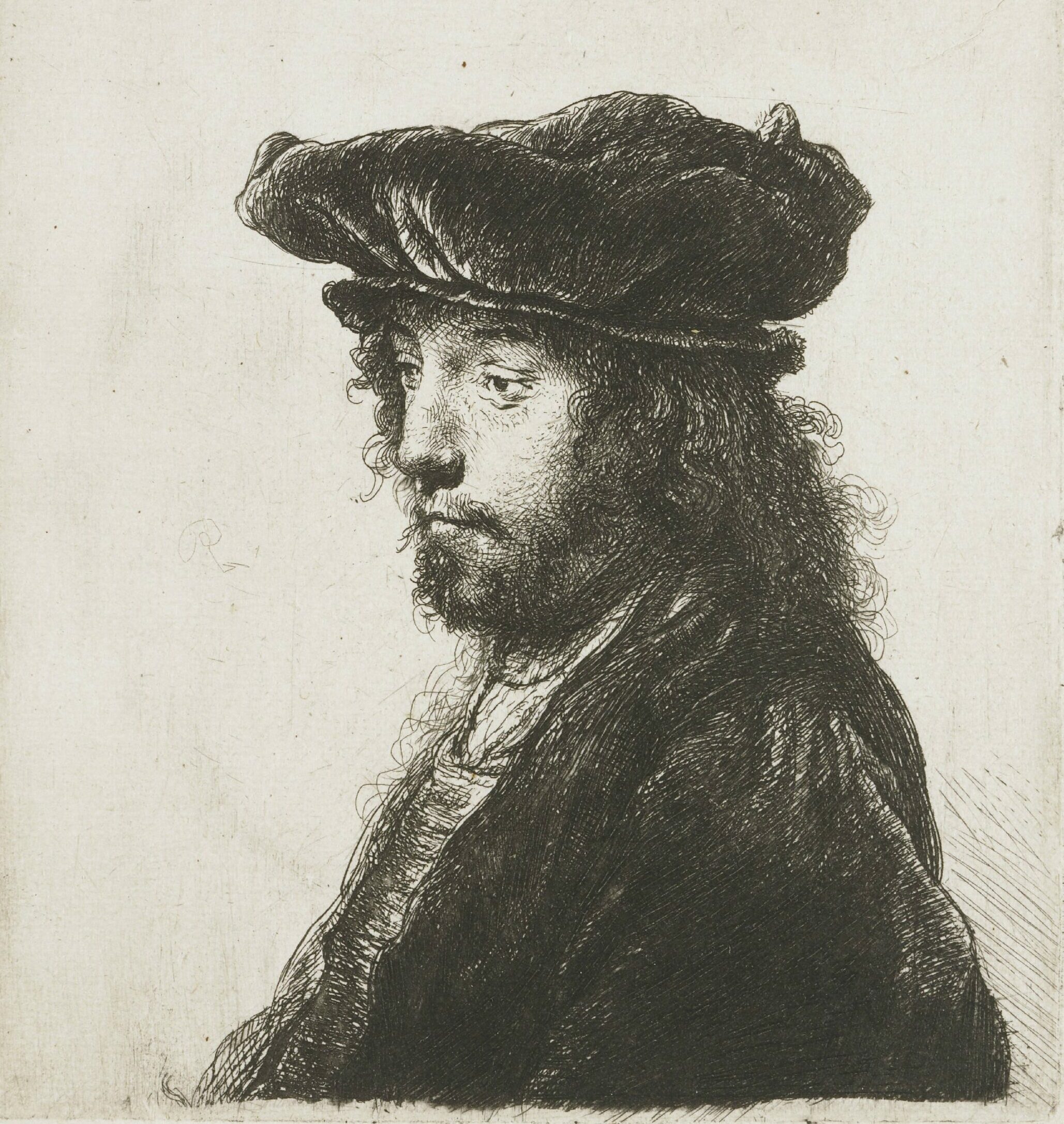 |
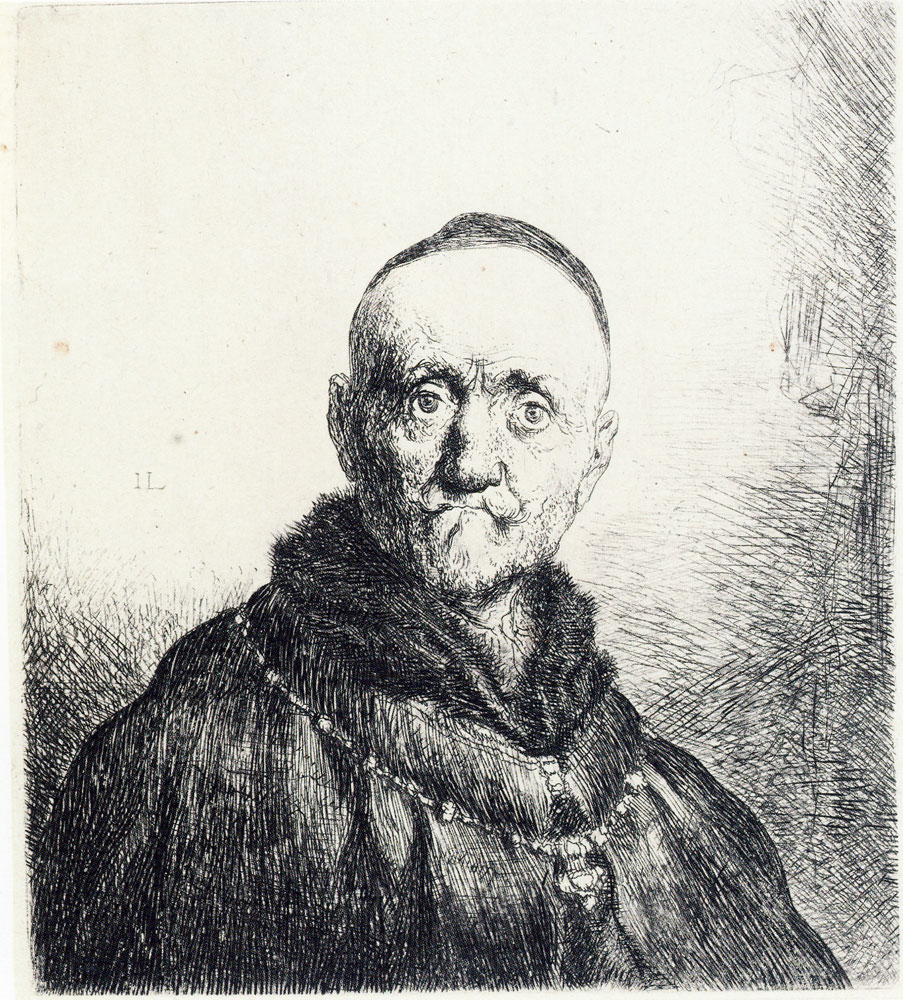
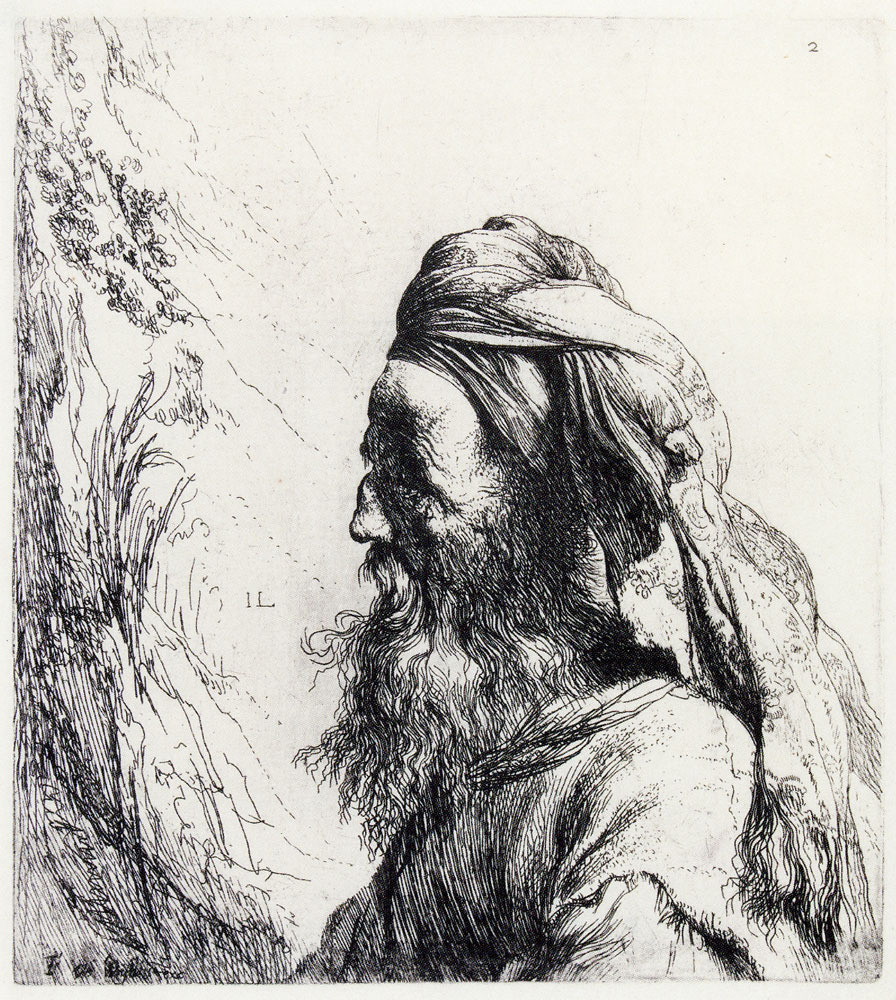
Around 1631, while both were still in Leiden, Lievens had etched a number of tronies, including seven heads of men, which he initialed and numbered as a series.12 In 1635, once he was fully established in Amsterdam and after Lievens had left for England and Antwerp, Rembrandt made what would be, in effect, his own series of four historicized tronies. Both series were displays of virtuosity; Rembrandt’s appropriation was also a demonstration of emulation. He chose as his models the three most fanciful and exotic of Lievens’s set of seven, the Old Man Facing Forward (fig. 1) and two that epitomize the descriptor ‘Turckse tronie’, An Oriental Man, Facing Right and Bearded Man in a Turban, Facing Left (fig. 3). That Rembrandt left aside from Lievens’s series two rather ordinary bearded men wearing undefined clothing and two younger men in contemporary dress suggests that his interest was specifically in the most intriguing of the exotic, weathered figures. A stand-alone print of the same date, Lievens’s Young Man in a Velvet Beret (fig. 5), inspired the Fourth Head (fig. 6).
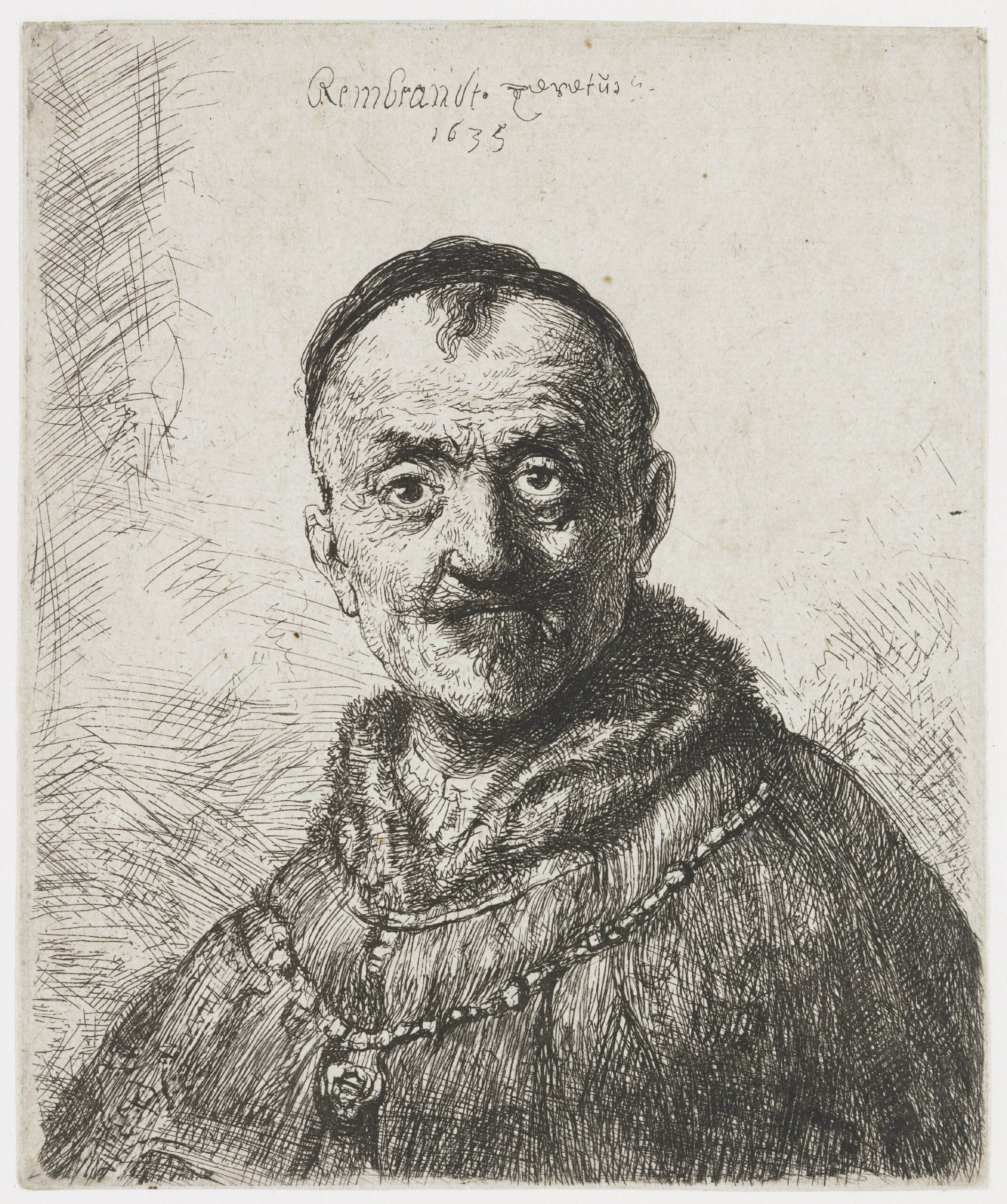
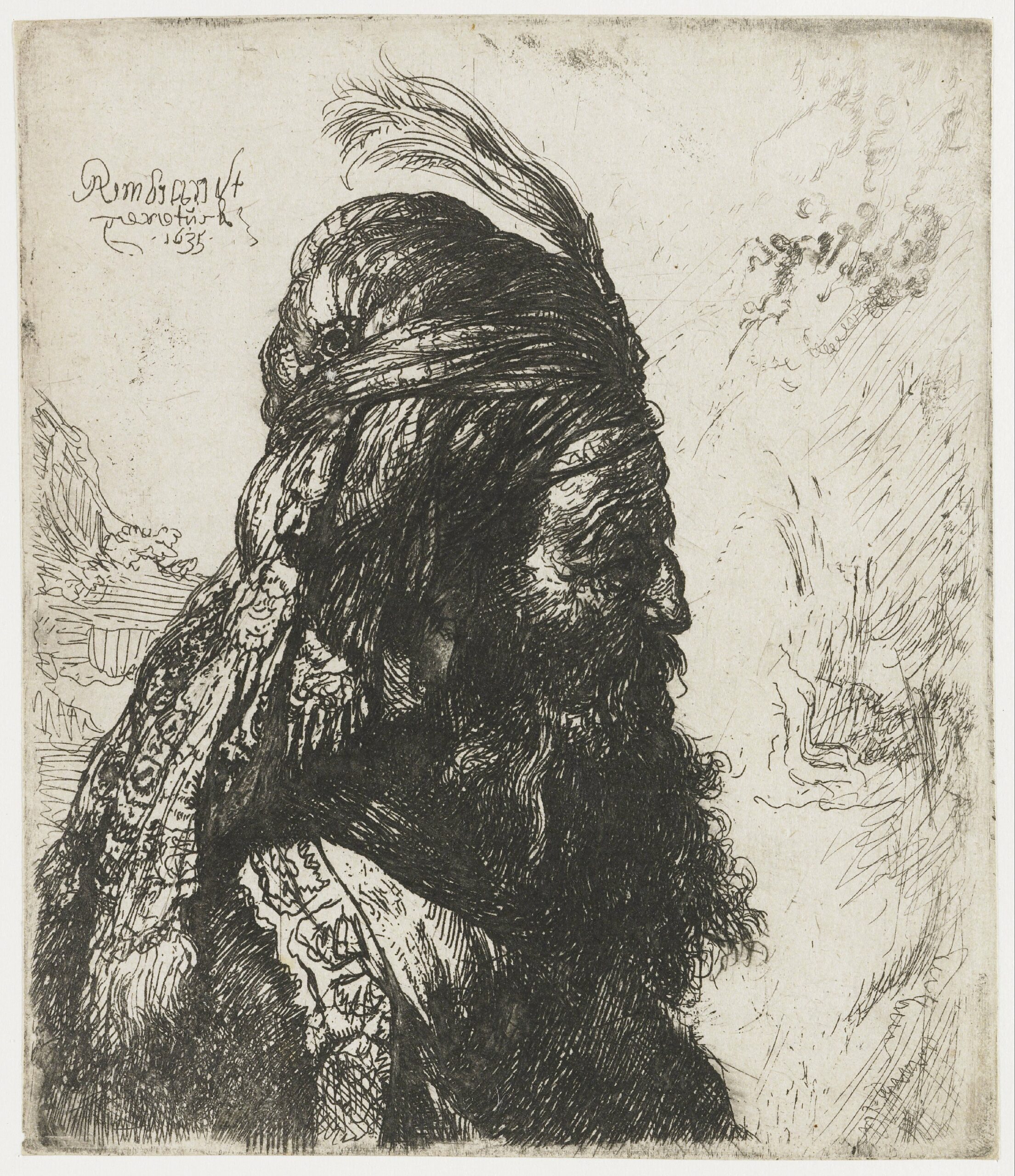
Rembrandt called his appropriation of Lievens’s work ‘retouching.’ The First Head is based on Lievens’s Old Man Facing Forward (figs. 1 and 2); its prominent signature ‘Rembrandt geretuc 1635’ claims authorship. The second is inscribed ‘Rembrandt geretuckert’ and the third ‘Rembrandt geretuck 1635.’ The Fourth Head is faintly signed only with the monogram ‘Rt.’ The meaning and connotations of the terms ‘retouching’ and ‘retouched’ have been debated. On the one hand, as Gerard de Lairesse describes painting practice, retouching (retocqueeren) was used for the final, finishing layer of paint that was applied after the dead coloring (doodverven) and the working-up (opschilderen).13 But ‘retouched’ also meant reworked, which is apparently how it was used in the 1656 inventory of Rembrandt’s possessions.14 There, the descriptor ‘geretukeert’ adds to the evidence that Rembrandt assisted the notary with drawing up the inventory; only he could have had the depth of knowledge of his works and collection.15 A still life, four vanitas paintings, and a painting of a Samaritan are ‘van Rembrant geretukeert’ or ‘geretukeert van Rembrant.’ Without knowing the works, we can only speculate as to what exactly this entailed.
However, in the case of the Four Heads, we can see what Rembrandt meant by geretuckert. His understanding of the term and practice of ‘retouching’ are evident in how he reworked the images to embolden the drawing, as well as to improve them aesthetically, by making them more artful compositionally and stylistically. More importantly, he crafted the heads into more powerful, more dignified figures—figures better suited to the gravity and nobility of history paintings. The nature of the retouchings suggests that Lievens’s prints presented Rembrandt with a specific challenge that was important to his own creative endeavors.
Though reversed in the printing, Rembrandt’s Four Heads are at once virtually identical to and significantly different from their models. They began as near exact, to-scale copies of Lievens’s heads, which Rembrandt appears to have achieved by tracing the outlines and primary compositional lines of Lievens’s figures. Using impressions of Lievens’s prints, he incised their designs into the grounds of new plates.16 These Rembrandt then reworked—some heavily, some more economically—with etching (and drypoint) to improve upon the compositions, enhance costumes, refine the shading, and develop the rendering of faces, to give each figure greater presence. The resulting obviously derivative appropriations of Lievens’s originals have been variously characterized as ‘freely interpreted copies’, imitations, appreciative emulations, and cruel critiques.17 Although Rembrandt’s retouchings have been referred to as ‘small changes’, their impact is transformational.18
Rembrandt approached each tronie by Lievens as if it presented a different specific challenge. Lievens’s Old Man Facing Forward offered the opportunity to rework—while critiquing—a man’s expressive character (fig. 1). To make the First Head, the only frontal tronie of the four, which is signed ‘Rembrandt geretuc 1635’, Rembrandt started with Lievens’s exact design. Then, with considerable intervention, he transformed a grand and rather pensive looking elderly man in a skullcap into a stronger, more present, and engaged character. By adding a lock of hair and enhancing the shading, Rembrandt eases the broad, blank expanse of the model’s brightly lit forehead. He deftly alters the expressive qualities of specific facial features. By furrowing the brow and raising the eyebrows, Rembrandt suggests thought, even a habit of thinking, rather than uncertainty. By lifting the model’s droopy eyelids and defining the pupils, Rembrandt turns what he might have seen as a vacant stare into an intelligent direct gaze. A toothless downturned mouth made more horizontal becomes more resolute. In the area of the costume, relatively little was done beyond darkening the lines of the fur cloak and chain with medallion, which Rembrandt would use in the Polish Nobleman of 1637 in Washington. The result is that a historicized figure is imagined as having greater dignity and strength of character.
In the case of Lievens’s Bust of an Oriental Man, Facing Right, Rembrandt seems to have been dissatisfied with a composition that appeared to oppress an elderly man. For his Second Head, which is signed ‘Rembrandt geretuckert’ but not dated, Rembrandt made relatively few strategic changes. He subtly revised the outline of the man’s headdress to correct what may have seemed to him a lopsided composition. And, with minor alterations, he improved the man’s unsatisfactory expression. Tronies are often called expression studies, although many rely on evocative character types, costumes, and lighting, rather than expressive faces.19 Especially in profile, expression is difficult to convey. Here, however, Lievens’s old man bodily evokes resignation. The diagonal slope of the back of the headdress, combined with forward concentration of the fur atop the turban, push the man forward and weigh down his head. This effect is compounded by his downcast eye, slack chin, and darkly wattled neck. Rembrandt, by adding height to the headdress, crafted a more balanced composition. He dignified an elderly man by defining his chin and lifting his downward gaze.
The Third Head, with its exotic flowing Turckse headgear of the sort that led these to be called ‘Oriental heads’, is the most dramatic of Rembrandt’s transformation of Lievens’s tronies (figs. 3 and 4). As with the others, Lievens’s Bearded Man in a Turban, Facing Left must have seemed compositionally weak and unsatisfactory in expression. But, above all, it presented Rembrandt with a costume challenge. Just as the Second Head improved upon a too slight exotic headdress, so this print transformed a rather ephemeral turban—its thin silk leaves the man’s neck exposed—into something grander. A heightened, thickened turban, of more substantial fabric, now adorned with a slim plume, gives the figure greater dignity and presence. Rembrandt reworked, or corrected, the visage with surer drawing and by shading the man’s features. He lessened the intensity of the light that Lievens directed, rather randomly, at the side of the man’s forehead. He also strengthened the profile, removed the prominent wrinkle from the side of the face, and enriched the wispy beard, thereby countering Lievens’s rough, earthy historicism. Turban and costume are elaborated, embellished, and unified, while the background is reduced to enhance concentration on the figure. Rembrandt’s retouching monumentalizes Lievens’s tronie.
Lievens’s Young Man in a Velvet Beret, the only young man of the four and the least exotic of the prints, presented a different challenge, correcting a weak, arguably poorly drawn face (fig. 5). The Fourth Head has been described as Rembrandt’s appreciative aging of a charming young man, rather than a critique of its model (fig. 6). However, this transformation, too, reveals Rembrandt’s inclination to improve upon—to correct—a countenance that seemed not just youthful but also formless and somewhat sullen. This Rembrandt responded to by reworking the eyes, with their oddly enlarged upper and lower eyelids, to create a sense of thoughtfulness. He strengthened the nose. By giving the youth a beard and moustache, he hid his weakest features—his puffy low cheeks and small, pouty lips—and brought his chin forward. Enhancing the young man’s hair accentuated his newly defined profile. His beret is reworked to make its lines stronger and more purposeful. With the adjustment of facial features and addition of a beard, Rembrandt, in the Fourth Head, turned a youth into a man of character and thought.
Taken together, Rembrandt’s unusual—and one might conclude, unusually harsh—retouchings amounted to an exercise in public rivalry, whether mean-spirited or in the spirit of sanctioned borrowing, of imitation and emulation. It is well known that Rembrandt’s and Lievens’s early artistic development in Leiden was a shared experience of extreme co-creativity.20 They must have started as teenagers with one of the closest friendships imaginable. Working together, challenging each other, each became the other’s teacher. As Constantijn Huygens, who treated them as a pair, put it, ‘these two owe nothing to their teachers but everything to their aptitude.’21 Elsewhere I have suggested that we might gain insight into the driving power of intense, friendly rivalry through a contemporary example, Just Kids, Patti Smith’s account of her artistic friendship with Robert Mapplethorpe.22
However competitive each was by nature, their rivalry would have been reinforced by an ideology of imitation and emulation that was rooted in antiquity and operative in Pieter Lastman’s teaching and Constantijn Huygens’s understanding of the progress of art.23 Over the course of five years, the slightly younger, precocious Lievens initially took the lead, and attracted more attention from Leiden patrons.24 However, the better educated latecomer Rembrandt quickly caught up and overtook Lievens. Like many an early bloomer, Lievens would have a solid career but did not live up to expectations. A preferred narrative that treats them as happy co-workers and artistic equals is summed up in Horst Gerson’s claim that ‘their collaboration must have been extremely close, with neither playing second fiddle.’25 Another narrative suggests they had a falling out, or that their working relationship became fraught. Writing around 1630, Constantijn Huygens suggested that Rembrandt may have been the nicer fellow and that Lievens was becoming a bit insufferable: ‘My only objection is his stubbornness, which derives from an excess of self-confidence. He either roundly rejects all criticism or, if he acknowledges its validity, takes it in bad spirit. This bad habit, harmful at any age, is especially pernicious in youth.’26 Years later, Sir Robert Kerr, 1st Earl of Ancram, whose portrait Lievens painted in 1654, would describe Lievens in a letter to his son: ‘he hath so high conceit of himself that he thinks there is none to be compared with him in all Germany, Holland, nor the rest of the 17 provinces.’27 Perhaps Rembrandt had tired of Lievens by the time the two left Leiden, Lievens for London, where he stayed from about 1632 until 1635, and Rembrandt for Amsterdam.
Arguably more consequential was Huygens’s judgment that Rembrandt was ‘superior to Lievens in his sure touch and liveliness of emotions’, with the result that ‘in what we are accustomed to calling history pieces, [Lievens], his astonishing talent notwithstanding, is unlikely to match Rembrandt’s vivid invention.’28 There may have come a point, as they painted the same subjects neck-in-neck, when it became clear that Rembrandt was the better history painter, and that Lievens had a streak of melodrama. Perhaps it was with Lievens’s Philistine with the exaggerated expression and theatrical gesture in the large, three-quarter-length Samson and Delilah of about 1627 (Rijksmuseum, Amsterdam), or with Lazarus’s upstretched, disembodied arms in Lievens’s Raising of Lazarus of 1631 (Brighton, Brighton Museum and Art Gallery), or with the paintings of Christ on the Cross that were likely made in competition for the Passion Series.29 Huygens’s account, and Rembrandt’s circumstances circa 1635, suggest that, in reimagining Lievens’s tronies as suitably ennobled historicized figures, Rembrandt seized an opportunity to prove his history painting credentials.
In 1635, Rembrandt was poised to become a history painter. His reputation, after all, was solidified in Amsterdam with the portraits he painted while in the employ of Hendrik Uylenburgh. In 1634, Rembrandt had married Saskia and, in 1635, they moved to the Nieuwe Doelenstraat, where Rembrandt opened his own studio and shifted his attention from portraiture toward large, dramatic histories, such as Belshazzar’s Feast (National Gallery, London) and the Sacrifice of Isaac (Hermitage, St. Petersburg). That same year, arguably with a purpose comparable to that which prompted the Four Heads, he made several drawings in emulation of Leonardo’s Last Supper; it is hard to imagine him inscribing these prominently signed, loose, creative copies ‘geretuckert.’30 Rembrandt’s learning from Leonardo plays out in the composition and groups of conversing figures in the Wedding Feast of Samson (Gemäldegalerie, Dresden), of 1638. This lavish Old Testament scene would catch the eye of Philips Angel, who, in his enumeration of the virtues required of a painter addressed to the Leiden painters in 1641, described it as a model of ‘the adornment of our work’, of accurate costuming and staging, that arises from a painter’s knowledge of history. Notably, Angel praised Rembrandt’s distinctive choice to represent figures reclining on small beds at the table, like the ancients, ‘as is still customary in those countries under the Turks.’31
From beginning to end of his career, Rembrandt was constantly, and in infinitely varied ways, imitating, emulating, and taking inspiration from works by other artists, mostly from the past but some his contemporaries. In no other instance, however, did he start by exactly copying, probably tracing, another artist’s work, which he appropriated as his own by violating the original. Years later, in the 1650s, Rembrandt would make corrections on his pupils’ drawings, as when he redrew and enlarged the angel in Constantijn van Renesse’s Annunciation (Staatliche Museen, Berlin). Perhaps based on his experience training with Rembrandt, Samuel van Hoogstraten recommended this teaching practice so that students could improve themselves (datze de zelve…verbeeteren).32 Yet this was correcting in the studio, teaching on the spot, in relative private, to encourage a student to be bolder. Rembrandt did, however, commit a singular and more radical repurposing—perhaps a violation—of another’s work in his transformation, in about 1653, of Hercules Segers’s plate for Tobias and the Angel into The Flight into Egypt. That Segers, who had a profound impact on Rembrandt’s art, was no longer around to take offense, and that the 1656 inventory of Rembrandt’s collection includes eight paintings by Segers, suggests Rembrandt’s motivation for reworking the plate may have been artistic.
The inventory also lists, in the sijdelcaemer, paintings of the raising of Lazarus by Lievens and Rembrandt; presumably these were the pictures they had made in competition with each other in 1631 and 1632. The extent to which Rembrandt’s Raising of Lazarus was a reworking of Lievens’s is beyond the scope of this essay.33 Why Rembrandt displayed them in his house is beyond our ken. Even though Rembrandt also owned several landscapes by Lievens, which probably dated from the 1640s, we can only wonder, fruitlessly, whether the two remained friendly rivals or devolved into frenemies. Likewise, we cannot know whether Rembrandt’s Four Heads were received in their time, and especially by Lievens, as a public chiding or appreciative emulations. And we can only speculate as to whether they arose out of some personal, perhaps ungenerous inclination to upstage Lievens or, conceivably, in response to a challenge from Lievens.
But, turning to the works themselves, we see a different, perhaps more grounded story. With Lievens abroad—out of sight and perhaps out of mind—the retouchings of Lievens’s tronies emerge more forcefully as Rembrandt’s responses to a series of challenges in artistic expression. With each intervention, Rembrandt furthered his art and cast himself as the creator of figures with the human dignity and gravitas necessary for the invention of histories.
- Stephanie S. Dickey, Prints, Portraits and Patronage in Rembrandt’s Work Around 1640, PhD dissertation, New York University, Institute of Fine Arts, 1994; Dickey, Rembrandt: Portraits in Print, Amsterdam 2004. H. Perry Chapman, The Image of the Artist: Roles and Guises in Rembrandt’s Self-Portraits, PhD dissertation, Princeton University, 1983; Chapman, Rembrandt’s Self-Portraits: A Study in Seventeenth-Century Identity, Princeton 1990. For the normalization of artists, see H. Perry Chapman, ‘The Problem with Artists’, review of Ernst Kris and Otto Kurz, Legend, Myth, and Magic in the Image of the Artist, and Rudolf Wittkower and Margot Wittkower, ‘Born under Saturn: The Character and Conduct of Artists; A Documented History from Antiquity to the French Revolution’, Art Bulletin 95 (2013), pp. 484-488.
- For some uncertainty surrounding Rembrandt’s date of birth, see RKD artists: https://research.rkd.nl/en/detail/https%3A%2f%2fdata.rkd.nl%2fartists%2f66219?image=0
- Stephanie S. Dickey, ‘Jan Lievens in Rembrandt’s House’, Kroniek van het Rembrandthuis (2008), pp. 36-53; Stephanie S. Dickey, ‘Jan Lievens and Printmaking’, in Arthur K. Wheelock et al., Jan Lievens. A Dutch Master Rediscovered, exh. cat. Washington: National Gallery of Art; Milwaukee: Milwaukee Art Museum; Amsterdam: Rembrandt House Museum, 2008-2009, pp. 54-67 and cat. nos. 67-70, pp. 197-199; H. Perry Chapman, ‘Rembrandt, Lievens, Dou. Imagining Artistic Friendship’, in Ars Amicitiae: The Art of Friendship in the Netherlands, Nederlands Kunsthistorisch Jaarboek 70 (2020), pp. 240-257. E.-F. Gersaint, Catalogue raisonné de toutes les pieces qui forment l’Oeuvre de Rembrandt, Paris 1751, no. 266. For Rembrandt’s Oriental Heads, Erik Hinterding, Rembrandt as an Etcher: The Practice of Production and Distribution, 3 vols., Ouderkerk aan den IJssel 2006; Erik Hinterding, Rembrandt Etchings from the Frits Lugt Collection, Fondation Custodia, Paris (Bossum 2008), cat. nos. 213-215, pp. 523-529; Erik Hinterding, ‘The Incomparable Rembrandt: Rembrandt als onafhankelijk prentmaker in zeventiende-eeuws Amsterdam’, in Gedrukt tot Amsterdam: Amsterdamse prentmakers en –uitgevers in de Gouden Eeuw, Museum Rembrandthuis (Amsterdam 2011), pp. 175-176; Erik Hinterding in The New Hollstein Dutch and Flemish Etchings, Engravings and Woodcuts, 1450-1700: Rembrandt I (1625-1635), compiled by Erik Hinterding and Jaco Rutgers, Ouderkerk aan den Ijssel, 2013, cat. nos. 149-152, pp. 240-245; and Martin Royalton-Kisch, British Museum online catalogue, https://www.britishmuseum.org/collection/object/P_1851-0530-8
- For captions, this essay uses the titles of the holding institutions, most of which retain the term ‘oriental.’
- For Turckse tronies, Claudia Swan, Rarities of These Lands: Art, Trade, and Diplomacy in the Dutch Republic, Princeton 2021, pp. 129-137.
- The clothing and beret in the Fourth Head resemble those Rembrandt would use for, among other things, his etched Self-Portrait Leaning on a Stone Sill of 1639 and painted Self-Portrait of 1640 in the National Gallery, London. He derived these historicized costumes from a range of pictorial sources, including portraits of artists from Dominicus Lampsonius’s Pictorum aliquot celebrium Germaniae Inferioris Effigies (1572) and Hendrik Hondius’s expansion of the series (1610), as well as, presumably, from theatrical costumes and extant garments.
- Hinterding, Lugt (see note 3), pp. 523-524: ‘It is not clear why Rembrandt etched his own versions of Lievens’s heads, unless it was because he was critical of the examples, as Broos believed’, referring to Ben Broos, review of Walter Strauss and Marjon van der Meulen, The Rembrandt Documents, Simiolus 12 (1981-82), pp. 250-251.
- As discussed below, Rembrandt would later correct his students’ drawings, which is described by Samuel van Hoogstraten and evidenced in drawings by Constantijn van Renesse.
- C. Vosmaer, Rembrandt Harmens van Rijn, sa vie et ses oeuvres, The Hague 1868, p. 96; Hinterding, Incomparable (see note 3), p. 176; Hinterding, Hollstein (see note 3), p. 240.
- Hinterding, Hollstein (see note 3), p. 240, notes the similarity of the signature on the First Head to a Rembrandt school etching, The Artist’s Mother in Widow’s Dress and Black Gloves. Yet similar signatures are found on autograph prints of around 1635, including the Self-Portrait with Raised Sabre (1634), Self-Portrait with Saskia (1636), Quacksalver (1635), and Hans Sebald Beham derived pair of A Peasant Calling Out and A Peasant Replying (1634).
- Broos, Rembrandt Documents (see note 7); Chapman, Friendship (see note 3), p. 248.
- For Lieven’s prints, Dickey, in Wheelock, Lievens (see note 3), cat. nos. 67-70, pp. 197-199. The first states were printed in Leiden; subsequent editions, printed in Antwerp (of six heads by publisher Pieter Bailliu, and all seven by Franciscus van den Wijngaerde), gained the images wider circulation but only after Rembrandt had made his versions.
- Gerard De Lairesse, Groot schilderboek, Amsterdam 1712, vol. 1, p. 16, cited by Petria Noble, ‘The Role of the Colored Ground in Rembrandt’s Painting Practice’, Journal of Historians of Netherlandish Art 17:2 (2025) DOI: 10.5092/jhna.2025.17.2.5.
- Inventory of Rembrandt’s possessions, Bob van den Boogert, ed., Rembrandt’s Treasures, Rembrandt House Museum (Zwolle 1999), pp. 147-152: [25] Een stilleggent leven van Rembrant geretukert (a still life retouched by Rembrandt); [27] een vanitas van Rembrant geretukeert (a vanitas retouched by Rembrandt); [28] een ditto van denselven met een scepter geretukeert (another of the same with a scepter retouched); [33] Een schilderije van een samaritaen door Rembrant geretukeert (a painting of a Samaritan retouched by Rembrandt); [120] Een vanitas van Rembrant geretukeert (a vanitas retouched by Rembrandt); [123] Een vanitas geretukeert van Rembrant.
- Evidence that Rembrandt assisted with the inventory lies in details about the authorship of paintings, the contents of folios (kunstboeken), and the illustrators—rather than the authors—of books that only he would have known. See H. Perry Chapman, ‘Rembrandt on Display: The Rembrandthuis as Portrait of an Artist’, in Arts of Display, eds. H. Perry Chapman, Frits Scholten, Joanna Woodall, Nederlands Kunsthistorisch Jaarboek 65 (2015), pp. 204-206.
- Hinterding, Lugt (see note 3), p. 523.
- Royalton-Kisch, British Museum online catalogue, https://www.britishmuseum.org/collection/object/P_1851-0530-8
- Hinterding, Lugt (see note 3), cat. no. 214, p. 526, on The Second Oriental Head: ‘Again he made small changes in this etching compared with the original.’
- For tronies, see Franziska Gottwald, Das Tronie. Muster—Studie—Meisterwerk: Die Genese einer Gattung der Malerei vom 15. Jahrhundert bis zu Rembrandt, Berlin 2011; Nico van Hout et al., Turning Heads: Rubens, Rembrandt and Vermeer, exh. cat. Antwerp: Koninklijk Museum voor Schone Kunsten, and Dublin: National Gallery of Ireland, 2023.
- Ernst van de Wetering, ‘De symbiose van Lievens en Rembrandt’, in: Christiaan Vogelaar, ed., Rembrandt en Lievens in Leiden: ‘een jong en edel schildersduo’, Zwolle 1991, pp. 39-47; Roelof van Straten, Young Rembrandt: The Leiden Years, 1606-1632, Leiden 2005; An van Camp, Christopher Brown, Christiaan Vogelaar, Young Rembrandt, exh. cat. Leiden, Museum de Lakenhal; Oxford, Ashmolean Museum, 2019.
- Constantijn Huygens, in Van Camp, Young Rembrandt (see note 20), p. 297.
- Chapman, Friendship (see note 3), pp. 241-242.
- On artistic competition and rivalry: Eric Jan Sluijter, Rembrandt’s Rivals: History Painting in Amsterdam (1630–1650), Amsterdam 2015; Rona Goffen, Renaissance Rivals: Michelangelo, Leonardo, Raphael, Titian, New Haven 2002; Sebastian Smee, The Art of Rivalry: Four Friendships, Betrayals, and Breakthroughs in Modern Art, New York 2016.
- Piet Bakker, ‘Rembrandt and the Emergence of the Leiden Art Market’, in Jaquelyn Coutré, ed., Leiden circa 1630: Rembrandt Emerges, exh. cat. Kingston, ON, Agnes Etherington Art Centre, 2020, pp. 81-85.
- ‘There is no other known instance of such a symbiosis in seventeenth-century Dutch art.’ Horst Gerson, Rembrandt Paintings, Amsterdam 1968, p. 38; quoted in Broos, Rembrandt Documents (see note 7), pp. 250-251.
- Huygens, translated in Vogelaar, Rembrandt en Lievens (see note 20), p. 133. Huygens in Van Camp Young Rembrandt (see note 20), p. 298.
- Quoted in H. Schneider and R.E.O. Ekkart, Jan Lievens: Sein Leben und seine Werke, Amsterdam 1973, p. 303.
- Huygens, translated in Vogelaar, Rembrandt en Lievens (see note 20), p. 133. Huygens in Van Camp, Young Rembrandt (see note 20), pp. 297-298.
- Lievens’s Christ on the Cross, in the Musée des Beaux-Arts, Nancy, and Rembrandt’s, in Église Saint-Vincent, in Le Mas-d’Agenais, Lot-et-Garonne, are presumed to have been painted in competition for the Passion Series (most now in the Alte Pinakothek, Munich) for the stadtholder Frederik Hendrik, the commission for which was awarded to Rembrandt.
- Rembrandt’s drawing after Leonardo’s Last Supper in Berlin is dated 1635.
- Philips Angel, Lof der schilder-konst, Leiden 1642, pp. 47-48; Philips Angel, ‘Praise of Painting’, trans. Michael Hoyle, introduction by Hessel Miedema, Simiolus 24 (1996), p. 246.
- Holm Bevers, ‘Drawing in Rembrandt’s Workshop’, in Drawings by Rembrandt and His Pupils: Telling the Difference, ed. Holm Bevers et al., exh. cat. Los Angeles, The J. Paul Getty Museum, 2009, pp. 22-25; Samuel van Hoogstraten, Inleyding tot de Hooge Schoole der Schilderkonst, Rotterdam 1678, p. 192. Also relevant to this discussion is the 1636 studio version (Alte Pinakothek, Munich) of the Sacrifice of Isaac of 1635 (Hermitage, St. Petersburg), which is inscribed ‘Rembrandt verandert En overgeschildert.’ See Ben Broos, ‘Rembrandt. Verandert. En overgeschildert’, De Kroniek van het Rembrandthuis 26 (1972), pp. 144-146.
- Wheelock, Lievens (see note 3), cat. no. 31, p. 142.