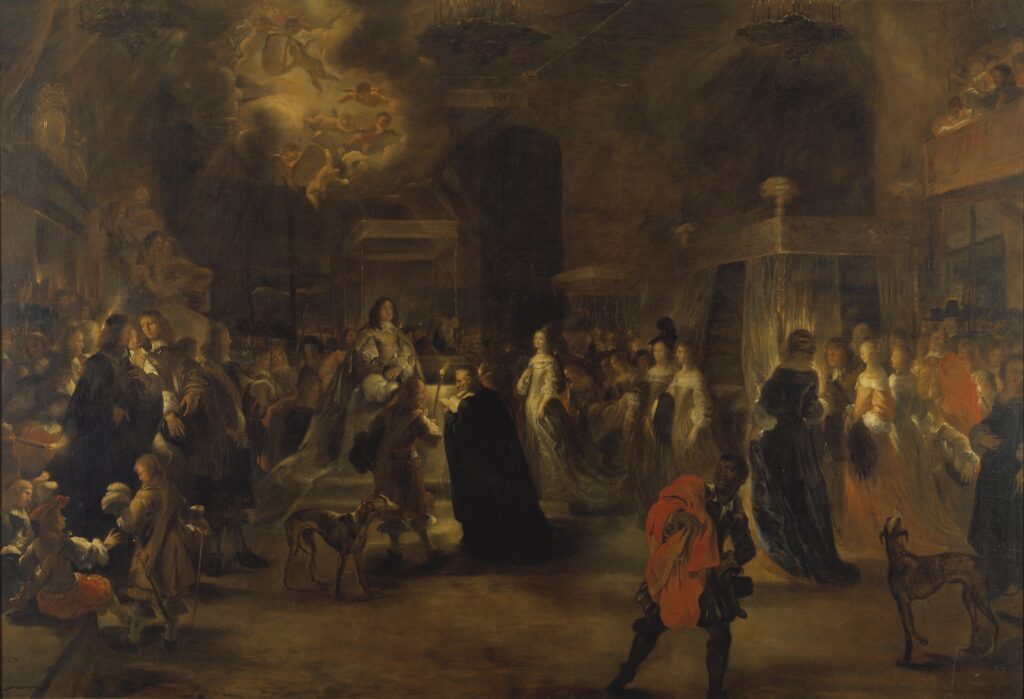
Recently, an impressive, large seventeenth-century painting featuring the Christian New Testament feast of Pentecost appeared on the market (fig. 1). The unsigned and undated work was published for the first time in an auction catalogue in December 2020 as: “Dutch School, circa 1650”.1 No provenance was offered, other than that it came from an English private collection. There are, however, strong indications to believe this work was executed by the German-Dutch artist Jürgen Ovens. According to Arnold Houbraken (1660-1719), Ovens was a pupil of Rembrandt (1606-1669).2 Although this is uncertain, the painting clearly demonstrates that Ovens was influenced by several of Rembrandt’s religious etchings.
An invoice and old collection catalogues
After having worked in Amsterdam in the 1640s, Ovens set up a studio in Friedrichstadt in his native Schleswig-Holstein in 1651, where he became the preferred painter of Duke Frederick III (1597-1659) the next year.3 In 1654, Ovens addressed a handwritten invoice of 500 Reichstaler to the Duke for “the Pentecost of your royal Highness”.4 The opening words, “What painting[s] I have submissively made for you […]”, make it clear that the work was commissioned by the Duke.5 This Pentecost could very well be the painting being discussed here: the fairly high price indicates that Ovens delivered a sizeable work. Fortunately, this painting can be traced over the next 150 years in collection catalogues of Schloss Gottorf, the main residence of the Dukes of Schleswig-Holstein-Gottorf, and Schloss Salzdahlum near Braunschweig, but after about 1815 it seems lost.
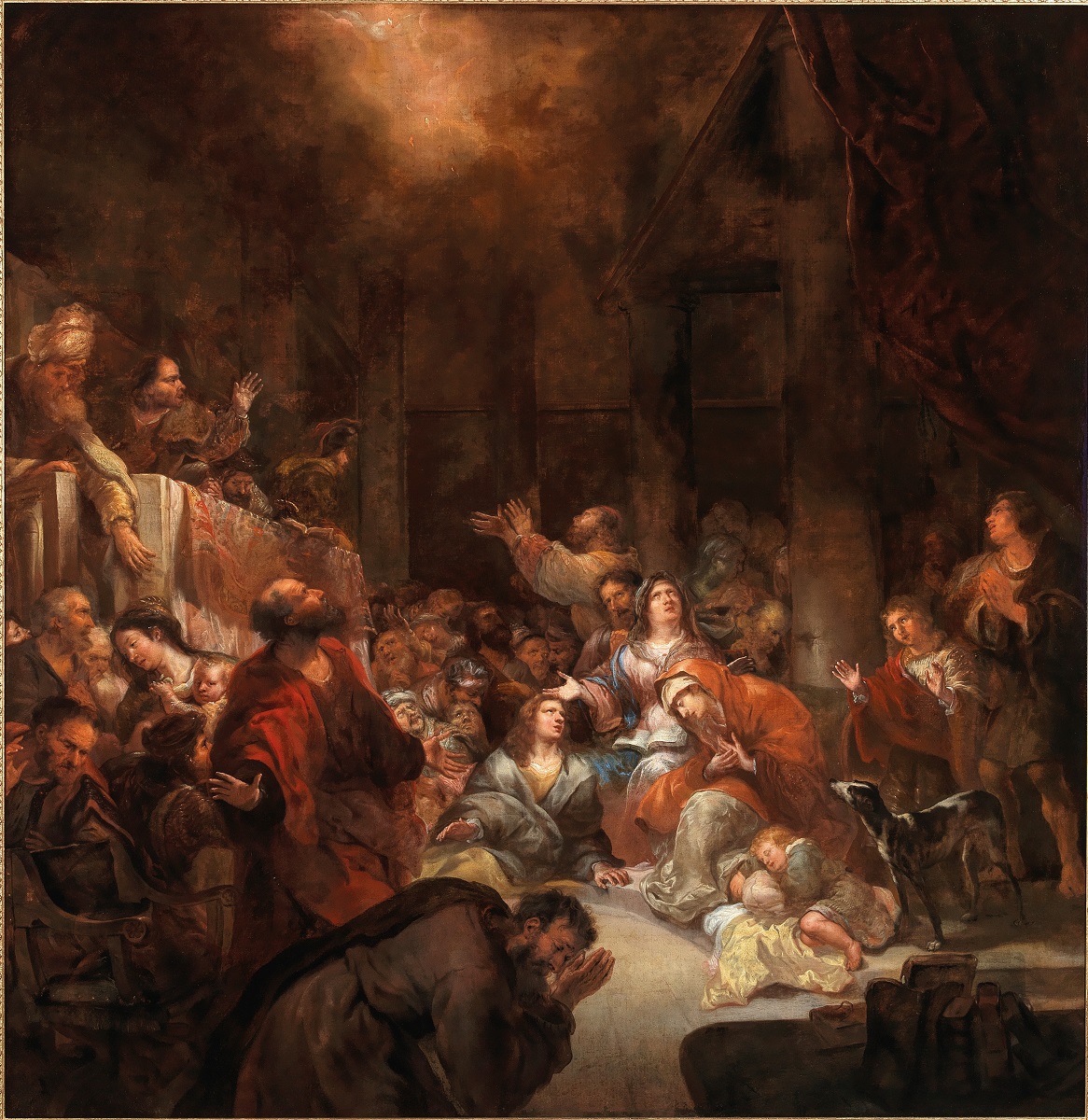
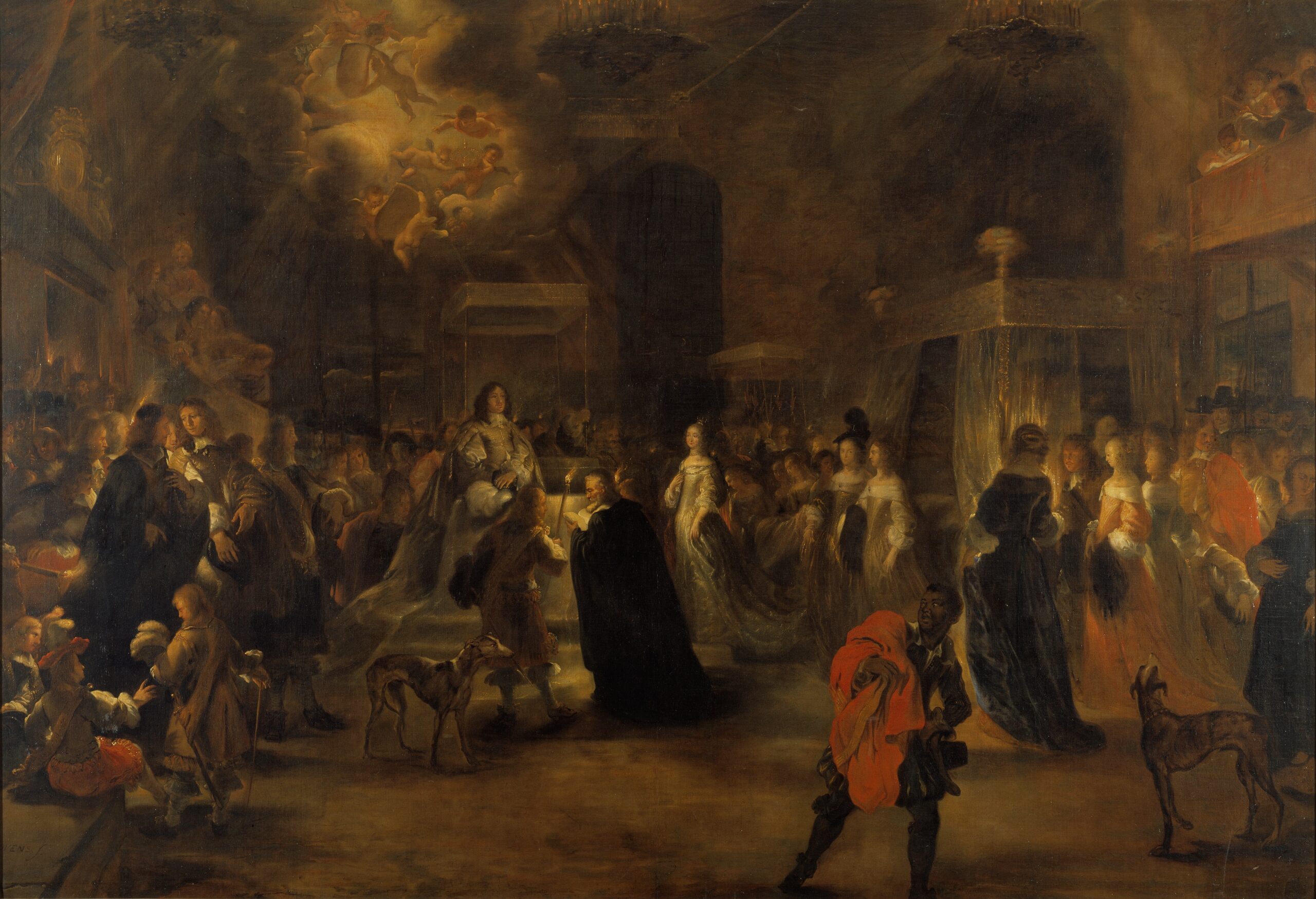
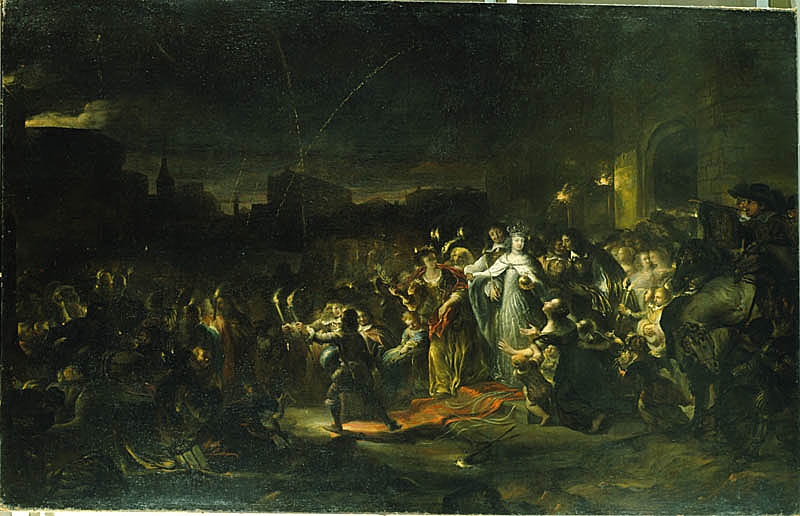
The depicted scene is set in a large room, where the Holy Spirit descends upon the apostles and other followers of Jesus Christ while they are in Jerusalem celebrating the Feast of Weeks, as described in the acts of the apostles (Acts 2:1-13): “When the day of Pentecost came, they were all together in one place. Suddenly a sound like the blowing of a violent wind came from heaven and filled the whole house where they were sitting. They saw what seemed to be tongues of fire that came down to rest on each of them.”. Looking at the manner in which the work is painted, it can be placed mid-century, as it reflects the developments in Amsterdam around this time in the oeuvre of Govert Flinck (1615-1660) and his circle. The fluid, characteristic brushwork in a large part of Pentecost, the depiction of forms, the use of colours, the distribution of light and dark, the handling of space and the compositional scheme recall the style of Flinck’s pupil Ovens. These aspects compare well with his Marriage of Princess Hedwig Eleonora of Schleswig-Holstein-Gottorf with King Charles X of Sweden on the 24th of October 1654, which is signed and has never been questioned (fig. 2).6 The whippet dog in the Pentecost corresponds to the one in this painting, whereas the sleeping boy echoes the small child in the centre of Ovens’s painting of The Procession of the Swedish Queen Hedwig Eleonora of Schleswig-Holstein-Gottorf (fig. 3).7 Furthermore, the boy and dog in the two Eleonora paintings are executed in the same style as those in Pentecost.
 |
 |
The odds that this painting is the work in the abovementioned invoice and catalogues are increased by the rarity of the theme of Pentecost in Northern Baroque art, and the absence of any archival reference to another example by the artist. At the end of the nineteenth century, Pentecost was very likely owned by the American beer brewer John William Brown (1844-1903), in whose memory it was donated to the Brooklyn Institute of Arts and Sciences in 1906.8 In the course of the twentieth century we lose track of the painting until it resurfaces at the 2020 auction.
We can exclude the possibility that this is the painting appearing in the 1691 estate of Jürgen’s widow Maria Ovens. A “large piece of the sending of the Holy Spirit […]” is mentioned under the section “copies of paintings”.9 It is visible to the naked eye that Ovens made several corrections during the creative process, such as the overpainted book at the bottom right, the face of the turbaned man on the balcony and the raised left hand of his brown-haired neighbour, which was originally extended. In all probability the painting with Maria Ovens was a copy after our Pentecost. Unfortunately, all traces of this work are lost.
Ovens looks to Rembrandt
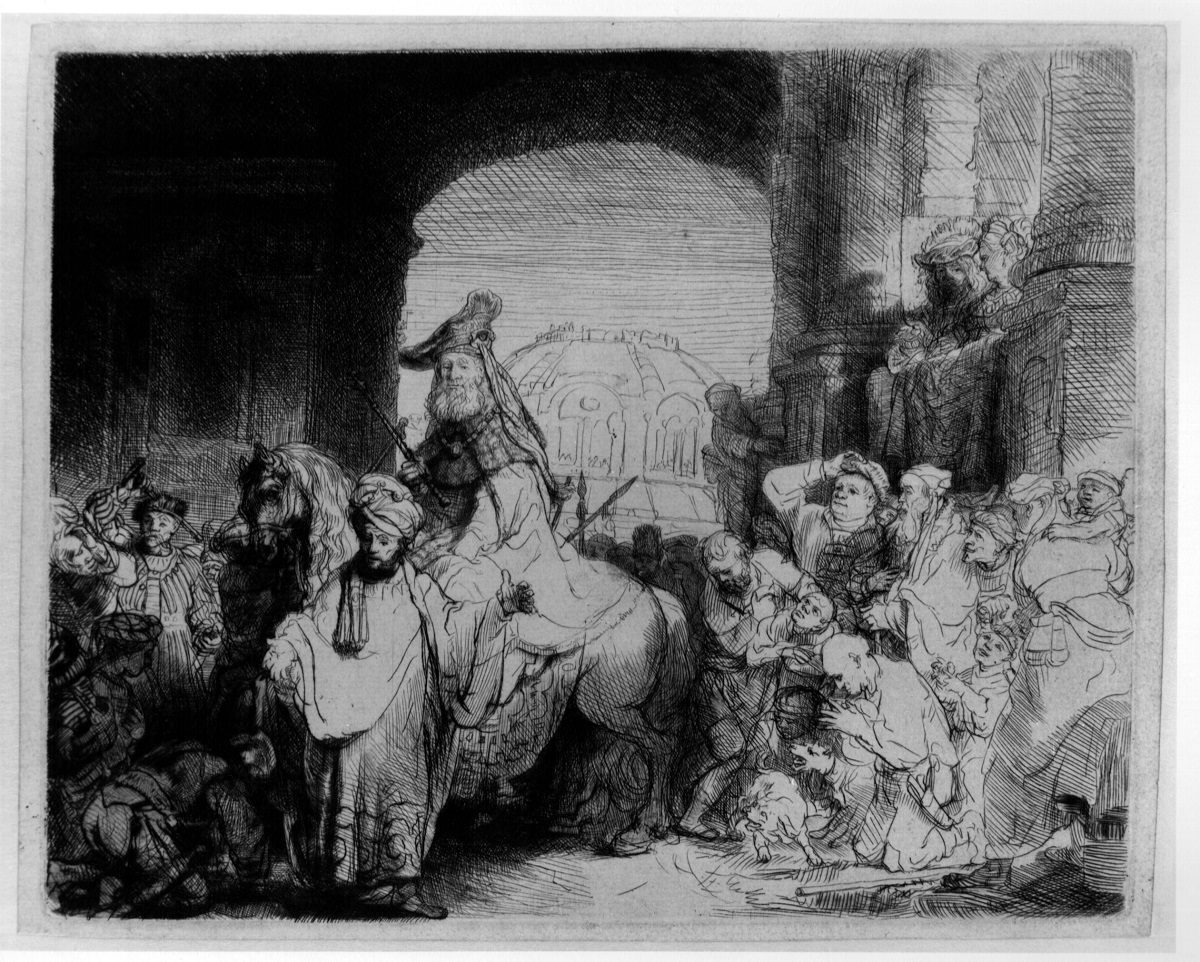
It is most interesting to note that Ovens composed parts of this work by borrowing from no less than seven of Rembrandt’s religious prints. Most obviously, he was inspired by the etching of The Triumph of Mordecai (c. 1641) for the low, draped balcony, in mirror-image, as well as by the motif of the carpet thrown over a white sheet, and even its pattern of wavy lines, rendered in red (fig. 4).10
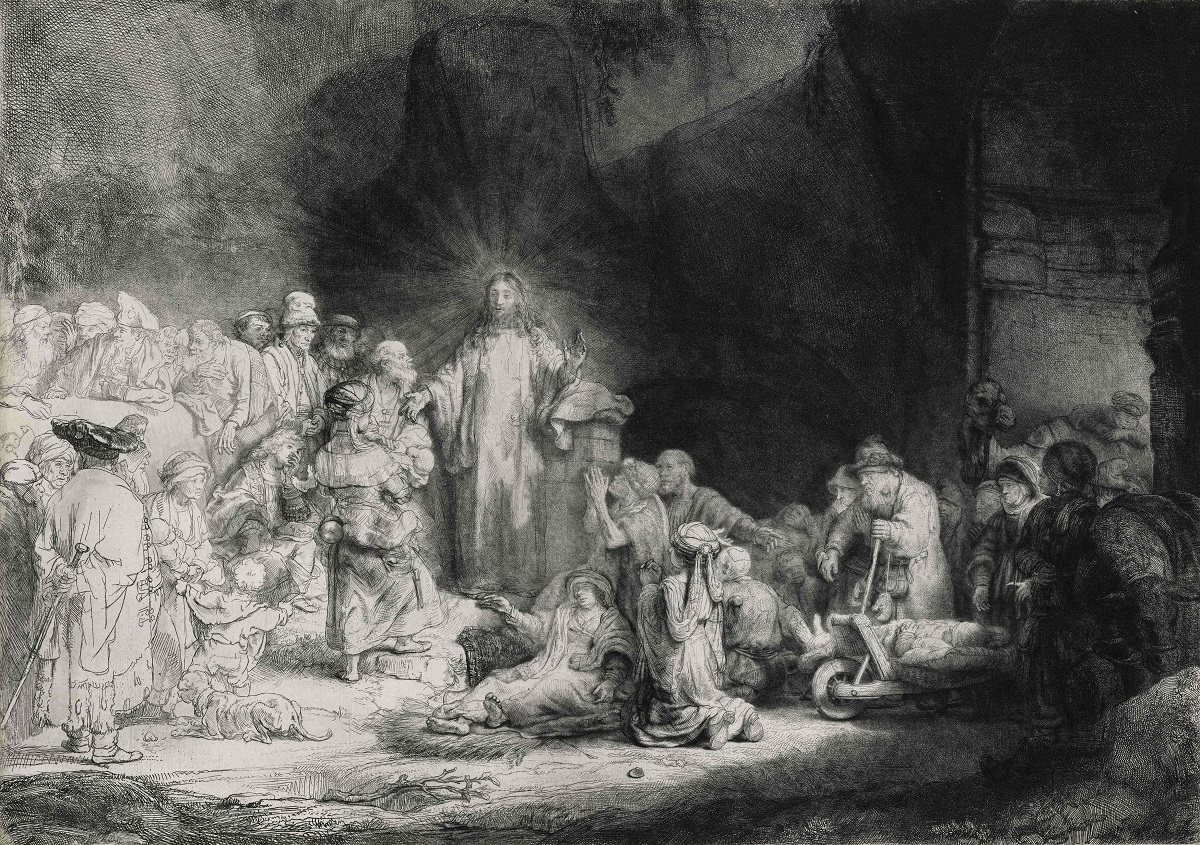
The mother under the painted balcony, carrying her son on her left arm, calls to mind the woman with child on the far right in the etching. They are both positioned at more or less the same location in the composition. An old, bearded man standing close to her and raising his hand to his chest is taken over by Ovens for the figure to the far left. His face in turn resembles that of the apostle Saint Peter in Rembrandt’s Hundred Guilder Print from circa 1648 (fig. 5).11
The kneeling, helmeted soldier in the left foreground of the Mordecai etching could very well have been the prototype for Ovens’s apostle – dressed in a brown tunic and wearing a scapular over his left shoulder – who functions as a repoussoir. His hands, folded in prayer near his face, echo those of the kneeling, lightly sketched man to the right in the print. Rembrandt’s small barking dogs likely inspired Ovens to add a whippet to his scene.
Significantly, Ovens’s balcony is the first known (partial) borrowing from Rembrandt’s Mordecai print in the German-speaking areas. Up till now, an engraved copy in mirror-image in the print bible of the German artist Melchior Küsel (possibly 1622-1681/83), published in Augsburg in 1679, was considered the earliest following of Rembrandt’s etching.12
The balding man with outstretched arms in a red robe to the left in Ovens’s painting has stepped out of the Hundred Guilder Print, where he kneels behind Christ. In the etching he turns his eyes to the Saviour, but in the painting he looks up to the Holy Spirit. Ovens granted this figure a more prominent role, uniting the foreground with the middle ground, thereby drawing the viewer into the picture.13 Ovens would return to the Hundred Guilder Print a decade later in two drawings of The Raising of Lazarus (John 11:1-44) , in which he adapts Christ and the surrounding figures.14 These sheets testify to his enduring admiration for this masterpiece etching.
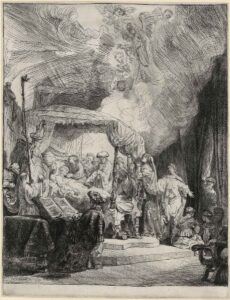
From another etching by Rembrandt, his 1639 Death of the Virgin (fig. 6), Ovens borrowed the wooden chair with a low rectangular back and decorated arms in the right foreground.15 He turned the chair to the right in order to suggest that the kneeling apostle has just stood up from it. Perhaps the slightly elevated platform in the middle plan of the painting was also taken over from Rembrandt’s print. The upward looking Virgin, wearing a blue veil and seated with an open booklet on her lap, could go back to the etched mourner near the foot of Mary’s deathbed.16 The boy with a red cloth over his arm might have been partly modelled after the apostle with outstretched arms standing somewhat separately on the right in The Death of the Virgin, though one, of course, should give Ovens some room for inventions of his own.
 |
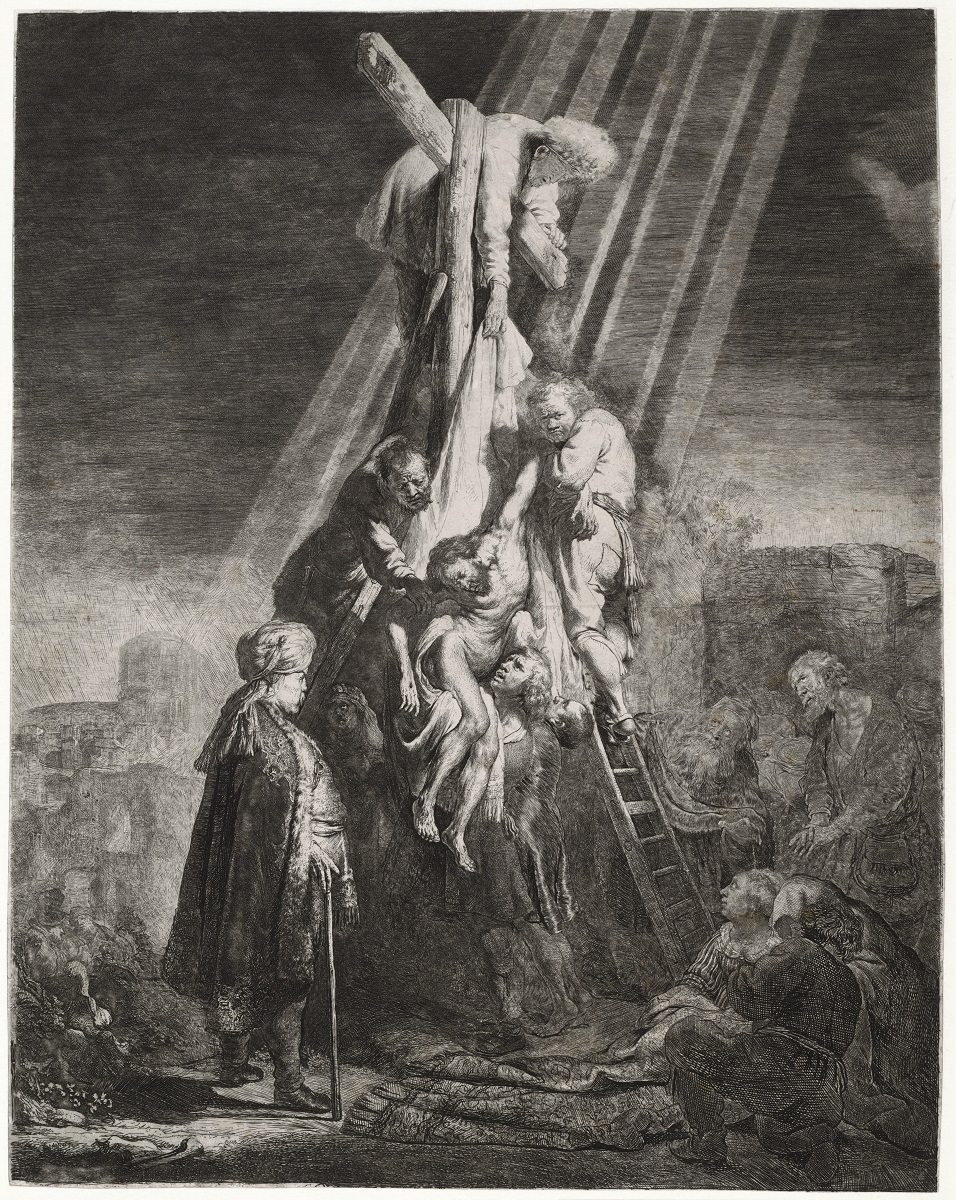 |
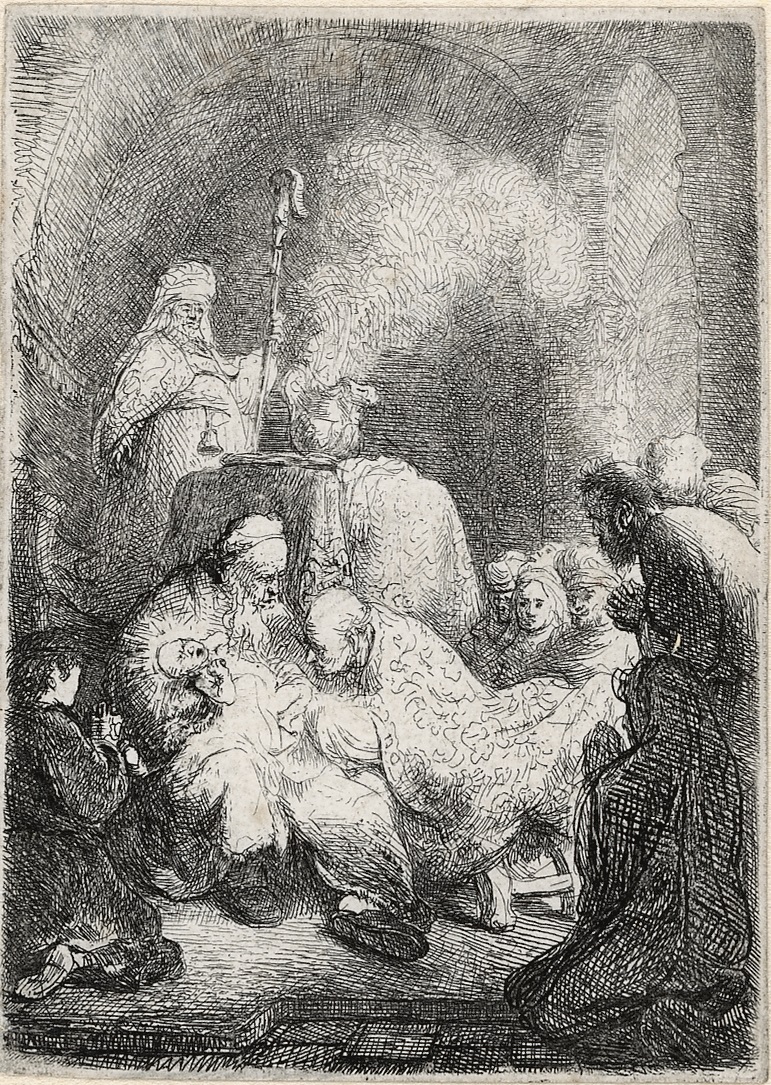
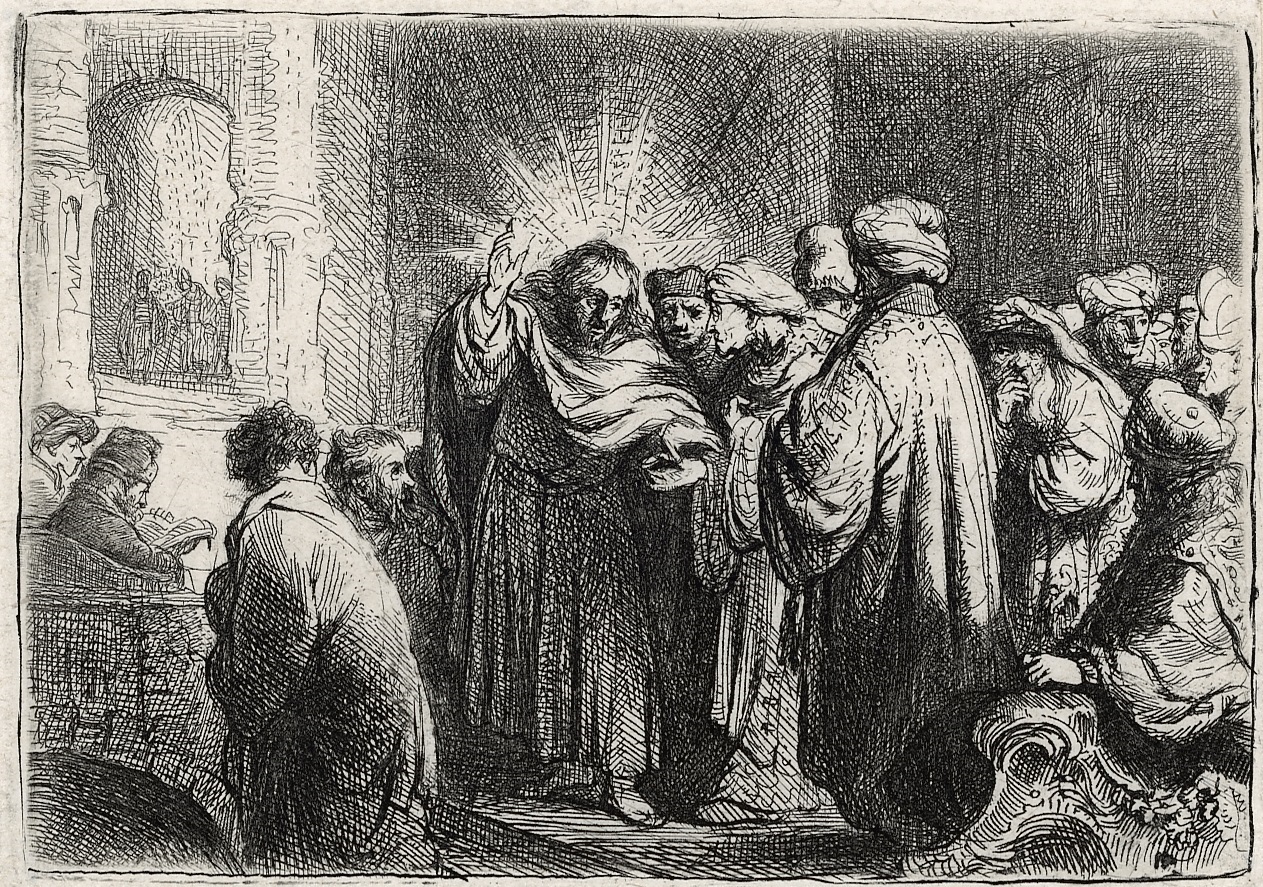
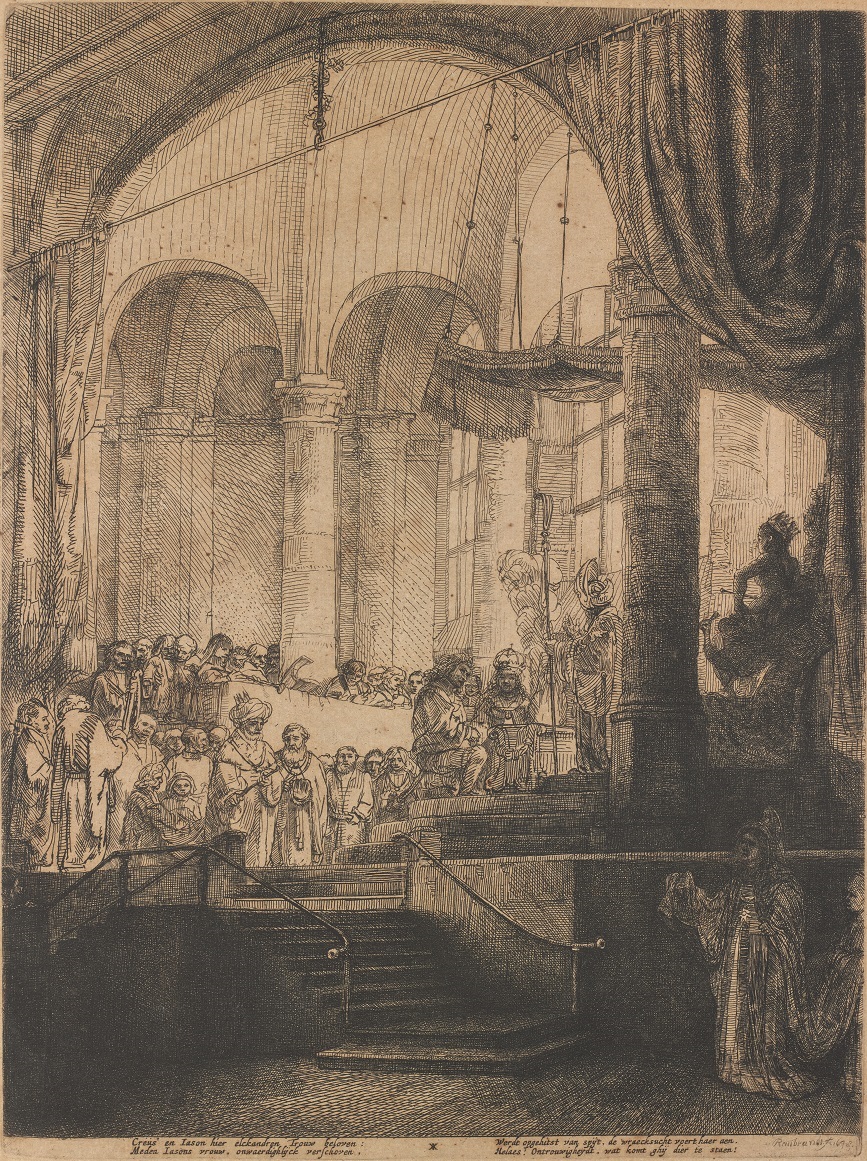
Ovens also drew inspiration from slightly older Rembrandt etchings. The prototype for the woman in the orange cloak, presumably Mary Magdalene, was the hooded Virgin who gazes down toward the ground at the bottom right of the large print of The Descent from the Cross: Second Plate that Rembrandt made (together with Johannes Gillisz. van Vliet [1600/10-1668]) in 1633 (fig. 7).17 The mourning, bearded man standing behind her recalls the brown-haired figure between the apostle with raised arms in the centre of Ovens’s painting (probably Saint Peter) and the Virgin. The brown-bearded man turning away from the light, next to the column in the background, echoes (in mirror image) the onlooker to the right in Rembrandt’s etching The Circumcision: Small Plate (fig. 8) of circa 1630, and the figure to the left in The Tribute Money (fig. 9), created some five years later.18 The man with a book on Ovens’s balcony might even be a free variant of the reader to the far left in this etching. And lastly, the large red curtain to the right recalls the similar element in Rembrandt’s print Medea: or the Marriage of Jason and Creusa from 1648 (fig. 10).19
 |
 |
 |
A homage to Rembrandt?
Ovens’s extensive use of figures and motives from Rembrandt’s prints in one single painting is especially striking when we consider that – as far as is known – there are no other such borrowings in any of his paintings.20 We may assume him to be familiar with the remark by Karel van Mander (1548-1606) that “well-cooked turnips [“rapen”, a pun which also refers to gleanings] make a good soup”, which means that an artist who borrows elements from the works of other masters should do so in such a subtle way that it escapes notice.21 Ovens subtly combined figures from several of Rembrandt’s most ambitious, important and technically complicated religious prints, altered their poses and reinterpreted their roles. Thus, he adhered to the contemporary Dutch art-theoretical notion of imitatio: a respectful transformation by the artist of his models.22 Ovens might have wanted to measure up, and pay homage to his possible teacher. He surely will have admired Rembrandt’s mastery of the etching technique. Ovens produced several (history) prints himself, in which the manner of applying etched lines recalls Rembrandt’s graphic work.23
Already in the 1630s, several former Rembrandt pupils drew on his prints for their paintings, for instance Flinck’s Annunciation to the Shepherds of 1639, which goes back to the 1634 etching of the same theme.24 Such examples may have provided an impetus for Ovens to base Pentecost in part on Rembrandt etchings. Aert de Gelder (1645-1727), Rembrandt’s last known pupil, drew extensively on his master’s prints when realising history paintings such as his Passion Series, dating from as late as circa 1715.25 And, for example, most of the figures in De Gelder’s 1684 painting The Presentation in the Temple are taken from Rembrandt’s etching of circa 1640.26 In around 1651, Heinrich Jansen (1625-1667) from Flensburg, who studied with Rembrandt in Amsterdam between 1645 and 1648, painted a copy of his 1636 print of Christ before Pilate: Large Plate, made in collaboration with Van Vliet, for an epitaph in the church of Mary in Husum, not far from Friedrichstadt.27 Perhaps Ovens had already met Jansen during his apprenticeship in Amsterdam. Ovens and Frederick III could certainly have known Jansen’s painting in Husum, which is, just like Pentecost, almost square-shaped. It might have (further) triggered their desire to have a large painting produced after Rembrandt’s graphic works.
Maria Ovens’s 1691 estate inventory does not list any Rembrandt etchings, but her well-to-do husband could have acquired and studied them in Amsterdam. Although Ovens might not have been taught directly by Rembrandt, he certainly moved in his circle. Next to being an artist, Ovens was a collector and an art dealer as well. In November 1652, shortly after the painter returned to Schleswig-Holstein, Frederick III paid him for a copper plate that had been engraved in Amsterdam, evidently a commission from the Duke.28 Ovens might also have sold graphic work by Rembrandt in Northern Germany.29 However, no information is available about possible ownership of Rembrandt prints by Frederick III.30
The idea that Ovens studied under Rembrandt is not borne out by his painting of Pentecost. The dynamic, colourful canvas bears little stylistic resemblance to the painted oeuvre of the famous artist. However, by way of his prints, the great Dutch master occupied Jürgen more than was hitherto known.
- London (Christie’s), 17 December 2020 (online auction 18877), lot 231 (inaccurately described as 185.4 x 195.5 cm); Old Master Paintings, Vienna (Dorotheum), 10 November 2021, lot 82 (as Jürgen Ovens, Pentecost).
- Arnold Houbraken, De groote schouburgh der Nederlantsche konstschilders en schilderessen I, Amsterdam 1718, p. 273.
- Constanze Köster, Jürgen Ovens (1623-1678). Maler in Schleswig-Holstein und Amsterdam, Petersberg 2017, p. 53; pp. 327-328, Qu. II.A.7.
- Archive of Schleswig-Holstein (LAS), Abt. 7, no. 6504, f. 1r; Köster 2017 (see note 3), pp. 37-38; p. 326, Qu. II.A.2.
- Köster 2017 (see note 3), p. 38.
- Köster 2017 (see note 3), p. 389, G145.
- Köster 2017 (see note 3), p. 390, G147.
- The Eighteenth Year Book of the Brooklyn Institute of Arts and Sciences, 1905-1906, pp. 70, 124, 224; “Department of Fine Arts”, The Museum News (Brooklyn Institute of Arts and Sciences) 1 (1906) no. 10, p. 144.
- Handwritten list of Maria Ovens’s estate (private collection, location unknown), cited after Harry Schmidt, “Das Nachlass-Inventar des Malers Jürgen Ovens”, Oud-Holland 32 (1914), p. 44, no. 16, note 7; Harry Schmidt, Jürgen Ovens. Sein Leben und seine Werke. Ein Beitrag zur Geschichte der niederländischen Malerei im XVII. Jahrhundert, Kiel 1922, p. 150, under no. 59a, p. 271, note 26 (as probably a copy after an original by Ovens); Köster 2017 (see note 3), p. 39; p. 325, Qu. I.4.c.
- Erik Hinterding, Jaco Rutgers, The New Hollstein, Dutch & Flemish etchings, engravings and woodcuts, 1450-1700. Rembrandt, Ouderkerk aan den IJssel 2013, text 2, pp. 59-60, no. 185.
- Hinterding, Rutgers 2013 (see note 10), text 2, pp. 151-154, no. 239.
- Melchior Küsel, Icones Biblicae Veteris et Novi Testamenti. Figuren biblischer Historien alten und neuen Testaments, Augsburg 1679, ‘Book of Esther, Chapter 6’, fig. 20; reprint Hildesheim 1968. See also: Peter van der Coelen, ‘Rembrandt in Duitsland – Iconografie en verspreiding van zijn etsen in de zeventiende eeuw’, Kroniek van het Rembrandthuis 2004, no. 1-2, p. 3, fig. 2.
- or a mirror-image of this man in the Hundred Guilder Print, see: Ernst van de Wetering et al., A Corpus of Rembrandt Paintings V. Small-scale history paintings, Dordrecht 2011, p. 144, fig. 4.
- Köster 2017 (see note 3), p. 397, Z12-13.
- Hinterding, Rutgers 2013 (see note 10), pp. 39-41, no. 173.
- The presence of Mary or of other women at Pentecost, such as Mary Magdalene, is usually inferred from Acts 1:14: “They all joined together constantly in prayer, along with the women and Mary, the mother of Jesus […]”.
- Hinterding, Rutgers 2013 (see note 10), text 1, pp. 189-191, no. 119.
- Hinterding, Rutgers 2013 (see note 10), text 1, p. 84, no. 55; pp. 220-221, no. 138.
- Hinterding, Rutgers 2013 (see note 10), text 2, pp. 158-159, no. 241.
- The only possible exception in this respect is Ovens’s painted self-portrait from c. 1652 in the Hamburger Kunsthalle (inv. no. HK-26), which seems to go back to Rembrandt’s famous 1639 etching Self-Portrait leaning on a Stone Sill. See: Patrick Larsen, “The relationship between Govert Flinck and Jürgen Ovens”, in: Stephanie S. Dickey (ed.), Ferdinand Bol and Govert Flinck. New research, Zwolle 2017, p. 182, fig. 12.2, p. 184; Hinterding, Rutgers 2013 (see note 10), text 2, pp. 33-35, no. 171.
- Karel van Mander, Het schilder-boeck, Haarlem 1604, fol. 5r; Philips Angel, Lof der schilder-konst, Leiden 1642, pp. 36-37.
- For Ovens’s artistic appropriations of figures and motives from seventeenth-century art of the Low Countries during his Northern German periods, see: Patrick Larsen, “The Imitation of Dutch and Flemish Art in Jürgen Ovens’ (1623-1678) Paintings in Schleswig-Holstein”, in: Rieke van Leeuwen, Juliette Roding (eds.), Masters of Mobility. Cultural exchange between the Netherlands and the German lands in the long 17th century (Gerson Digital VI), The Hague: RKD, 2020, https://masters-of-mobility.rkdstudies.nl/13-the-imitation-of-dutch-and-flemish-art-in-j%C3%BCrgen-ovens-1623-1678-paintings-in-schleswig-holstein/.
- Nadine M. Orenstein, “Printmaking among artists of the Rembrandt School”, in: Stephanie S. Dickey (ed.), Rembrandt and his circle. Insights and discoveries, Amsterdam 2017, p. 308, fig. 16.3. For Ovens’s prints, see: Tilman Falk, Robert Zijlma, “Jürgen Ovens”, in: Hollstein’s German engravings, etchings and woodcuts, 1400-1700, vol. XXXI, Amsterdam 1991, pp. 61-74, nos. 1-10b; Köster 2017 (see note 3), pp. 415-416, R1-R7.
- Werner Sumowski, Gemälde der Rembrandt-Schüler II, Landau/Pfalz 1983, p. 1020, no. 615; Hinterding, Rutgers (see note 10), text 1, pp. 201-202, no. 125.
- Guus Sluiter, “‘De Passie, anders de Historie van den lydenden Christus’. Arent de Gelders Passieserie”, in: Peter Schoon et al., Arent de Gelder (1645-1727). Rembrandts laatste leerling, exh. cat. Dordrecht: Dordrechts Museum; Cologne: Wallraf–Richartz-Museum, 1998, pp. 73-75, figs. 2-13; pp. 78-80, 85; Guus Sluiter, “De fascinatie van Arent de Gelder voor Rembrandts etsen”, Bulletin Dordrechts Museum 22 (1998), pp. 35-45.
- Sumowski 1983 (see note 24), p. 1163, no. 738; Hinterding, Rutgers 2013 (see note 10), text 2, pp. 57-58, no. 184.
- Sumowski 1983 (see note 24), p. 1421, no. 935; Hinterding, Rutgers 2013 (see note 10), text 1, pp. 251-253, no. 155.
- LAS, Abt. 7, no. 2311, fol. 90r; Köster 2017 (see note 3), p. 304, note 195; p. 332, Qu. II.B.1.1652. Also see: Patrick Larsen, “Jürgen Ovens (1623-1678) as an Art Agent for the Dukes of Gottorf”, in: Rieke van Leeuwen et al., The Big Picture. Collecting Dutch and Flemish Art in Germany 1600-1850 (Gerson Digital VIII), The Hague: RKD, 2022, https://the-big-picture.rkdstudies.nl/2-jürgen-ovens-16231678-as-an-art-agent-for-the-dukes-of-gottorf/.
- Rembrandt prints were offered for sale in the German-speaking lands fairly early. See Van der Coelen 2004 (see note 12), pp. 5-15; Jaco Rutgers, “Rembrandt op papier. De rol van prenten bij het vestigen van Rembrandts reputatie als schilder”, in: Jaco Rutgers, Mieke Rijnders (eds.), Rembrandt in perspectief. De veranderende visie op de meester en zijn werk, Zwolle 2014, p. 122.
- Neither the so-called Gottorf account books nor the 1694, 1710 and 1743 inventories of Gottorf castle mention works on paper by Rembrandt.