Extramarital relationships, whether or not unequal in nature or not, were a common matter in early modern Amsterdam. Not infrequently these led to (unwanted) pregnancies. Sex outside marriage was not permitted. In Amsterdam, matters of love, sex, and adultery fell under the commissioners of Marital Affairs. That Rembrandt had to appear there in 1649 is well known; that his colleague and (youthful) friend Jan Lievens had already been obliged to account for an extramarital relationship in the same chamber three years earlier has not previously been noted.
 |
Dispute registers of the Chamber of Marital Affairs
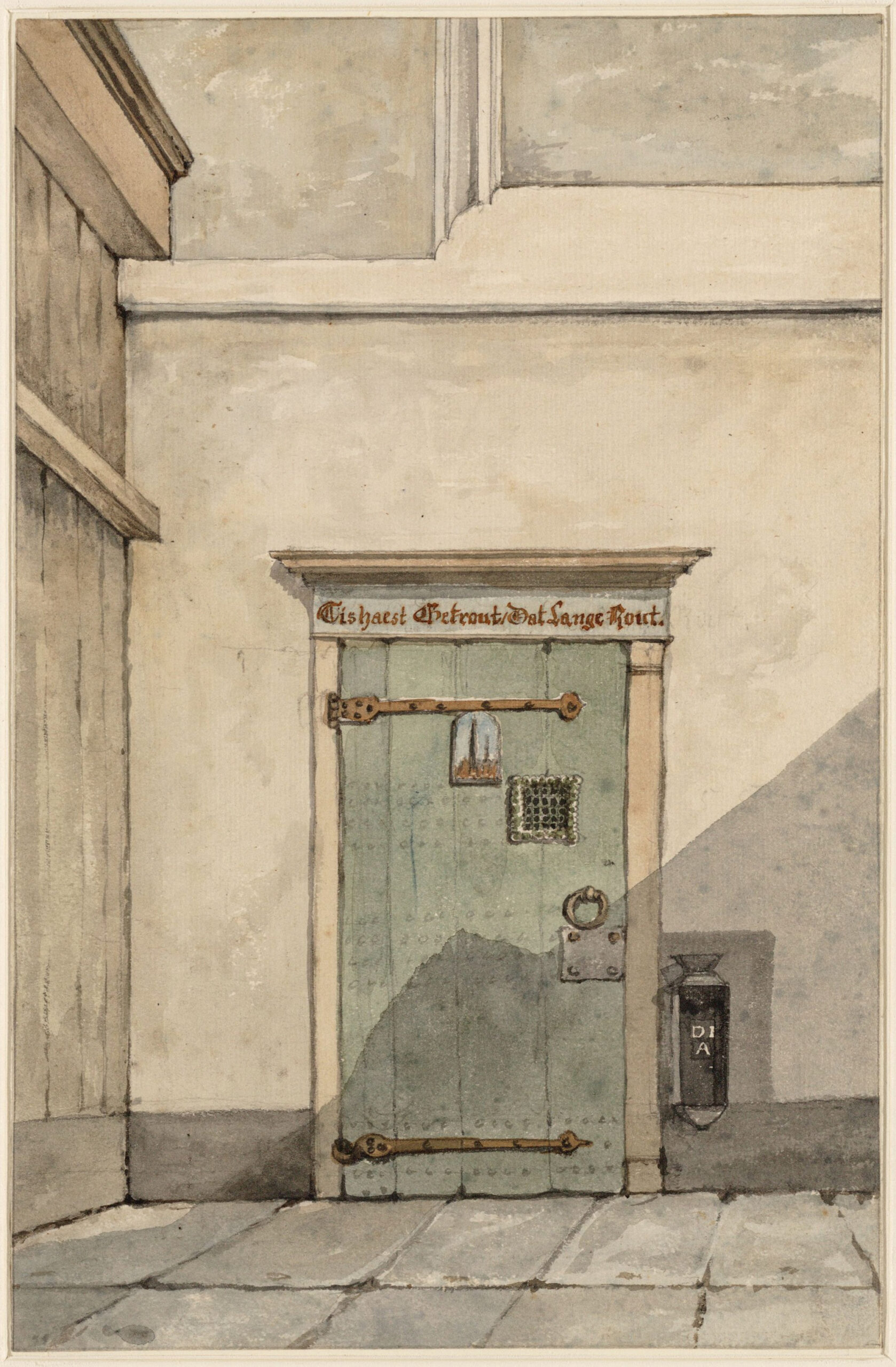
In the seventeenth century, attempts were made to regulate sex and marriage. In Amsterdam, the Chamber of Marital Affairs was established for this purpose. Every year in February, five commissioners were appointed. The commission met weekly on Saturdays.1 They also kept the registers of marriage banns: the names, origins, ages, and addresses of all those wishing to marry in the city were recorded. Disputes of (extra)marital nature were taken before the Chamber of Marital Affairs and recorded in the Krakeelregister (dispute register). Initially, all of this took place in the Spiegelkamer (Mirror Room) behind the Roodeur (Red Door) of the Oude Kerk (fig 1); after 28 October 1656 in the Chamber of Marital Affairs in the New Town Hall on the Dam.2
It is a well-known episode in Rembrandt’s life. After Saskia Uylenburgh died in the summer of 1642, Rembrandt entered into a relationship with Geertje Dircx of Edam (c. 1610–in or after 1656). Geertje had come to live in the house on the Jodenbreestraat as dry nurse to the infant Titus. Rembrandt and Geertje entered into a sexual relationship, which would lead to a complicated affair, in the course of which Geertje ultimately ended up in the spinhuis (women’s house of correction) of Gouda. In 1649, Geertje attempted to force Rembrandt to marry her by summoning him before the Chamber of Marital Affairs. The case was eventually settled. Alongside several other agreements, it was stipulated that Rembrandt would pay Geertje annual maintenance, on the condition that Titus would be and remain her universal heir.3 As in so many matters, Jan Lievens also preceded his old friend and colleague Rembrandt in the hallway leading to the dispute chamber. This emerges from a previously unpublished document in the Amsterdam City Archives.
Between Amsterdam and Antwerp
Although Lievens was much more eager to travel than his fellow townsman Rembrandt, both spent a significant part of their careers in Amsterdam. This began in the workshop of Pieter Lastman on the Sint Antoniesbreestraat, where Lievens began advanced training in 1617. In 1618 he returned to his native city. After working in Leiden for a period, he travelled first to London and subsequently stayed in Antwerp from 1635 onwards. In December 1638 the painter married Susanna Colijns de Nole (c. 1615–c. 1646), the daughter of a sculptor,4 in that city. The couple had at least two children, the first son died young. In January 1644 another boy was born: Jan Andrea (1644–1680), who would later also become a painter. Shortly after Jan Andrea’s baptism in Antwerp, the family moved to Amsterdam. A notarial deed shows that at the beginning of 1644 they were living in the household of the painter couple Judith Leyster and Jan Miense Molenaer, or at least that Lievens shared a studio with them.5 In the course of that year he must have opened his own studio on the Rozengracht.
These were difficult years for Lievens. Financially, things were not going well: in 1643 he was forced to transfer his possessions to creditors in Antwerp.6 On a personal level, too, Lievens went through a low point: after the move to Amsterdam, Susanna died. Precisely when and where she was buried is unknown. Lievens thus found himself alone with his young son Jan Andrea. In spite of his financial situation, he is likely to have sought a nursemaid to help raise and care for the child, just as Rembrandt had done a year earlier.
 |
Lievens vs Jacobs
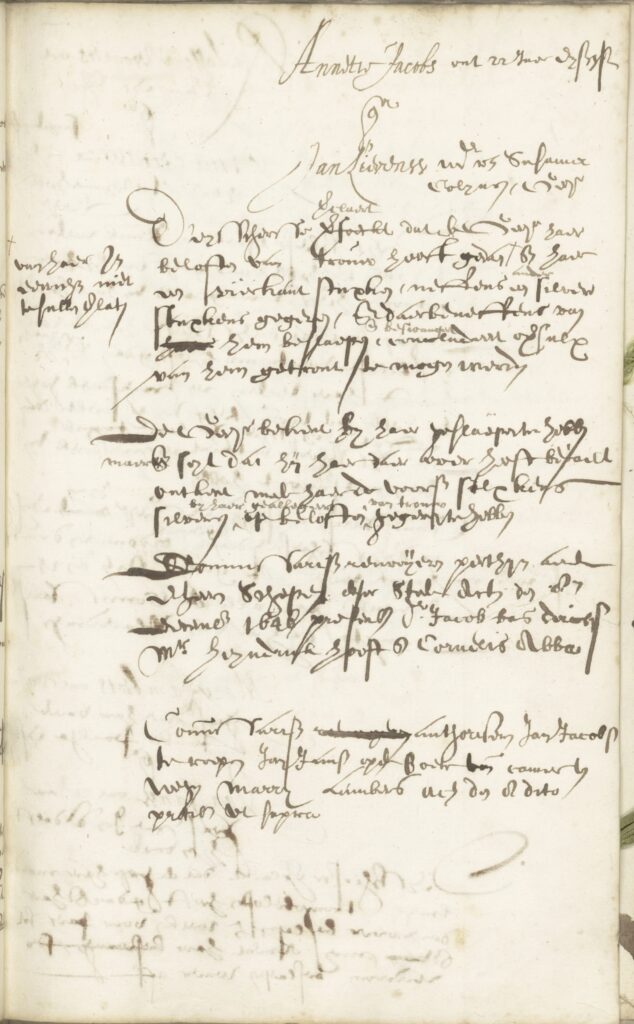
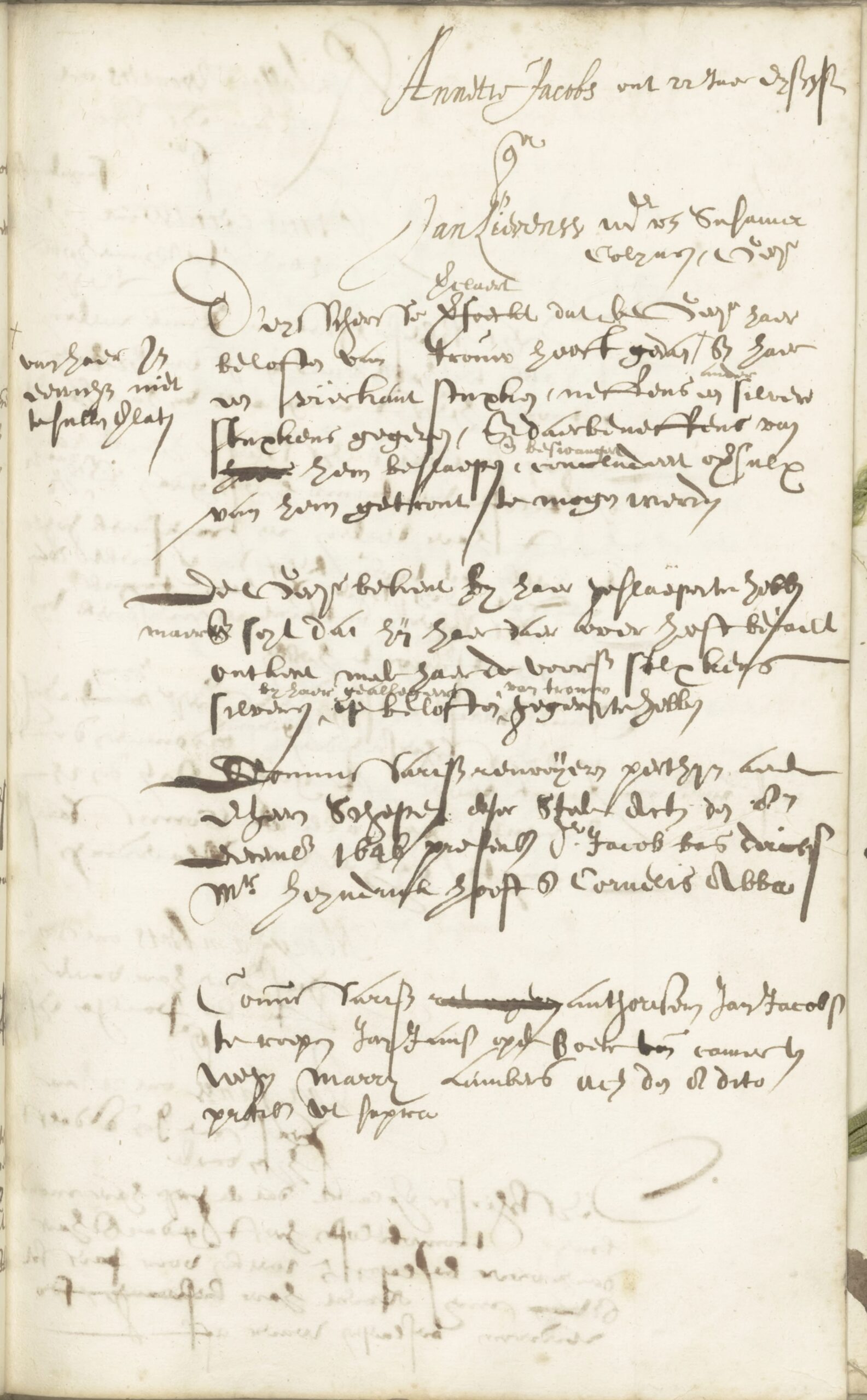
Just as Rembrandt did, Lievens also entered into a sexual relationship with an employee following the death of his wife, although it remains unclear what exactly her role was within the household. On Saturday, 8 December 1646, Lievens was required to give account before the commissioners of Marital Affairs, present being the commissioners Jacob Bas Dircksz, Hendrick Hooft and Cornelis Abba (fig. 2).7 Lievens’s 22-year-old pregnant maidservant, Annetje Jacobs, tried to compel him to marry her. Annetje had previously lived in Lievens’s house, where she had supervised the household. This appears from a notarial statement given by Belitje Jacobs the day before the hearing in the Chamber of Marital Affairs.8 Belitje too worked in Lievens’s household. A month earlier, Annetje had taken a considerable quantity of butter from Lievens’s stores. Belitje had not dared refuse her “because she had previously lived as her superior in the service of the petitioner [Lievens]”.9
Annetje must therefore have left the painter’s household at the beginning of November. But she did not intend to stay away; on the contrary. Before the commissioners of Marital Affairs, Annetje declared that the painter “had given her promises of fidelity, not ever to abandon her, and had given her a square piece, together with another small silver piece, and that, moreover, he had lain with her and impregnated her”.10 She was of the opinion that she therefore ought to be married by him. Lievens stated that he had indeed shared the bed with Annetje, but that he had paid her for this with the coins, and certainly had not promised to marry her. In other words, in Lievens’s view the coins were not a marriage token, but a payment as if she were a sex worker.
Rembrandt (after Lievens)
The accusation corresponds closely to that brought against Rembrandt two years later. Geertje Dircx likewise declared that she had received a verbal promise of marriage from Rembrandt; in her case, this was said to have been sealed with a golden ring. She stated that they had shared a bed on several occasions (“diverse reyzen”).11 She was probably never pregnant – in contrast to Annetje Jacobs – for otherwise she would certainly have used this against Rembrandt as well. Rembrandt was not even willing to acknowledge that he had so much as slept with Geertje. In this case the commissioners acted as mediators, resulting in an annual maintenance payment.
What the outcome was of this hitherto undescribed case of Annetje Jacobs against Jan Lievens is not clear. The case was referred to the municipal court. Unfortunately, the archives for this early period have not survived. Nor is it clear whether a child resulted from the affair,12 and we do not know whether compensation was paid, either as a settlement or for the upkeep of the possible child.13 Nor, therefore, whether he was pushed further into financial difficulties as a result. A marriage to his maidservant certainly did not follow, just as it did not in Rembrandt’s case.
Lievens eventual second marriage
In contrast to Rembrandt, the widower Jan Lievens would indeed enter into a second marriage. On 23 April 1648, Jan Lievens appeared once more in the Spiegelkamer of the Old Church, this time together with the 20-year-old Cornelia de Braij, in order to have their intended marriage registered. Her father, the lawyer Jan de Braij, acted as witness. The marriage was registered by Jacob Hinlopen and Cornelis Abba. Abba had also been present at the matter concerning Annetje Jacobs. Would Abba have reminded Lievens one more time of the affair with his maidservant? The announcement of this marriage did not proceed entirely smoothly. The ‘first notice’ – the announcement in church – was blocked, but this had to do with the inheritance of Jan Andrea. After he had accounted for the inheritance of his child to the Orphans’ Chamber on 26 July 1648, Lievens was able to marry a second time on 2 August 1648 – three and a half months after the betrothal – to enter into marriage for the second time. The marriage was solemnised in Ouderkerk aan de Amstel.
- Gerard Roosenboom, Recueil van verscheyde keuren, en costumen. Midtsgaders maniere van procederen binnen de stadt Amsterdam. Eerst gecollecteert en beschreven, door Gerard Rooseboom, Amsterdam, 1656, pp. 120-131.
- Stadsarchief Amsterdam (hereafter SAA), 5061, 3051 Memorieboek, p. 29.
- http://remdoc.huygens.knaw.nl/#/document/remdoc/e4581 (accessed 3 December 2025).
- Arthur K. Wheelock jr., “Jan Lievens: Bringing new light to an old master”, in: Wheelock Jr. ed, Jan Lievens. A Dutch master rediscovered, exh. cat. Washington: National Gallery of Art; Milwaukee: Milwaukee Art Museum; Amsterdam: Rembrandt House Museum, 2008-2009, pp. 6-7.
- SAA, 5075, 1745 not. Jan Quirijnen Spithof, pp. 124-125, 1-3-1644; Abraham Bedius, “Het verblijf van Jan Miense Molenaer te Amsterdam, in documenten”, in: Frederik D.O. Obreen, Archief voor Nederlandsche Kunstgeschiedenis, vol. 7, Rotterdam 1888-1890, p. 293.
- Arthur K. Wheelock jr., in: exh. cat. Amsterdam 2009 (see note 4), pp. 17-18.
- SAA, 5061, 3063 Huwelijkskrakeelregisters, 8-12-1646.
- SAA, 5075, 1080, not. Joost van de Ven, ff. 203r-203v, 7-12-1646.
- “ter saecke sij als haar regeerster bij den req[uiran]t gewoont hadde” (see note 8).
- “haer beloften van trouw heeft gedaan, van haer in eeuwig niet te sullen verlate & haer een vierkant stucken, neefens een ander silvere stuxkens gegeven & daarbeneffens van hem beslaepen & beswangert” (see note 7). The mentioned silver square piece was a klip, an emergency coinage at that time struck mainly in West Friesland, or a medal/jeton.
- SAA, 5061, 3064, Huwelijkskrakeelregisters, 14-10-1649.
- The name Anna or Annetje Jacobs was fairly common; in 1647, eleven children were baptised in Amsterdam whose mother bore a variant of this name.
- The notarial archives contain many examples of such payments, both as compensation for the woman and as maintenance costs for any illegitimate children. For instance, Jan van de Velde agreed to the payments of two guilders per week in maintenance for the child he had conceived out of wedlock with Trijn Jans in 1636 (SAA, 5075, 601 not. Laurens Lamberti, p. 456, 17-07-1642). Whether this concerns the painter Jan van de Velde (III) from Haarlem, active in Amsterdam, is not clear. In 1661 David Abraham Cardozo paid no less than 1,000 guilders for “defloration” and the maintenance of two children resulting from his extramarital relationship with Dorothea Jans Bentem (SAA, 5075, 2210 not. Adriaen Lock, pp. 1107-1108, 27-05-1661).