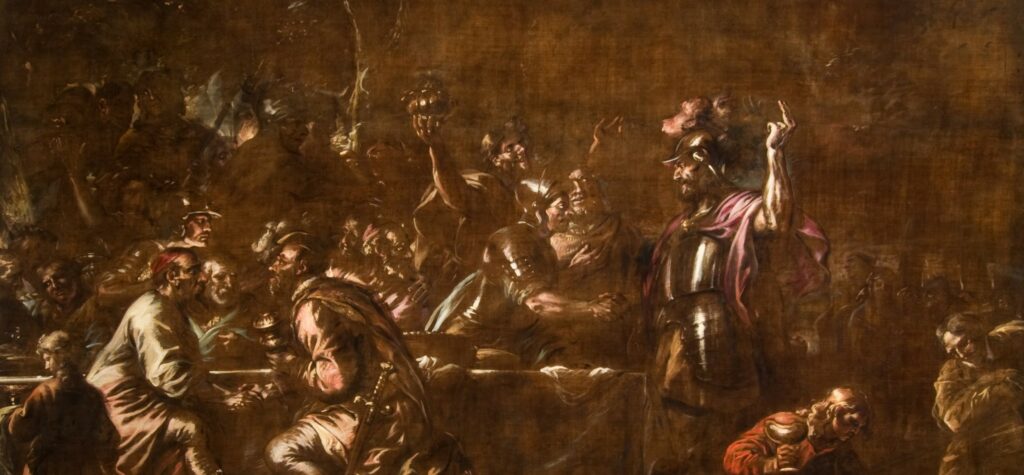
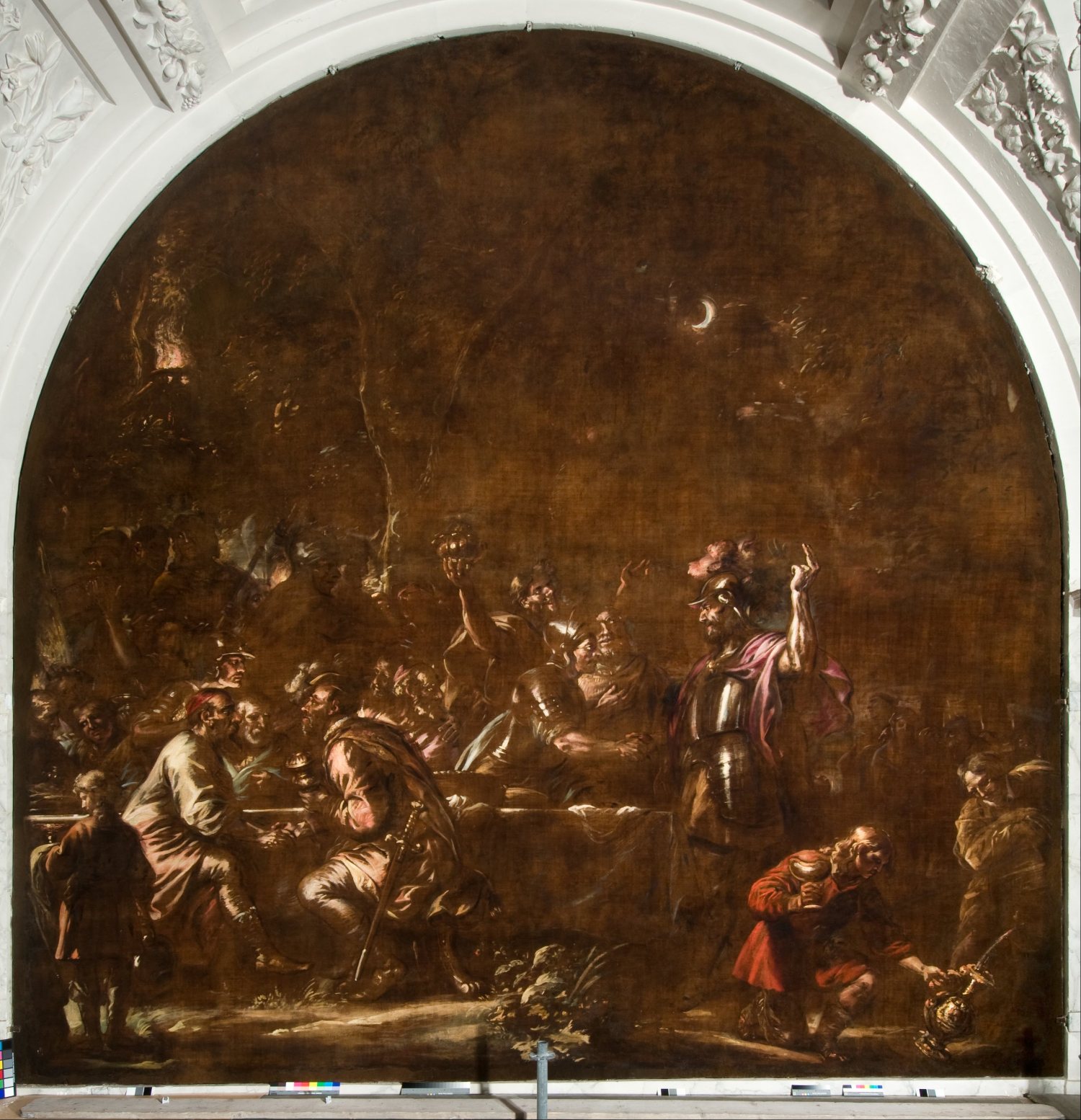
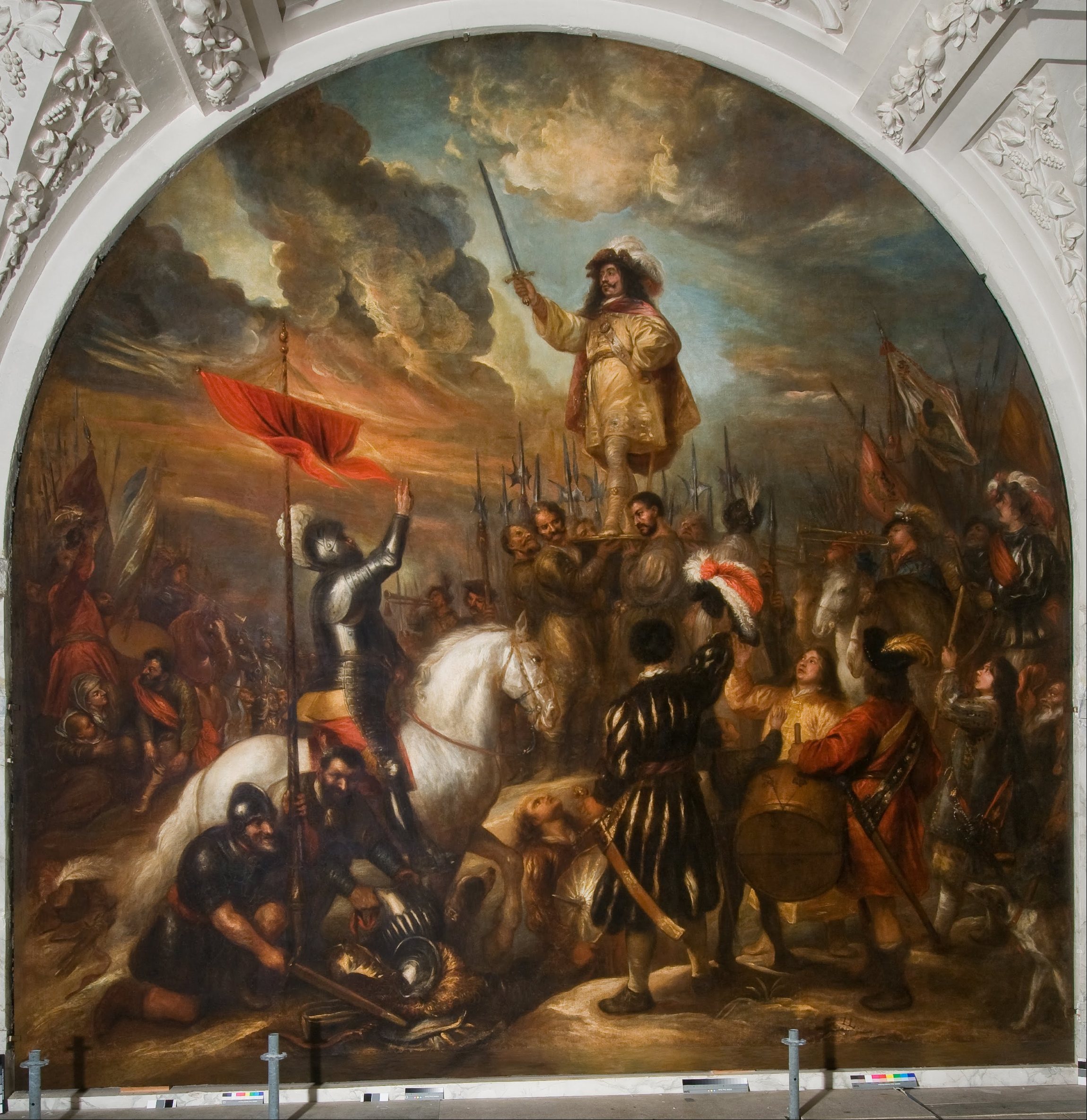
Philipp von Zesen’s Beschreibung der Stadt Amsterdam of 1664 contains a surprising bounty of information about the first painting in the Batavian series decorating the new Amsterdam Town Hall (fig. 1). The German historian, who became an honorary resident of Amsterdam in the same year that the Beschreibung was published, spent one paragraph describing the subject matter, taken from Tacitus’s Historiae (IV, 14ff): the most prominent members of the Batavian nobility and the best of the common folk, gathered at a banquet in the forest and united by Claudius Civilis’s rousing words, pledge to revolt against the Romans.1 He dedicated another paragraph to delineating its material components. Most unusual for a city description, Von Zesen recorded that Govert Flinck had sketched out a simple design on linen coated with glue, using only charcoal and a little watercolor, and that he had done so in a mere two days in order to accommodate the entry of the Princess of Orange into the city.2 He also wrote that shortly after completing this sketch, Flinck died, necessitating that Jürgen Ovens complete the composition. Ovens, in turn, took only four days to reinforce the sketch with oil paint and add ten to twelve figures, at the request of the burgomasters.3 Such a delineation of technique and hands offered seventeenth-century readers a rare glimpse into the production of a major public commission.
The study of the painting between 2007 and 2009 by Margriet van Eikema Hommes and Emilie Froment confirmed that Von Zesen’s assessment was fairly accurate in terms of the media used and the presence of two campaigns.4 They found that Flinck had modelled the contours of the figures in black water-based paint and had highlighted them with a limited palette of beiges and ochres.5 They also verified that Ovens ‘put the finishing touches’ on Flinck’s composition using a lighter palette of rose, lilac, and light blue oil paint, though they could not distinguish the full dozen figures that Von Zesen mentioned.6 One discovery made by Van Eikema Hommes and Froment is that Ovens adjusted the position of the raised left arm of Claudius Civilis: the artist moved the hand further away from the head and added highlights to it.7
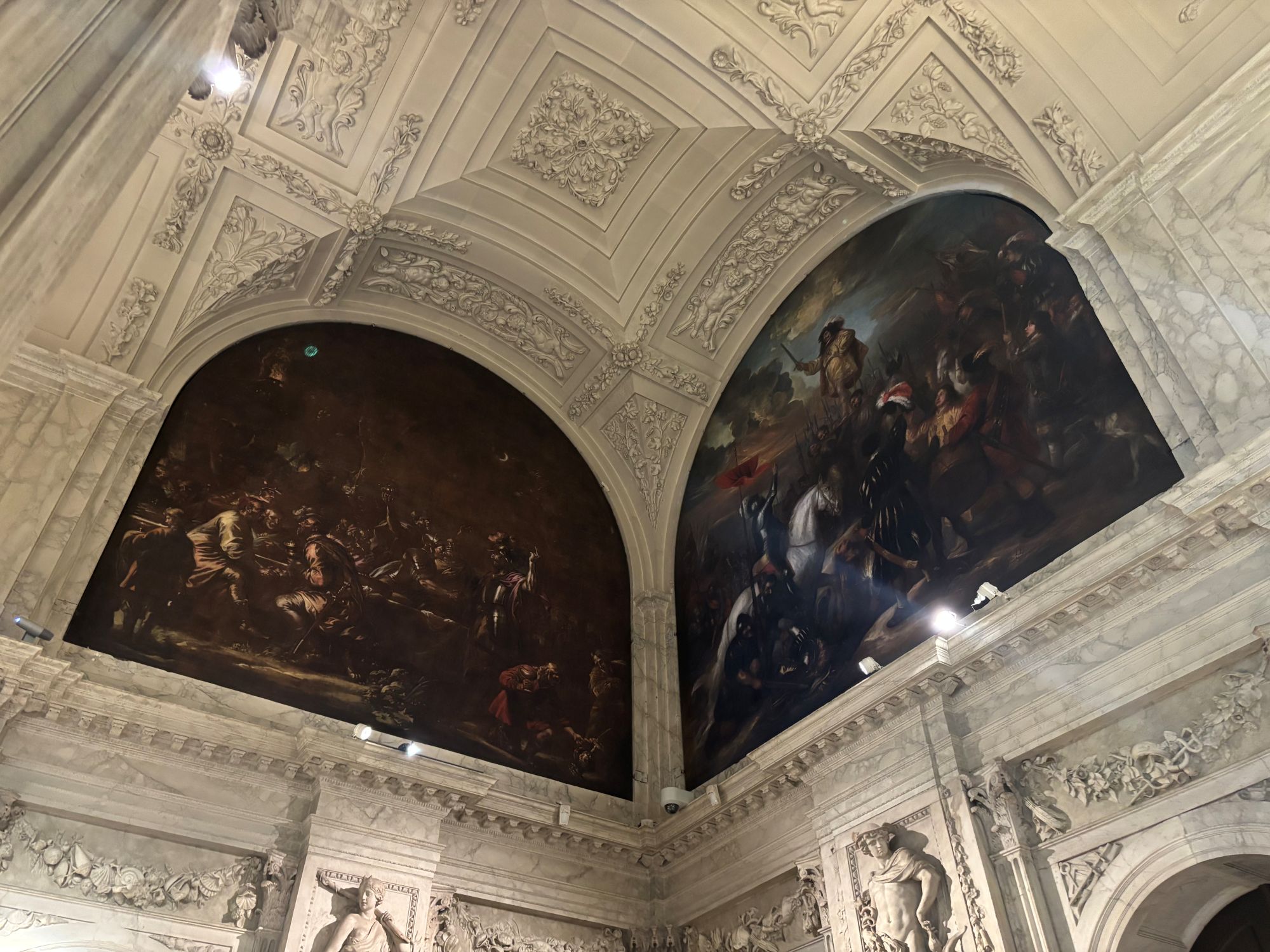
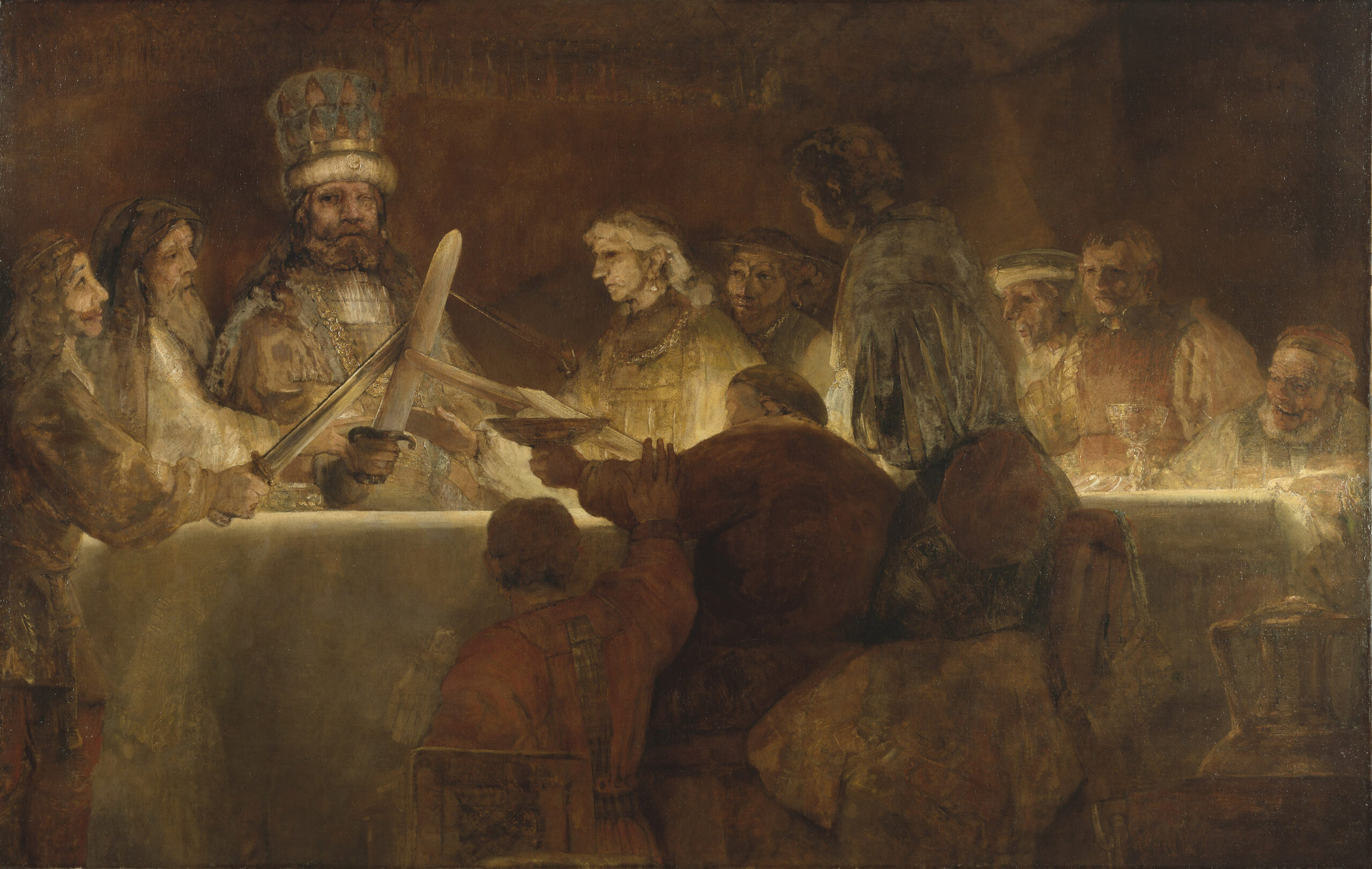
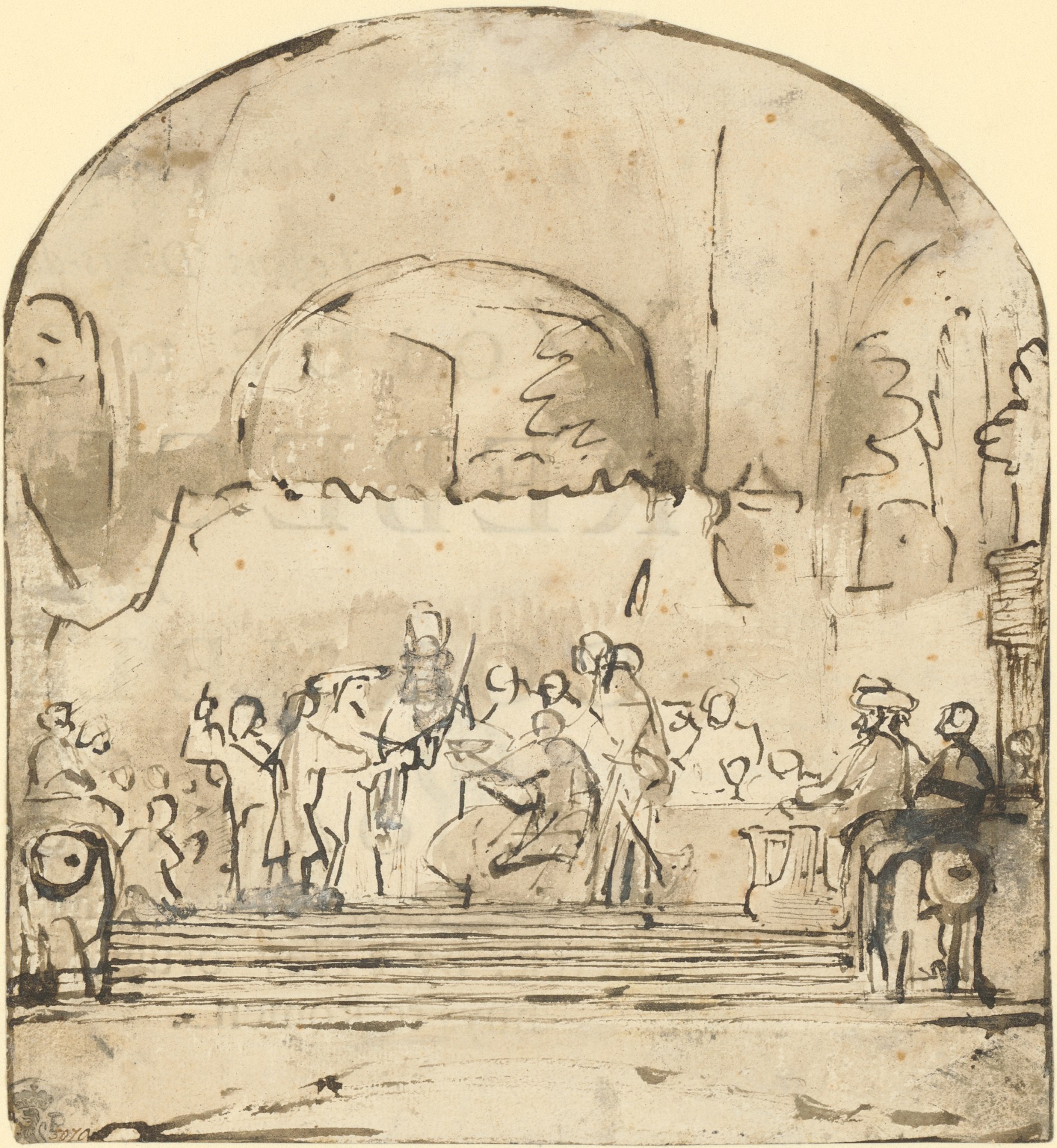
Van Eikema Hommes and Froment’s assertion that the canvas, still in situ in the building’s Burgerzaal (Citizen’s Hall), was a makeshift solution to the immediate problem of the visit of Maximilian Heinrich of Bavaria, archbishop-elector of Cologne, in September 1662 raises fascinating questions (fig. 2).8 On the one hand, it was natural to return to Flinck’s composition after the removal of Rembrandt’s painting in the late summer, as addressed by Eric Jan and Nicolette Sluijter in this volume (fig. 3). Not only was the 5.5-meter canvas appropriately sized and shaped for the gallery lunette, but the composition was easily legible from a distance, with figures of approximately the same scale as the adjacent Brinio Raised on the Shield by Jan Lievens (fig. 4). In addition, the painting contained all the important elements from Tacitus’s Historiae: a nocturnal and forested setting, a feast, and a communal agreement. Most importantly, the canvas could be made ‘gallery-ready’ for the archbishop-elector’s visit with revisions so limited that they could be completed in a matter of days and for a modest stipend.9 That said, why would attention be paid to such an otherwise negligible component of the composition as a raised arm, particularly when Ovens was confronted with the looming deadline of 24 September 1662? And can comparison with the remnant of Rembrandt’s painting yield any insights into the burgomasters’ ambitions for the inaugural painting in the series?
 |  |
Though the Town Hall has been connected to the histories of ancient Rome and the Dutch liberation from Spain since its inauguration in 1655, recent research on the Batavian cycle has focused on its relationship to the political moment of the First Stadholderless Period (1650-1672).10 Albert Blankert first made this connection with Lievens’s Brinio Raised on the Shield, arguing in an unpublished lecture of 1979 that Jacob Cats had advocated for the abolition of the captaincy-general in its permanent form and recommended the election of a new general for each campaign.11 Margaret Deutsch Carroll, in an article of 1986 about Rembrandt’s painting, built upon Blankert’s suggestion, postulating that Amsterdam’s anti-Orangism did not provide a receptive context for Rembrandt’s pro-Orangist depiction of Civilis as a Christ-like figure.12 Peter van der Coelen, writing in 2006, argued extensively that Rembrandt’s painting actually supported Amsterdam’s Staatsgezind ideology by depicting Civilis as a temporarily elected leader within a mixed government comprised of a stadholder and the provincial states.13 Most recently, Elmer Kolfin situated the cycle within the battle between Orange and Amsterdam in the early 1660s, positing that the leader of the Batavian revolt represents the elected leader—’a virtuous, courageous and self-sacrificing soldier in temporary service of the States’—that the Amsterdam burgomasters envisioned in the face of an aggressive house of Orange.14
The question of the stadholder’s role in Dutch government was a critical one for the province of Holland, and for Amsterdam specifically, in this period. The city was, after all, the target of Willem II’s attempted coup in 1650, a blatant misuse of military might by the stadholder that would inform the three Staatsgezind tenets of 1) the sovereignty of the provincial states, 2) the appointment of a stadholder according to merit only, and 3) the subordination of the stadholder’s authority to that of the States General. Amsterdam had long been a thorn in the side of the stadholder: not only was it the sole city that selected its own burgomasters without the stadholder’s input, but it, along with other cities in the province, had also long opposed the continuation of the war with Spain and had started to campaign for a reduction in the size of the army in the 1640s.15 This was further solidified with the Act of Exclusion, a secret article in the Treaty of Westminster that was later defended in the Deduction of 1654, in which the States of Holland and West Friesland pledged never to nominate a member of the house of Orange to the stadholderate or the captaincy-general.16 Grand Pensionary Johan de Witt would suspend this resolution only in September 1660, with the restoration of the monarchy in Britain. As Jonathan Israel has pointed out, Holland’s hostility towards the stadholder ultimately came down to a question of ‘who controlled the Republic’.17
In late summer 1662, precisely when Ovens was asked by the burgomasters to touch up Flinck’s sketch, anti-Orangist factions had taken retaliatory measures to prevent Willem III’s ascension to the stadholderate, for it had been revealed that his uncle Charles II, not the States of Holland, was the orphaned prince’s legal guardian. By 12 September, the States of Holland and the States of Zeeland had agreed that neither province would bestow any charge upon the young Willem until he reached the age of eighteen years.18 Furthermore, by the end of the month, Grand Pensionary De Witt had withdrawn his resolution to tutor the Orange prince ‘in the spirits, laws and customs of this nation’.19 In short, the political situation in Holland, and certainly in rabidly anti-Orange Amsterdam, had drastically curtailed the prince’s potential to become the next stadholder.
Returning to the Flinck-Ovens painting, it is striking that the changes made by Ovens dramatically enhance the legibility of Civilis’s left arm: not only is his forearm one of the most illuminated passages in the otherwise dark painting, but his index and middle fingers are clearly extended, visible even from the marble floor of the gallery (fig. 2). This gesture, performed only by the Batavian leader, is one of contemporary Dutch oath-swearing. This act of swearing allegiance through the elevation of ‘erected fingers in the wonted solemnitie’, as described by the historian Lieuwe van Aitzema in terms of the loyalty pledges taken by soldiers to the States General, is also performed by the soldier in the foreground of Lievens’s Brinio Raised on the Shield (fig. 4).20 The historian Melchior Fokkens even recorded this armored man’s motion in Lievens’s painting as ‘the oath taken, as was customary in this country at that time’ in his 1662 description of Amsterdam.21
In contrast, Rembrandt’s fragment shows a different act, that of the crossing of swords, reported by Tacitus in his Germania as the manner in which oaths were sealed by Germanic tribes.22 Yet this historically accurate action would not have been quickly identified by the average seventeenth-century Amsterdammer, especially if situated in the middle distance of the composition, as indicated by the only surviving record of Rembrandt’s thoughts on the full composition (fig. 5).23 The Flinck-Ovens painting, in contrast, privileges the central placement of this gesture, suggesting that the burgomasters wished for a recognizable sign of oath-taking to be performed by Civilis.
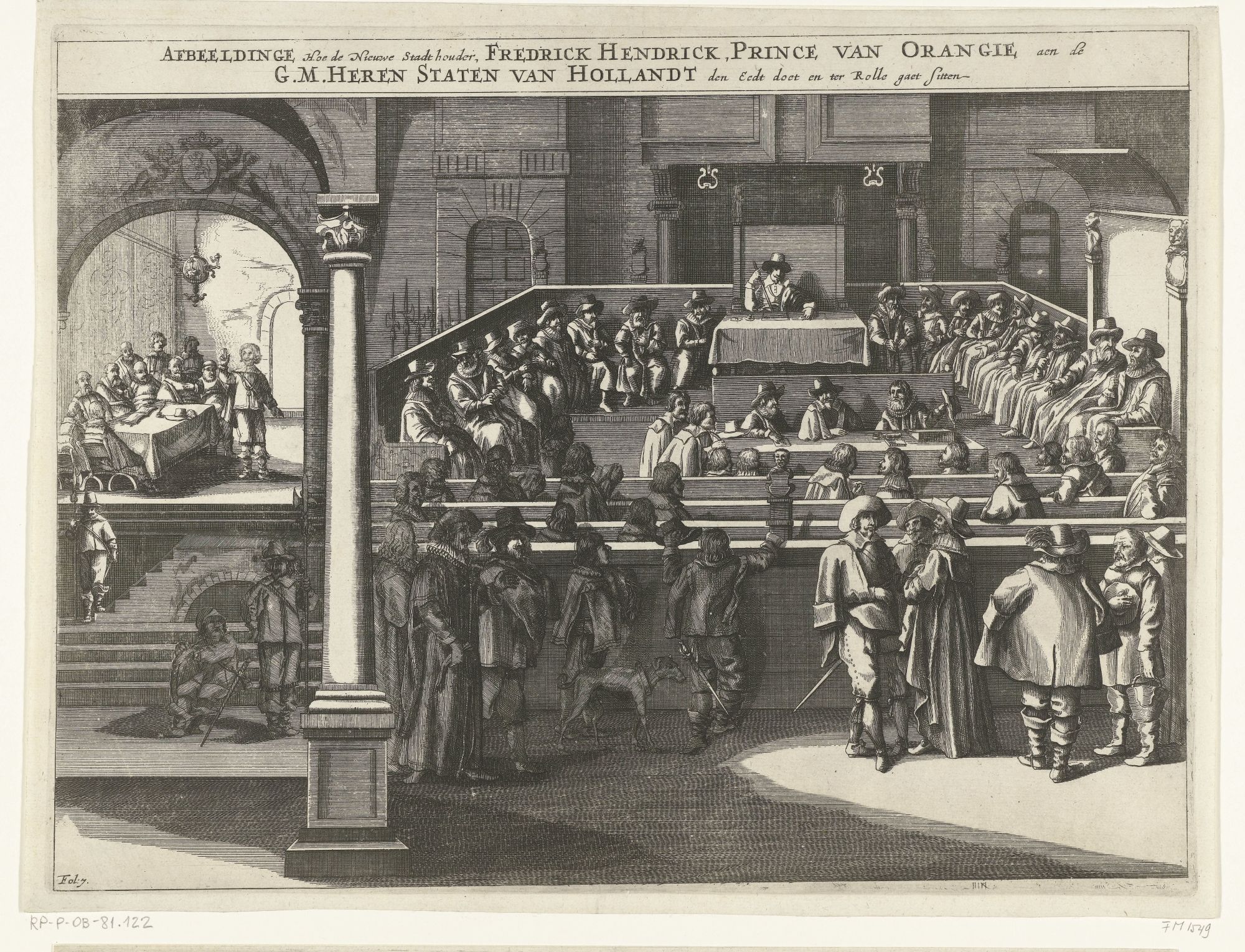
Ovens’s revisions to Civilis’s raised arm can only be explained by a need to reinforce Orange’s loyalty to the republic, as seen in a well-known print of c. 1650 depicting Frederik Hendrik at the far left pledging allegiance before the States of Holland (fig. 6).24 The threat of Charles’s intervention into Willem III’s future may have waned in the face of making peace with England, but the contentious treaty with England was only signed in September 1662 after months of negotiation.25 In the early 1660s, the States of Holland had done their best to restrict the prince’s access to the stadholderate, but his exclusion from the office was not a fait accompli, particularly if Charles was to suddenly show interest in his nephew’s fate. If an Orange stadholder was not wholly unthinkable in the ensuing years, the burgomasters of Amsterdam would certainly make clear that his will was subordinate to the will of the states, with Civilis as a stand-in for the Orange stadholder and the Batavian tribal members representing the provinces.
The emphasis on this gesture, with all of its political connotations, is put into relief when compared with the action performed by Civilis’s right hand: it clasps the hand of a tribesman, echoing the two Batavians at the lower left of the canvas.26 As Herman Roodenburg has shown, the joining of hands functioned as a symbol of harmony and unity in the seventeenth century.27 That Civilis-cum-Orange signals his allegiance with one hand and his consensus with the other to the tribesman-cum-statesman further ascribes a Staatsgezind approach to this composition.28 Pushing this argument further, one could even argue that the Flinck-Ovens painting illustrates all three Staatsgezind principles: 1) the sovereignty of the provincial states, as represented by the agreement of the autonomous tribesmen and, specifically, the pair shaking hands with each other; 2) the appointment of a stadholder according to merit only, as evident in the selection of the (royal but also) highly experienced Civilis; and 3) the subordination of the stadholder’s authority to the States General, as observed in Civilis’s pledge to the tribesmen conveyed by his raised fingers. It is foremost Civilis’s oath-taking, however, that would have struck the minds and hearts of the Staatsgezinden.
The burgomasters of Amsterdam were involved in political myth-making of ambitious proportions in the Amsterdam Town Hall. While myths are often perceived as timeless stories, Laura Cruz and Willem Frijhoff have proposed that they evolve according to the intellectual and emotional needs of their audience.29 The demands upon the representation of the oath of Claudius Civilis were many in the seventeenth century, as could be inferred by the installation and subsequent removal of Rembrandt’s painting and by the minor but consequential modifications made by Ovens to Flinck’s composition. The revision to Civilis’s left arm was clearly decisive in delivering a political message through the Batavian cycle in the Town Hall, a message that was not immediately intelligible in Rembrandt’s interpretation of the scene: Orange’s loyalty to the Dutch states must be unwavering. As Von Zesen wrote, the freedom of the Batavians ‘had been horribly undermined’, a sentiment that would have redounded upon the citizens of Amsterdam.30 The city’s burgomasters, facing a challenging deadline, salvaged Flinck’s canvas and instructed Ovens to make changes, some of which were according to their firm ideological position. When considering the freedom of the Batavians as a typological equivalent to the freedom of seventeenth-century Hollanders, the imminent threats of 1662 could not simply be ignored.
I would like to thank Nicolette Sluijter, Eric Jan Sluijter, Elmer Kolfin, and the editors of this journal for sharing their thoughts on this essay.
- ‘Darinnen stehet das Gastmahl entworfen / welches ihr heerführer Klaudius Ziviel im Schaker-busche / oder im geheiligten Walde / gehalten: aldaer die fürnehmsten des Adels / samt den besten aus der Gemeine zu gaste geladen / und zwar zu dem ende / damit er ihnen / wan sie der wein erhizt und muhtig gemacht / den frefel und übermuht der Röhmer vorhalten / und sie wider dieselben / welche sie / samt ihrer freiheit / so greulich unterdrükten / aufmuntern / und in den harnisch bringen möchte. Auch siehet man in diesem gemelde / wie sein verschlag / mit frohlokken und guhtheissen der ganzen versamlung / angenommen / und der eid / ihm getreulich zu folgen / geleistet / ja zum zeichen und zur bekräftigung desselben / ein güldener Bokahl ümgetrunken wird’: Philipp von Zesen, Beschreibung der stadt Amsterdam, Amsterdam 1664, p. 262.
- ‘auf ein rauhes allein mit leim überzogenes leinen tuch / mit holßkohlen / und ein wenig wasserfarben’: Von Zesen, Beschreibung (see note 1), p. 262.
- Von Zesen, Beschreibung (see note 1), pp. 262-263.
- Ovens may have shared details about the project with Von Zesen, as the two Germans were living in Amsterdam at the time. See Margriet van Eikema Hommes and Emilie Froment, ‘“Een Doek van Geene Beteekenis”: De Nachtelijke Samenzwering van Claudius Civilis in het Schakerbos van Govert Flinck en Jürgen Ovens Technisch Onderzocht’, Oud Holland 124 (2011), no. 2/3, p. 153.
- Van Eikema Hommes and Froment, ‘Een Doek’ (see note 4), p. 152.
- ‘die endliche hand daran geschlagen’: Von Zesen, Beschreibung (see note 1), p. 263.
- Van Eikema Hommes and Froment, ‘Een Doek’ (see note 4), p. 154.
- In 1664, the burgomasters put a five-year moratorium on new commissions for the building. The hastily touched-up sketch was never replaced. For an overview of this process, see Elmer Kolfin, De kunst van de macht. Jordaens, Lievens en Rembrandt in het Paleis op de Dam, Zwolle 2023, p. 61.
- Ovens received 48 guilders for his retouching of Flinck’s painting, as compared to the 252 guilders he received for his Justice or the 1250 guilders that Lievens and Jordaens each received for their Batavian paintings. See Constanze Köster, Jürgen Ovens (1623-1678): Maler in Schleswig-Holstein und Amsterdam, Studien zur internationalen Architektur- und Kunstgeschichte 147, Petersberg 2017, p. 340.
- For non-political readings of the Flinck-Ovens painting, see Harry Schmidt, Jürgen Ovens: Sein Leben und seine Werke, Kiel 1922, pp. 84-88 and 163; Patrick Larsen, ‘The Relationship between Govert Flinck and Jürgen Ovens’, in: Stephanie S. Dickey ed., Ferdinand Bol and Govert Flinck: New Research, Zwolle 2017, pp. 193-195; Köster, Jürgen Ovens (see note 9), pp. 161-168, 390, and 408-409; and the literature cited in Eric Jan and Nicolette Sluijter’s essay.
- Gregor Weber, ‘Jan Lievens’s ‘The Shield-Raising of Brinio’ – A Second Oil Sketch’, The Hoogsteder Mercury 13/14 (1992), p. 44. Blankert would publish his thoughts in 2009: Albert Blankert, ‘Lievens’ Onroerende Schilderijen’, Kunstschrift 3 (2009), pp. 20-27.
- Margaret Deutsch Carroll, ‘Civic Ideology and its Subversion: Rembrandt’s Oath of Claudius Civilis’, Art History 9 (1986), no. 1, pp. 12-35.
- Peter van der Coelen, ‘Rembrandt’s Civilis: Iconography, Meaning and Impact’, in M. Roscam Abbing ed., Rembrandt 2006: Essays, Leiden 2006, pp. 31-56.
- Elmer Kolfin, ‘Past Imperfect. Political Ideals in the Unfinished Batavian Series for the Town Hall of Amsterdam’, in Marianna van der Zwaag and Renske Cohen Tervaert eds., Opstand als Opdracht/The Batavian Commissions, exh. cat. Amsterdam, Koninklijk Paleis, 2011, pp. 11-19.
- Robert Fruin, ‘Bijdrage tot de Geschiedenis van het Burgermeesterschap van Amsterdam tijdens de Republiek’, in De Tijd van De Witt en Willem III. Historisches Opstellen, vol. 1, ’s-Gravenhage 1929, p. 76.
- For a modern Dutch translation of this document with an introduction, see Serge ter Braake ed., De Deductie van Johan de Witt. Manifest van de ware vrijheid uit 1654, Arnhem 2009.
- Jonathan I. Israel, The Dutch Republic: Its Rise, Greatness, and Fall, 1477-1806, Oxford 1995, p. 603.
- This was reported by Sir George Downing, Charles II’s ambassador ordinary to The Hague, in a letter of 12 September 1662, but Downing had alluded to collusion between the two provinces as early as February. See Israel, Dutch Republic (see note 17), p. 757.
- As translated in Kolfin, ‘Past Imperfect’ (see note 14), p. 19. For the original Dutch, see Luc Panhuysen, De Ware Vrijheid: De levens van Johan en Cornelis de Witt, Amsterdam 2005, p. 287.
- Lieuwe van Aitzema, Notable Revolutions, Being a true relation of what hap’ned in the United Provinces of the Netherlands In the years MDCL and MDCLI, London 1653, p. 334. Ovens’s sketch of the elevation of Brinio (c. 1660-1661, University Library, Warsaw) also contains the same motif of a soldier on horseback with raised fingers.
- ‘en den Eedt gedaan gelijk doemaals in dit Landt gebruykelijk was’: Melchior Fokkens, Beschrijvinge der wijdt-vermaarde koop-stadt Amstelredam, Amsterdam 1662, p. 162. It can also famously be seen in Gerard ter Borch’s Ratification of the Treaty of Munster, 15 May 1648 and was characterized, again by Van Aitzema, in his 1650 Verhael van de Nederlantsche Vreede-handeling: ‘…all [the Dutch] stood up and stretching out their two foremost fingers, the oath was read in French by the Lord van Loenen [Barthold van Gent], and all [the Dutch] said the words ‘Ainsi m’aide Dieu [So Help Me God]…’ As quoted in Alison McNeil Kettering, Gerard ter Borch and the Treaty of Münster, exh. cat. The Hague, Mauritshuis, 1998, p. 16.
- Van der Coelen, ‘Rembrandt’s Civilis’ (see note 13), p. 38.
- I would like to thank Eric Jan Sluijter for observing that this act is also performed by the man at the far left in this drawing. Situated too far from the table to comfortably cross his sword, he raises his fingers to signal his vow.
- I would like to thank Elmer Kolfin for bringing this print to my attention. It was published as folio 7 in Isaac Commelin, Frederick Hendrick van Nassauw Prince van Orangien: zyn leven en bedryf, Amsterdam 1651.
- Israel, Dutch Republic (see note 17), p. 757.
- Van Eikema Hommes and Froment note that Ovens added highlights to the hands. See Van Eikema Hommes and Froment, ‘Een Doek’ (see note 4), p. 156.
- Herman Roodenburg, ‘The ‘Hand of Friendship’: Shaking Hands and Other Gestures in the Dutch Republic’, in: Jan Bremmer and Herman Roodenburg eds., A Cultural History of Gesture, Cambridge 1991, especially pp. 171-176.
- The handshake is also found on ancient Roman denarii, some of which bear the inscription ‘Concordia exercitvvm’ (harmony with the army), as seen in an example in Museu de Prehistòria de València. I would like to thank Jochem van Eijsden for bringing this object to my attention. Reading Civilis’s handshake through such a lens, while distant from seventeenth-century Amsterdam, corresponds all too well to the Staatsgezind perspective after Willem II’s invasion of 1650.
- Laura Cruz and Willem Frijhoff, ‘Introduction’, in: Laura Cruz and Willem Frijhoff eds., Myth in History, History in Myth, Brill’s Studies in Intellectual History 182, Leiden/Boston 2009, p. 7.
- ‘ihrer freiheit so greulich unterdrükten’: Von Zesen, Beschreibung (see note 1), p. 262.