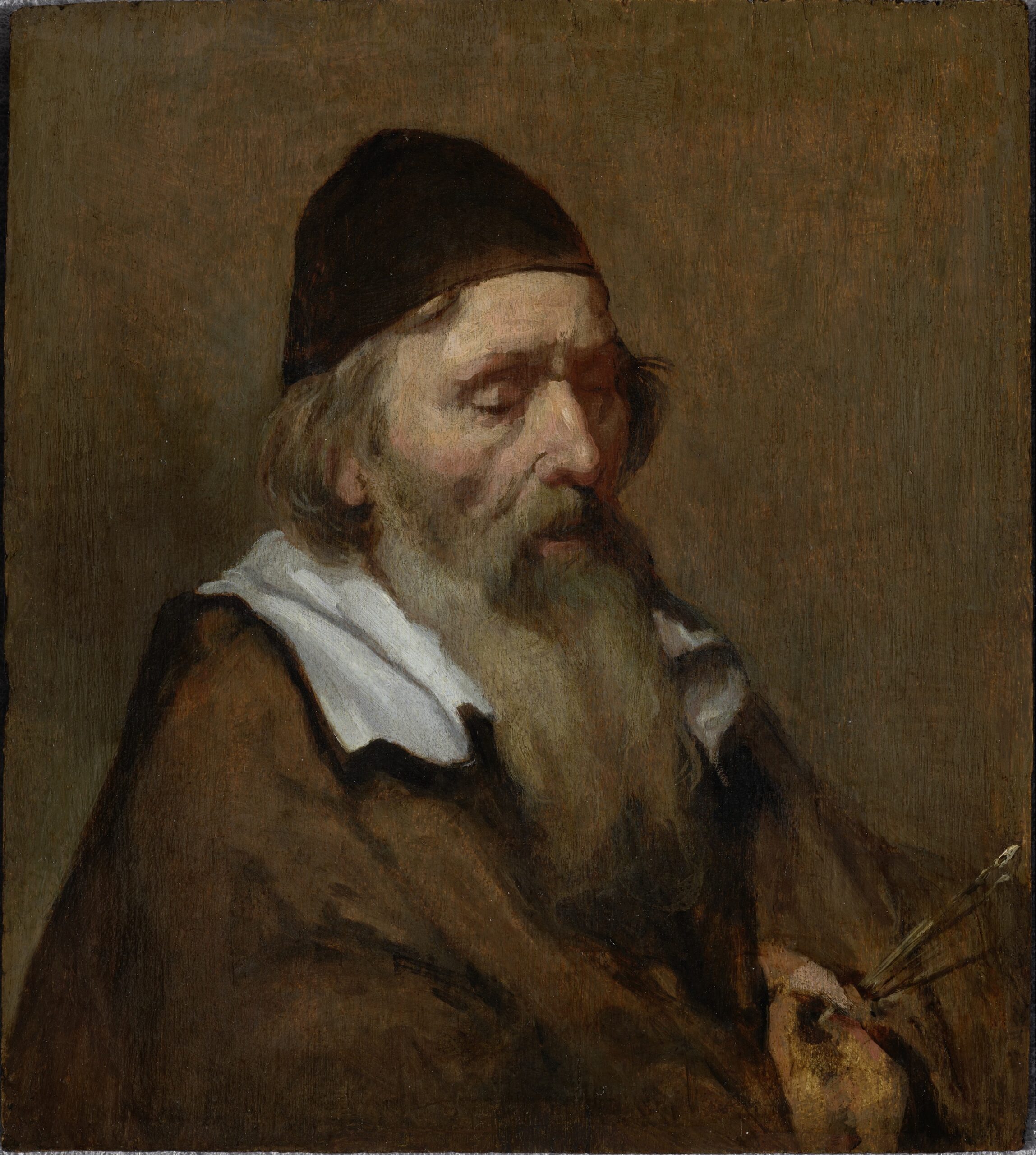
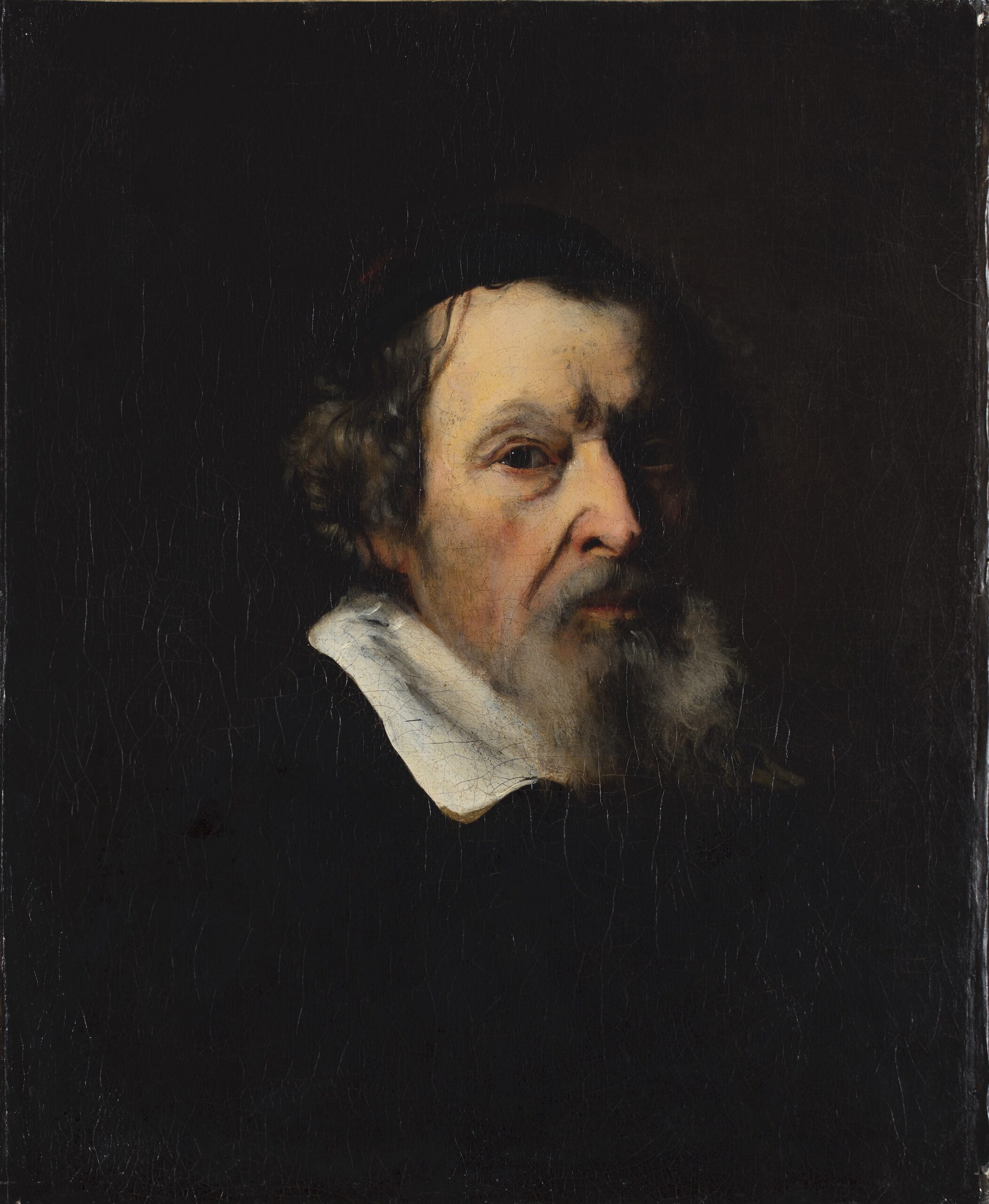
Among the most enjoyable aspects of searching for overlooked gems in the far reaches of the online auction jungle is discussing one’s finds with experts in the field. One of these experts in the field of Dutch 17th century art is Stephanie Dickey, herself a sharp follower of such auctions. In early 2024 Stephanie and I both stumbled upon the fascinating portrait presented here in a tiny Florida estate sale, where it was catalogued as ‘Old Master Painting. Rembrandt School’ (fig. 1). The ensuing attribution and identification – argued in this article – came about in consultation with Stephanie and other scholars.1
Strongly reminiscent of Rembrandt’s late style, this engaging and striking portrait, today with a distinguished European collector, depicts a young man, squarely facing the beholder with a sympathetic demeanor. Evidently in his early twenties, the sitter has long chestnut-colored curly hair, pale skin, dark eyes, a firm nose, downy moustache, full red lips and a conspicuous dimple in his chin. The left side of his face remains dark; his left eye seems positioned relatively low, accentuating the recession of the far side of the face, already cast in shadow. The black velvet beret, worn obliquely, blends in with the dark background, while hues on top provide volume and contrast. The sitter is dressed in a dark brown coat with a high upstanding collar, partly protruding beyond his cheek; the collar casts a shadow on the cheek, adding to the spatial effect. The red doublet underneath his coat enlivens the soft browns and resonates with the yellow ochre highlights on the coat’s lapel. The face is subtly executed with thinner paint, applied in transparent layers of pinks and olive over a dark ground; the execution of the clothing is sturdier. The chiaroscuro and tight cropping contribute to the portrait’s intimate, personal atmosphere.
The earliest known reference to the portrait dates from February 1959, when its owner at the time, Mrs. Mary van Berg in New York, handed a photo of her painting to the Frick Art Reference Library, stating that she had obtained it from a London art dealer, who had offered it as ‘Rembrandt (?)’.2 This purchase must have taken place after 1947, when Mr. and Mrs. Van Berg published a catalogue of their collection, which does not include the portrait.3 Mrs. Van Berg further related that the painting had been studied by no less than Julius Held, then professor at Barnard College who, according to Van Berg’s statement, considered the work to be a self-portrait by Rembrandt’s son Titus van Rijn (1641-1668). The portrait briefly surfaced again at a New York auction in 1978, as ‘Portrait of a Young Man, said to be Titus van Rijn’ carrying an attribution to Philips Koninck (1619-1688).4 In 1983 Werner Sumowski included the portrait in his Gemälde der Rembrandt-Schüler, as by Rembrandt’s pupil Willem Drost (1633-1659).5 However, this attribution was rejected by Jonathan Bikker in his 2005 monograph on Drost, where he also referred to the opinion of Horst Gerson, who had attributed the work to Nicolaes Maes (1634-1693).6
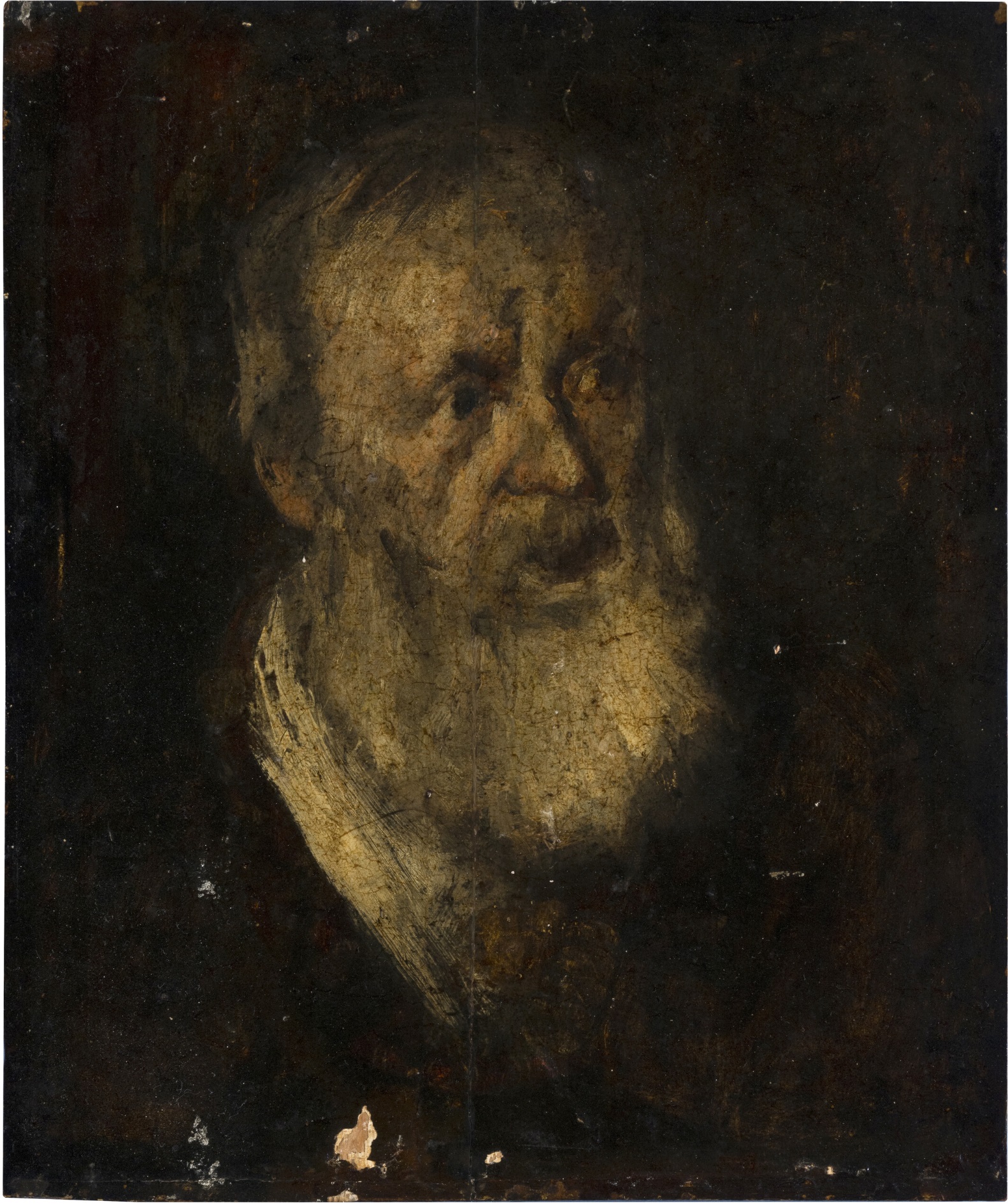
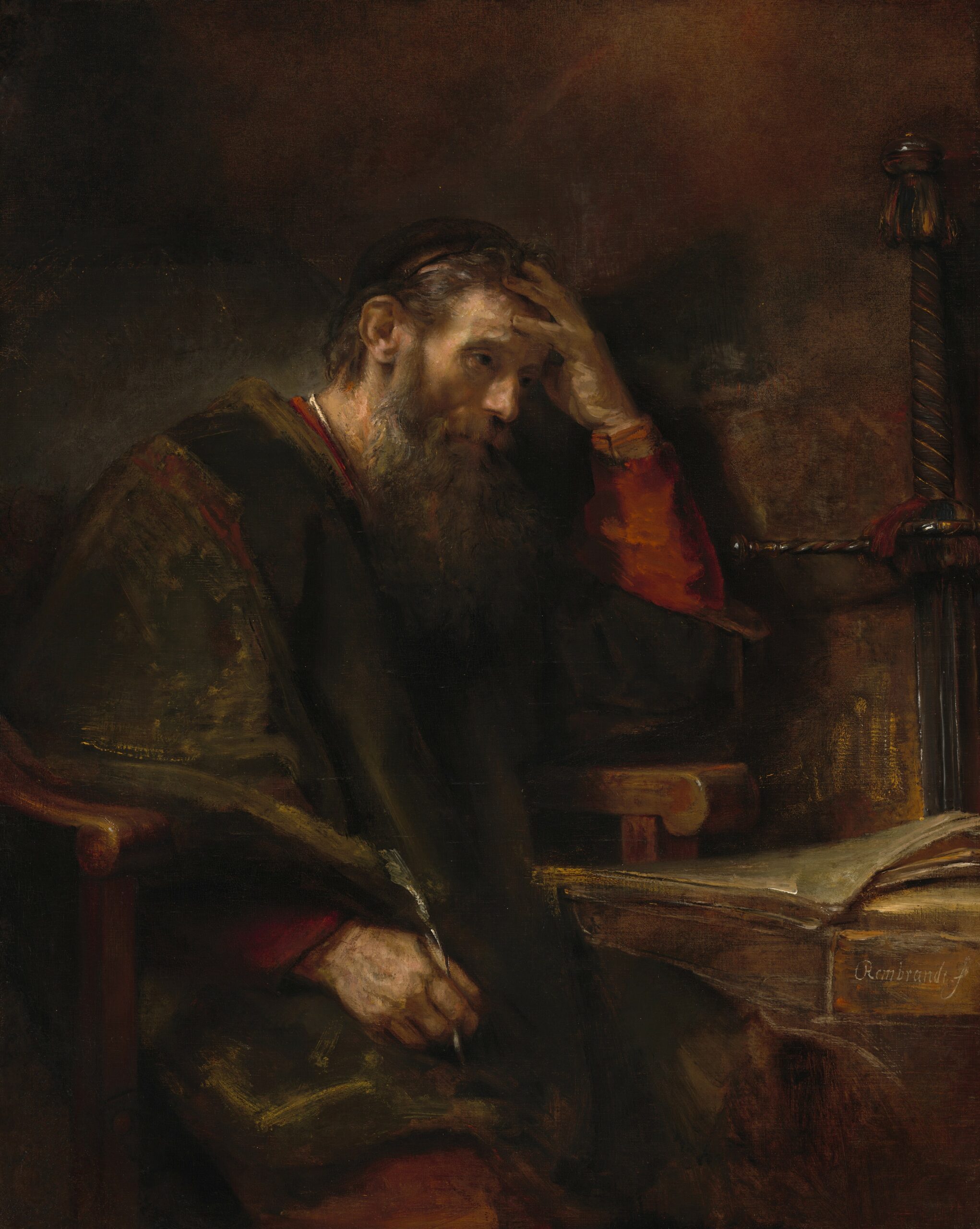
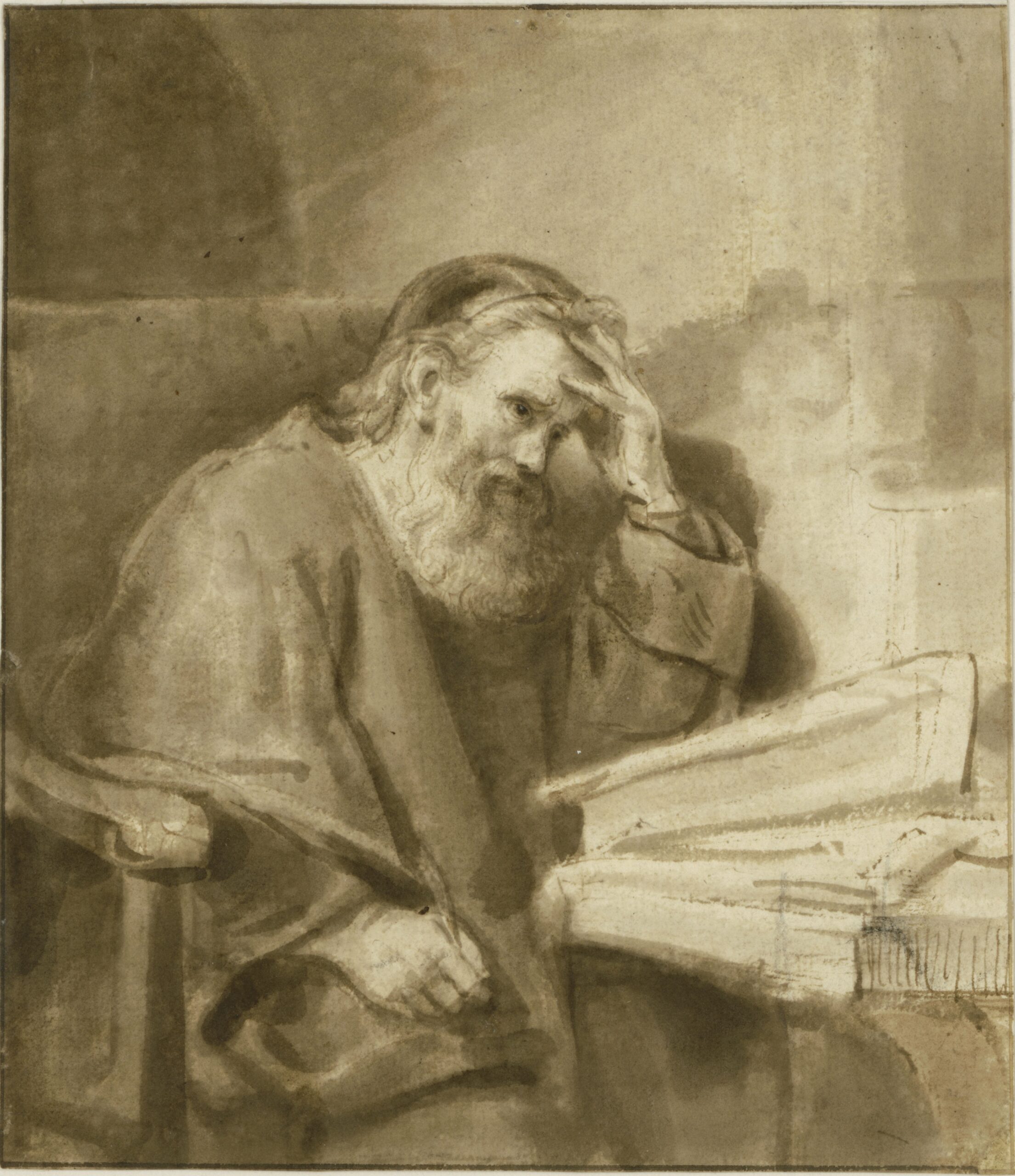
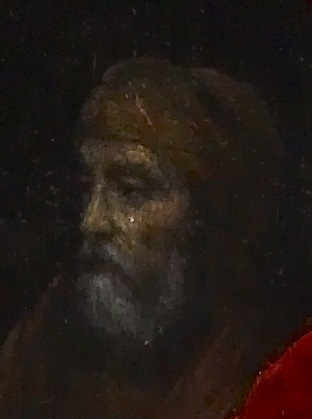
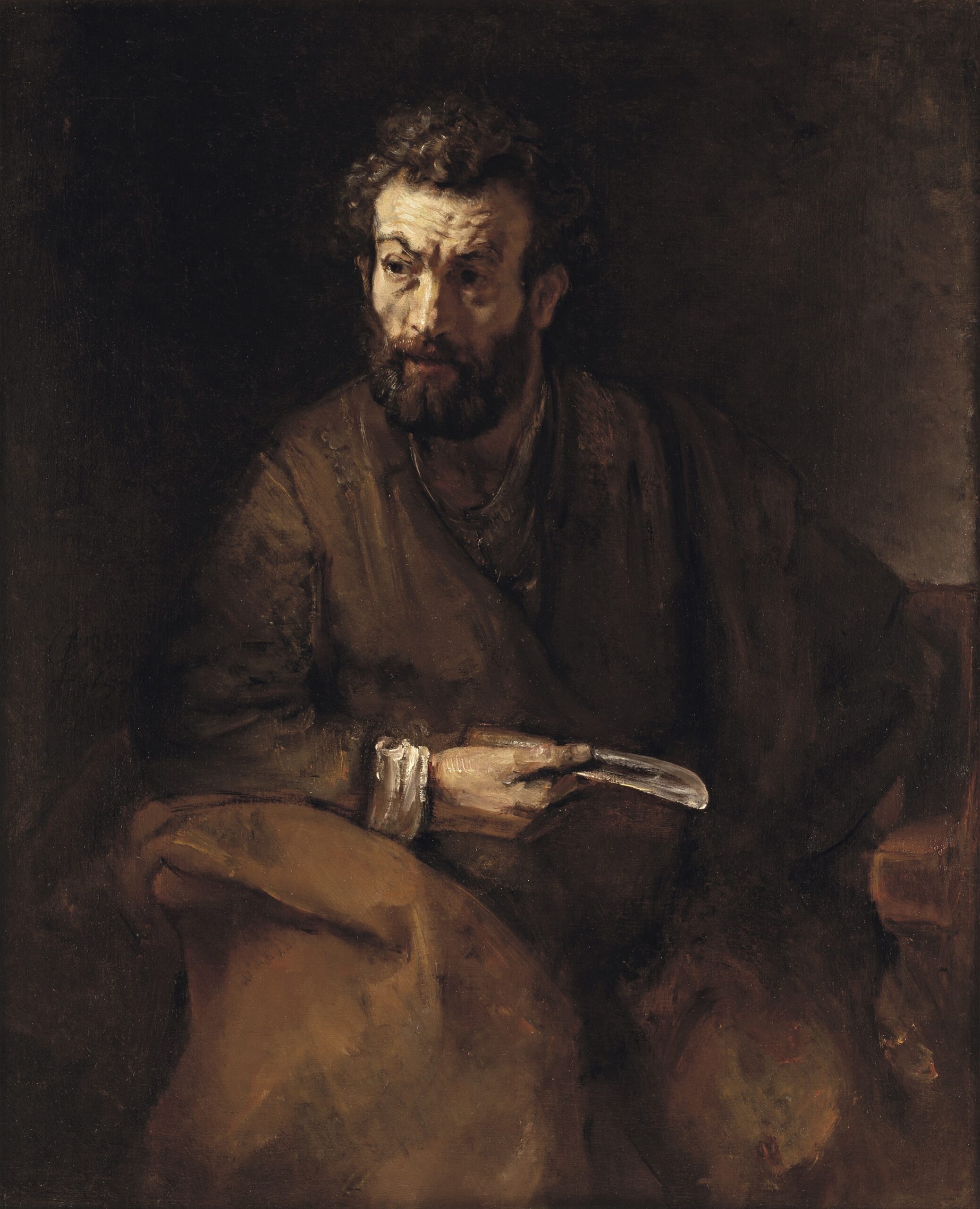
1650s? 1660s! This leaves us with varying scholarly opinions, and several names regarding maker and sitter, all pointing to the later Rembrandt and his circle. Before considering the portrait’s possible painter, let us reassess its approximate dating and its sitter. By attributing the portrait to Drost, Sumowski compellingly placed its execution around 1653, during or after Drost’s period in Rembrandt’s studio, before his departure in 1654/55 for Italy. The portrait’s atmosphere and composition, however, rely on Rembrandt’s later output, from the early 1660s. Such a dating was already implied by Held, whose identification of Titus, and attribution to him, inevitably place the work in the 1660s. Rembrandt’s Self-Portrait of 1660 in the Metropolitan Museum, New York, above all, resembles our portrait, to the extent that it must have provided a template for its painter (fig. 2).7 There Rembrandt depicted himself à trois-quarts in his brown work gown, worn over a doublet with a turned-up collar, a red shirt underneath, and a black velvet beret. Especially when cropping the image (fig. 3), the parallels with the present painting are striking: the opened coat with yellow-ochre hatches to emphasize its structure; the collar’s edges, highlighted with lighter brown and warm orange, similarly protruding beyond the cheek; a red shirt with a white edge worn underneath; and obliquely worn beret. The stark lighting from the left and the frontal view of the face in our portrait differs from Rembrandt’s three-quarter New York Self-Portrait, but is found in other Rembrandts from the period, such as the St Bavo in the Göteborgs Konstmuseum (fig. 4).8 While the St Bavo is executed more vigorously, the lighting, which highlights the cheekbone and the nose while striking the right side of the forehead, leaving dark the left side of the face, is surprisingly similar to that in the portrait discussed here. Another strong example of this concept is Rembrandt’s Portrait of Jeremias de Decker of 1656/66 in the Hermitage, St Petersburg.9 Not only does this empathic portrait employ the same lighting, but the sitter’s eyes also are likewise positioned at slightly differing heights. This tendency is observed again in Rembrandt’s Man in a Red Cloak in the Metropolitan Museum of Art, New York of c. 1662/65, which, with its intimate shadowy setting and atmospheric color range, conveys a similar mood.10
In addition to Stephanie, I wish to thank Eric Jan Sluijter, Nicolette Sluijter-Seijffert and David de Witt for listening to my ideas concerning the attribution and identification presented here, offering support and feedback, and commenting constructively on an earlier draft of this article.
Frick Art Reference Library, as attributed to Titus van Rijn, Presumed Self-Portrait (https://library.frick.org/permalink/01NYA_INST/d73c5u/alma991000313219707141, website accessed 26 June 2024). The information on the mount mentions that the Frick’s reference worker, identified only by the initals DMH, had visited Mary van Berg at home in January 1959, where she saw the painting in the flesh. I thank Elizabeth Kobert, archivist of the Frick, for identifying DMH as Daphne Mebane Hoffman.
M. van Berg, The van Berg collection of paintings, New York 1947.
Sale New York, Christie’s, 9 June 1978, lot 44 (as attributed to Philips Koninck, Portrait of a Young Man, said to be Titus van Rijn).
W. Sumowski, Gemälde der Rembrandt-Schüler, 6 vols., Landau/Pfalz 1983-1994, 1 (1983), pp. 610, 616, 636, cat no. 327, ill., as Willem Drost.
J. Bikker, Willem Drost (1633-1659) : a Rembrandt pupil in Amsterdam and Venice, New Haven 2005, p. 150, cat. no. R18 (not by Drost). Known only from a black/white photo. Bikker mentions a note by Gerson at the RKD. He agrees with Sumowski that the identification of the sitter as Titus van Rijn cannot be substantiated. His remark that the work was probably cut down on the left and the bottom makes sense, insofar that the photo he consulted (and reproduced in his book) was cropped on both sides.
W. Liedtke, Dutch paintings in The Metropolitan Museum of Art, 2 vols., New York 2007, 2, pp. 687-692, cat. no. 157. E. van de Wetering, in: E. van de Wetering et al., A Corpus of Rembrandt Paintings, 6 vols., The Hague/Boston/London 1982-2014, 4 (2005), pp. 288-294, 517-525, cat. no 20; 6 (2014), p. 665, cat. no. 282.
Göteborg, Göteborgs Konstmuseum. See A. Blankert, M. Blokhuis, in: A. Blankert et al., Rembrandt : A Genius and his Impact, exh. cat. Melbourne, National Gallery of Victoria, Canberra, National Gallery of Australia 1997-1998, pp. 168-172, cat. no. 24 (c. 1662/65); P.C. Sutton, in: A.K. Wheelock, Jr., P.C. Sutton, Rembrandt’s Late Religious Portraits, exh. cat. Washington, National Gallery of Art, Los Angeles, J. Paul Getty Museum 2005, pp. 129-131, cat. no 17. Sutton compares the painting to works from 1661 but refers (note 3) to Blankert (in Melbourne/Canberra 1997-1998) and Giltaij (J. Giltaij, Rembrandt Rembrandt, exh. cat. Kyoto, Kyoto National Museum, Frankfurt, Städelsches Kunstinstitut 2002-2003, pp. 214-216, cat. no. 42) and follows them in dating the work 1662/65 (p. 131). Van de Wetering, in: Corpus 6 (2014), p. 658, cat. no. 272, dates the painting slightly earlier (N.B. Van de Wetering dates the supposed study for the work, cat. no. 271 (Copenhagen, Statens Museum) c. 1660).
Oil on panel, 71 x 56 cm., St. Petersburg State Hermitage Museum. The portrait’s date is difficult to decipher but was always read as 1666. Van de Wetering, in: Corpus 6 (2014), p. 636, cat. no. 250, proposed to read the date as 1656.
New York, Metropolitan Museum of Art.The small painting was rejected as autograph by Gerson in 1969. Van de Wetering, in: Corpus 6 (2014), p. 678, cat. no. 310 has included it again in Rembrandt’s oeuvre, suggesting its function as a preparatory study for the male figure in the Jewish Bride, following earlier scholarship. The dendrochronological report by Prof. Peter Klein states that an origin of the painting is plausible from 1658 onwards. See also Liedtke 2007, pp. 754-757, cat. no. 171, as ‘style of Rembrandt’, suggesting the possibility that the work is a tronie based on the Jewish Bride.
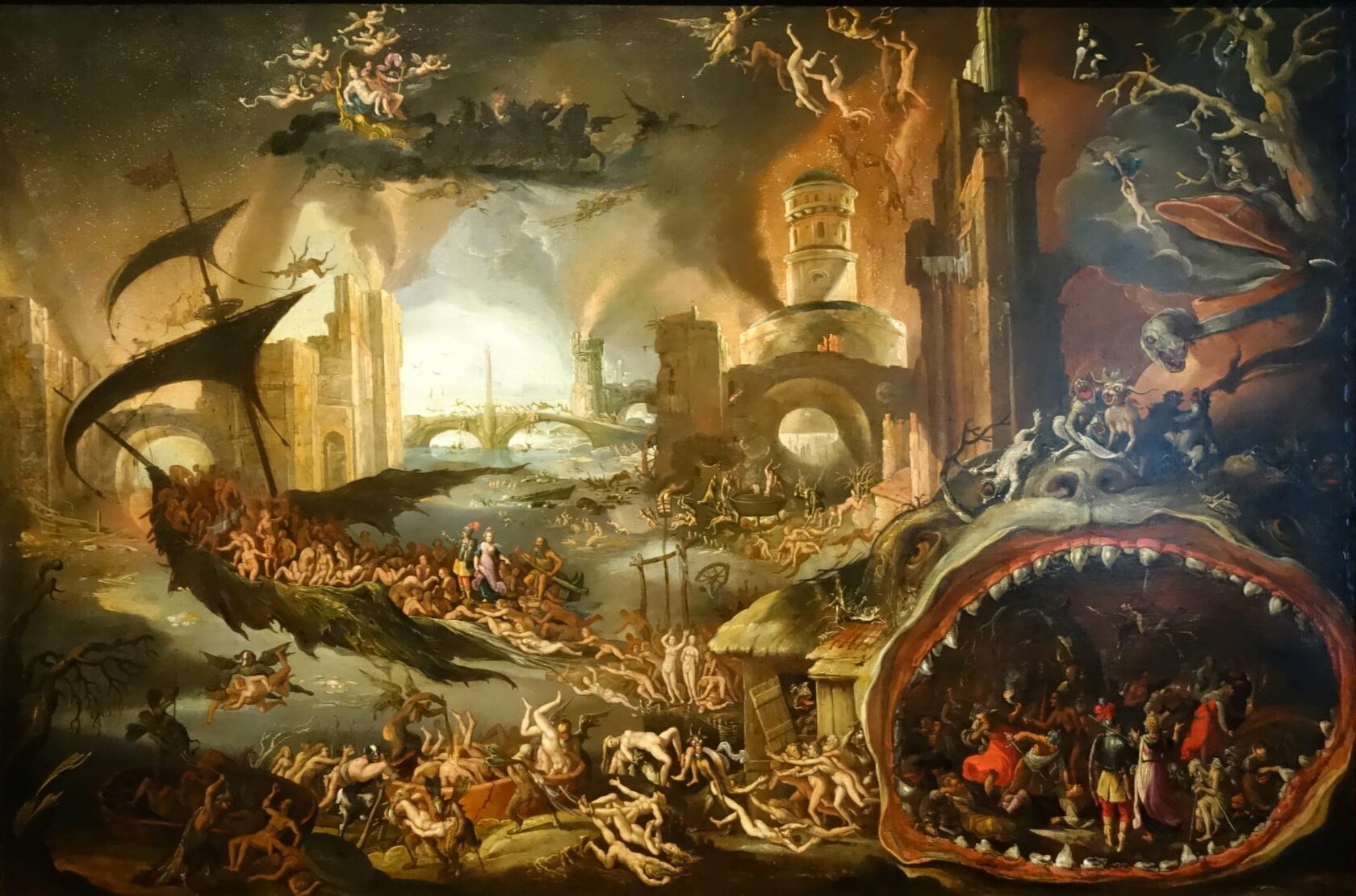
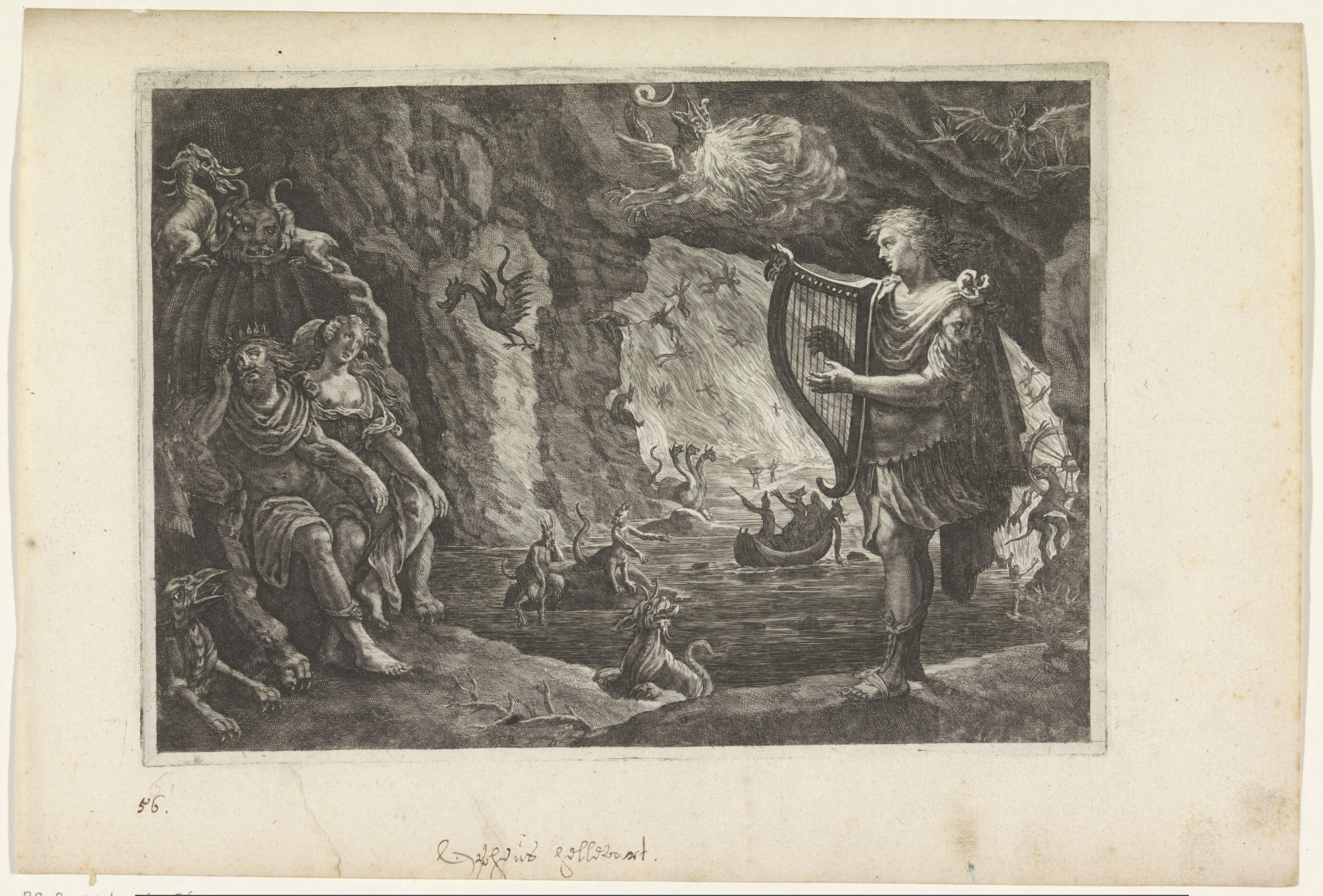
Jacob van Swanenburg (Leiden 1571-1638 Utrecht), generally known as the first teacher of Rembrandt, is among those Dutch artists who worked abroad and in the Netherlands. He specialised in underworld scenes, of which four are in public museums and considered the core and standard of his work (fig. 1).11 A fifth painting, Orpheus in the Underworld, which is lost but known from a print, is attributed to Jacob and the focus of this essay (fig. 2).12 Jacob’s brothers Willem and Claesz, were also artists, following their father, Isaac Claesz van Swanenburg (1537-1614), who had a successful career as burgomaster and artist in Leiden.13 About 1590, Jacob traveled through Hamburg, Venice, and Florence; settling in Naples c. 1596, he married and finally returned to Leiden with his wife and three children in January 1618.
Fig 1. Jacob Isaacsz van Swanenburg, Aeneas and the Sibyl in the Underworld, c. 1618-1638. Oil on canvas, 101.5 x 150 cm. Musée des Beaux-Arts, Brussels, inv. no. 10241.
Fig 2. Crispijn de Passe II or Magdalena de Passe after Jacob Isaacsz van Swanenburg, Orpheus in the Underworld, c. 1634-1660. Engraving, 165 x 231 mm. Rijksmuseum, Amsterdam, inv. no. RP-P-2014-34-56 (on loan from the Rijksakademie van Beeldende Kunsten).
The Orpheus was certainly painted during Jacob’s Leiden years. We may suppose that the four core hellish scenes were also painted after his return from Italy, as two are on hardwood, most likely indicating a north European origin of support. A chronology for his hellish works is difficult to propose, as none are dated. The four core scenes are extremely similar in their paint application and motifs of hell mouth, serpents, devils, nudes, tortures, and ruins. Circumstantial evidence indicates that many of these motifs appeared in his Neapolitan imagery before 1603, as they were adapted without much alteration by two artists in Italy; they found the hell mouth, ruins, silhouetted figures on a bridge, and tortures especially appealing, convenient, and worth emulating.14 Jacob van Swanenburg was appreciated for this imagery while in Italy, and identified, with it during his later years in Leiden.
The Amsterdam doctor Jan Sysmus noted in his diary that these hellish scenes were admired: ‘’Swanenburg in Leiden, in Hellish ghostly scenes, beautiful’’.15 In his diary, written between 1669 and 1678, Sysmus listed artists whose works he had seen and briefly characterized their imagery. His term spoken may be loosely translated as apparitions or ghosts, and refers to the category spookerij, indicating infernal compositions.16 Jacob van Swanenburg’s underworld paintings are mentioned in inventories in Leiden, Delft, and The Hague.17
The Orpheus engraving was made for an edition of Ovid’s Metamorphoses planned by the publishing enterprise of Crispijn de Passe I (c. 1565-1637), his daughter Magdalena (c. 1600-1638), and his son Crispijn de Passe II (1594-1670).18 The project went through several phases, and only in 1677 was it finalized under the direction of the Brussels publisher François Foppens, who added the Latin text, Pierre du Ryer’s French translation and commentary, and plates by various printmakers.19 This folio volume contained 124 prints, of which 90 were by the De Passe workshop with a few by other artists added by Crispijn II, and others added later for the publication. By c. 1660, proofs were in circulation. A set was owned by Michiel Hinloopen.20 On the Orpheus engraving, Hinloopen wrote in pen ‘56’ for the order in which he kept the impressions, and the title Orpheus hellevaert. The print is possibly by Magdalena.21
Jacob portrayed Orpheus playing the lyre for Pluto and Proserpina, who are enthroned in a scalloped niche. Orpheus has descended to retrieve his bride Eurydice, who was killed by a venomous snake (Ovid, Metamorphoses, 10:1-85). Pluto agrees to release Eurydice to Orpheus, who is instructed not to look at her during their ascent to earth. But Orpheus glances back at Eurydice as they depart, and so she cannot return with him. Flying demons, fantastic creatures, and tortures are similar to those in the four core paintings.22 The print shows Jacob’s interest in Pluto and Proserpina, who are included aloft in a chariot surveying their realm in three of these core paintings.23 The Orpheus print includes a fire-breathing hybrid creature flying at the centre and rough, rocky arches which evoke the grottoes around Naples.
Most of the models for the De Passe Ovidian edition are paintings already made, and their choice depended on the availability for the appropriate subjects; when such images were not easily accessible, Crispijn II adapted compositions from Antonio Tempesta’s 1606 Metamorphoses and several Italian images known in print. Some prints are after artists with ties to Utrecht where the De Passe workshop was based from 1611-1637; these include Gerrit van Honthorst, Abraham Bloemaert, Joachim Wtewael, Cornelis van Poelenburgh, and Roeland Savery. The Van Swanenburg family had relatives in Utrecht. Through his younger brother Joost, Jacob became related to the Van Veen and Bloemaert families; he died in Utrecht, which suggests professional or familial obligations at the time.24 His presence in Utrecht may have brought him into contact with the De Passe workshop. Other prints were sourced from artists associated with Amsterdam where Crispijn II lived from 1639-1670.
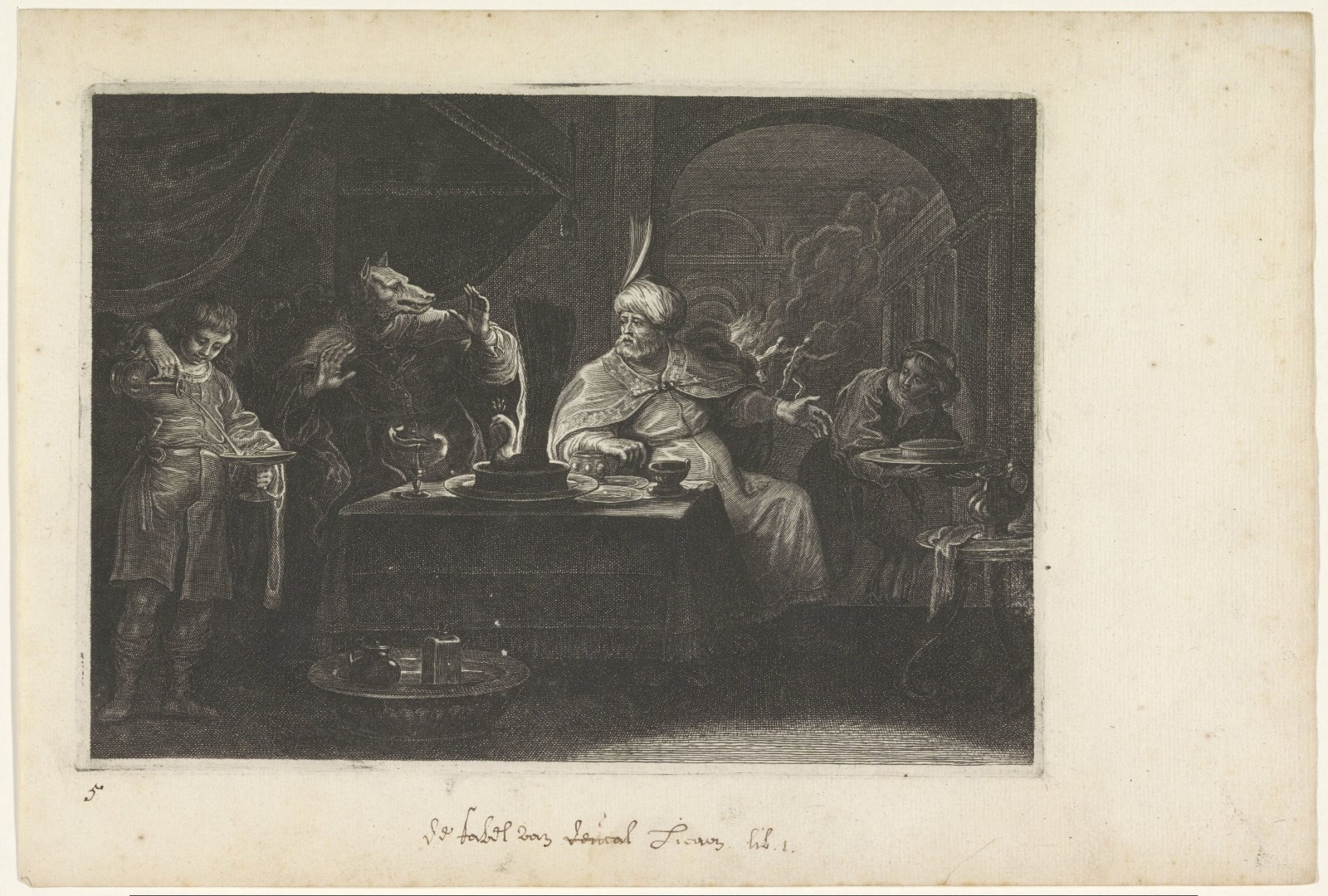
Fig 3. Pieter de Bailliu after Pieter Lastman, Jupiter and Lycaon, c. 1637-1660. Engraving, 162 x 228 mm. Rijksmuseum, Amsterdam, inv. no. RP-P-2014-34-5 (on loan from the Rijksakademie van Beeldende Kunsten).
Attributed to Pieter Lastman is the episode of Lycaon and Jupiter (Ovid, Metamorphoses, 1:199-243) (fig. 3).25 The cruel king of Arcadia, Lycaon was jealous of the adoration given to the visiting Jupiter by his own subjects and planned to kill the sleeping god in the night after inviting him to dinner. When Lycaon served Jupiter the human meat of a prisoner, the god turned the king into a wolf as punishment and set ablaze his household. The main figures of Jupiter and Lycaon at table are flanked by a boy pouring wine and a serving maid. A hallway opens to the courtyard, where two figures flee in terror from flames. As a crowded architectural night scene, Lycaon and Jupiter seems atypical in Lastman’s oeuvre, but, with its inclusion of a central pair of figures in dramatic confrontation, it is comparable to his other compositions.26
Here, Jupiter is not the physically powerful ruler of the gods as he appears elsewhere in Lastman’s work, but a turbaned and robed official, resembling a king from ancient history.27 Circumstances of the narrative help explain his appearance. Jupiter calmly recounts the episode to the gathered gods after having come to earth in human form intending to punish Lycaon for his barbarousness. Gesturing toward the meat platter, held by the maid, Jupiter emphasizes his restraint by causing only Lycaon’s household to go up in flames rather than punishing the whole community.
Although no related design for the Jupiter and Lycaon associated with Lastman is known, his authorship is strengthened and even confirmed by the inscription on an early proof at Wolfegg Castle examined by Jaco Rutgers.28 Inscribed in ink are the names of the inventor and printmaker: ‘’Lasman in /Petrus de balli fe.’’ The Antwerp engraver Pieter de Bailliu (1613-1660) worked on the Galleria Giustiniani project in Rome with Reynier Persijn from January 1635 to January 1637. Upon his return to Antwerp, he engraved the Jupiter and Lycaon before 1660, but he is not otherwise associated with the De Passe Ovid project. The Wolfegg print cabinet was assembled between 1650 and 1667 by Maximilian Willibald of Waldburg-Wolfegg (1604-1667), military leader and governor of the Upper Palatinate for the Electorate of Bavaria. The Wolfegg impression of Lycaon and Jupiter indicates that proof sheets were in circulation before 1667, by which time the Wolfegg cabinet was complete.29 The Antwerp publisher and engraver Joannes Meyssens helped form the Wolfegg cabinet, and would have been well informed about the material he assembled. The inscription on the proof may be by Meyssens, or even by De Bailliu himself.
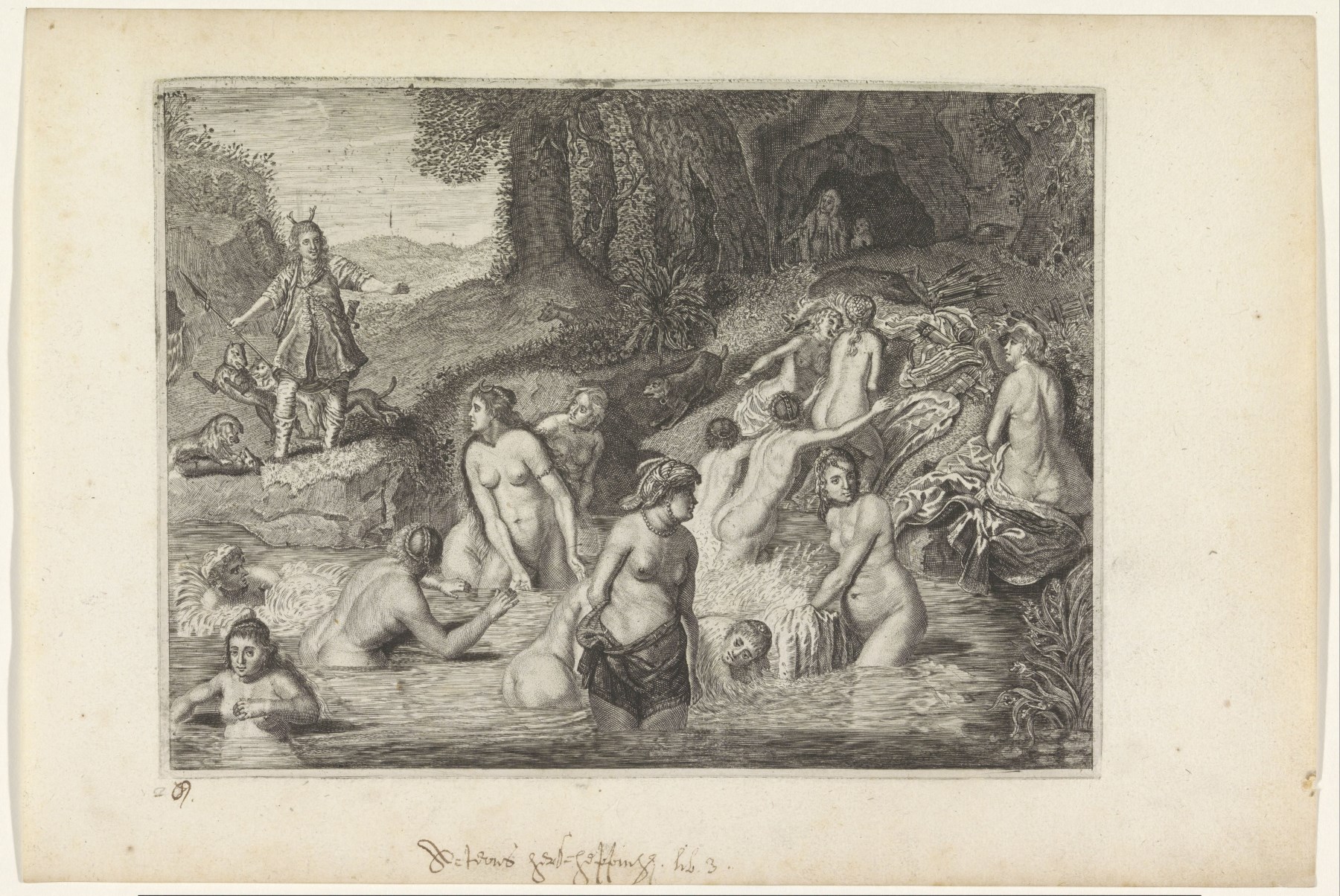
Fig 4. Crispijn de Passe II after Rembrandt, Diana and Actaeon, c. 1635-1660. Engraving, 166 x 223 mm. Rijksmuseum, Amsterdam, inv. no. RP-P-2014-34-28 (on loan from the Rijksakademie van Beeldende Kunsten).
For the episode of Diana and Actaeon, Crispijn II adapted Rembrandt’s painting Diana and Actaeon with Callisto and Nymphs (fig. 4).30 The painting combines two separate episodes: Callisto’s pregnancy discovered by the nymphs (Ovid, Metamorphoses, 2:461-445) and Diana spraying water on Actaeon (Ovid, Metamorphoses, 3:165-205). The print takes the central action of Diana spraying water upon Actaeon from Rembrandt’s painting and includes the seated nymph at the far right as a framing element. For the episode of Diana and Callisto, a composition from the circle of Cornelis van Poelenburch was used, possibly by Dirck van der Lisse or Abraham van Cuylenborch.
Based in Amsterdam 1639-1670, Crispijn II lived on the Rozengracht, an area of artists including David and Philips Lingelbach, Meindert Hobbema, Adam Pynacker, Ludolf Bakhuizen, and Jan Abrahamsz Beerstraten. We may suppose that Rembrandt was familiar with the neighborhood before he moved there in 1658 and speculate that he may have had contact with Crispijn II; we may imagine that a conversation about Rembrandt’s Diana and Actaeon with Callisto and Nymphs occurred which led to the use of that composition for the series.
Significantly for Jacob van Swanenburg, Orpheus in the Underworld places him in the grand Ovidian series initiated by the De Passe workshop, and in the company of his most successful and prominent contemporaries. In this publication, the two teachers of Rembrandt make an appearance along with their famous pupil. Perhaps Van Swanenburg may be considered as an artist worthy of attention, rather than merely Rembrandt’s first teacher.
For help with research for this article, I warmly and appreciatively thank Tania De Nile, Kate Harper, Lisanne den Hartog, Kennedy Harwood, Sylvia Hickman, Jaco Rutgers, Natasha Seaman, Tico Seifert, Nicolette Sluijter-Seiffert, and, for their help at the Fondation Custodia, Juliette Parmentier-Courreau and Ben Pelloud.
In addition to Stephanie, I wish to thank Eric Jan Sluijter, Nicolette Sluijter-Seijffert and David de Witt for listening to my ideas concerning the attribution and identification presented here, offering support and feedback, and commenting constructively on an earlier draft of this article.
Frick Art Reference Library, as attributed to Titus van Rijn, Presumed Self-Portrait (https://library.frick.org/permalink/01NYA_INST/d73c5u/alma991000313219707141, website accessed 26 June 2024). The information on the mount mentions that the Frick’s reference worker, identified only by the initals DMH, had visited Mary van Berg at home in January 1959, where she saw the painting in the flesh. I thank Elizabeth Kobert, archivist of the Frick, for identifying DMH as Daphne Mebane Hoffman.
M. van Berg, The van Berg collection of paintings, New York 1947.
Sale New York, Christie’s, 9 June 1978, lot 44 (as attributed to Philips Koninck, Portrait of a Young Man, said to be Titus van Rijn).
W. Sumowski, Gemälde der Rembrandt-Schüler, 6 vols., Landau/Pfalz 1983-1994, 1 (1983), pp. 610, 616, 636, cat no. 327, ill., as Willem Drost.
J. Bikker, Willem Drost (1633-1659) : a Rembrandt pupil in Amsterdam and Venice, New Haven 2005, p. 150, cat. no. R18 (not by Drost). Known only from a black/white photo. Bikker mentions a note by Gerson at the RKD. He agrees with Sumowski that the identification of the sitter as Titus van Rijn cannot be substantiated. His remark that the work was probably cut down on the left and the bottom makes sense, insofar that the photo he consulted (and reproduced in his book) was cropped on both sides.
W. Liedtke, Dutch paintings in The Metropolitan Museum of Art, 2 vols., New York 2007, 2, pp. 687-692, cat. no. 157. E. van de Wetering, in: E. van de Wetering et al., A Corpus of Rembrandt Paintings, 6 vols., The Hague/Boston/London 1982-2014, 4 (2005), pp. 288-294, 517-525, cat. no 20; 6 (2014), p. 665, cat. no. 282.
Göteborg, Göteborgs Konstmuseum. See A. Blankert, M. Blokhuis, in: A. Blankert et al., Rembrandt : A Genius and his Impact, exh. cat. Melbourne, National Gallery of Victoria, Canberra, National Gallery of Australia 1997-1998, pp. 168-172, cat. no. 24 (c. 1662/65); P.C. Sutton, in: A.K. Wheelock, Jr., P.C. Sutton, Rembrandt’s Late Religious Portraits, exh. cat. Washington, National Gallery of Art, Los Angeles, J. Paul Getty Museum 2005, pp. 129-131, cat. no 17. Sutton compares the painting to works from 1661 but refers (note 3) to Blankert (in Melbourne/Canberra 1997-1998) and Giltaij (J. Giltaij, Rembrandt Rembrandt, exh. cat. Kyoto, Kyoto National Museum, Frankfurt, Städelsches Kunstinstitut 2002-2003, pp. 214-216, cat. no. 42) and follows them in dating the work 1662/65 (p. 131). Van de Wetering, in: Corpus 6 (2014), p. 658, cat. no. 272, dates the painting slightly earlier (N.B. Van de Wetering dates the supposed study for the work, cat. no. 271 (Copenhagen, Statens Museum) c. 1660).
Oil on panel, 71 x 56 cm., St. Petersburg State Hermitage Museum. The portrait’s date is difficult to decipher but was always read as 1666. Van de Wetering, in: Corpus 6 (2014), p. 636, cat. no. 250, proposed to read the date as 1656.
New York, Metropolitan Museum of Art.The small painting was rejected as autograph by Gerson in 1969. Van de Wetering, in: Corpus 6 (2014), p. 678, cat. no. 310 has included it again in Rembrandt’s oeuvre, suggesting its function as a preparatory study for the male figure in the Jewish Bride, following earlier scholarship. The dendrochronological report by Prof. Peter Klein states that an origin of the painting is plausible from 1658 onwards. See also Liedtke 2007, pp. 754-757, cat. no. 171, as ‘style of Rembrandt’, suggesting the possibility that the work is a tronie based on the Jewish Bride.
These four underworld paintings are considered his core oeuvre: The Sibyl shows Aeneas the Underworld (Charon’s Boat), c. 1620, panel, 93.5 x 124 cm, Museum De Lakenhal, Leiden, S 251; Aeneas taken by the Sibyl to the Underworld, c. 1620, canvas, 101.5 x 150 cm. Musée Royal des Beaux-Arts, Brussels, inv. no. 10241; Aeneas and Sibilla in the Underworld (Charon’s boat), c. 1620, canvas, 101 x 140 cm. National Museum in Gdansk, Gdansk, inv. no. 1936-7-4-2; Charon’s Boat with the Hellmouth and Seven Sins, c. 1620, panel, 28 x 88 cm. Rijksmuseum, Amsterdam, inv. no. SK-A-730. For Van Swanenburg’s hellish scenes, which include several others on the art market or in private collections, see Tania De Nile, “Rethinking Swanenburg: The Rise and Fortune of New Iconographies of the ‘Hell’ in Italy and the Northern Netherlands”, in Marije Osnabrugge ed., Questioning Pictorial Genres in Dutch Seventeenth-Century Definitions, Artistic Practices, Market & Society, Turnhout, 2021, pp. 291-309; and Tania De Nile, Fantasmagori. Streghe, demoni e tentazioni nell’arte fiamminga e olandese del Seicento, Rome 2023, pp. 204-214.
The Orpheus has been listed without attribution in print catalogues, and linked to Jacob van Swanenburg in two publications. M. D. Henkel, “Nederlandsche Ovidius-Illustraties van de 15e tot de 18e eeuw”, Oud Holland 39 (1921), pp. 149-187, esp. p. 170, attributed the engraving to Magdalena de Passe and the composition to Jacob in pl. 17; and Jan van der Waals, De Prentschat van Michiel Hinloopen (1619-1708), The Hague/ Amsterdam 1988, pp. 82 and 85, credited Jacob based on comparison to his hellish paintings.
R. E. O. Ekkart, Isaac Claesz. van Swanenburg, 1537-1614. Leids schilder en burgemeester, Zwolle 1998.
By 1603, Baldasar Corenzio incorporated these motifs in his frescoes in two Neapolitan churches, Santa Maria la Nova and Santa Maria delle Parete, Liveri; see De Nile, ‘Rethinking Swanenburg’ (see note 1), pp. 305-306, and Tania De Nile, ‘Un ‘Inferno’ su carta agli Uffizi. Intorno a uno studio inedito di Belisario Corenzio perh Santa Maria la Nova’, Horti Hesperidum 11: 2 (2021), pp. 173-201. In his frescoes of 1615 in Santi Eusebio e Vittoria, Peglio, Lombardy, Giovanni Maria Mauro della Rovere did the same; Tania De Nile presented Mauro’s Peglio frescoes at the Historians of Netherlandish Art Conference, Cambridge UK, July 12, 2024: ‘When the North met the south: the fortunate case of the nordic Hellmouth in the Italian frescoes of the Counter-Reformation’.
“Swanenburch te Leyde, in Helse spoken moy”: Abraham Bredius, “Het Schildersregister van Jan Sysmus, Stads-Doctor van Amsterdam”, Oud Holland 9 (1891), pp. 137-149, esp. p. 147.
For this category, see De Nile, Fantasmagorie, passim (see note 1).
Inventories with hellish scenes include these: 1624/12/01, inventory Michiel Corn. Wijtland’s widow, Leiden; 1640, Pietersz. van den Bosch sale, Leiden; 1640, inventory Jan Jansz. Orlers, Leiden; 17 September 1659, inventory Catherina Willems van Thoornvliet, Dirck Segersz van Campen’s widow, Leiden; 15 September 1666, inventory Jan Maire, Leiden; 1666, inventory Henric Bugge van Ring and Aeltge Henricx van Swieten, Leiden; 20 April 1673, inventory Maria Elandts, Laurens Borsman’s widow, The Hague; 27 April 1692, inventory Geertruijt Brasfer, Johan van der Chijs’s widow, Delft; see De Nile, “Rethinking Swanenburg” (see note 1), p. 308, note 69.
For this project, see Ilya Veldman, Crispijn de Passe and his progeny (1564-1670): a century of print production, trans. Michael Hoyle, Rotterdam 2001, pp. 287-290; Lisanne den Hartog, “Crispijn (II) and Magdalena de Passe’s Metamorphoses Series: A comparative study in printmaking”, MA Thesis, University of Amsterdam, 2023.
Pierre Du Ryer tr., Les metamorphoses d’Ovide, en latin et françois, divisées en XV. livres, avec de nouvelles explications historiques, Brussels 1677.
Van der Waals, “Prentschat” (see note 2), pp. 79-102.
The Orpheus is in Du Ryer, Les metamorphoses (see note 9), p. 309. The print is by Magdalena de Passe according to Henkel, “Nederlandsche Ovidius” (see note 2), p. 170; Den Hartog, Crispijn (II) and Magdalena de Passe’s Metamorphoses Series (see note 8), p. 77. It is attributed to Magdalena with a question mark by Van de Waals, in “Prentschat” (see note 2), p. 85; and the Rijksmuseum. Veldman does not group it with other prints by Magdalena, apparently attributing it to Crispijn de Passe II, in Crispijn de Passe (see note 8), pp. 287-290. If by Magdalena, the print would have been made before 1634, the year she married and ceased engraving.
In various forms, these are generic to hell scenes, and also appear in other renditions of Orpheus in the underworld, as in Pieter van der Borcht’s illustration, Ovid, Metamorphoses Expositae, Antwerp, 1591, pp. 240-241.
These three are in Gdansk, Brussels and Leiden.
Joost van Swanenburg (1577-1620) married Elisabeth van Veen, the niece of Otto van Veen. Her brother Simon van Veen Jr. married Divera van der Eem (c.1682); Divera’s sister Margaretha married Hendrick Bloemaert on October 1, 1631. In this way, the Bloemaert, Van Veen and Van Swanenburg families became related. R. E. O. Ekkart, “Familiekroniek van Heemskerck en van Swanenburg (2)”, Jaarboek Centraal Bureau voor Genealogie 33 (1979), pp. 44-75, esp. p. 70; M. G. Roethlisberger and M. J. Bok, Abraham Bloemaert and his sons, paintings and prints, 2 vols., Doornspijk,1993, vol. 2, pp. 590, 659-660.
Van der Waals, “Prentschat” (see note 2), p. 83; Du Ryer, Les metamorphoses (see note 9), p. 14.
These include Jupiter, Juno and Io, 1618, panel, 54.3 x 77.8 cm, London, National Gallery, inv. no. NG 6272; Bacchus and Ariadne, 1628, panel, 60 x 87 cm, Stockholm, University Art Collection, inv. no. 278, and two paintings of David and Uriah, 1611, oak, 51.1 x 61.3 cm, Detroit, Detroit Institute of Arts, inv. no. 60.63; 1619, panel, 42.8 x 63.3 cm. New York, The Leiden Collection, inv. no. PL-100.
Comparable to Jupiter are Lastman’s figures of Ahasuerus in the Feast of Esther, 1619, oak, 52 x 78 cm, Warsaw, National Museum, inv. no. M.Ob.558 MNW and David in David and Jonathan, 1620, panel, 40 x 59 cm. Moscow, Pushkin Museum; Jan Lievens’ Ahasuerus in the Feast of Esther, c. 1625, canvas, 130.8 x 163.8 cm, Raleigh NC, North Carolina Museum of Art, inv. no. 52.9.55, and Jan Tengnagel’s Cambyses in the Judgement of Cambyses, 1619, canvas, 111 x 151 cm, The Hague, private collection.
Jaco Rutgers and Tico Seifert generously shared their knowledge of this print with me, and this analysis of Lastman and Bailliu is gratefully indebted to Jaco.
Several sets of proofs must have been in circulation. One group of proof impressions was recently acquired by the Rijksmuseum (inv. nos. RP-P-2013-10-1 to 13), with contemporary inscriptions indicating the title and occasionally the engraver or inventor.
Rembrandt, Diana and Actaeon with Callisto and Nymphs, 1634, canvas, 73.5 x 93.5 cm. Anholt, Museum Wasserburg. The print Diana and Actaeon appears in Du Ryer, Les metamorphoses (see note 9), p. 83. Two painted copies are known that omit the Callisto scene, but in specific details both differ from the De Passe print; J. Bruyn et al., A Corpus of Rembrandt Paintings, 6 vols., The Hague 1982-2015, vol. 2, pp. 493-494, gives information: Emil Goldschmidt collection; sale, Berlin 27 April 1909, no. 55; and Wolverhampton, Wolverhampton Art Gallery.
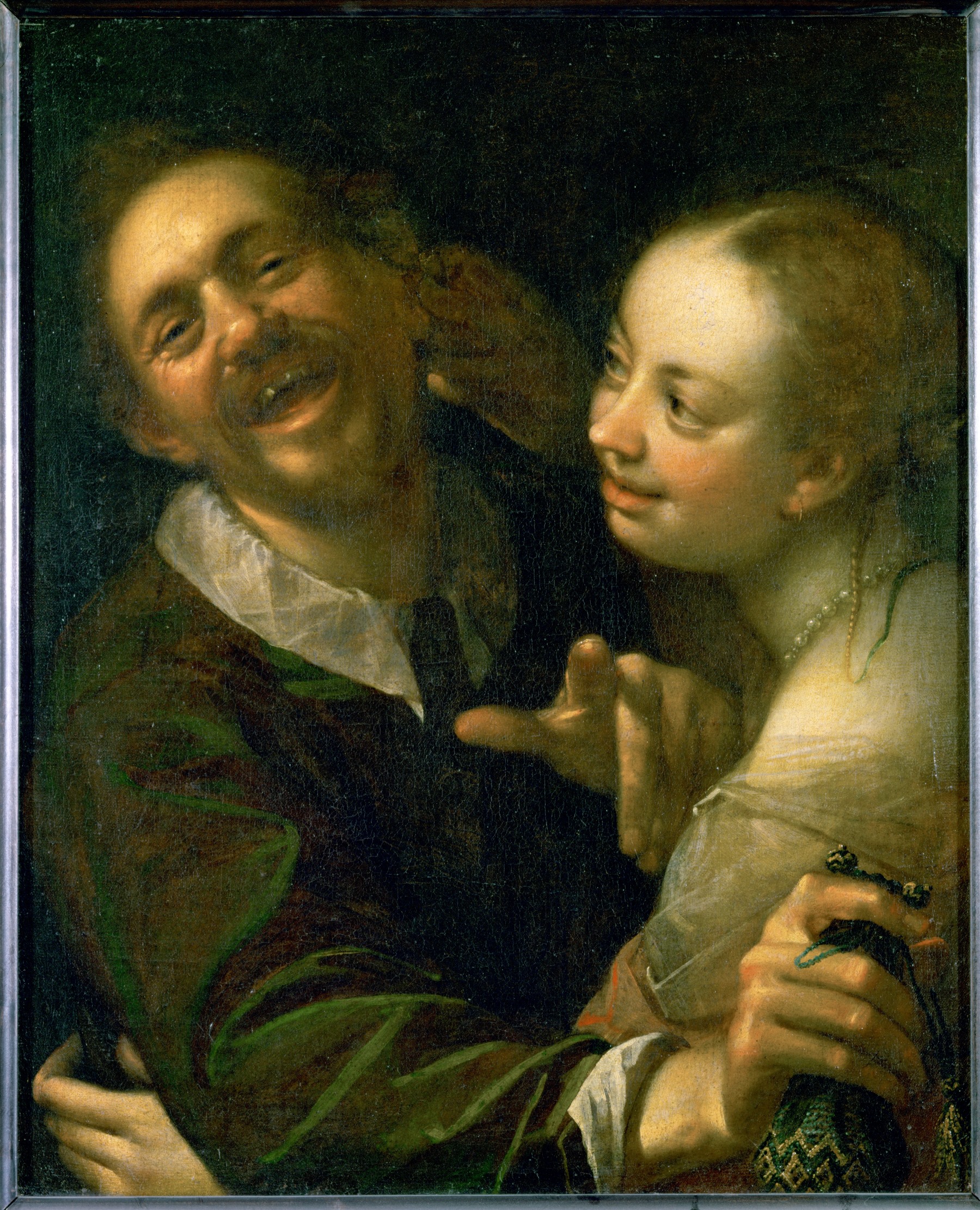
Fig. 1. Hans von Aachen, Joking Couple (Self-Portrait of the Artist with His Wife), c. 1596. Canvas, 63 x 51.3 cm. Kunsthistorisches Museum, Vienna, inv. no. GG 1134 (photo: Erich Lessing / Art Resource, NY).
All of us who have followed Stephanie Dickey’s distinguished career know that it would be reductive to describe her simply as a ‘Rembrandt scholar’, notwithstanding the many valuable contributions she has made to the study of this preeminent artist. For Stephanie’s impressive scholarly output over the years has encompassed a wide variety of topics that extend well beyond Rembrandt and his artistic followers. One essay of hers caught my attention quite some time ago: ‘Strategies of Self-Portraiture from Hans von Aachen to Rembrandt’, published as part of the proceedings of the international conference, Hans von Aachen in Context, held in Prague in 2010. Admittedly, the title of Stephanie’s contribution includes Rembrandt’s name, but her main focus here is upon Von Aachen (1552-1615), particularly what she terms his ‘transgressive self-portraits’ (fig. 1).31 In illustrating what is best described as raucous behaviour, these comical and entertaining pictures purposely violate contemporary conventions of gentlemanly and artistic propriety, as expounded by such art theorists as Karel van Mander.32 Their appearances deceive, however, because they served various purposes, inter alia, to demonstrate stylistic flexibility and painterly virtuosity, and to attract prospective patrons – and, hence, to promote artistic enterprise.33
Stephanie outlines the critical early role that Von Aachen played in the development of what has come to be known as artist-as-rogue self-portraits.34 She goes on to discuss the precedents he established for later examples by Rembrandt van Rijn, namely his well-known Self Portrait with Saskia in a Tavern (Dresden, Gemäldegalerie), and Jan Steen’s Self-Portrait as a Lutenist (Madrid, Museo Thyssen-Bornemisza).35 Stephanie concludes her contribution by exploring an intriguing link between these self-portraits and early modern concepts of masculinity and its performance among young men. Thus, she reasons, ‘the transgressive self-portrait should arise as an experiment undertaken by youthful male artists’.36
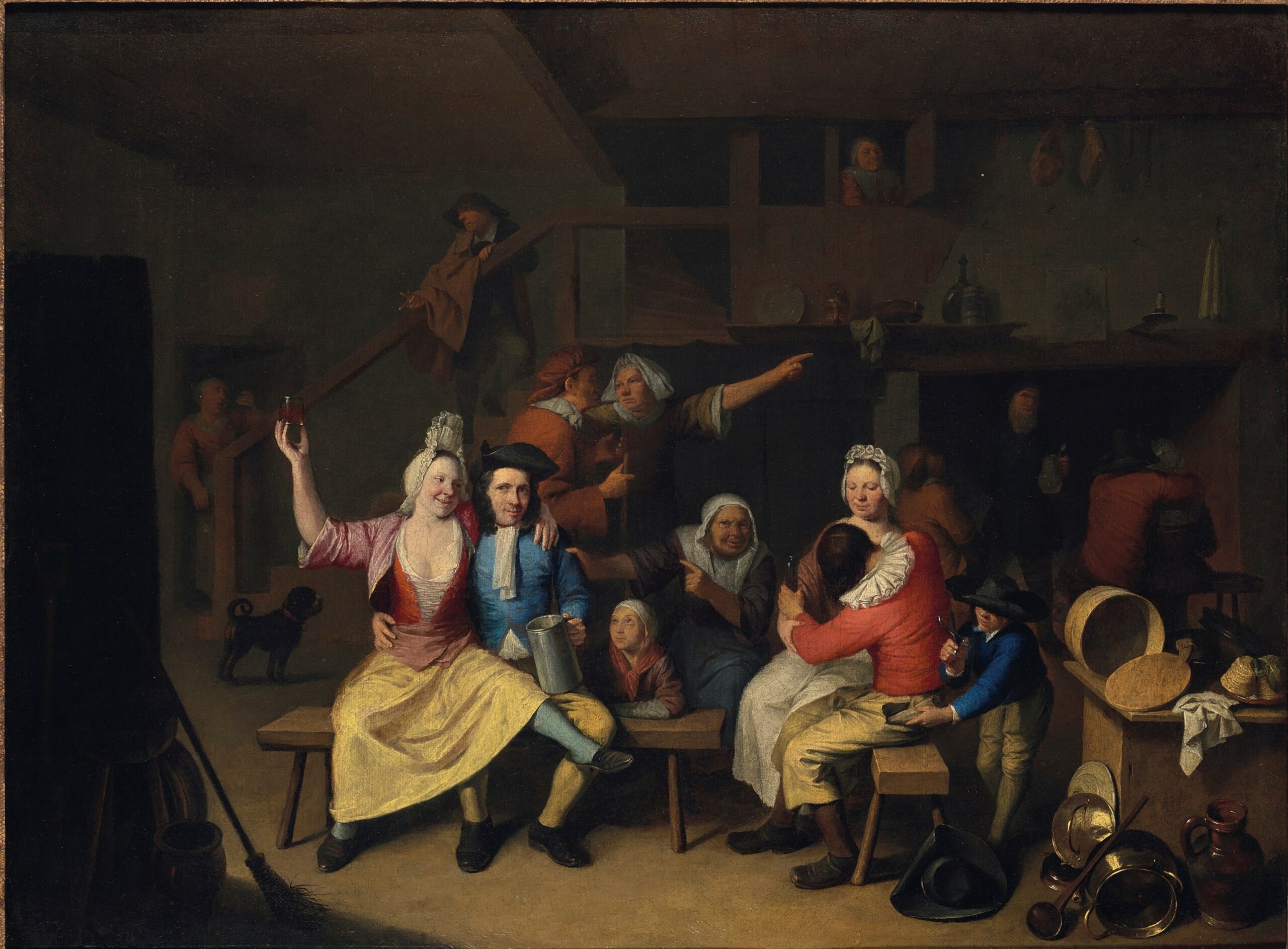
Stephanie’s informative essay reminded me immediately of a picture that she and I have discussed in the past. In this case, however, the painting — unlike the examples considered in her article — dates from the late seventeenth century and was executed by a now obscure, painter: Nicolaes van Haeften (c. 1663–1715), A Tavern Scene, signed and dated 1696 (fig. 2).37
Fig. 2. Nicolaes van Haeften, A Tavern Scene, 1696. Canvas, 47 x 62 cm. Private collection.
Van Haeften is no Hans von Aachen and certainly no Rembrandt, but his work is still fascinating. It is only in recent years that he has finally attracted well-deserved attention. As it turns out, this artist is an ancestor of the prominent old-master art dealer, Johnny van Haeften, who staged the first-ever Nicolaes van Haeften show at his former gallery on Duke Street in London during the summer of 2012: A Long-Neglected Master: Nicolaes van Haeften. At the core of this exhibition were the twenty-six assorted paintings and prints by the artist that his art-dealing descendent owns. Twenty-six is an impressive number because only thirty paintings and some forty-eight prints by the artist are known today.
Two years after the London exhibition, Fred Meijer published the first and, to date, only study of Van Haeften, in the form of a short article that appeared in a Festschrift.38 Despite consisting of only an eight-page text, Meijer’s article was groundbreaking in that it presented an informative survey of the artist’s life and career. The peripatetic Van Haeften was born in 1663 in the town of Gorinchem in the south-east of the Dutch Republic. Seven years later, in 1670, he moved with his parents to the city of Rotterdam. Van Haeften most likely received his artistic training there, presumably during the late 1670s. The heyday of Rotterdam’s artistic prominence lay between the years 1630 and 1670; in other words, it was already on the wane when Van Haeften began to prepare for his career.39 There were still a decent number of active painters in the town, many of whom specialised in genre paintings depicting peasants, which would become our master’s main subject matter.
The impact of seventeenth-century Flemish genre painting was also significant for Van Haeften’s future career. Rotterdam’s proximity to the Southern or Spanish Netherlands virtually guaranteed the relocation of Flemish painters, who decades earlier had helped to swell the numbers of resident artists, to this Dutch city. Moreover, the influence of such Flemish masters as Adriaen Brouwer and David Teniers the Younger would be keenly felt.40 Rotterdam thus developed a reputation for peasant imagery painted in the circle of the so-called ‘Dutch Teniers Group’, including, among others, Pieter de Bloot and Cornelis Saftleven.41 Saftleven was still alive when Van Haeften began his apprenticeship and, incidentally, both men had been born in Gorinchem. Regardless, we do not know where or with whom Van Haeften studied. Meijer has called attention to the similarities between Van Haeften’s art and that of Pieter Jacobsz Duyfhuysen.42 The latter died in 1677 when our artist was just fourteen years of age, but perhaps he received some rudimentary tutelage from that older master.
In 1690, when he was twenty-six or twenty-seven, Van Haeften moved to Antwerp, the principal centre for Flemish painting in the Spanish Netherlands. While his name is not found in the records of the Antwerp painters’ guild, one of his etchings thankfully provides evidence of his sojourn there because it is inscribed, ‘the first of my life in Antwerp’.43 No doubt, the impact of Flemish genre painting upon his work and that of his Rotterdam colleagues induced this move. Even so, Van Haeften was not finished traveling. In 1694 or 1695, he resettled permanently in Paris, working in the French capital until his death in 1715.44 In essence then, he is a Dutch painter merely by birth, because he practiced a Flemish style of painting primarily in the service of the Antwerp and Paris art markets.
Returning to the painting under consideration here, one can easily detect the artist’s appropriations of Brouwer’s well-known stylistic and iconographic prototypes. These include the box-like construction of the interior space with a peeping figure, in this instance, a taciturn old woman peering out of an upper-floor window, observing the boisterous shenanigans unfolding in the room below her. Van Haeften must have been particularly impressed with what might be termed the ‘psychological nuances’ that Brouwer explores through the ingenious facial and body language of his figures. A Tavern Scene is particularly masterful in its transient facial expressions, which serve so well to capture the rowdy atmosphere of this transgressive space. The foreground figures, all arrayed on two wooden benches, are wonderfully rendered with individualised faces, including the grinning, dishevelled prostitute, who leans against her similarly inebriated client.45 This man’s hat is askew; he holds an immense tankard in hand, while gazing directly at the viewer. Just to the right of this pair, an elderly woman points at the drunkard and, with a scowl, likewise addresses the viewer. In between them, a wistful young girl is deftly portrayed. Van Haeften has captured the innocence of childhood, as this girl stares in wonder at the dissolute adults seated beside her. Moving further to the right in the foreground, we encounter another prostitute who looks down dispassionately at a drunken, hatless man whose face is buried in her cleavage. Just below this pair, a boy, likely the woman’s accomplice, relieves her unfortunate client of some sort of object, perhaps his purse.
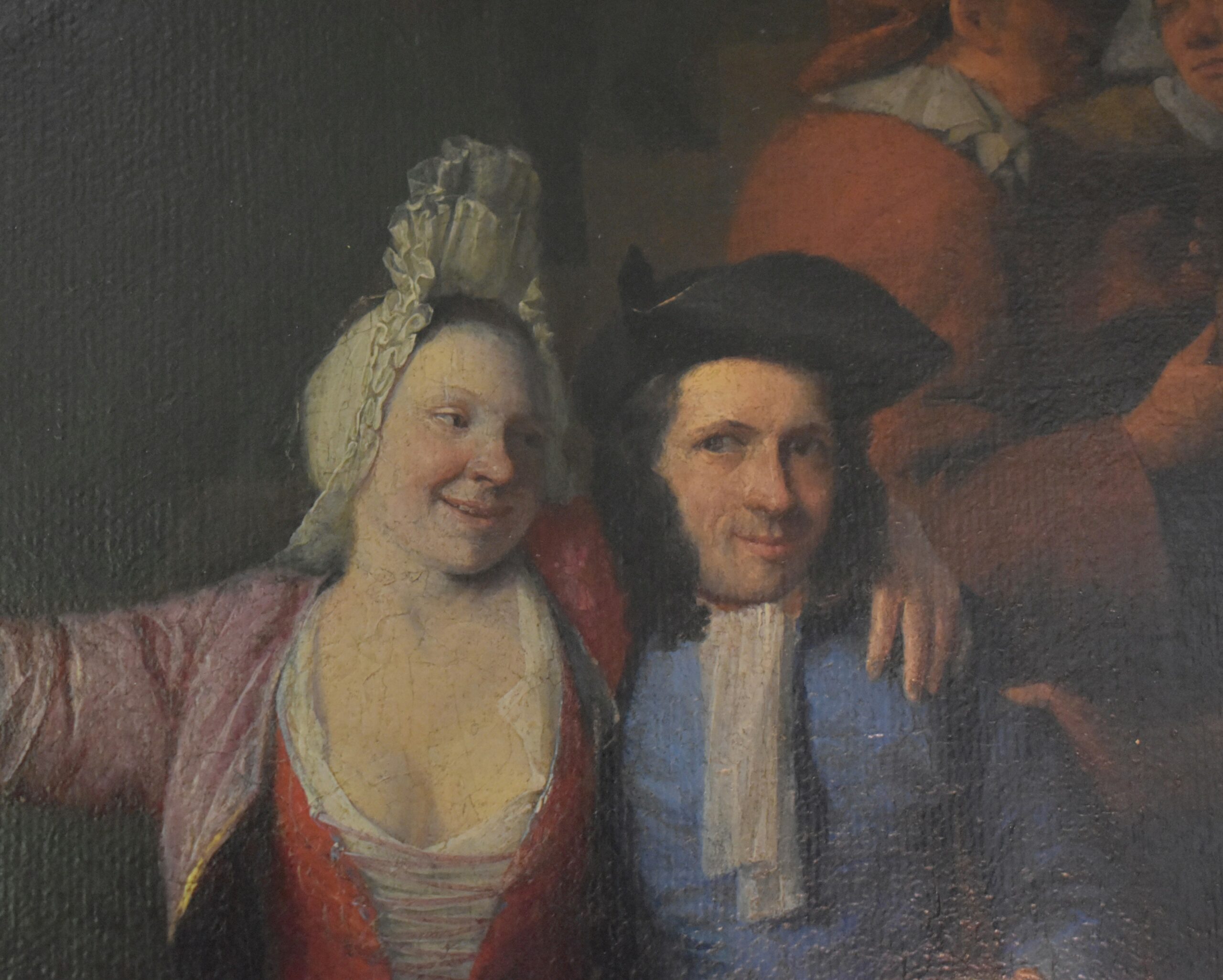
Fig. 3. Detail of Fig. 2.
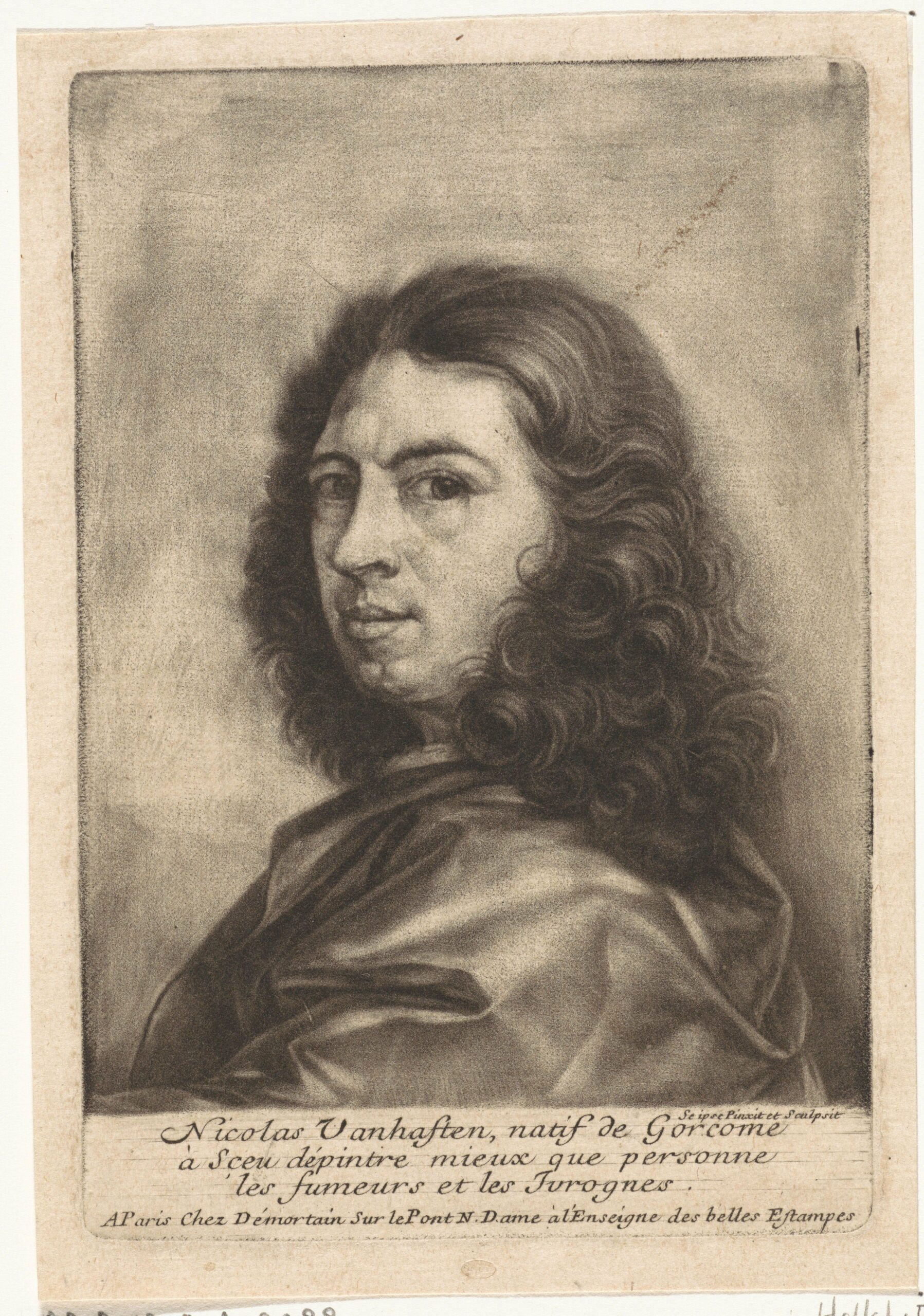
What has hitherto escaped notice is that the drunkard seated in the foreground is, in fact, a self-portrait of the artist. This is easily confirmed by comparing his face to that of his undated Self-Portrait mezzotint and engraving that was likely executed in the 1690s, so potentially concurrent with the canvas (figs. 3-4).46 Regardless of the Tavern Scene’s comparatively late date of creation, it participates in the artist-as-rogue self-portrait tradition whose early manifestations Stephanie so skilfully explored in her Von Aachen article. By engaging the viewer and carefully positioning himself just off-centre in this rambunctious tavern scene, Van Haeften declares his virtuosic command of rowdy, boisterous subject matter while implying, in a most entertaining fashion, his full participation in such disreputable goings-on.
Van Haeften’s specialty, low life subject matter, was appreciated in the Dutch Republic, but perhaps more so in Antwerp given that city’s longstanding pictorial traditions for showing peasants and other riffraff in art. This probably induced his move there in 1690. But by the late seventeenth century, the market for genre painting in Antwerp had experienced a decline in tandem with that of the city’s overall artistic and economic fortunes.47 While Van Haeften had probably encountered less competition there from rival painters, he did quit Antwerp, as we have seen, for Paris, around 1694-95. Perhaps the declining commercial possibilities in Antwerp, given its lacklustre economy, persuaded him to move on to one of Europe’s largest cities, where he could seek his fame and fortune. There, he could produce pictures with distinctly Netherlandish subject matter such as A Tavern Scene, which served to promote his artistic prowess and secure for him ample financial rewards.
Fig. 4. Nicolaes van Haeften, Self-Portrait, c. 1694-1715. Mezzotint and engraving, 144 x 97 mm. Rijksmuseum, Amsterdam, inv. no. RP-P-1879-A-3088.
Further light can be shed on this when one surveys the state of French painting around that time. During the late seventeenth century, it was dominated by the Royal Academy of Painting and Sculpture. Nearly all the major French painters of the day were trained at the academy and held memberships there, which was their principal means of securing commissions. With an aesthetic grounded in classical antiquity and Renaissance art, painters privileged the portrayal of Bible stories, mythology and ancient history since these were considered the most estimable subjects in art. Nevertheless, there existed in Paris a market for pictures of low-life subjects painted in a Flemish manner, regardless of the nationalities of their creators. The Parisian centre for this imagery was the Pont Notre-Dame and its surrounding neighbourhood, with most practitioners having memberships in the Académie de Saint-Luc.48
It is noteworthy that the business of the publisher and printer of Van Haeften’s portrait was located on this very same bridge (see fig. 4). This portrait print was therefore issued at the Parisian heart of this commercial enterprise associated with the production and distribution of ‘Flemish’ imagery. This neighbourhood was thus part of the lively market for both Dutch and Flemish art in Paris, fostered by foreign artists living there, but aided, in part, by the activities of professional art dealers.49
Van Haeften died in 1715, in the very same year as France’s longest serving monarch, the Sun King, Louis XIV (ruled 1643-1715). In the last years of that king’s reign, there was a general relaxing of artistic and aesthetic standards, which only accelerated following his death.50 This paved the way for artists such as Jean Antoine Watteau, whose wide-ranging, often Flemish-inspired genre paintings included bawdy portrayals of country folk.51 The market for low-life painting in early eighteenth-century France was never large, but it is nevertheless conceivable that Van Haeften played some role in its formation, even if it was only a minor one. In the end, Van Haeften emerges as a well-travelled artist who resided in three countries during his career. This fact and the multiple sources and subjects of his art suggest that Dutch seventeenth-century genre painting was neither a purely isolated phenomenon nor an exclusively Dutch one.52
In addition to Stephanie, I wish to thank Eric Jan Sluijter, Nicolette Sluijter-Seijffert and David de Witt for listening to my ideas concerning the attribution and identification presented here, offering support and feedback, and commenting constructively on an earlier draft of this article.
Frick Art Reference Library, as attributed to Titus van Rijn, Presumed Self-Portrait (https://library.frick.org/permalink/01NYA_INST/d73c5u/alma991000313219707141, website accessed 26 June 2024). The information on the mount mentions that the Frick’s reference worker, identified only by the initals DMH, had visited Mary van Berg at home in January 1959, where she saw the painting in the flesh. I thank Elizabeth Kobert, archivist of the Frick, for identifying DMH as Daphne Mebane Hoffman.
M. van Berg, The van Berg collection of paintings, New York 1947.
Sale New York, Christie’s, 9 June 1978, lot 44 (as attributed to Philips Koninck, Portrait of a Young Man, said to be Titus van Rijn).
W. Sumowski, Gemälde der Rembrandt-Schüler, 6 vols., Landau/Pfalz 1983-1994, 1 (1983), pp. 610, 616, 636, cat no. 327, ill., as Willem Drost.
J. Bikker, Willem Drost (1633-1659) : a Rembrandt pupil in Amsterdam and Venice, New Haven 2005, p. 150, cat. no. R18 (not by Drost). Known only from a black/white photo. Bikker mentions a note by Gerson at the RKD. He agrees with Sumowski that the identification of the sitter as Titus van Rijn cannot be substantiated. His remark that the work was probably cut down on the left and the bottom makes sense, insofar that the photo he consulted (and reproduced in his book) was cropped on both sides.
W. Liedtke, Dutch paintings in The Metropolitan Museum of Art, 2 vols., New York 2007, 2, pp. 687-692, cat. no. 157. E. van de Wetering, in: E. van de Wetering et al., A Corpus of Rembrandt Paintings, 6 vols., The Hague/Boston/London 1982-2014, 4 (2005), pp. 288-294, 517-525, cat. no 20; 6 (2014), p. 665, cat. no. 282.
Göteborg, Göteborgs Konstmuseum. See A. Blankert, M. Blokhuis, in: A. Blankert et al., Rembrandt : A Genius and his Impact, exh. cat. Melbourne, National Gallery of Victoria, Canberra, National Gallery of Australia 1997-1998, pp. 168-172, cat. no. 24 (c. 1662/65); P.C. Sutton, in: A.K. Wheelock, Jr., P.C. Sutton, Rembrandt’s Late Religious Portraits, exh. cat. Washington, National Gallery of Art, Los Angeles, J. Paul Getty Museum 2005, pp. 129-131, cat. no 17. Sutton compares the painting to works from 1661 but refers (note 3) to Blankert (in Melbourne/Canberra 1997-1998) and Giltaij (J. Giltaij, Rembrandt Rembrandt, exh. cat. Kyoto, Kyoto National Museum, Frankfurt, Städelsches Kunstinstitut 2002-2003, pp. 214-216, cat. no. 42) and follows them in dating the work 1662/65 (p. 131). Van de Wetering, in: Corpus 6 (2014), p. 658, cat. no. 272, dates the painting slightly earlier (N.B. Van de Wetering dates the supposed study for the work, cat. no. 271 (Copenhagen, Statens Museum) c. 1660).
Oil on panel, 71 x 56 cm., St. Petersburg State Hermitage Museum. The portrait’s date is difficult to decipher but was always read as 1666. Van de Wetering, in: Corpus 6 (2014), p. 636, cat. no. 250, proposed to read the date as 1656.
New York, Metropolitan Museum of Art.The small painting was rejected as autograph by Gerson in 1969. Van de Wetering, in: Corpus 6 (2014), p. 678, cat. no. 310 has included it again in Rembrandt’s oeuvre, suggesting its function as a preparatory study for the male figure in the Jewish Bride, following earlier scholarship. The dendrochronological report by Prof. Peter Klein states that an origin of the painting is plausible from 1658 onwards. See also Liedtke 2007, pp. 754-757, cat. no. 171, as ‘style of Rembrandt’, suggesting the possibility that the work is a tronie based on the Jewish Bride.
These four underworld paintings are considered his core oeuvre: The Sibyl shows Aeneas the Underworld (Charon’s Boat), c. 1620, panel, 93.5 x 124 cm, Museum De Lakenhal, Leiden, S 251; Aeneas taken by the Sibyl to the Underworld, c. 1620, canvas, 101.5 x 150 cm. Musée Royal des Beaux-Arts, Brussels, inv. no. 10241; Aeneas and Sibilla in the Underworld (Charon’s boat), c. 1620, canvas, 101 x 140 cm. National Museum in Gdansk, Gdansk, inv. no. 1936-7-4-2; Charon’s Boat with the Hellmouth and Seven Sins, c. 1620, panel, 28 x 88 cm. Rijksmuseum, Amsterdam, inv. no. SK-A-730. For Van Swanenburg’s hellish scenes, which include several others on the art market or in private collections, see Tania De Nile, “Rethinking Swanenburg: The Rise and Fortune of New Iconographies of the ‘Hell’ in Italy and the Northern Netherlands”, in Marije Osnabrugge ed., Questioning Pictorial Genres in Dutch Seventeenth-Century Definitions, Artistic Practices, Market & Society, Turnhout, 2021, pp. 291-309; and Tania De Nile, Fantasmagori. Streghe, demoni e tentazioni nell’arte fiamminga e olandese del Seicento, Rome 2023, pp. 204-214.
The Orpheus has been listed without attribution in print catalogues, and linked to Jacob van Swanenburg in two publications. M. D. Henkel, “Nederlandsche Ovidius-Illustraties van de 15e tot de 18e eeuw”, Oud Holland 39 (1921), pp. 149-187, esp. p. 170, attributed the engraving to Magdalena de Passe and the composition to Jacob in pl. 17; and Jan van der Waals, De Prentschat van Michiel Hinloopen (1619-1708), The Hague/ Amsterdam 1988, pp. 82 and 85, credited Jacob based on comparison to his hellish paintings.
R. E. O. Ekkart, Isaac Claesz. van Swanenburg, 1537-1614. Leids schilder en burgemeester, Zwolle 1998.
By 1603, Baldasar Corenzio incorporated these motifs in his frescoes in two Neapolitan churches, Santa Maria la Nova and Santa Maria delle Parete, Liveri; see De Nile, ‘Rethinking Swanenburg’ (see note 1), pp. 305-306, and Tania De Nile, ‘Un ‘Inferno’ su carta agli Uffizi. Intorno a uno studio inedito di Belisario Corenzio perh Santa Maria la Nova’, Horti Hesperidum 11: 2 (2021), pp. 173-201. In his frescoes of 1615 in Santi Eusebio e Vittoria, Peglio, Lombardy, Giovanni Maria Mauro della Rovere did the same; Tania De Nile presented Mauro’s Peglio frescoes at the Historians of Netherlandish Art Conference, Cambridge UK, July 12, 2024: ‘When the North met the south: the fortunate case of the nordic Hellmouth in the Italian frescoes of the Counter-Reformation’.
“Swanenburch te Leyde, in Helse spoken moy”: Abraham Bredius, “Het Schildersregister van Jan Sysmus, Stads-Doctor van Amsterdam”, Oud Holland 9 (1891), pp. 137-149, esp. p. 147.
For this category, see De Nile, Fantasmagorie, passim (see note 1).
Inventories with hellish scenes include these: 1624/12/01, inventory Michiel Corn. Wijtland’s widow, Leiden; 1640, Pietersz. van den Bosch sale, Leiden; 1640, inventory Jan Jansz. Orlers, Leiden; 17 September 1659, inventory Catherina Willems van Thoornvliet, Dirck Segersz van Campen’s widow, Leiden; 15 September 1666, inventory Jan Maire, Leiden; 1666, inventory Henric Bugge van Ring and Aeltge Henricx van Swieten, Leiden; 20 April 1673, inventory Maria Elandts, Laurens Borsman’s widow, The Hague; 27 April 1692, inventory Geertruijt Brasfer, Johan van der Chijs’s widow, Delft; see De Nile, “Rethinking Swanenburg” (see note 1), p. 308, note 69.
For this project, see Ilya Veldman, Crispijn de Passe and his progeny (1564-1670): a century of print production, trans. Michael Hoyle, Rotterdam 2001, pp. 287-290; Lisanne den Hartog, “Crispijn (II) and Magdalena de Passe’s Metamorphoses Series: A comparative study in printmaking”, MA Thesis, University of Amsterdam, 2023.
Pierre Du Ryer tr., Les metamorphoses d’Ovide, en latin et françois, divisées en XV. livres, avec de nouvelles explications historiques, Brussels 1677.
Van der Waals, “Prentschat” (see note 2), pp. 79-102.
The Orpheus is in Du Ryer, Les metamorphoses (see note 9), p. 309. The print is by Magdalena de Passe according to Henkel, “Nederlandsche Ovidius” (see note 2), p. 170; Den Hartog, Crispijn (II) and Magdalena de Passe’s Metamorphoses Series (see note 8), p. 77. It is attributed to Magdalena with a question mark by Van de Waals, in “Prentschat” (see note 2), p. 85; and the Rijksmuseum. Veldman does not group it with other prints by Magdalena, apparently attributing it to Crispijn de Passe II, in Crispijn de Passe (see note 8), pp. 287-290. If by Magdalena, the print would have been made before 1634, the year she married and ceased engraving.
In various forms, these are generic to hell scenes, and also appear in other renditions of Orpheus in the underworld, as in Pieter van der Borcht’s illustration, Ovid, Metamorphoses Expositae, Antwerp, 1591, pp. 240-241.
These three are in Gdansk, Brussels and Leiden.
Joost van Swanenburg (1577-1620) married Elisabeth van Veen, the niece of Otto van Veen. Her brother Simon van Veen Jr. married Divera van der Eem (c.1682); Divera’s sister Margaretha married Hendrick Bloemaert on October 1, 1631. In this way, the Bloemaert, Van Veen and Van Swanenburg families became related. R. E. O. Ekkart, “Familiekroniek van Heemskerck en van Swanenburg (2)”, Jaarboek Centraal Bureau voor Genealogie 33 (1979), pp. 44-75, esp. p. 70; M. G. Roethlisberger and M. J. Bok, Abraham Bloemaert and his sons, paintings and prints, 2 vols., Doornspijk,1993, vol. 2, pp. 590, 659-660.
Van der Waals, “Prentschat” (see note 2), p. 83; Du Ryer, Les metamorphoses (see note 9), p. 14.
These include Jupiter, Juno and Io, 1618, panel, 54.3 x 77.8 cm, London, National Gallery, inv. no. NG 6272; Bacchus and Ariadne, 1628, panel, 60 x 87 cm, Stockholm, University Art Collection, inv. no. 278, and two paintings of David and Uriah, 1611, oak, 51.1 x 61.3 cm, Detroit, Detroit Institute of Arts, inv. no. 60.63; 1619, panel, 42.8 x 63.3 cm. New York, The Leiden Collection, inv. no. PL-100.
Comparable to Jupiter are Lastman’s figures of Ahasuerus in the Feast of Esther, 1619, oak, 52 x 78 cm, Warsaw, National Museum, inv. no. M.Ob.558 MNW and David in David and Jonathan, 1620, panel, 40 x 59 cm. Moscow, Pushkin Museum; Jan Lievens’ Ahasuerus in the Feast of Esther, c. 1625, canvas, 130.8 x 163.8 cm, Raleigh NC, North Carolina Museum of Art, inv. no. 52.9.55, and Jan Tengnagel’s Cambyses in the Judgement of Cambyses, 1619, canvas, 111 x 151 cm, The Hague, private collection.
Jaco Rutgers and Tico Seifert generously shared their knowledge of this print with me, and this analysis of Lastman and Bailliu is gratefully indebted to Jaco.
Several sets of proofs must have been in circulation. One group of proof impressions was recently acquired by the Rijksmuseum (inv. nos. RP-P-2013-10-1 to 13), with contemporary inscriptions indicating the title and occasionally the engraver or inventor.
Rembrandt, Diana and Actaeon with Callisto and Nymphs, 1634, canvas, 73.5 x 93.5 cm. Anholt, Museum Wasserburg. The print Diana and Actaeon appears in Du Ryer, Les metamorphoses (see note 9), p. 83. Two painted copies are known that omit the Callisto scene, but in specific details both differ from the De Passe print; J. Bruyn et al., A Corpus of Rembrandt Paintings, 6 vols., The Hague 1982-2015, vol. 2, pp. 493-494, gives information: Emil Goldschmidt collection; sale, Berlin 27 April 1909, no. 55; and Wolverhampton, Wolverhampton Art Gallery.
Stephanie S. Dickey, ‘Strategies of Self-Portraiture from Hans von Aachen to Rembrandt’, in: Lubomír Konečný and Štěpán Vácha, eds., Hans von Aachen in Context: Proceedings of the International Conference, Prague 22-25 September 2010, Prague 2012, pp. 72-81.
Dickey, ‘Strategies of Self-Portraiture’ (see note 1), pp. 74-75, 77-78.
Dickey, ‘Strategies of Self-Portraiture’ (see note 1), pp. 76-78.
For the artist-as-rogue in seventeenth-century Dutch and Flemish art, see Ingrid A. Cartwright, ‘Hoe schilder hoe wilder: Dissolute Self-Portraits in Seventeenth-Century Dutch and Flemish Art’, PhD dissertation, University of Maryland, College Park 2007, http://hdl.handle.net/1903/7720.
Dickey, ‘Strategies of Self-Portraiture’ (see note 1), pp. 76-78.
Dickey, ‘Strategies of Self-Portraiture’ (see note 1), p. 80.
Van Haeften’s painting, now in a private collection, was acquired by its present owner at the anonymous sale, Paris (Christie’s), 15 September 2020, lot 53. It was shown in the exhibition Da hverdagen stjal billedet – i Holland og Danmark, Nivå: Nivaagaards Malerisamling, 28 January-16 June 2024.
Fred G. Meijer, ‘Nicolaes van Haeften, Prints and Paintings’, in: Edwin Buijsen et al., eds., Kunst op papier in de achttiende eeuw; Liber Amicorum aangeboden aan Charles Dumaster gelegenheid van zijn 65ste verjaardag, Zoetermeer 2014, pp. 142-153. The following remarks are heavily indebted to Meijer’s publication. He briefly discusses the painting under consideration here on p. 147
For a survey of painting in seventeenth-century Rotterdam, see Nora Schadee, ed., Rotterdamse meesters uit de Gouden Eeuw, exh. cat. Rotterdam: Historisch Museum Rotterdam, 1994.
For Teniers, see Margret Klinge and Dietmar Lüdke, eds., David Teniers der Jüngere 1610-1690: Alltag und Vergnügen in Flandern, exh. cat. Karlsruhe: Staatliche Kunsthalle Karlsruhe, 2005. For Brouwer, see Katrien Lichtert, ed., Adriaen Brouwer: Master of Emotions. Between Rubens and Rembrandt, exh. cat. Oudenaarde: MOU – Museum van Oudenaarde en de Vlaamse Ardennen, 2018.
For Saftleven, see Wolfgang Schulz, Cornelis Saftleven 1607-1681: Leben und Werke. Mit einem kritischen Katalog der Gemälde und Zeichnungen, Berlin and New York 1978.
Meijer, ‘Nicolaes van Haeften’ (see note 8), p. 142. For Duyfhuysen, see Willem L. van de Watering, ‘Pieter Duyfhuysen (1608-1677): een reconstructie van het oeuvre van een vergeten Rotterdamse schilder van boereninterieurs’, in: Henning Bock and Thomas W. Gaehtgens, eds., Holländische Genremalerei im 17. Jahrhundert: Symposium Berlin 1984, Jahrbuch Preussischer Kulturbesitz, Sonderband 4, Berlin 1987, pp. 357-383.
See Meijer, ‘Nicolaes van Haeften’ (see note 8), pp. 145-146, fig. 4, ‘het eersten van mijn leven tot antwerpen’.
Stephanie Levert, ‘Étrangers, mais habitués en cette ville de Paris’: Les artistes néerlandais à Paris (1550-1700). Une prosopographie, PhD dissertation, Utrecht University 2017, vol. 2, dossier prosopographique, s.v., Van Haeften, points out that Van Haeften returned to Antwerp at least once, in 1700, so possibly at other times as well.
On prostitution and its imagery in seventeenth-century Dutch art, see Lotte van de Pol, ‘The Whore, the Bawd, and the Artist: The Reality and Imagery of Seventeenth-Century Dutch Prostitution’, Journal of Historians of Netherlandish Art 2 (2010), no. 1-2, https://doi.org/10.5092/jhna.2010.2.1.3; Lotte van de Pol, The Burgher and the Whore: Prostitution in Early Modern Amsterdam, Oxford 2011. For the iconography of tavern, brothel and Prodigal Son, see Konrad Renger, Lockere Gesellschaft: Zur Ikonographie des Verlorenen Sohnes und von Wirtshausszenen in der niederländischen Malerei, Berlin 1970. For prostitution in fifteenth and sixteenth-century German and Netherlandish art, see the recent study by Frank Schmidt, Prostitution im Bild: zur visuellen Konstruktion von Bordelldarstellungen in der frühen Neuzeit, Regensburg 2025. A comparable study of this scope on prostitution in seventeenth-century Dutch art is still lacking.
This print (fig. 4), bears the address of the Paris publisher Gilles de Mortain, and includes an inscription recording the artist’s native city. More significantly, it lists smokers and drinkers as the specialities in which he excelled, just like Brouwer before him: ‘Nicolas Vanhaeften, natif de Gorcome / à Sçeu dépintre mieux que personne / les fumeurs et les Ivrognes’. Meijer, ‘Nicolaes van Haeften’ (see note 8), p.151 note 2, transcribes the last word as ‘Turognes’, which he translates as tronies, which is not correct; the old French word for drunkards is ivrognes. Von Aachen’s picture, and for that matter, Rembrandt’s as well, feature the artists’ wives playing the roles of their painted companions; both works are often said to portray the Prodigal Son in a tavern. It is tempting to recognize the facial features of Van Haeften’s wife, Marie Michelle de Vuoll, in the foreground prostitute in his Tavern Scene, but this cannot be ascertained because there is no known portrayal of her.
For overviews of Antwerp’s economic and artistic fortunes, see Herman van der Wee and Jan Materné, ‘Antwerp as a World Market in the Sixteenth and Seventeenth Centuries’, in: Jan van der Stock, ed., Antwerp, Story of a Metropolis: 16th-17th Century, exh. cat. Antwerp: Hessenhuis, 1993, pp. 19-31; and Arnout Balis, ‘Antwerp, Foster-Mother of the Arts: Its Contribution to the Artistic Culture in Europe in the Seventeenth Century’, in: Van der Stock, Antwerp, pp. 115-127.
See Guillaume Glorieux, ‘Les peintres-marchands du pont Notre-Dame: une production organisée de tableaux ‘flamands’ pour Lille et sa région’, in: Sophie Raux, ed., Collectionner dans les Flandres et la France du Nord au XVIIIe siècle, Villeneuve d’Ascq 2005, pp. 139–145; Mickaël Szanto, ‘The Pont Notre-Dame, Heart of the Picture Trade in France (16th–18th Centuries)’, in: Neil De Marchi and Sophie Raux, eds., Moving Pictures. Intra-European Trade in Images, 16th–18th Centuries, Turnhout 2014, pp. 77–91. My thanks to Jochem van Eijsden for his insights in this regard.
For Dutch and Flemish artists living in Paris, see Levert, Étrangers (see note 14). Documentation of the dealings of Paris-based art dealers with Dutch and Flemish painters survives; see, for example, Neil De Marchi and Hans J. Van Miegroet, ‘Novelty and Fashion Circuits in the Mid-Seventeenth-Century Antwerp-Paris Art Trade’, Journal of Medieval and Early Modern Studies 28 (1998), pp. 201-246; and Wayne Franits, Godefridus Schalcken: A Late 17th-Century Dutch Painter in Pursuit of Fame and Fortune, London 2023, p. 55.
See Jay Caplan, In the King’s Wake: Post-Absolutist Culture in France, Chicago and London 1999; and Julie Anne Plax, Watteau and the Cultural Politics of Eighteenth-Century France, Cambridge and New York 2000. See also the literature cited in note 21 below.
M. Crawford Volk, Rubenism, Bell Gallery, Brown University (Providence, RI, 1975), pp. 109-145; Oliver T. Banks, Watteau and the North: Studies in the Dutch and Flemish Baroque Influence on French Rococo Painting, New York and London 1977; François Moureau, ‘Watteau in His Time’, in: Margaret Morgan Grasselli and Pierre Rosenberg, Watteau 1684-1721, exh. cat. Washington: National Gallery of Art, 1984, pp. 469-506; Donald Posner, Antoine Watteau, Ithaca 1984, pp. 12-107; and Hervé Oursel et al., Au temps de Watteau, Fragonard et Chardin: Les Pays-Bas et les peintres français du XVIIIe siècle, exh. cat. Lille: Musée des Beaux-Arts, 1985. See also the literature cited in note 20 above.
See Karolien De Clippel, ‘Two Sides of the Same Coin? Genre Painting in the North and South during the Sixteenth and Seventeenth Centuries’, Simiolus 32 (2006), no. 1, pp. 17-34; Krista De Jonge, Rudi Ekkart and Tom Verschaffel, with Karolien De Clippel, ‘La fracture entre les Pays-Bas du Nord et les Pays-Bas du Sud’, Perspective (2011), no. 2, pp. 627-640, https://doi.org/10.4000/perspective.697; and Karolien De Clippel and Filip Vermeylen, ‘In Search of Netherlandish Art: Cultural Transmission and Artistic Exchanges in the Low Countries, an Introduction’, De Zeventiende Eeuw 31 (2015), no. 1, pp. 2-17. The last is the introduction to a special issue of the journal devoted to cultural transmission and artistic exchange, mainly between the northern and southern Low Countries.
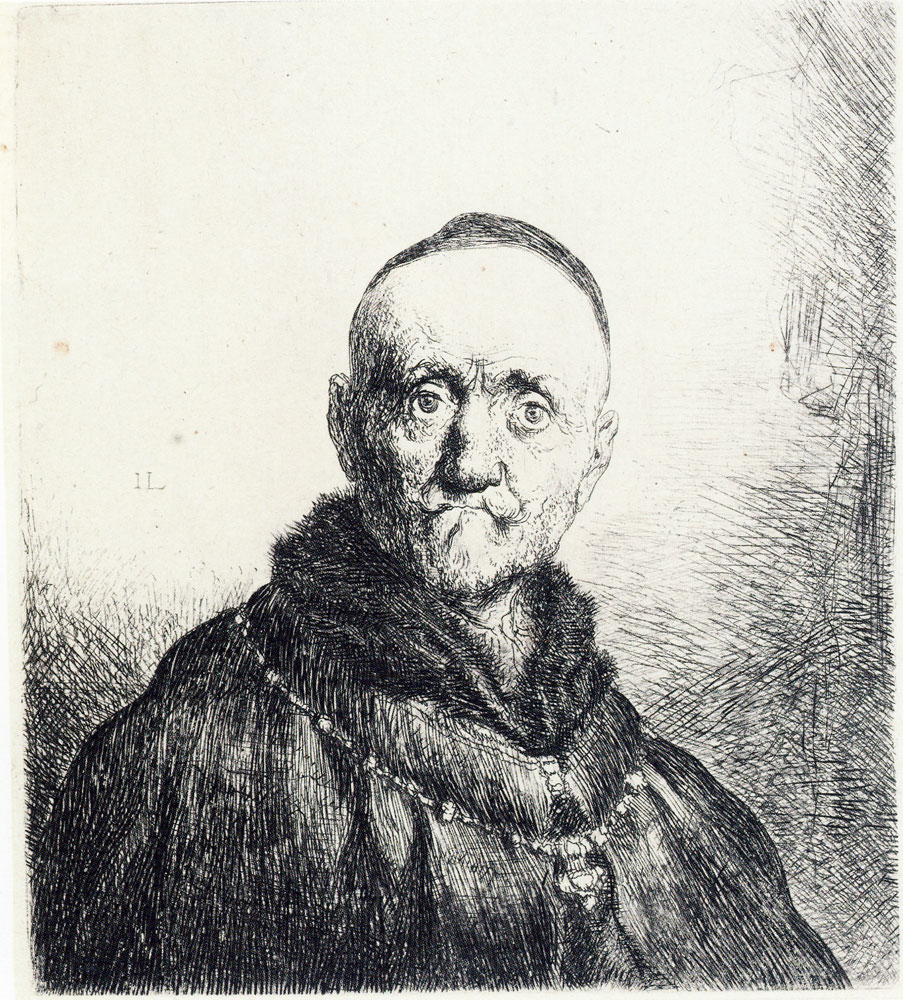
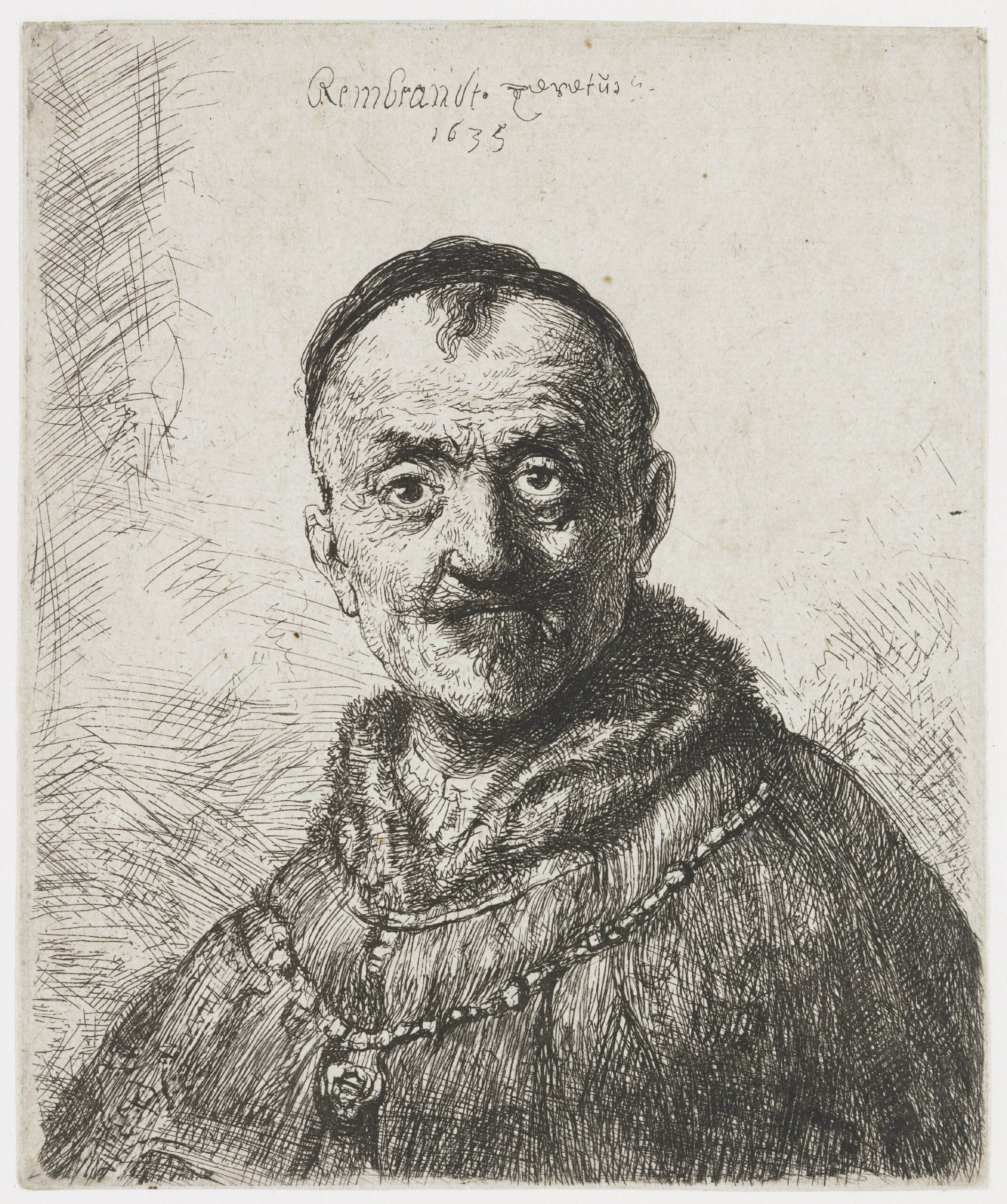
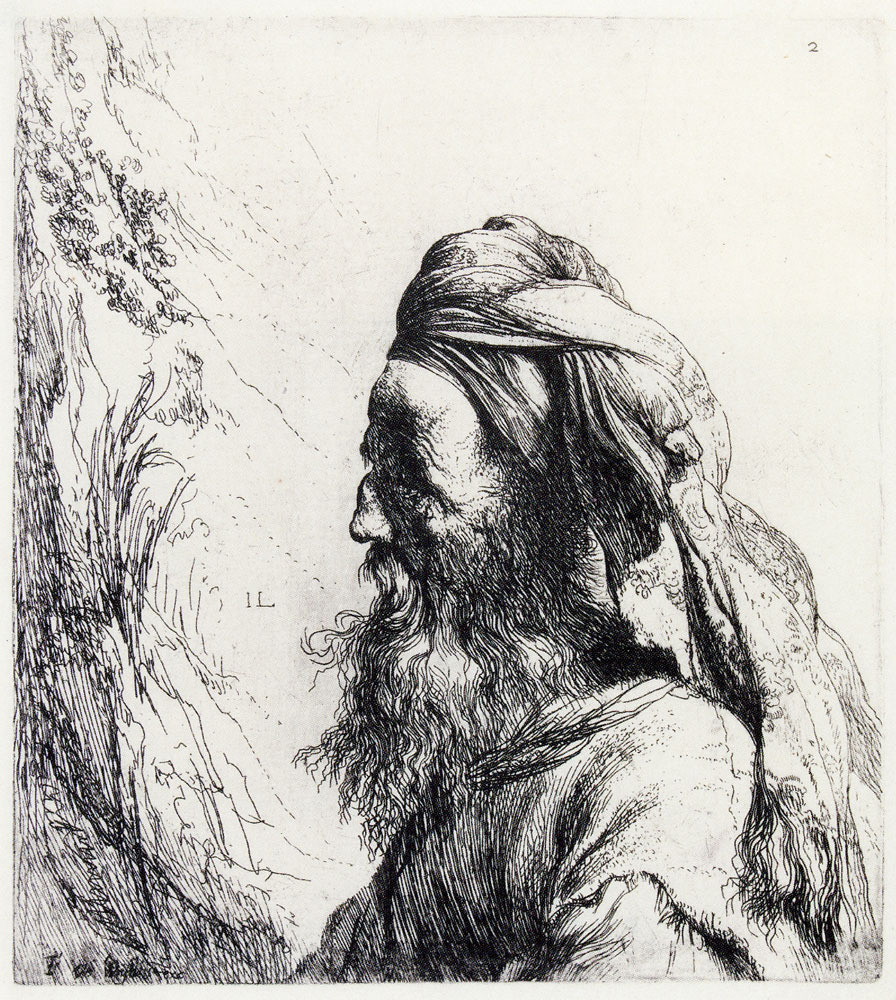
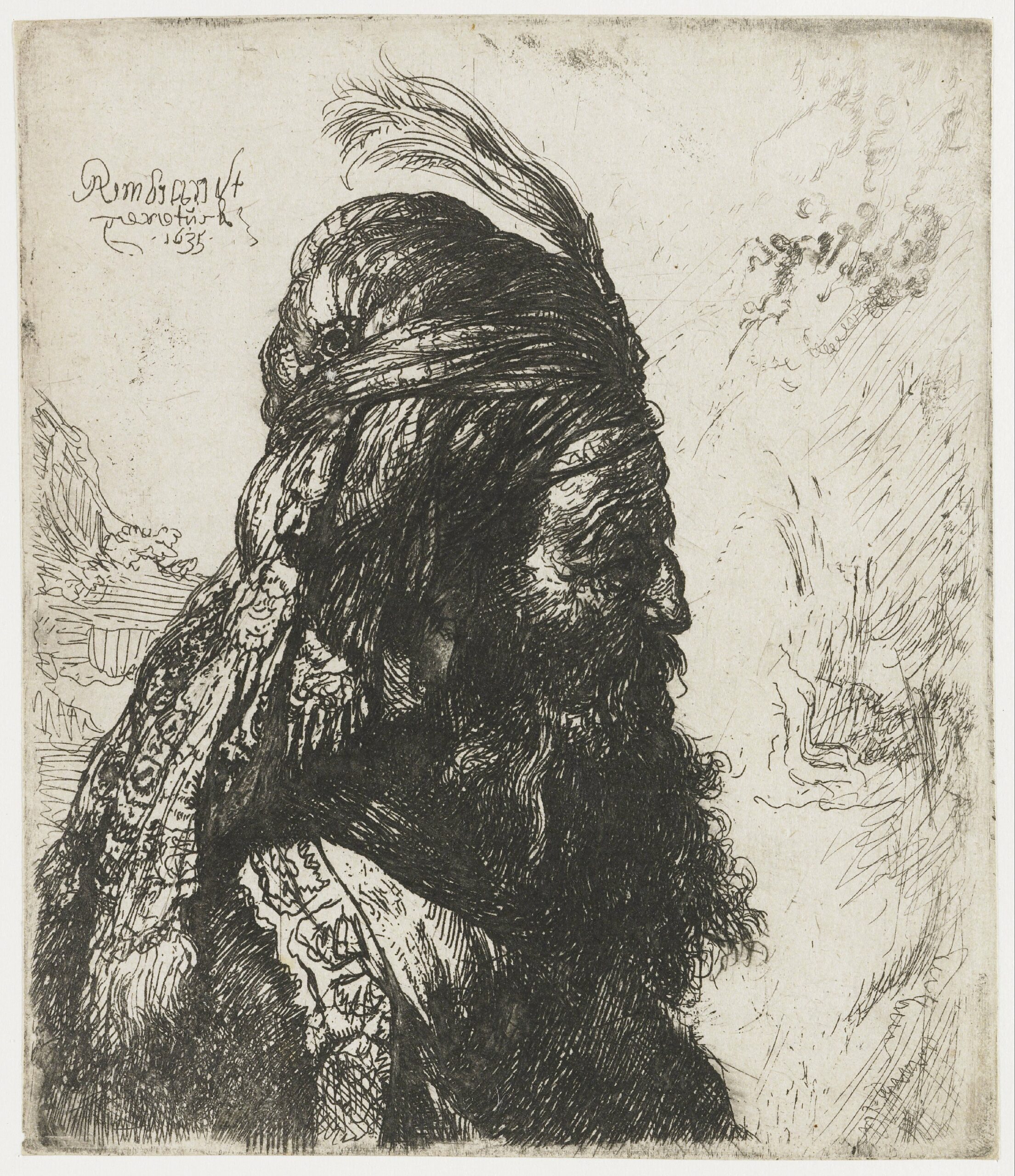
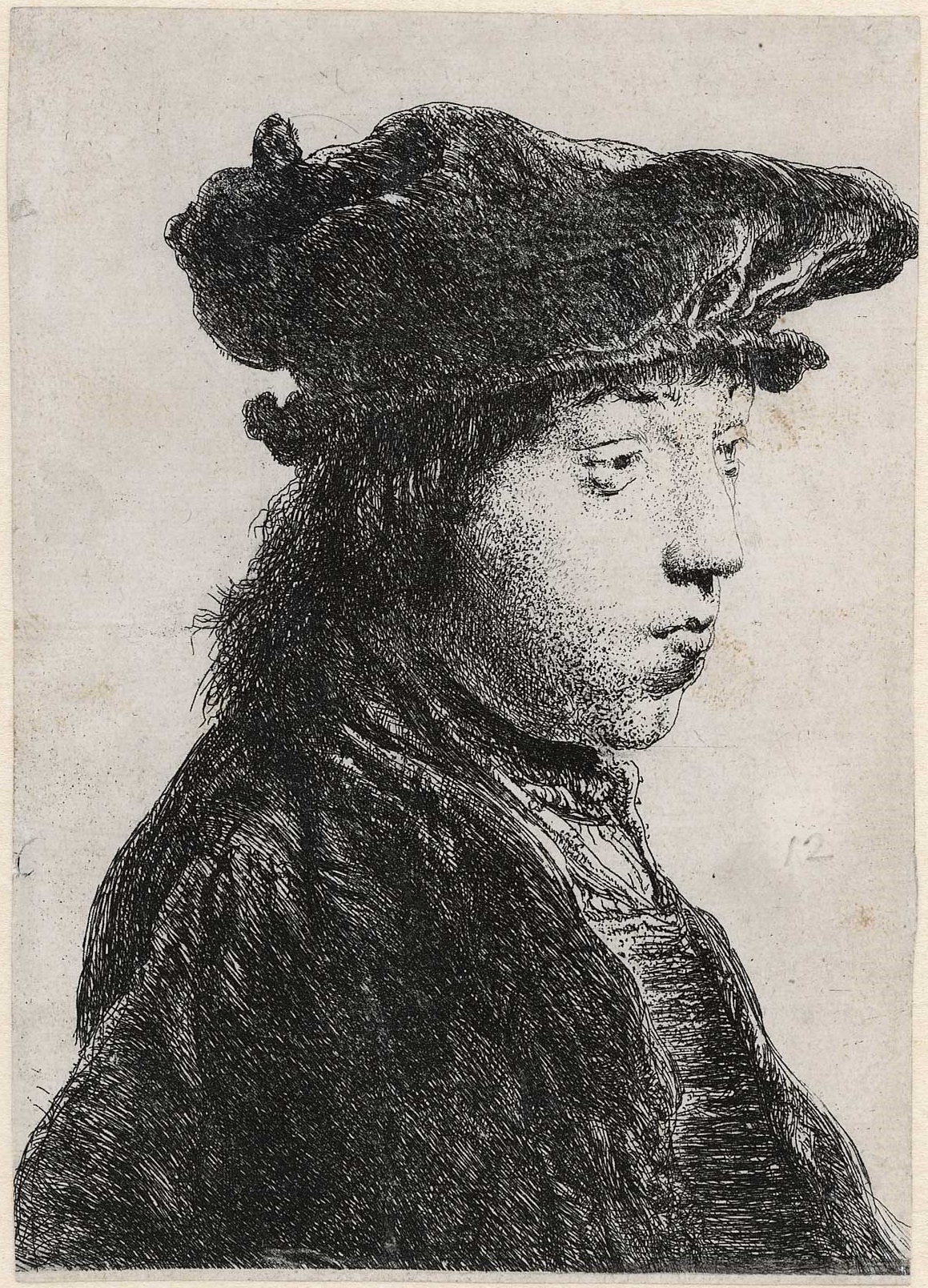
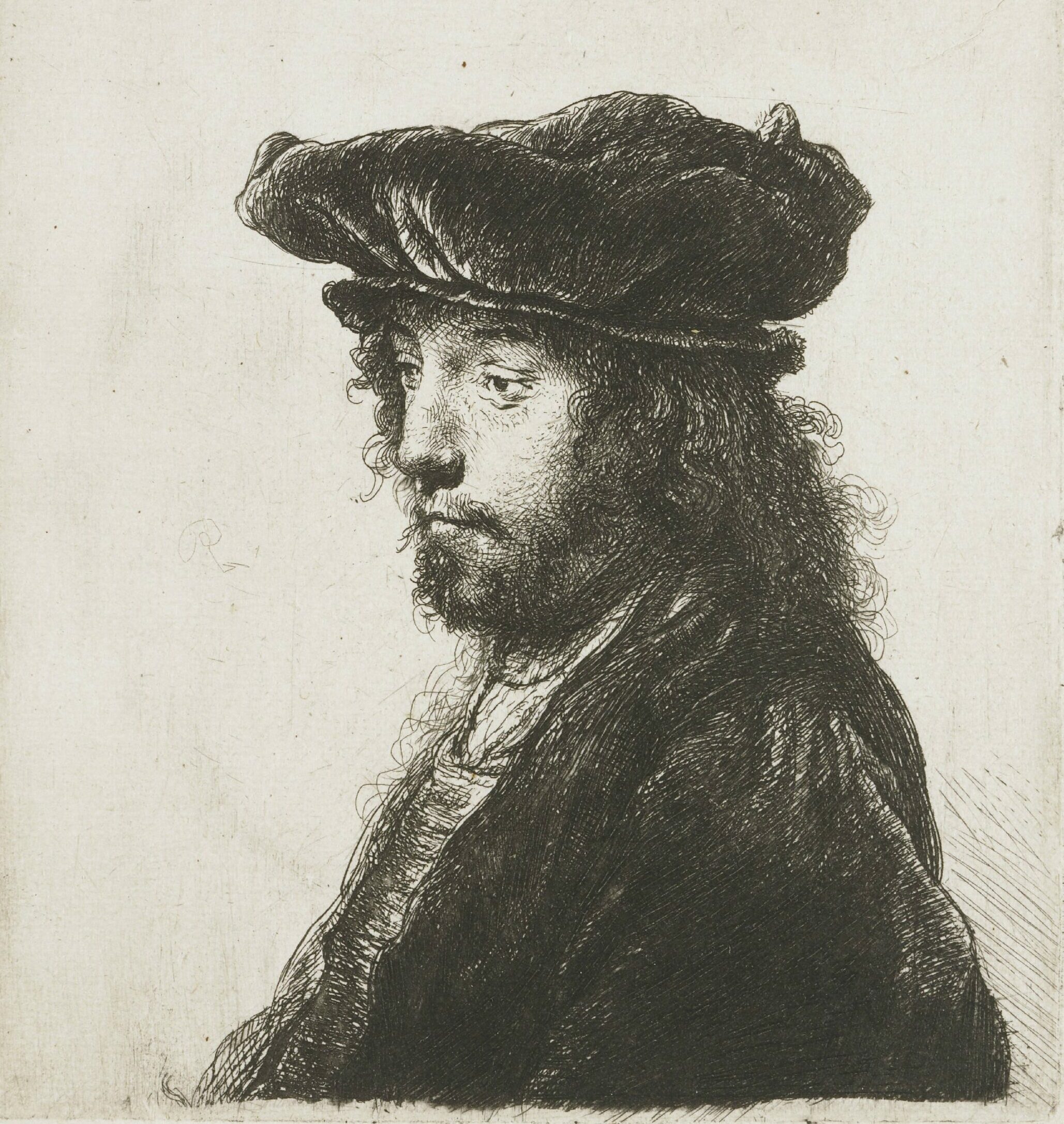
Stephanie Dickey and I began as young scholars and friends with dissertations and then books on related aspects of Rembrandt’s unparalleled exploration of human nature and character. She focused on the portraits and I on the self-portraits, each seeing Rembrandt in his social and cultural context, while resisting the trend to normalize his exceptional talent and production.53 It is thus in the spirit of scholarly friendship that I offer a brief speculation on a subject that Stephanie and I have pondered: the evolving nature of the artistic friendship and rivalry between Rembrandt (July 1606-1669) and Jan Lievens (October 1607-1674).54 Specifically, I look at a group of prints on which we have both commented: The instance in which Rembrandt geretuckert—retouched, or improved upon—four etchings by Lievens to create the Oriental Heads, as they have been titled since 1751, if not before(figs. 1-6).55 Like their models, Rembrandt’s Four Heads, as they are called in this essay, are not portraits but tronies, literally ‘heads’ and the period’s term for expressive character types.56All four of Rembrandt’s tronies are historicized. Because of their exotic turbans, the Second and Third Heads would have been described as Turcks, or Turkish, a catch-all term used to describe garments and objects from the Ottoman empire that pictorially signified the ancient and Biblical worlds.57The Fourth Head, a young man wearing a beret and sixteenth-century garb, though not as obviously foreign or exotic as the others, would have nonetheless evoked the past.58
Fig 1. Jan Lievens, Old Man Facing Forward, c. 1631. Etching, 164 x 144 mm. Rijksmuseum, Amsterdam, inv. no. RP-P-OB-12.559.
Fig. 2. Rembrandt, The First Oriental Head, 1635. Etching with drypoint, 151 x 125 mm. Rijksmuseum, Amsterdam, inv. no. RP-P-1961-1162.
Fig. 3. Jan Lievens, Bearded Man in a Turban, Facing Left, c. 1631. Etching, 160 x 143 mm. Rijksmuseum, Amsterdam, inv. no. RP-P-OB-12.553
Fig. 4. Rembrandt, The Third Oriental Head, 1635. Etching, 156 x 134 mm. Rijksmuseum, Amsterdam, inv. no. RP-P-1961-1164.
From Lievens’s prototypes Rembrandt etched, on new plates, unusually exact but substantially altered versions, which appear in reverse when printed. Rembrandt at once imitated Lievens’s prints and made a display of emulating—improving upon and surpassing—them by labeling his prints ‘Rembrandt geretuckert.’ The singularity of Rembrandt’s series of retouchings has prompted critics to want to understand his motivation.59 It may be that they arose in part from Rembrandt’s inclination to teach.60 Revisiting Carel Vosmaer’s 1868 assessment of the prints—with their ‘inscriptions énigmatique’—as student work improved by Rembrandt, Erik Hinterding has raised the possibility that they came about as a workshop teaching exercise, perhaps with student assistance.61 Yet, qualitatively and stylistically, their handling and tonality throughout are distinctively Rembrandt’s.62The Four Heads have also been framed as a critique directed at Lievens and an escalation of the longstanding rivalry between the two; if Rembrandt associated the term ‘geretuckert’ with teaching, perhaps it here cast Lievens as in need of a lesson from the master.63
This essay argues that whatever their initial relation to Lievens, and whether or not a pupil witnessed or participated in their execution, making the prints was a learning experience for Rembrandt. However they came about, the Four Heads was a project in transformative emulation driven by Rembrandt’s artistic ambitions, and growing recognition, as a history painter.
Fig 5. Jan Lievens, Young Man in a Velvet Beret, c. 1631. Etching, 132 x 94 mm. Museum Rembrandthuis, Amsterdam, inv. no. 241.
Fig 6. Rembrandt, The Fourth Oriental Head, c. 1635. Etching, 158 x 135 mm. RP-P-1961-1165.
Around 1631, while both were still in Leiden, Lievens had etched a number of tronies, including seven heads of men, which he initialed and numbered as a series.64 In 1635, once he was fully established in Amsterdam and after Lievens had left for England and Antwerp, Rembrandt made what would be, in effect, his own series of four historicized tronies. Both series were displays of virtuosity; Rembrandt’s appropriation was also a demonstration of emulation. He chose as his models the three most fanciful and exotic of Lievens’s set of seven, the Old Man Facing Forward (fig. 1) and two that epitomize the descriptor ‘Turcksetronie’, An Oriental Man, Facing Right and Bearded Man in a Turban, Facing Left (fig. 3). That Rembrandt left aside from Lievens’s series two rather ordinary bearded men wearing undefined clothing and two younger men in contemporary dress suggests that his interest was specifically in the most intriguing of the exotic, weathered figures. A stand-alone print of the same date, Lievens’s Young Man in a Velvet Beret (fig. 5), inspired the Fourth Head (fig. 6).
Rembrandt called his appropriation of Lievens’s work ‘retouching.’ The First Head is based on Lievens’s Old Man Facing Forward (figs. 1 and 2); its prominent signature ‘Rembrandt geretuc 1635’ claims authorship. The second is inscribed ‘Rembrandt geretuckert’ and the third ‘Rembrandt geretuck 1635.’ The Fourth Head is faintly signed only with the monogram ‘Rt.’ The meaning and connotations of the terms ‘retouching’ and ‘retouched’ have been debated. On the one hand, as Gerard de Lairesse describes painting practice, retouching (retocqueeren) was used for the final, finishing layer of paint that was applied after the dead coloring (doodverven) and the working-up (opschilderen).65 But ‘retouched’ also meant reworked, which is apparently how it was used in the 1656 inventory of Rembrandt’s possessions.66 There, the descriptor ‘geretukeert’ adds to the evidence that Rembrandt assisted the notary with drawing up the inventory; only he could have had the depth of knowledge of his works and collection.67 A still life, four vanitas paintings, and a painting of a Samaritan are ‘van Rembrantgeretukeert’ or ‘geretukeert van Rembrant.’ Without knowing the works, we can only speculate as to what exactly this entailed.
However, in the case of the Four Heads, we can see what Rembrandt meant by geretuckert. His understanding of the term and practice of ‘retouching’ are evident in how he reworked the images to embolden the drawing, as well as to improve them aesthetically, by making them more artful compositionally and stylistically. More importantly, he crafted the heads into more powerful, more dignified figures—figures better suited to the gravity and nobility of history paintings. The nature of the retouchings suggests that Lievens’s prints presented Rembrandt with a specific challenge that was important to his own creative endeavors.
Though reversed in the printing, Rembrandt’s Four Heads are at once virtually identical to and significantly different from their models. They began as near exact, to-scale copies of Lievens’s heads, which Rembrandt appears to have achieved by tracing the outlines and primary compositional lines of Lievens’s figures. Using impressions of Lievens’s prints, he incised their designs into the grounds of new plates.68 These Rembrandt then reworked—some heavily, some more economically—with etching (and drypoint) to improve upon the compositions, enhance costumes, refine the shading, and develop the rendering of faces, to give each figure greater presence. The resulting obviously derivative appropriations of Lievens’s originals have been variously characterized as ‘freely interpreted copies’, imitations, appreciative emulations, and cruel critiques.69 Although Rembrandt’s retouchings have been referred to as ‘small changes’, their impact is transformational.70
Rembrandt approached each tronie by Lievens as if it presented a different specific challenge. Lievens’s Old Man Facing Forward offered the opportunity to rework—while critiquing—a man’s expressive character (fig. 1). To make the First Head, the only frontal tronie of the four, which is signed ‘Rembrandt geretuc 1635’, Rembrandt started with Lievens’s exact design. Then, with considerable intervention, he transformed a grand and rather pensive looking elderly man in a skullcap into a stronger, more present, and engaged character. By adding a lock of hair and enhancing the shading, Rembrandt eases the broad, blank expanse of the model’s brightly lit forehead. He deftly alters the expressive qualities of specific facial features. By furrowing the brow and raising the eyebrows, Rembrandt suggests thought, even a habit of thinking, rather than uncertainty. By lifting the model’s droopy eyelids and defining the pupils, Rembrandt turns what he might have seen as a vacant stare into an intelligent direct gaze. A toothless downturned mouth made more horizontal becomes more resolute. In the area of the costume, relatively little was done beyond darkening the lines of the fur cloak and chain with medallion, which Rembrandt would use in the Polish Nobleman of 1637 in Washington. The result is that a historicized figure is imagined as having greater dignity and strength of character.
In the case of Lievens’s Bust of an Oriental Man, Facing Right, Rembrandt seems to have been dissatisfied with a composition that appeared to oppress an elderly man. For his Second Head, which is signed ‘Rembrandt geretuckert’ but not dated, Rembrandt made relatively few strategic changes. He subtly revised the outline of the man’s headdress to correct what may have seemed to him a lopsided composition. And, with minor alterations, he improved the man’s unsatisfactory expression. Tronies are often called expression studies, although many rely on evocative character types, costumes, and lighting, rather than expressive faces.71 Especially in profile, expression is difficult to convey. Here, however, Lievens’s old man bodily evokes resignation. The diagonal slope of the back of the headdress, combined with forward concentration of the fur atop the turban, push the man forward and weigh down his head. This effect is compounded by his downcast eye, slack chin, and darkly wattled neck. Rembrandt, by adding height to the headdress, crafted a more balanced composition. He dignified an elderly man by defining his chin and lifting his downward gaze.
The Third Head, with its exotic flowing Turckse headgear of the sort that led these to be called ‘Oriental heads’, is the most dramatic of Rembrandt’s transformation of Lievens’s tronies (figs. 3 and 4). As with the others, Lievens’s Bearded Man in a Turban, Facing Left must have seemed compositionally weak and unsatisfactory in expression. But, above all, it presented Rembrandt with a costume challenge. Just as the Second Head improved upon a too slight exotic headdress, so this print transformed a rather ephemeral turban—its thin silk leaves the man’s neck exposed—into something grander. A heightened, thickened turban, of more substantial fabric, now adorned with a slim plume, gives the figure greater dignity and presence. Rembrandt reworked, or corrected, the visage with surer drawing and by shading the man’s features. He lessened the intensity of the light that Lievens directed, rather randomly, at the side of the man’s forehead. He also strengthened the profile, removed the prominent wrinkle from the side of the face, and enriched the wispy beard, thereby countering Lievens’s rough, earthy historicism. Turban and costume are elaborated, embellished, and unified, while the background is reduced to enhance concentration on the figure. Rembrandt’s retouching monumentalizes Lievens’s tronie.
Lievens’s Young Man in a Velvet Beret, the only young man of the four and the least exotic of the prints, presented a different challenge, correcting a weak, arguably poorly drawn face (fig. 5). The Fourth Head has been described as Rembrandt’s appreciative aging of a charming young man, rather than a critique of its model (fig. 6). However, this transformation, too, reveals Rembrandt’s inclination to improve upon—to correct—a countenance that seemed not just youthful but also formless and somewhat sullen. This Rembrandt responded to by reworking the eyes, with their oddly enlarged upper and lower eyelids, to create a sense of thoughtfulness. He strengthened the nose. By giving the youth a beard and moustache, he hid his weakest features—his puffy low cheeks and small, pouty lips—and brought his chin forward. Enhancing the young man’s hair accentuated his newly defined profile. His beret is reworked to make its lines stronger and more purposeful. With the adjustment of facial features and addition of a beard, Rembrandt, in the Fourth Head, turned a youth into a man of character and thought.
Taken together, Rembrandt’s unusual—and one might conclude, unusually harsh—retouchings amounted to an exercise in public rivalry, whether mean-spirited or in the spirit of sanctioned borrowing, of imitation and emulation. It is well known that Rembrandt’s and Lievens’s early artistic development in Leiden was a shared experience of extreme co-creativity.72 They must have started as teenagers with one of the closest friendships imaginable. Working together, challenging each other, each became the other’s teacher. As Constantijn Huygens, who treated them as a pair, put it, ‘these two owe nothing to their teachers but everything to their aptitude.’73 Elsewhere I have suggested that we might gain insight into the driving power of intense, friendly rivalry through a contemporary example, Just Kids, Patti Smith’s account of her artistic friendship with Robert Mapplethorpe.74
However competitive each was by nature, their rivalry would have been reinforced by an ideology of imitation and emulation that was rooted in antiquity and operative in Pieter Lastman’s teaching and Constantijn Huygens’s understanding of the progress of art.75 Over the course of five years, the slightly younger, precocious Lievens initially took the lead, and attracted more attention from Leiden patrons.76 However, the better educated latecomer Rembrandt quickly caught up and overtook Lievens. Like many an early bloomer, Lievens would have a solid career but did not live up to expectations. A preferred narrative that treats them as happy co-workers and artistic equals is summed up in Horst Gerson’s claim that ‘their collaboration must have been extremely close, with neither playing second fiddle.’77 Another narrative suggests they had a falling out, or that their working relationship became fraught. Writing around 1630, Constantijn Huygens suggested that Rembrandt may have been the nicer fellow and that Lievens was becoming a bit insufferable: ‘My only objection is his stubbornness, which derives from an excess of self-confidence. He either roundly rejects all criticism or, if he acknowledges its validity, takes it in bad spirit. This bad habit, harmful at any age, is especially pernicious in youth.’78 Years later, Sir Robert Kerr, 1st Earl of Ancram, whose portrait Lievens painted in 1654, would describe Lievens in a letter to his son: ‘he hath so high conceit of himself that he thinks there is none to be compared with him in all Germany, Holland, nor the rest of the 17 provinces.’79 Perhaps Rembrandt had tired of Lievens by the time the two left Leiden, Lievens for London, where he stayed from about 1632 until 1635, and Rembrandt for Amsterdam.
Arguably more consequential was Huygens’s judgment that Rembrandt was ‘superior to Lievens in his sure touch and liveliness of emotions’, with the result that ‘in what we are accustomed to calling history pieces, [Lievens], his astonishing talent notwithstanding, is unlikely to match Rembrandt’s vivid invention.’80 There may have come a point, as they painted the same subjects neck-in-neck, when it became clear that Rembrandt was the better history painter, and that Lievens had a streak of melodrama. Perhaps it was with Lievens’s Philistine with the exaggerated expression and theatrical gesture in the large, three-quarter-length Samson and Delilah of about 1627 (Rijksmuseum, Amsterdam), or with Lazarus’s upstretched, disembodied arms in Lievens’s Raising of Lazarus of 1631 (Brighton, Brighton Museum and Art Gallery), or with the paintings of Christ on the Cross that were likely made in competition for the Passion Series.81 Huygens’s account, and Rembrandt’s circumstances circa 1635, suggest that, in reimagining Lievens’s tronies as suitably ennobled historicized figures, Rembrandt seized an opportunity to prove his history painting credentials.
In 1635, Rembrandt was poised to become a history painter. His reputation, after all, was solidified in Amsterdam with the portraits he painted while in the employ of Hendrik Uylenburgh. In 1634, Rembrandt had married Saskia and, in 1635, they moved to the NieuweDoelenstraat, where Rembrandt opened his own studio and shifted his attention from portraiture toward large, dramatic histories, such as Belshazzar’s Feast (National Gallery, London) and the Sacrifice of Isaac (Hermitage, St. Petersburg). That same year, arguably with a purpose comparable to that which prompted the Four Heads, he made several drawings in emulation of Leonardo’s Last Supper; it is hard to imagine him inscribing these prominently signed, loose, creative copies ‘geretuckert.’82 Rembrandt’s learning from Leonardo plays out in the composition and groups of conversing figures in the Wedding Feast of Samson (Gemäldegalerie, Dresden), of 1638. This lavish Old Testament scene would catch the eye of Philips Angel, who, in his enumeration of the virtues required of a painter addressed to the Leiden painters in 1641, described it as a model of ‘the adornment of our work’, of accurate costuming and staging, that arises from a painter’s knowledge of history. Notably, Angel praised Rembrandt’s distinctive choice to represent figures reclining on small beds at the table, like the ancients, ‘as is still customary in those countries under the Turks.’83
From beginning to end of his career, Rembrandt was constantly, and in infinitely varied ways, imitating, emulating, and taking inspiration from works by other artists, mostly from the past but some his contemporaries. In no other instance, however, did he start by exactly copying, probably tracing, another artist’s work, which he appropriated as his own by violating the original. Years later, in the 1650s, Rembrandt would make corrections on his pupils’ drawings, as when he redrew and enlarged the angel in Constantijn van Renesse’sAnnunciation (Staatliche Museen, Berlin). Perhaps based on his experience training with Rembrandt,Samuel van Hoogstraten recommended this teaching practice so that students could improve themselves (datzedezelve…verbeeteren).84 Yet this was correcting in the studio, teaching on the spot, in relative private, to encourage a student to be bolder. Rembrandt did, however, commit a singular and more radical repurposing—perhaps a violation—of another’s work in his transformation, in about 1653, of Hercules Segers’s plate for Tobias and the Angel into The Flight into Egypt. That Segers, who had a profound impact on Rembrandt’s art, was no longer around to take offense, and that the 1656 inventory of Rembrandt’s collection includes eight paintings by Segers, suggests Rembrandt’s motivation for reworking the plate may have been artistic.
The inventory also lists, in the sijdelcaemer, paintings of the raising of Lazarus by Lievens and Rembrandt; presumably these were the pictures they had made in competition with each other in 1631 and 1632. The extent to which Rembrandt’s Raising of Lazarus was a reworking of Lievens’s is beyond the scope of this essay.85 Why Rembrandt displayed them in his house is beyond our ken. Even though Rembrandt also owned several landscapes by Lievens, which probably dated from the 1640s, we can only wonder, fruitlessly, whether the two remained friendly rivals or devolved into frenemies. Likewise, we cannot know whether Rembrandt’s Four Heads were received in their time, and especially by Lievens, as a public chiding or appreciative emulations. And we can only speculate as to whether they arose out of some personal, perhaps ungenerous inclination to upstage Lievens or, conceivably, in response to a challenge from Lievens.
But, turning to the works themselves, we see a different, perhaps more grounded story. With Lievens abroad—out of sight and perhaps out of mind—the retouchings of Lievens’s tronies emerge more forcefully as Rembrandt’s responses to a series of challenges in artistic expression. With each intervention, Rembrandt furthered his art and cast himself as the creator of figures with the human dignity and gravitas necessary for the invention of histories.
In addition to Stephanie, I wish to thank Eric Jan Sluijter, Nicolette Sluijter-Seijffert and David de Witt for listening to my ideas concerning the attribution and identification presented here, offering support and feedback, and commenting constructively on an earlier draft of this article.
Frick Art Reference Library, as attributed to Titus van Rijn, Presumed Self-Portrait (https://library.frick.org/permalink/01NYA_INST/d73c5u/alma991000313219707141, website accessed 26 June 2024). The information on the mount mentions that the Frick’s reference worker, identified only by the initals DMH, had visited Mary van Berg at home in January 1959, where she saw the painting in the flesh. I thank Elizabeth Kobert, archivist of the Frick, for identifying DMH as Daphne Mebane Hoffman.
M. van Berg, The van Berg collection of paintings, New York 1947.
Sale New York, Christie’s, 9 June 1978, lot 44 (as attributed to Philips Koninck, Portrait of a Young Man, said to be Titus van Rijn).
W. Sumowski, Gemälde der Rembrandt-Schüler, 6 vols., Landau/Pfalz 1983-1994, 1 (1983), pp. 610, 616, 636, cat no. 327, ill., as Willem Drost.
J. Bikker, Willem Drost (1633-1659) : a Rembrandt pupil in Amsterdam and Venice, New Haven 2005, p. 150, cat. no. R18 (not by Drost). Known only from a black/white photo. Bikker mentions a note by Gerson at the RKD. He agrees with Sumowski that the identification of the sitter as Titus van Rijn cannot be substantiated. His remark that the work was probably cut down on the left and the bottom makes sense, insofar that the photo he consulted (and reproduced in his book) was cropped on both sides.
W. Liedtke, Dutch paintings in The Metropolitan Museum of Art, 2 vols., New York 2007, 2, pp. 687-692, cat. no. 157. E. van de Wetering, in: E. van de Wetering et al., A Corpus of Rembrandt Paintings, 6 vols., The Hague/Boston/London 1982-2014, 4 (2005), pp. 288-294, 517-525, cat. no 20; 6 (2014), p. 665, cat. no. 282.
Göteborg, Göteborgs Konstmuseum. See A. Blankert, M. Blokhuis, in: A. Blankert et al., Rembrandt : A Genius and his Impact, exh. cat. Melbourne, National Gallery of Victoria, Canberra, National Gallery of Australia 1997-1998, pp. 168-172, cat. no. 24 (c. 1662/65); P.C. Sutton, in: A.K. Wheelock, Jr., P.C. Sutton, Rembrandt’s Late Religious Portraits, exh. cat. Washington, National Gallery of Art, Los Angeles, J. Paul Getty Museum 2005, pp. 129-131, cat. no 17. Sutton compares the painting to works from 1661 but refers (note 3) to Blankert (in Melbourne/Canberra 1997-1998) and Giltaij (J. Giltaij, Rembrandt Rembrandt, exh. cat. Kyoto, Kyoto National Museum, Frankfurt, Städelsches Kunstinstitut 2002-2003, pp. 214-216, cat. no. 42) and follows them in dating the work 1662/65 (p. 131). Van de Wetering, in: Corpus 6 (2014), p. 658, cat. no. 272, dates the painting slightly earlier (N.B. Van de Wetering dates the supposed study for the work, cat. no. 271 (Copenhagen, Statens Museum) c. 1660).
Oil on panel, 71 x 56 cm., St. Petersburg State Hermitage Museum. The portrait’s date is difficult to decipher but was always read as 1666. Van de Wetering, in: Corpus 6 (2014), p. 636, cat. no. 250, proposed to read the date as 1656.
New York, Metropolitan Museum of Art.The small painting was rejected as autograph by Gerson in 1969. Van de Wetering, in: Corpus 6 (2014), p. 678, cat. no. 310 has included it again in Rembrandt’s oeuvre, suggesting its function as a preparatory study for the male figure in the Jewish Bride, following earlier scholarship. The dendrochronological report by Prof. Peter Klein states that an origin of the painting is plausible from 1658 onwards. See also Liedtke 2007, pp. 754-757, cat. no. 171, as ‘style of Rembrandt’, suggesting the possibility that the work is a tronie based on the Jewish Bride.
These four underworld paintings are considered his core oeuvre: The Sibyl shows Aeneas the Underworld (Charon’s Boat), c. 1620, panel, 93.5 x 124 cm, Museum De Lakenhal, Leiden, S 251; Aeneas taken by the Sibyl to the Underworld, c. 1620, canvas, 101.5 x 150 cm. Musée Royal des Beaux-Arts, Brussels, inv. no. 10241; Aeneas and Sibilla in the Underworld (Charon’s boat), c. 1620, canvas, 101 x 140 cm. National Museum in Gdansk, Gdansk, inv. no. 1936-7-4-2; Charon’s Boat with the Hellmouth and Seven Sins, c. 1620, panel, 28 x 88 cm. Rijksmuseum, Amsterdam, inv. no. SK-A-730. For Van Swanenburg’s hellish scenes, which include several others on the art market or in private collections, see Tania De Nile, “Rethinking Swanenburg: The Rise and Fortune of New Iconographies of the ‘Hell’ in Italy and the Northern Netherlands”, in Marije Osnabrugge ed., Questioning Pictorial Genres in Dutch Seventeenth-Century Definitions, Artistic Practices, Market & Society, Turnhout, 2021, pp. 291-309; and Tania De Nile, Fantasmagori. Streghe, demoni e tentazioni nell’arte fiamminga e olandese del Seicento, Rome 2023, pp. 204-214.
The Orpheus has been listed without attribution in print catalogues, and linked to Jacob van Swanenburg in two publications. M. D. Henkel, “Nederlandsche Ovidius-Illustraties van de 15e tot de 18e eeuw”, Oud Holland 39 (1921), pp. 149-187, esp. p. 170, attributed the engraving to Magdalena de Passe and the composition to Jacob in pl. 17; and Jan van der Waals, De Prentschat van Michiel Hinloopen (1619-1708), The Hague/ Amsterdam 1988, pp. 82 and 85, credited Jacob based on comparison to his hellish paintings.
R. E. O. Ekkart, Isaac Claesz. van Swanenburg, 1537-1614. Leids schilder en burgemeester, Zwolle 1998.
By 1603, Baldasar Corenzio incorporated these motifs in his frescoes in two Neapolitan churches, Santa Maria la Nova and Santa Maria delle Parete, Liveri; see De Nile, ‘Rethinking Swanenburg’ (see note 1), pp. 305-306, and Tania De Nile, ‘Un ‘Inferno’ su carta agli Uffizi. Intorno a uno studio inedito di Belisario Corenzio perh Santa Maria la Nova’, Horti Hesperidum 11: 2 (2021), pp. 173-201. In his frescoes of 1615 in Santi Eusebio e Vittoria, Peglio, Lombardy, Giovanni Maria Mauro della Rovere did the same; Tania De Nile presented Mauro’s Peglio frescoes at the Historians of Netherlandish Art Conference, Cambridge UK, July 12, 2024: ‘When the North met the south: the fortunate case of the nordic Hellmouth in the Italian frescoes of the Counter-Reformation’.
“Swanenburch te Leyde, in Helse spoken moy”: Abraham Bredius, “Het Schildersregister van Jan Sysmus, Stads-Doctor van Amsterdam”, Oud Holland 9 (1891), pp. 137-149, esp. p. 147.
For this category, see De Nile, Fantasmagorie, passim (see note 1).
Inventories with hellish scenes include these: 1624/12/01, inventory Michiel Corn. Wijtland’s widow, Leiden; 1640, Pietersz. van den Bosch sale, Leiden; 1640, inventory Jan Jansz. Orlers, Leiden; 17 September 1659, inventory Catherina Willems van Thoornvliet, Dirck Segersz van Campen’s widow, Leiden; 15 September 1666, inventory Jan Maire, Leiden; 1666, inventory Henric Bugge van Ring and Aeltge Henricx van Swieten, Leiden; 20 April 1673, inventory Maria Elandts, Laurens Borsman’s widow, The Hague; 27 April 1692, inventory Geertruijt Brasfer, Johan van der Chijs’s widow, Delft; see De Nile, “Rethinking Swanenburg” (see note 1), p. 308, note 69.
For this project, see Ilya Veldman, Crispijn de Passe and his progeny (1564-1670): a century of print production, trans. Michael Hoyle, Rotterdam 2001, pp. 287-290; Lisanne den Hartog, “Crispijn (II) and Magdalena de Passe’s Metamorphoses Series: A comparative study in printmaking”, MA Thesis, University of Amsterdam, 2023.
Pierre Du Ryer tr., Les metamorphoses d’Ovide, en latin et françois, divisées en XV. livres, avec de nouvelles explications historiques, Brussels 1677.
Van der Waals, “Prentschat” (see note 2), pp. 79-102.
The Orpheus is in Du Ryer, Les metamorphoses (see note 9), p. 309. The print is by Magdalena de Passe according to Henkel, “Nederlandsche Ovidius” (see note 2), p. 170; Den Hartog, Crispijn (II) and Magdalena de Passe’s Metamorphoses Series (see note 8), p. 77. It is attributed to Magdalena with a question mark by Van de Waals, in “Prentschat” (see note 2), p. 85; and the Rijksmuseum. Veldman does not group it with other prints by Magdalena, apparently attributing it to Crispijn de Passe II, in Crispijn de Passe (see note 8), pp. 287-290. If by Magdalena, the print would have been made before 1634, the year she married and ceased engraving.
In various forms, these are generic to hell scenes, and also appear in other renditions of Orpheus in the underworld, as in Pieter van der Borcht’s illustration, Ovid, Metamorphoses Expositae, Antwerp, 1591, pp. 240-241.
These three are in Gdansk, Brussels and Leiden.
Joost van Swanenburg (1577-1620) married Elisabeth van Veen, the niece of Otto van Veen. Her brother Simon van Veen Jr. married Divera van der Eem (c.1682); Divera’s sister Margaretha married Hendrick Bloemaert on October 1, 1631. In this way, the Bloemaert, Van Veen and Van Swanenburg families became related. R. E. O. Ekkart, “Familiekroniek van Heemskerck en van Swanenburg (2)”, Jaarboek Centraal Bureau voor Genealogie 33 (1979), pp. 44-75, esp. p. 70; M. G. Roethlisberger and M. J. Bok, Abraham Bloemaert and his sons, paintings and prints, 2 vols., Doornspijk,1993, vol. 2, pp. 590, 659-660.
Van der Waals, “Prentschat” (see note 2), p. 83; Du Ryer, Les metamorphoses (see note 9), p. 14.
These include Jupiter, Juno and Io, 1618, panel, 54.3 x 77.8 cm, London, National Gallery, inv. no. NG 6272; Bacchus and Ariadne, 1628, panel, 60 x 87 cm, Stockholm, University Art Collection, inv. no. 278, and two paintings of David and Uriah, 1611, oak, 51.1 x 61.3 cm, Detroit, Detroit Institute of Arts, inv. no. 60.63; 1619, panel, 42.8 x 63.3 cm. New York, The Leiden Collection, inv. no. PL-100.
Comparable to Jupiter are Lastman’s figures of Ahasuerus in the Feast of Esther, 1619, oak, 52 x 78 cm, Warsaw, National Museum, inv. no. M.Ob.558 MNW and David in David and Jonathan, 1620, panel, 40 x 59 cm. Moscow, Pushkin Museum; Jan Lievens’ Ahasuerus in the Feast of Esther, c. 1625, canvas, 130.8 x 163.8 cm, Raleigh NC, North Carolina Museum of Art, inv. no. 52.9.55, and Jan Tengnagel’s Cambyses in the Judgement of Cambyses, 1619, canvas, 111 x 151 cm, The Hague, private collection.
Jaco Rutgers and Tico Seifert generously shared their knowledge of this print with me, and this analysis of Lastman and Bailliu is gratefully indebted to Jaco.
Several sets of proofs must have been in circulation. One group of proof impressions was recently acquired by the Rijksmuseum (inv. nos. RP-P-2013-10-1 to 13), with contemporary inscriptions indicating the title and occasionally the engraver or inventor.
Rembrandt, Diana and Actaeon with Callisto and Nymphs, 1634, canvas, 73.5 x 93.5 cm. Anholt, Museum Wasserburg. The print Diana and Actaeon appears in Du Ryer, Les metamorphoses (see note 9), p. 83. Two painted copies are known that omit the Callisto scene, but in specific details both differ from the De Passe print; J. Bruyn et al., A Corpus of Rembrandt Paintings, 6 vols., The Hague 1982-2015, vol. 2, pp. 493-494, gives information: Emil Goldschmidt collection; sale, Berlin 27 April 1909, no. 55; and Wolverhampton, Wolverhampton Art Gallery.
Stephanie S. Dickey, ‘Strategies of Self-Portraiture from Hans von Aachen to Rembrandt’, in: Lubomír Konečný and Štěpán Vácha, eds., Hans von Aachen in Context: Proceedings of the International Conference, Prague 22-25 September 2010, Prague 2012, pp. 72-81.
Dickey, ‘Strategies of Self-Portraiture’ (see note 1), pp. 74-75, 77-78.
Dickey, ‘Strategies of Self-Portraiture’ (see note 1), pp. 76-78.
For the artist-as-rogue in seventeenth-century Dutch and Flemish art, see Ingrid A. Cartwright, ‘Hoe schilder hoe wilder: Dissolute Self-Portraits in Seventeenth-Century Dutch and Flemish Art’, PhD dissertation, University of Maryland, College Park 2007, http://hdl.handle.net/1903/7720.
Dickey, ‘Strategies of Self-Portraiture’ (see note 1), pp. 76-78.
Dickey, ‘Strategies of Self-Portraiture’ (see note 1), p. 80.
Van Haeften’s painting, now in a private collection, was acquired by its present owner at the anonymous sale, Paris (Christie’s), 15 September 2020, lot 53. It was shown in the exhibition Da hverdagen stjal billedet – i Holland og Danmark, Nivå: Nivaagaards Malerisamling, 28 January-16 June 2024.
Fred G. Meijer, ‘Nicolaes van Haeften, Prints and Paintings’, in: Edwin Buijsen et al., eds., Kunst op papier in de achttiende eeuw; Liber Amicorum aangeboden aan Charles Dumaster gelegenheid van zijn 65ste verjaardag, Zoetermeer 2014, pp. 142-153. The following remarks are heavily indebted to Meijer’s publication. He briefly discusses the painting under consideration here on p. 147
For a survey of painting in seventeenth-century Rotterdam, see Nora Schadee, ed., Rotterdamse meesters uit de Gouden Eeuw, exh. cat. Rotterdam: Historisch Museum Rotterdam, 1994.
For Teniers, see Margret Klinge and Dietmar Lüdke, eds., David Teniers der Jüngere 1610-1690: Alltag und Vergnügen in Flandern, exh. cat. Karlsruhe: Staatliche Kunsthalle Karlsruhe, 2005. For Brouwer, see Katrien Lichtert, ed., Adriaen Brouwer: Master of Emotions. Between Rubens and Rembrandt, exh. cat. Oudenaarde: MOU – Museum van Oudenaarde en de Vlaamse Ardennen, 2018.
For Saftleven, see Wolfgang Schulz, Cornelis Saftleven 1607-1681: Leben und Werke. Mit einem kritischen Katalog der Gemälde und Zeichnungen, Berlin and New York 1978.
Meijer, ‘Nicolaes van Haeften’ (see note 8), p. 142. For Duyfhuysen, see Willem L. van de Watering, ‘Pieter Duyfhuysen (1608-1677): een reconstructie van het oeuvre van een vergeten Rotterdamse schilder van boereninterieurs’, in: Henning Bock and Thomas W. Gaehtgens, eds., Holländische Genremalerei im 17. Jahrhundert: Symposium Berlin 1984, Jahrbuch Preussischer Kulturbesitz, Sonderband 4, Berlin 1987, pp. 357-383.
See Meijer, ‘Nicolaes van Haeften’ (see note 8), pp. 145-146, fig. 4, ‘het eersten van mijn leven tot antwerpen’.
Stephanie Levert, ‘Étrangers, mais habitués en cette ville de Paris’: Les artistes néerlandais à Paris (1550-1700). Une prosopographie, PhD dissertation, Utrecht University 2017, vol. 2, dossier prosopographique, s.v., Van Haeften, points out that Van Haeften returned to Antwerp at least once, in 1700, so possibly at other times as well.
On prostitution and its imagery in seventeenth-century Dutch art, see Lotte van de Pol, ‘The Whore, the Bawd, and the Artist: The Reality and Imagery of Seventeenth-Century Dutch Prostitution’, Journal of Historians of Netherlandish Art 2 (2010), no. 1-2, https://doi.org/10.5092/jhna.2010.2.1.3; Lotte van de Pol, The Burgher and the Whore: Prostitution in Early Modern Amsterdam, Oxford 2011. For the iconography of tavern, brothel and Prodigal Son, see Konrad Renger, Lockere Gesellschaft: Zur Ikonographie des Verlorenen Sohnes und von Wirtshausszenen in der niederländischen Malerei, Berlin 1970. For prostitution in fifteenth and sixteenth-century German and Netherlandish art, see the recent study by Frank Schmidt, Prostitution im Bild: zur visuellen Konstruktion von Bordelldarstellungen in der frühen Neuzeit, Regensburg 2025. A comparable study of this scope on prostitution in seventeenth-century Dutch art is still lacking.
This print (fig. 4), bears the address of the Paris publisher Gilles de Mortain, and includes an inscription recording the artist’s native city. More significantly, it lists smokers and drinkers as the specialities in which he excelled, just like Brouwer before him: ‘Nicolas Vanhaeften, natif de Gorcome / à Sçeu dépintre mieux que personne / les fumeurs et les Ivrognes’. Meijer, ‘Nicolaes van Haeften’ (see note 8), p.151 note 2, transcribes the last word as ‘Turognes’, which he translates as tronies, which is not correct; the old French word for drunkards is ivrognes. Von Aachen’s picture, and for that matter, Rembrandt’s as well, feature the artists’ wives playing the roles of their painted companions; both works are often said to portray the Prodigal Son in a tavern. It is tempting to recognize the facial features of Van Haeften’s wife, Marie Michelle de Vuoll, in the foreground prostitute in his Tavern Scene, but this cannot be ascertained because there is no known portrayal of her.
For overviews of Antwerp’s economic and artistic fortunes, see Herman van der Wee and Jan Materné, ‘Antwerp as a World Market in the Sixteenth and Seventeenth Centuries’, in: Jan van der Stock, ed., Antwerp, Story of a Metropolis: 16th-17th Century, exh. cat. Antwerp: Hessenhuis, 1993, pp. 19-31; and Arnout Balis, ‘Antwerp, Foster-Mother of the Arts: Its Contribution to the Artistic Culture in Europe in the Seventeenth Century’, in: Van der Stock, Antwerp, pp. 115-127.
See Guillaume Glorieux, ‘Les peintres-marchands du pont Notre-Dame: une production organisée de tableaux ‘flamands’ pour Lille et sa région’, in: Sophie Raux, ed., Collectionner dans les Flandres et la France du Nord au XVIIIe siècle, Villeneuve d’Ascq 2005, pp. 139–145; Mickaël Szanto, ‘The Pont Notre-Dame, Heart of the Picture Trade in France (16th–18th Centuries)’, in: Neil De Marchi and Sophie Raux, eds., Moving Pictures. Intra-European Trade in Images, 16th–18th Centuries, Turnhout 2014, pp. 77–91. My thanks to Jochem van Eijsden for his insights in this regard.
For Dutch and Flemish artists living in Paris, see Levert, Étrangers (see note 14). Documentation of the dealings of Paris-based art dealers with Dutch and Flemish painters survives; see, for example, Neil De Marchi and Hans J. Van Miegroet, ‘Novelty and Fashion Circuits in the Mid-Seventeenth-Century Antwerp-Paris Art Trade’, Journal of Medieval and Early Modern Studies 28 (1998), pp. 201-246; and Wayne Franits, Godefridus Schalcken: A Late 17th-Century Dutch Painter in Pursuit of Fame and Fortune, London 2023, p. 55.
See Jay Caplan, In the King’s Wake: Post-Absolutist Culture in France, Chicago and London 1999; and Julie Anne Plax, Watteau and the Cultural Politics of Eighteenth-Century France, Cambridge and New York 2000. See also the literature cited in note 21 below.
M. Crawford Volk, Rubenism, Bell Gallery, Brown University (Providence, RI, 1975), pp. 109-145; Oliver T. Banks, Watteau and the North: Studies in the Dutch and Flemish Baroque Influence on French Rococo Painting, New York and London 1977; François Moureau, ‘Watteau in His Time’, in: Margaret Morgan Grasselli and Pierre Rosenberg, Watteau 1684-1721, exh. cat. Washington: National Gallery of Art, 1984, pp. 469-506; Donald Posner, Antoine Watteau, Ithaca 1984, pp. 12-107; and Hervé Oursel et al., Au temps de Watteau, Fragonard et Chardin: Les Pays-Bas et les peintres français du XVIIIe siècle, exh. cat. Lille: Musée des Beaux-Arts, 1985. See also the literature cited in note 20 above.
See Karolien De Clippel, ‘Two Sides of the Same Coin? Genre Painting in the North and South during the Sixteenth and Seventeenth Centuries’, Simiolus 32 (2006), no. 1, pp. 17-34; Krista De Jonge, Rudi Ekkart and Tom Verschaffel, with Karolien De Clippel, ‘La fracture entre les Pays-Bas du Nord et les Pays-Bas du Sud’, Perspective (2011), no. 2, pp. 627-640, https://doi.org/10.4000/perspective.697; and Karolien De Clippel and Filip Vermeylen, ‘In Search of Netherlandish Art: Cultural Transmission and Artistic Exchanges in the Low Countries, an Introduction’, De Zeventiende Eeuw 31 (2015), no. 1, pp. 2-17. The last is the introduction to a special issue of the journal devoted to cultural transmission and artistic exchange, mainly between the northern and southern Low Countries.
Stephanie S. Dickey, Prints, Portraits and Patronage in Rembrandt’s Work Around 1640, PhD dissertation, New York University, Institute of Fine Arts, 1994; Dickey, Rembrandt: Portraits in Print, Amsterdam 2004. H. Perry Chapman, The Image of the Artist: Roles and Guises in Rembrandt’s Self-Portraits, PhD dissertation, Princeton University, 1983; Chapman, Rembrandt’s Self-Portraits: A Study in Seventeenth-Century Identity, Princeton 1990. For the normalization of artists, see H. Perry Chapman, ‘The Problem with Artists’, review of Ernst Kris and Otto Kurz, Legend, Myth, and Magic in the Image of the Artist, and Rudolf Wittkower and Margot Wittkower, ‘Born under Saturn: The Character and Conduct of Artists; A Documented History from Antiquity to the French Revolution’, Art Bulletin 95 (2013), pp. 484-488.
Stephanie S. Dickey, ‘Jan Lievens in Rembrandt’s House’, Kroniek van het Rembrandthuis (2008), pp. 36-53; Stephanie S. Dickey, ‘Jan Lievens and Printmaking’, in Arthur K. Wheelock et al., Jan Lievens. A Dutch Master Rediscovered, exh. cat. Washington: National Gallery of Art; Milwaukee: Milwaukee Art Museum; Amsterdam: Rembrandt House Museum, 2008-2009, pp. 54-67 and cat. nos. 67-70, pp. 197-199; H. Perry Chapman, ‘Rembrandt, Lievens, Dou. Imagining Artistic Friendship’, in Ars Amicitiae: The Art of Friendship in the Netherlands, Nederlands Kunsthistorisch Jaarboek 70 (2020), pp. 240-257. E.-F. Gersaint, Catalogue raisonné de toutes les pieces qui forment l’Oeuvre de Rembrandt, Paris 1751, no. 266. For Rembrandt’s Oriental Heads, Erik Hinterding, Rembrandt as an Etcher: The Practice of Production and Distribution, 3 vols., Ouderkerk aan den IJssel 2006; Erik Hinterding, Rembrandt Etchings from the Frits Lugt Collection, Fondation Custodia, Paris (Bossum 2008), cat. nos. 213-215, pp. 523-529; Erik Hinterding, ‘The Incomparable Rembrandt: Rembrandt als onafhankelijk prentmaker in zeventiende-eeuws Amsterdam’, in Gedrukt tot Amsterdam: Amsterdamse prentmakers en –uitgevers in de Gouden Eeuw, Museum Rembrandthuis (Amsterdam 2011), pp. 175-176; Erik Hinterding in The New Hollstein Dutch and Flemish Etchings, Engravings and Woodcuts, 1450-1700: Rembrandt I (1625-1635), compiled by Erik Hinterding and Jaco Rutgers, Ouderkerk aan den Ijssel, 2013, cat. nos. 149-152, pp. 240-245; and Martin Royalton-Kisch, British Museum online catalogue, https://www.britishmuseum.org/collection/object/P_1851-0530-8
For captions, this essay uses the titles of the holding institutions, most of which retain the term ‘oriental.’
For Turckse tronies, Claudia Swan, Rarities of These Lands: Art, Trade, and Diplomacy in the Dutch Republic, Princeton 2021, pp. 129-137.
The clothing and beret in the Fourth Head resemble those Rembrandt would use for, among other things, his etched Self-Portrait Leaning on a Stone Sill of 1639 and painted Self-Portrait of 1640 in the National Gallery, London. He derived these historicized costumes from a range of pictorial sources, including portraits of artists from Dominicus Lampsonius’s Pictorum aliquot celebrium Germaniae Inferioris Effigies (1572) and Hendrik Hondius’s expansion of the series (1610), as well as, presumably, from theatrical costumes and extant garments.
Hinterding, Lugt (see note 3), pp. 523-524: ‘It is not clear why Rembrandt etched his own versions of Lievens’s heads, unless it was because he was critical of the examples, as Broos believed’, referring to Ben Broos, review of Walter Strauss and Marjon van der Meulen, The Rembrandt Documents, Simiolus 12 (1981-82), pp. 250-251.
As discussed below, Rembrandt would later correct his students’ drawings, which is described by Samuel van Hoogstraten and evidenced in drawings by Constantijn van Renesse.
C. Vosmaer, Rembrandt Harmens van Rijn, sa vie et ses oeuvres, The Hague 1868, p. 96; Hinterding, Incomparable (see note 3), p. 176; Hinterding, Hollstein (see note 3), p. 240.
Hinterding, Hollstein (see note 3), p. 240, notes the similarity of the signature on the First Head to a Rembrandt school etching, The Artist’s Mother in Widow’s Dress and Black Gloves. Yet similar signatures are found on autograph prints of around 1635, including the Self-Portrait with Raised Sabre (1634), Self-Portrait with Saskia (1636), Quacksalver (1635), and Hans Sebald Beham derived pair of A Peasant Calling Out and A Peasant Replying (1634).
Broos, Rembrandt Documents (see note 7); Chapman, Friendship (see note 3), p. 248.
For Lieven’s prints, Dickey, in Wheelock, Lievens (see note 3), cat. nos. 67-70, pp. 197-199. The first states were printed in Leiden; subsequent editions, printed in Antwerp (of six heads by publisher Pieter Bailliu, and all seven by Franciscus van den Wijngaerde), gained the images wider circulation but only after Rembrandt had made his versions.
Gerard De Lairesse, Groot schilderboek, Amsterdam 1712, vol. 1, p. 16, cited by Petria Noble, ‘The Role of the Colored Ground in Rembrandt’s Painting Practice’, Journal of Historians of Netherlandish Art 17:2 (2025) DOI: 10.5092/jhna.2025.17.2.5.
Inventory of Rembrandt’s possessions, Bob van den Boogert, ed., Rembrandt’s Treasures, Rembrandt House Museum (Zwolle 1999), pp. 147-152: [25] Een stilleggent leven van Rembrant geretukert (a still life retouched by Rembrandt); [27] een vanitas van Rembrant geretukeert (a vanitas retouched by Rembrandt); [28] een ditto van denselven met een scepter geretukeert (another of the same with a scepter retouched); [33] Een schilderije van een samaritaen door Rembrant geretukeert (a painting of a Samaritan retouched by Rembrandt); [120] Een vanitas van Rembrant geretukeert (a vanitas retouched by Rembrandt); [123] Een vanitas geretukeert van Rembrant.
Evidence that Rembrandt assisted with the inventory lies in details about the authorship of paintings, the contents of folios (kunstboeken), and the illustrators—rather than the authors—of books that only he would have known. See H. Perry Chapman, ‘Rembrandt on Display: The Rembrandthuis as Portrait of an Artist’, in Arts of Display, eds. H. Perry Chapman, Frits Scholten, Joanna Woodall, Nederlands Kunsthistorisch Jaarboek 65 (2015), pp. 204-206.
Hinterding, Lugt (see note 3), cat. no. 214, p. 526, on The Second Oriental Head: ‘Again he made small changes in this etching compared with the original.’
For tronies, see Franziska Gottwald, Das Tronie. Muster—Studie—Meisterwerk: Die Genese einer Gattung der Malerei vom 15. Jahrhundert bis zu Rembrandt, Berlin 2011; Nico van Hout et al., Turning Heads: Rubens, Rembrandt and Vermeer, exh. cat. Antwerp: Koninklijk Museum voor Schone Kunsten, and Dublin: National Gallery of Ireland, 2023.
Ernst van de Wetering, ‘De symbiose van Lievens en Rembrandt’, in: Christiaan Vogelaar, ed., Rembrandt en Lievens in Leiden: ‘een jong en edel schildersduo’, Zwolle 1991, pp. 39-47; Roelof van Straten, Young Rembrandt: The Leiden Years, 1606-1632, Leiden 2005; An van Camp, Christopher Brown, Christiaan Vogelaar, Young Rembrandt, exh. cat. Leiden, Museum de Lakenhal; Oxford, Ashmolean Museum, 2019.
Constantijn Huygens, in Van Camp, Young Rembrandt (see note 20), p. 297.
Chapman, Friendship (see note 3), pp. 241-242.
On artistic competition and rivalry: Eric Jan Sluijter, Rembrandt’s Rivals: History Painting in Amsterdam (1630–1650), Amsterdam 2015; Rona Goffen, Renaissance Rivals: Michelangelo, Leonardo, Raphael, Titian, New Haven 2002; Sebastian Smee, The Art of Rivalry: Four Friendships, Betrayals, and Breakthroughs in Modern Art, New York 2016.
Piet Bakker, ‘Rembrandt and the Emergence of the Leiden Art Market’, in Jaquelyn Coutré, ed., Leiden circa 1630: Rembrandt Emerges, exh. cat. Kingston, ON, Agnes Etherington Art Centre, 2020, pp. 81-85.
‘There is no other known instance of such a symbiosis in seventeenth-century Dutch art.’ Horst Gerson, Rembrandt Paintings, Amsterdam 1968, p. 38; quoted in Broos, Rembrandt Documents (see note 7), pp. 250-251.
Huygens, translated in Vogelaar, Rembrandt en Lievens (see note 20), p. 133. Huygens in Van Camp Young Rembrandt (see note 20), p. 298.
Quoted in H. Schneider and R.E.O. Ekkart, Jan Lievens: Sein Leben und seine Werke, Amsterdam 1973, p. 303.
Huygens, translated in Vogelaar, Rembrandt en Lievens (see note 20), p. 133. Huygens in Van Camp, Young Rembrandt (see note 20), pp. 297-298.
Lievens’s Christ on the Cross, in the Musée des Beaux-Arts, Nancy, and Rembrandt’s, in Église Saint-Vincent, in Le Mas-d’Agenais, Lot-et-Garonne, are presumed to have been painted in competition for the Passion Series (most now in the Alte Pinakothek, Munich) for the stadtholder Frederik Hendrik, the commission for which was awarded to Rembrandt.
Rembrandt’s drawing after Leonardo’s Last Supper in Berlin is dated 1635.
Philips Angel, Lof der schilder-konst, Leiden 1642, pp. 47-48; Philips Angel, ‘Praise of Painting’, trans. Michael Hoyle, introduction by Hessel Miedema, Simiolus 24 (1996), p. 246.
Holm Bevers, ‘Drawing in Rembrandt’s Workshop’, in Drawings by Rembrandt and His Pupils: Telling the Difference, ed. Holm Bevers et al., exh. cat. Los Angeles, The J. Paul Getty Museum, 2009, pp. 22-25; Samuel van Hoogstraten, Inleyding tot de Hooge Schoole der Schilderkonst, Rotterdam 1678, p. 192. Also relevant to this discussion is the 1636 studio version (Alte Pinakothek, Munich) of the Sacrifice of Isaac of 1635 (Hermitage, St. Petersburg), which is inscribed ‘Rembrandt verandert En overgeschildert.’ See Ben Broos, ‘Rembrandt. Verandert. En overgeschildert’, De Kroniek van het Rembrandthuis 26 (1972), pp. 144-146.
Wheelock, Lievens (see note 3), cat. no. 31, p. 142.
Within the small corpus of Netherlandish art treatises, Samuel van Hoogstraten’s Inleyding tot de hooge schoole der schilderkonst, anders de Zichtbaere Werelt stands out as one of two substantial accounts of painting penned by a seventeenth-century artist (fig. 1). His text has provided valuable eye-witness commentary on Rembrandt’s art and teaching and offered numerous insights into Dutch art and culture more generally. Today digital editions and published translations have made his text accessible to a broader international readership than ever before.86At the same time these technologies have enabled changes in format, medium, and search capabilities that have literally transformed Van Hoogstraten’s text and the ways we read it. Early modern print technologies and typographic conventions played an equally critical role in shaping the reading habits of Van Hoogstraten’s early readers. Yet the focus of modern scholarship on the content of art theoretical writings too often overlooks, or takes as self-evident, the practices of reading, writing, and thinking that produced these books and the kinds of reading they invited. Taking account of these marginalized practices can offer fresh insights into theoretical texts and what contemporary and near-contemporary readers made of them.87
Fig. 1. Samuel van Hoogstraten, Inleyding tot de hooge schoole der schilderkonst, anders de zichtbaere werelt, Rotterdam, 1678, in prize binding. Folger Shakespeare Library, Washington DC.
This article reveals what we can learn about Van Hoogstraten’s treatise and its reception by examining three types of material evidence derived from extant copies of his Inleyding, or Introduction to the Academy of Painting.88It begins with questions of format and function, focusing on the integral role of graphic design in the conception of the book. It then turns to the marginalia in a richly annotated copy of the book for clues to ways early readers read and used it.89 Finally, it considers some custom-bound editions of Van Hoogstraten’s book that shed further light on its academic readership and functions during the century and a half following its publication.
Fig. 2. Samuel van Hoogstraten, Inleyding tot de hooge schoole der schilderkonst, anders de zichtbaere werelt, Rotterdam, 1678, p. 47. Rijksmuseum Library, Amsterdam, shelf number 329 E11.
Van Hoogstraten intended his book to serve as a comprehensive reference work on painting that combined a methodical program of instruction with a comprehensive description of the art and its purview.90Faced with the task of organizing a large body of textual material and practical knowledge between two covers, he envisioned his text spatially as a nine-part Academy governed by the Muses. Working with his brother Francois, who was its publisher, Van Hoogstraten supplied the nine leerwinkels, literally ‘workshops’ or ‘stores’ of teachings. Housed in his academy-in-print with inventive emblematic title pages, each comprising an original etching accompanied by explanatory poems that summarize the governing conceit of each print and the contents of each Muse’s store of knowledge. This encyclopedic framework, which aided in compiling the text, later served as a mnemonic device for its readers. He designed in-text anatomical figures and diagrams in his chapters on proportionality, as well as illustrations explaining the principles of perspective and optics discussed in his book on light and shadow. In both cases the illustrations demonstrate his own scientific knowledge and the rational basis of his teachings. Bold chapter headings with italicized titles signpost the progression of topics addressed in the sequential instructional program that forms the book’s through-line. He supplemented these divisions with way-finding marginalia of two kinds. One sort provided references to source material or authors mentioned in the text, as was customary in scholarly compilations. Other marginal notes gloss the topics and exempla discussed in each chapter (fig. 2). Proper names, rendered in italics in the body of the text, join these marginal tags to facilitate skimming and piecemeal consultation. A register at the end of the book further aids browsing by providing a list of headings to help readers locate passages of interest. The absence of an alphabetical index with page references required readers to read around in the text to gather material on related topics and collate it to suit their own purposes. These typographical features, which serve the book’s dual agenda of compilation and instruction, thus engaged various habits of reading, notetaking, collecting, and comparison of sources that were current at the time.91
Readers and Uses The Academy’s typographical design speaks to the multiple audiences to which the book was addressed, notably: aspiring painters of ambition, fellow artists entrusted with the training of painters, and a broader Dutch reading public of amateurs, antiquarians, and others seeking knowledge of the arts. Each group would have read the book through its preferred lenses. For example, when the book was hot off the press, Van Hoogstraten promptly sent a copy to his friend Joachim Oudaen, who had contributed to the book a substantial liminary poem as well as laudatory verses accompanying the author’s portrait (fig. 3).92 Oudaen, who had recently published a numismatic history of the Roman Empire and its customs93, read the book with keen antiquarian interest. He responded with queries in a letter that does not survive, but his questions were addressed point-by-point in a reply from Van Hoogstraten dated 22 May 1678.94 Citing his sources in the margins, and assessing documentary evidence, he eagerly sparred with Oudaen as a scholar and fellow antiquarian on matters of chronology, technology, and customs relating to pictorial images and their uses. Oudaen’s questions focused predictably on historical matters taken up in Van Hoogstraten’s novel chronicle of the origins, progress, and the changing fortunes of the art precipitated by world affairs.95Notably the marginalia in that chapter mark key dates that serve as a timeline and identify it typographically as a chronicle, a genre convention that would be immediately recognizable to scholarly readers (fig. 4).96
Fig. 3. Samuel van Hoogstraten, Self-Portrait, 1677. Etching and engraving, 16.2 x 12.2 cm. From Samuel van Hoogstraten, Inleyding tot de hooge schoole der schilderkonst, anders de zichtbaere werelt, Rotterdam, 1678, vi. Rijksmuseum Library, Amsterdam, shelf number 329 E11.
Fig. 4. Samuel van Hoogstraten, Inleyding tot de hooge schoole der schilderkonst, anders de zichtbaere werelt, Rotterdam, 1678, p. 249. Rijksmuseum Library, Amsterdam, shelf number 329 E11.
Academic Artist/Readers A copiously annotated volume in the Rijksmuseum Library offers a unique register of the diverse interests of several early readers who left their marks in the margins (figs. 2-6).97At least three hands, one probably from the late seventeenth and the others from the eighteenth century, inscribed more than half of this volume’s pages with marginal notes. Several of the earlier annotations cite comparative material from other sources and compilations including some that had appeared since the Inleyding’s publication.98 These notes reveal readers engaging with the book as a reference work to be supplemented, much like a commonplace book for collecting and comparing sources on topics of interest. Among the most interesting of these annotations are detailed comparative references to the newly published travels of the French journalist and historian Jean Dumont that reflect the reader’s interest in religious history and the documentation of miraculous images.99
Far more of the book’s marginalia suggest its use by artists or art instructors with a pedagogical interest in the text. Their notes consist largely of internal cross-references that throw the book’s instructional program into higher relief. Several annotations link discussions of topics that are treated in multiple contexts—such as landscape, hairstyles, clothing, and animals.100 For one reader, Van Hoogstraten’s literary excursions, digressions, and accumulation of tangential materials—the ‘Visible World’ that is painting’s domain—clearly intruded on the step-by-step curriculum set forth in the Academy’s nine stores of teachings. His cross-references seek to refocus attention on lessons, often with a more classicist agenda. A noteworthy example occurs at the end of a chapter in Polymnia’s book 2 on portraying likeness (fig. 2).101 Where Van Hoogstraten mentions that a further exemplary picture will be discussed in Melpomene (book 7), the annotator located that discussion on page 249 and flagged it in the margin for easy retrieval. He added that a further ‘beautiful lesson’ [Schoone lesse] on this subject appears on page 301 and flagged both passages with matching V-shaped markers. In a critical aside in the lower margin, as if speaking to students, he advises discounting the counterexamples that conclude Van Hoogstraten’s discussion of proportionality, noting that ‘deformities are described on p. 64, but our art can certainly do without them.’102
Whether or not he appreciated Van Hoogstraten’s ekphrastic wit in evoking literary depictions of ugliness, his admonition emphasizes that painters are not meant to emulate them. His added references to later lessons concerning beauty, grace, and dance-like movement draw attention to matters of selective imitation. Van Hoogstraten had deferred these aesthetic imperatives by design to stress the importance of learning first to observe and imitate nature in all its diversity. This reader’s academic approach is also evident in his cross-referencing of nearly all mentions of Rembrandt to page 273, where Van Hoogstraten coupled high praise of his teacher’s excellence in the art of reflections with a wish that Rembrandt had better understood the rules of that art.103 This reader further underscored the importance of scientifically based practice through comparative citations of academic texts, including Girard Desargues on perspective, and Willem Goeree on anatomy, sources that supply the underlying rationale for various methods of creating the illusions of projection, recession, proximity and distance through textural relief and chromatic modulation.104
Fig. 5. Samuel van Hoogstraten, Inleyding tot de hooge schoole der schilderkonst, anders de zichtbaere werelt, Rotterdam, 1678, p. 304. Rijksmuseum Library, Amsterdam, shelf number 329 E11.
The most striking marginalia in this volume are several watercolour annotations that gloss Van Hoogstraten’s discussion of the rainbow. The annotator has highlighted a passage that pivots between viewing the rainbow as an example of nature’s artistry that epitomizes the soft conjoining and colour harmonies which painters should imitate, and as a natural phenomenon of interest to experimental philosophers (fig. 5).105 It begins with a verse paraphrase of Van Mander’s evocation of the rainbow’s colours in the Grondt or ‘Foundation of the Art of Painting’106 followed by a comparative summary of René Descartes’ description of the sequence of colors in the rainbow which, Van Hoogstraten notes, basically aligns with Van Mander’s.107 Testing both accounts against an experiment of his own, he presents an amended chromatic sequence based on his close observation and depiction of the rainbow’s colours from life, thereby demonstrating the value of the painter’s skills in pursuing new knowledge of nature. He concludes with a short mnemonic verse reprising Van Mander to remind his readers of the colour harmonies that the rainbow exhibits, noting that, ‘After all, the colours that accompany each other in the rainbow are truly friends with each other, as this verse indicates:
The blue goes with the purple, and the purple again with the red,
The red goes with the orange, which does not offend the yellow,
The yellow loves the green, and the green likes to be close to the blue.108
What is interesting about the reader’s marginal notes is his attention to distinguishing each chromatic sequence both visually in his depictions and conceptually through precise captions. He differentiates the received studio knowledge from Van Mander, labeled as the ‘customary imitation of the rainbow’ [gemeene navolging van de Regenboog], from Descartes’ reported experimental finding [Des Kartes’ observatie] and from the author’s direct observation [des aútheúr’s waerněminge]. Beneath these comparisons the annotator also depicted the sequence of related colours named in Van Hoogstraten’s rhymed mnemonic, above the caption ‘furthermore’ [nog anders] marking it as the aesthetic corollary to the experiments described above. These considered annotations suggest both the reader’s interest in and understanding of the issues at stake in Van Hoogstraten’s argument.
Fig. 6. Samuel van Hoogstraten and Arnold Houbraken (?), ‘Van de schaduwen der Zonne en haere streekvallen’. Etching and engraving, 7.6 x 13 cm. Inleyding tot de hooge schoole der schilderkonst, anders de zichtbaere werelt, Rotterdam, 1678, p. 269. Rijksmuseum Library, Amsterdam, shelf number 329 E11.
Taken together the marginalia in this volume reflect the input of multiple users, and possibly successive owners. That so many annotations concern pedagogical matters further suggests that several of these writers, and perhaps the book itself, may have belonged to an art academy. One such institution, the Middelburg Teeken Akademie, actually commissioned specially bound copies of Van Hoogstraten’s Academy of Painting, to be awarded as prizes for excellence in drawing and painting from the late eighteenth and into the nineteenth century.109 Extant volumes in prize bindings feature the Academy’s motto ‘Vernuft en vlijt’ (Intellect and Diligence) embossed on the exterior cover and a wax seal bearing the imprint of its prize medallion encased inside the front cover (fig. 1).110 Although the prize volumes tend not to be annotated, the example now in the Folger Library was inscribed by a certain Mr. Meyer, who interestingly wrote his name on its title page in 1768, a good ten years before the founding of the Academy. Whether it was donated by Meyer or otherwise acquired by the Academy, this volume was in some sense an academic heirloom by the time it was bound for presentation in 1791.
A final set of documentary annotations on the prints in the Rijksmuseum volume is worth noting. The author’s portrait and each of the titlepage prints is inscribed in an eighteenth-century hand with Van Hoogstraten’s name and the date 1676 (fig. 3).111 These captions beg the question of who would have known or could claim to know when these prints were made. And who would have cared to document them is this way? Was it a family member, perhaps Van Hoogstraten’s brother Francois or his nephew the renowned scholar David van Hoogstraten, who captioned them? Or could the annotator have been Arnold Houbraken, who witnessed the production of these prints as Van Hoogstraten’s pupil in the mid-1670s?
Houbraken mentions in his biography of his teacher that he would have had the honour of working with him on the book’s plates had not another student’s objections derailed the plan. By then, however, Houbraken had already made a trial print of the plate on p. 269, which illustrates the method for depicting shadows cast in sunlight (fig. 6).112 Some impressions of the print bear faint traces of Houbraken’s monogram at the lower right; however, in the Rijksmuseum volume, that print has been inscribed ‘SVH’ in dark brown ink at the lower center. Could the writer have wished to credit Van Hoogstraten with the invention of the design of Houbraken’s trial print?113 A similar ‘edit’ in dark brown ink, possibly by the same hand, appears on the author’s self-portrait (fig. 3). It emphasizes the date of [16]77 beside the artist’s monogram in the print, and thus disputes the date of 1676 given by another hand in the caption below. Without other corroborating evidence we may never be able to identify the writers responsible for these annotations.114 Nonetheless, the volume’s many anonymous inscriptions leave tantalizing traces of the book’s early users and their interests. Like the Middelburg prize volumes, they hint at ways Van Hoogstraten’s Academy in print remained a cherished relic of and memorial to the artist, and a catalyst for conversation among readers who pursued in their own ways the academic agenda that he worked so assiduously to promote.
In addition to Stephanie, I wish to thank Eric Jan Sluijter, Nicolette Sluijter-Seijffert and David de Witt for listening to my ideas concerning the attribution and identification presented here, offering support and feedback, and commenting constructively on an earlier draft of this article.
Frick Art Reference Library, as attributed to Titus van Rijn, Presumed Self-Portrait (https://library.frick.org/permalink/01NYA_INST/d73c5u/alma991000313219707141, website accessed 26 June 2024). The information on the mount mentions that the Frick’s reference worker, identified only by the initals DMH, had visited Mary van Berg at home in January 1959, where she saw the painting in the flesh. I thank Elizabeth Kobert, archivist of the Frick, for identifying DMH as Daphne Mebane Hoffman.
M. van Berg, The van Berg collection of paintings, New York 1947.
Sale New York, Christie’s, 9 June 1978, lot 44 (as attributed to Philips Koninck, Portrait of a Young Man, said to be Titus van Rijn).
W. Sumowski, Gemälde der Rembrandt-Schüler, 6 vols., Landau/Pfalz 1983-1994, 1 (1983), pp. 610, 616, 636, cat no. 327, ill., as Willem Drost.
J. Bikker, Willem Drost (1633-1659) : a Rembrandt pupil in Amsterdam and Venice, New Haven 2005, p. 150, cat. no. R18 (not by Drost). Known only from a black/white photo. Bikker mentions a note by Gerson at the RKD. He agrees with Sumowski that the identification of the sitter as Titus van Rijn cannot be substantiated. His remark that the work was probably cut down on the left and the bottom makes sense, insofar that the photo he consulted (and reproduced in his book) was cropped on both sides.
W. Liedtke, Dutch paintings in The Metropolitan Museum of Art, 2 vols., New York 2007, 2, pp. 687-692, cat. no. 157. E. van de Wetering, in: E. van de Wetering et al., A Corpus of Rembrandt Paintings, 6 vols., The Hague/Boston/London 1982-2014, 4 (2005), pp. 288-294, 517-525, cat. no 20; 6 (2014), p. 665, cat. no. 282.
Göteborg, Göteborgs Konstmuseum. See A. Blankert, M. Blokhuis, in: A. Blankert et al., Rembrandt : A Genius and his Impact, exh. cat. Melbourne, National Gallery of Victoria, Canberra, National Gallery of Australia 1997-1998, pp. 168-172, cat. no. 24 (c. 1662/65); P.C. Sutton, in: A.K. Wheelock, Jr., P.C. Sutton, Rembrandt’s Late Religious Portraits, exh. cat. Washington, National Gallery of Art, Los Angeles, J. Paul Getty Museum 2005, pp. 129-131, cat. no 17. Sutton compares the painting to works from 1661 but refers (note 3) to Blankert (in Melbourne/Canberra 1997-1998) and Giltaij (J. Giltaij, Rembrandt Rembrandt, exh. cat. Kyoto, Kyoto National Museum, Frankfurt, Städelsches Kunstinstitut 2002-2003, pp. 214-216, cat. no. 42) and follows them in dating the work 1662/65 (p. 131). Van de Wetering, in: Corpus 6 (2014), p. 658, cat. no. 272, dates the painting slightly earlier (N.B. Van de Wetering dates the supposed study for the work, cat. no. 271 (Copenhagen, Statens Museum) c. 1660).
Oil on panel, 71 x 56 cm., St. Petersburg State Hermitage Museum. The portrait’s date is difficult to decipher but was always read as 1666. Van de Wetering, in: Corpus 6 (2014), p. 636, cat. no. 250, proposed to read the date as 1656.
New York, Metropolitan Museum of Art.The small painting was rejected as autograph by Gerson in 1969. Van de Wetering, in: Corpus 6 (2014), p. 678, cat. no. 310 has included it again in Rembrandt’s oeuvre, suggesting its function as a preparatory study for the male figure in the Jewish Bride, following earlier scholarship. The dendrochronological report by Prof. Peter Klein states that an origin of the painting is plausible from 1658 onwards. See also Liedtke 2007, pp. 754-757, cat. no. 171, as ‘style of Rembrandt’, suggesting the possibility that the work is a tronie based on the Jewish Bride.
These four underworld paintings are considered his core oeuvre: The Sibyl shows Aeneas the Underworld (Charon’s Boat), c. 1620, panel, 93.5 x 124 cm, Museum De Lakenhal, Leiden, S 251; Aeneas taken by the Sibyl to the Underworld, c. 1620, canvas, 101.5 x 150 cm. Musée Royal des Beaux-Arts, Brussels, inv. no. 10241; Aeneas and Sibilla in the Underworld (Charon’s boat), c. 1620, canvas, 101 x 140 cm. National Museum in Gdansk, Gdansk, inv. no. 1936-7-4-2; Charon’s Boat with the Hellmouth and Seven Sins, c. 1620, panel, 28 x 88 cm. Rijksmuseum, Amsterdam, inv. no. SK-A-730. For Van Swanenburg’s hellish scenes, which include several others on the art market or in private collections, see Tania De Nile, “Rethinking Swanenburg: The Rise and Fortune of New Iconographies of the ‘Hell’ in Italy and the Northern Netherlands”, in Marije Osnabrugge ed., Questioning Pictorial Genres in Dutch Seventeenth-Century Definitions, Artistic Practices, Market & Society, Turnhout, 2021, pp. 291-309; and Tania De Nile, Fantasmagori. Streghe, demoni e tentazioni nell’arte fiamminga e olandese del Seicento, Rome 2023, pp. 204-214.
The Orpheus has been listed without attribution in print catalogues, and linked to Jacob van Swanenburg in two publications. M. D. Henkel, “Nederlandsche Ovidius-Illustraties van de 15e tot de 18e eeuw”, Oud Holland 39 (1921), pp. 149-187, esp. p. 170, attributed the engraving to Magdalena de Passe and the composition to Jacob in pl. 17; and Jan van der Waals, De Prentschat van Michiel Hinloopen (1619-1708), The Hague/ Amsterdam 1988, pp. 82 and 85, credited Jacob based on comparison to his hellish paintings.
R. E. O. Ekkart, Isaac Claesz. van Swanenburg, 1537-1614. Leids schilder en burgemeester, Zwolle 1998.
By 1603, Baldasar Corenzio incorporated these motifs in his frescoes in two Neapolitan churches, Santa Maria la Nova and Santa Maria delle Parete, Liveri; see De Nile, ‘Rethinking Swanenburg’ (see note 1), pp. 305-306, and Tania De Nile, ‘Un ‘Inferno’ su carta agli Uffizi. Intorno a uno studio inedito di Belisario Corenzio perh Santa Maria la Nova’, Horti Hesperidum 11: 2 (2021), pp. 173-201. In his frescoes of 1615 in Santi Eusebio e Vittoria, Peglio, Lombardy, Giovanni Maria Mauro della Rovere did the same; Tania De Nile presented Mauro’s Peglio frescoes at the Historians of Netherlandish Art Conference, Cambridge UK, July 12, 2024: ‘When the North met the south: the fortunate case of the nordic Hellmouth in the Italian frescoes of the Counter-Reformation’.
“Swanenburch te Leyde, in Helse spoken moy”: Abraham Bredius, “Het Schildersregister van Jan Sysmus, Stads-Doctor van Amsterdam”, Oud Holland 9 (1891), pp. 137-149, esp. p. 147.
For this category, see De Nile, Fantasmagorie, passim (see note 1).
Inventories with hellish scenes include these: 1624/12/01, inventory Michiel Corn. Wijtland’s widow, Leiden; 1640, Pietersz. van den Bosch sale, Leiden; 1640, inventory Jan Jansz. Orlers, Leiden; 17 September 1659, inventory Catherina Willems van Thoornvliet, Dirck Segersz van Campen’s widow, Leiden; 15 September 1666, inventory Jan Maire, Leiden; 1666, inventory Henric Bugge van Ring and Aeltge Henricx van Swieten, Leiden; 20 April 1673, inventory Maria Elandts, Laurens Borsman’s widow, The Hague; 27 April 1692, inventory Geertruijt Brasfer, Johan van der Chijs’s widow, Delft; see De Nile, “Rethinking Swanenburg” (see note 1), p. 308, note 69.
For this project, see Ilya Veldman, Crispijn de Passe and his progeny (1564-1670): a century of print production, trans. Michael Hoyle, Rotterdam 2001, pp. 287-290; Lisanne den Hartog, “Crispijn (II) and Magdalena de Passe’s Metamorphoses Series: A comparative study in printmaking”, MA Thesis, University of Amsterdam, 2023.
Pierre Du Ryer tr., Les metamorphoses d’Ovide, en latin et françois, divisées en XV. livres, avec de nouvelles explications historiques, Brussels 1677.
Van der Waals, “Prentschat” (see note 2), pp. 79-102.
The Orpheus is in Du Ryer, Les metamorphoses (see note 9), p. 309. The print is by Magdalena de Passe according to Henkel, “Nederlandsche Ovidius” (see note 2), p. 170; Den Hartog, Crispijn (II) and Magdalena de Passe’s Metamorphoses Series (see note 8), p. 77. It is attributed to Magdalena with a question mark by Van de Waals, in “Prentschat” (see note 2), p. 85; and the Rijksmuseum. Veldman does not group it with other prints by Magdalena, apparently attributing it to Crispijn de Passe II, in Crispijn de Passe (see note 8), pp. 287-290. If by Magdalena, the print would have been made before 1634, the year she married and ceased engraving.
In various forms, these are generic to hell scenes, and also appear in other renditions of Orpheus in the underworld, as in Pieter van der Borcht’s illustration, Ovid, Metamorphoses Expositae, Antwerp, 1591, pp. 240-241.
These three are in Gdansk, Brussels and Leiden.
Joost van Swanenburg (1577-1620) married Elisabeth van Veen, the niece of Otto van Veen. Her brother Simon van Veen Jr. married Divera van der Eem (c.1682); Divera’s sister Margaretha married Hendrick Bloemaert on October 1, 1631. In this way, the Bloemaert, Van Veen and Van Swanenburg families became related. R. E. O. Ekkart, “Familiekroniek van Heemskerck en van Swanenburg (2)”, Jaarboek Centraal Bureau voor Genealogie 33 (1979), pp. 44-75, esp. p. 70; M. G. Roethlisberger and M. J. Bok, Abraham Bloemaert and his sons, paintings and prints, 2 vols., Doornspijk,1993, vol. 2, pp. 590, 659-660.
Van der Waals, “Prentschat” (see note 2), p. 83; Du Ryer, Les metamorphoses (see note 9), p. 14.
These include Jupiter, Juno and Io, 1618, panel, 54.3 x 77.8 cm, London, National Gallery, inv. no. NG 6272; Bacchus and Ariadne, 1628, panel, 60 x 87 cm, Stockholm, University Art Collection, inv. no. 278, and two paintings of David and Uriah, 1611, oak, 51.1 x 61.3 cm, Detroit, Detroit Institute of Arts, inv. no. 60.63; 1619, panel, 42.8 x 63.3 cm. New York, The Leiden Collection, inv. no. PL-100.
Comparable to Jupiter are Lastman’s figures of Ahasuerus in the Feast of Esther, 1619, oak, 52 x 78 cm, Warsaw, National Museum, inv. no. M.Ob.558 MNW and David in David and Jonathan, 1620, panel, 40 x 59 cm. Moscow, Pushkin Museum; Jan Lievens’ Ahasuerus in the Feast of Esther, c. 1625, canvas, 130.8 x 163.8 cm, Raleigh NC, North Carolina Museum of Art, inv. no. 52.9.55, and Jan Tengnagel’s Cambyses in the Judgement of Cambyses, 1619, canvas, 111 x 151 cm, The Hague, private collection.
Jaco Rutgers and Tico Seifert generously shared their knowledge of this print with me, and this analysis of Lastman and Bailliu is gratefully indebted to Jaco.
Several sets of proofs must have been in circulation. One group of proof impressions was recently acquired by the Rijksmuseum (inv. nos. RP-P-2013-10-1 to 13), with contemporary inscriptions indicating the title and occasionally the engraver or inventor.
Rembrandt, Diana and Actaeon with Callisto and Nymphs, 1634, canvas, 73.5 x 93.5 cm. Anholt, Museum Wasserburg. The print Diana and Actaeon appears in Du Ryer, Les metamorphoses (see note 9), p. 83. Two painted copies are known that omit the Callisto scene, but in specific details both differ from the De Passe print; J. Bruyn et al., A Corpus of Rembrandt Paintings, 6 vols., The Hague 1982-2015, vol. 2, pp. 493-494, gives information: Emil Goldschmidt collection; sale, Berlin 27 April 1909, no. 55; and Wolverhampton, Wolverhampton Art Gallery.
Stephanie S. Dickey, ‘Strategies of Self-Portraiture from Hans von Aachen to Rembrandt’, in: Lubomír Konečný and Štěpán Vácha, eds., Hans von Aachen in Context: Proceedings of the International Conference, Prague 22-25 September 2010, Prague 2012, pp. 72-81.
Dickey, ‘Strategies of Self-Portraiture’ (see note 1), pp. 74-75, 77-78.
Dickey, ‘Strategies of Self-Portraiture’ (see note 1), pp. 76-78.
For the artist-as-rogue in seventeenth-century Dutch and Flemish art, see Ingrid A. Cartwright, ‘Hoe schilder hoe wilder: Dissolute Self-Portraits in Seventeenth-Century Dutch and Flemish Art’, PhD dissertation, University of Maryland, College Park 2007, http://hdl.handle.net/1903/7720.
Dickey, ‘Strategies of Self-Portraiture’ (see note 1), pp. 76-78.
Dickey, ‘Strategies of Self-Portraiture’ (see note 1), p. 80.
Van Haeften’s painting, now in a private collection, was acquired by its present owner at the anonymous sale, Paris (Christie’s), 15 September 2020, lot 53. It was shown in the exhibition Da hverdagen stjal billedet – i Holland og Danmark, Nivå: Nivaagaards Malerisamling, 28 January-16 June 2024.
Fred G. Meijer, ‘Nicolaes van Haeften, Prints and Paintings’, in: Edwin Buijsen et al., eds., Kunst op papier in de achttiende eeuw; Liber Amicorum aangeboden aan Charles Dumaster gelegenheid van zijn 65ste verjaardag, Zoetermeer 2014, pp. 142-153. The following remarks are heavily indebted to Meijer’s publication. He briefly discusses the painting under consideration here on p. 147
For a survey of painting in seventeenth-century Rotterdam, see Nora Schadee, ed., Rotterdamse meesters uit de Gouden Eeuw, exh. cat. Rotterdam: Historisch Museum Rotterdam, 1994.
For Teniers, see Margret Klinge and Dietmar Lüdke, eds., David Teniers der Jüngere 1610-1690: Alltag und Vergnügen in Flandern, exh. cat. Karlsruhe: Staatliche Kunsthalle Karlsruhe, 2005. For Brouwer, see Katrien Lichtert, ed., Adriaen Brouwer: Master of Emotions. Between Rubens and Rembrandt, exh. cat. Oudenaarde: MOU – Museum van Oudenaarde en de Vlaamse Ardennen, 2018.
For Saftleven, see Wolfgang Schulz, Cornelis Saftleven 1607-1681: Leben und Werke. Mit einem kritischen Katalog der Gemälde und Zeichnungen, Berlin and New York 1978.
Meijer, ‘Nicolaes van Haeften’ (see note 8), p. 142. For Duyfhuysen, see Willem L. van de Watering, ‘Pieter Duyfhuysen (1608-1677): een reconstructie van het oeuvre van een vergeten Rotterdamse schilder van boereninterieurs’, in: Henning Bock and Thomas W. Gaehtgens, eds., Holländische Genremalerei im 17. Jahrhundert: Symposium Berlin 1984, Jahrbuch Preussischer Kulturbesitz, Sonderband 4, Berlin 1987, pp. 357-383.
See Meijer, ‘Nicolaes van Haeften’ (see note 8), pp. 145-146, fig. 4, ‘het eersten van mijn leven tot antwerpen’.
Stephanie Levert, ‘Étrangers, mais habitués en cette ville de Paris’: Les artistes néerlandais à Paris (1550-1700). Une prosopographie, PhD dissertation, Utrecht University 2017, vol. 2, dossier prosopographique, s.v., Van Haeften, points out that Van Haeften returned to Antwerp at least once, in 1700, so possibly at other times as well.
On prostitution and its imagery in seventeenth-century Dutch art, see Lotte van de Pol, ‘The Whore, the Bawd, and the Artist: The Reality and Imagery of Seventeenth-Century Dutch Prostitution’, Journal of Historians of Netherlandish Art 2 (2010), no. 1-2, https://doi.org/10.5092/jhna.2010.2.1.3; Lotte van de Pol, The Burgher and the Whore: Prostitution in Early Modern Amsterdam, Oxford 2011. For the iconography of tavern, brothel and Prodigal Son, see Konrad Renger, Lockere Gesellschaft: Zur Ikonographie des Verlorenen Sohnes und von Wirtshausszenen in der niederländischen Malerei, Berlin 1970. For prostitution in fifteenth and sixteenth-century German and Netherlandish art, see the recent study by Frank Schmidt, Prostitution im Bild: zur visuellen Konstruktion von Bordelldarstellungen in der frühen Neuzeit, Regensburg 2025. A comparable study of this scope on prostitution in seventeenth-century Dutch art is still lacking.
This print (fig. 4), bears the address of the Paris publisher Gilles de Mortain, and includes an inscription recording the artist’s native city. More significantly, it lists smokers and drinkers as the specialities in which he excelled, just like Brouwer before him: ‘Nicolas Vanhaeften, natif de Gorcome / à Sçeu dépintre mieux que personne / les fumeurs et les Ivrognes’. Meijer, ‘Nicolaes van Haeften’ (see note 8), p.151 note 2, transcribes the last word as ‘Turognes’, which he translates as tronies, which is not correct; the old French word for drunkards is ivrognes. Von Aachen’s picture, and for that matter, Rembrandt’s as well, feature the artists’ wives playing the roles of their painted companions; both works are often said to portray the Prodigal Son in a tavern. It is tempting to recognize the facial features of Van Haeften’s wife, Marie Michelle de Vuoll, in the foreground prostitute in his Tavern Scene, but this cannot be ascertained because there is no known portrayal of her.
For overviews of Antwerp’s economic and artistic fortunes, see Herman van der Wee and Jan Materné, ‘Antwerp as a World Market in the Sixteenth and Seventeenth Centuries’, in: Jan van der Stock, ed., Antwerp, Story of a Metropolis: 16th-17th Century, exh. cat. Antwerp: Hessenhuis, 1993, pp. 19-31; and Arnout Balis, ‘Antwerp, Foster-Mother of the Arts: Its Contribution to the Artistic Culture in Europe in the Seventeenth Century’, in: Van der Stock, Antwerp, pp. 115-127.
See Guillaume Glorieux, ‘Les peintres-marchands du pont Notre-Dame: une production organisée de tableaux ‘flamands’ pour Lille et sa région’, in: Sophie Raux, ed., Collectionner dans les Flandres et la France du Nord au XVIIIe siècle, Villeneuve d’Ascq 2005, pp. 139–145; Mickaël Szanto, ‘The Pont Notre-Dame, Heart of the Picture Trade in France (16th–18th Centuries)’, in: Neil De Marchi and Sophie Raux, eds., Moving Pictures. Intra-European Trade in Images, 16th–18th Centuries, Turnhout 2014, pp. 77–91. My thanks to Jochem van Eijsden for his insights in this regard.
For Dutch and Flemish artists living in Paris, see Levert, Étrangers (see note 14). Documentation of the dealings of Paris-based art dealers with Dutch and Flemish painters survives; see, for example, Neil De Marchi and Hans J. Van Miegroet, ‘Novelty and Fashion Circuits in the Mid-Seventeenth-Century Antwerp-Paris Art Trade’, Journal of Medieval and Early Modern Studies 28 (1998), pp. 201-246; and Wayne Franits, Godefridus Schalcken: A Late 17th-Century Dutch Painter in Pursuit of Fame and Fortune, London 2023, p. 55.
See Jay Caplan, In the King’s Wake: Post-Absolutist Culture in France, Chicago and London 1999; and Julie Anne Plax, Watteau and the Cultural Politics of Eighteenth-Century France, Cambridge and New York 2000. See also the literature cited in note 21 below.
M. Crawford Volk, Rubenism, Bell Gallery, Brown University (Providence, RI, 1975), pp. 109-145; Oliver T. Banks, Watteau and the North: Studies in the Dutch and Flemish Baroque Influence on French Rococo Painting, New York and London 1977; François Moureau, ‘Watteau in His Time’, in: Margaret Morgan Grasselli and Pierre Rosenberg, Watteau 1684-1721, exh. cat. Washington: National Gallery of Art, 1984, pp. 469-506; Donald Posner, Antoine Watteau, Ithaca 1984, pp. 12-107; and Hervé Oursel et al., Au temps de Watteau, Fragonard et Chardin: Les Pays-Bas et les peintres français du XVIIIe siècle, exh. cat. Lille: Musée des Beaux-Arts, 1985. See also the literature cited in note 20 above.
See Karolien De Clippel, ‘Two Sides of the Same Coin? Genre Painting in the North and South during the Sixteenth and Seventeenth Centuries’, Simiolus 32 (2006), no. 1, pp. 17-34; Krista De Jonge, Rudi Ekkart and Tom Verschaffel, with Karolien De Clippel, ‘La fracture entre les Pays-Bas du Nord et les Pays-Bas du Sud’, Perspective (2011), no. 2, pp. 627-640, https://doi.org/10.4000/perspective.697; and Karolien De Clippel and Filip Vermeylen, ‘In Search of Netherlandish Art: Cultural Transmission and Artistic Exchanges in the Low Countries, an Introduction’, De Zeventiende Eeuw 31 (2015), no. 1, pp. 2-17. The last is the introduction to a special issue of the journal devoted to cultural transmission and artistic exchange, mainly between the northern and southern Low Countries.
Stephanie S. Dickey, Prints, Portraits and Patronage in Rembrandt’s Work Around 1640, PhD dissertation, New York University, Institute of Fine Arts, 1994; Dickey, Rembrandt: Portraits in Print, Amsterdam 2004. H. Perry Chapman, The Image of the Artist: Roles and Guises in Rembrandt’s Self-Portraits, PhD dissertation, Princeton University, 1983; Chapman, Rembrandt’s Self-Portraits: A Study in Seventeenth-Century Identity, Princeton 1990. For the normalization of artists, see H. Perry Chapman, ‘The Problem with Artists’, review of Ernst Kris and Otto Kurz, Legend, Myth, and Magic in the Image of the Artist, and Rudolf Wittkower and Margot Wittkower, ‘Born under Saturn: The Character and Conduct of Artists; A Documented History from Antiquity to the French Revolution’, Art Bulletin 95 (2013), pp. 484-488.
Stephanie S. Dickey, ‘Jan Lievens in Rembrandt’s House’, Kroniek van het Rembrandthuis (2008), pp. 36-53; Stephanie S. Dickey, ‘Jan Lievens and Printmaking’, in Arthur K. Wheelock et al., Jan Lievens. A Dutch Master Rediscovered, exh. cat. Washington: National Gallery of Art; Milwaukee: Milwaukee Art Museum; Amsterdam: Rembrandt House Museum, 2008-2009, pp. 54-67 and cat. nos. 67-70, pp. 197-199; H. Perry Chapman, ‘Rembrandt, Lievens, Dou. Imagining Artistic Friendship’, in Ars Amicitiae: The Art of Friendship in the Netherlands, Nederlands Kunsthistorisch Jaarboek 70 (2020), pp. 240-257. E.-F. Gersaint, Catalogue raisonné de toutes les pieces qui forment l’Oeuvre de Rembrandt, Paris 1751, no. 266. For Rembrandt’s Oriental Heads, Erik Hinterding, Rembrandt as an Etcher: The Practice of Production and Distribution, 3 vols., Ouderkerk aan den IJssel 2006; Erik Hinterding, Rembrandt Etchings from the Frits Lugt Collection, Fondation Custodia, Paris (Bossum 2008), cat. nos. 213-215, pp. 523-529; Erik Hinterding, ‘The Incomparable Rembrandt: Rembrandt als onafhankelijk prentmaker in zeventiende-eeuws Amsterdam’, in Gedrukt tot Amsterdam: Amsterdamse prentmakers en –uitgevers in de Gouden Eeuw, Museum Rembrandthuis (Amsterdam 2011), pp. 175-176; Erik Hinterding in The New Hollstein Dutch and Flemish Etchings, Engravings and Woodcuts, 1450-1700: Rembrandt I (1625-1635), compiled by Erik Hinterding and Jaco Rutgers, Ouderkerk aan den Ijssel, 2013, cat. nos. 149-152, pp. 240-245; and Martin Royalton-Kisch, British Museum online catalogue, https://www.britishmuseum.org/collection/object/P_1851-0530-8
For captions, this essay uses the titles of the holding institutions, most of which retain the term ‘oriental.’
For Turckse tronies, Claudia Swan, Rarities of These Lands: Art, Trade, and Diplomacy in the Dutch Republic, Princeton 2021, pp. 129-137.
The clothing and beret in the Fourth Head resemble those Rembrandt would use for, among other things, his etched Self-Portrait Leaning on a Stone Sill of 1639 and painted Self-Portrait of 1640 in the National Gallery, London. He derived these historicized costumes from a range of pictorial sources, including portraits of artists from Dominicus Lampsonius’s Pictorum aliquot celebrium Germaniae Inferioris Effigies (1572) and Hendrik Hondius’s expansion of the series (1610), as well as, presumably, from theatrical costumes and extant garments.
Hinterding, Lugt (see note 3), pp. 523-524: ‘It is not clear why Rembrandt etched his own versions of Lievens’s heads, unless it was because he was critical of the examples, as Broos believed’, referring to Ben Broos, review of Walter Strauss and Marjon van der Meulen, The Rembrandt Documents, Simiolus 12 (1981-82), pp. 250-251.
As discussed below, Rembrandt would later correct his students’ drawings, which is described by Samuel van Hoogstraten and evidenced in drawings by Constantijn van Renesse.
C. Vosmaer, Rembrandt Harmens van Rijn, sa vie et ses oeuvres, The Hague 1868, p. 96; Hinterding, Incomparable (see note 3), p. 176; Hinterding, Hollstein (see note 3), p. 240.
Hinterding, Hollstein (see note 3), p. 240, notes the similarity of the signature on the First Head to a Rembrandt school etching, The Artist’s Mother in Widow’s Dress and Black Gloves. Yet similar signatures are found on autograph prints of around 1635, including the Self-Portrait with Raised Sabre (1634), Self-Portrait with Saskia (1636), Quacksalver (1635), and Hans Sebald Beham derived pair of A Peasant Calling Out and A Peasant Replying (1634).
Broos, Rembrandt Documents (see note 7); Chapman, Friendship (see note 3), p. 248.
For Lieven’s prints, Dickey, in Wheelock, Lievens (see note 3), cat. nos. 67-70, pp. 197-199. The first states were printed in Leiden; subsequent editions, printed in Antwerp (of six heads by publisher Pieter Bailliu, and all seven by Franciscus van den Wijngaerde), gained the images wider circulation but only after Rembrandt had made his versions.
Gerard De Lairesse, Groot schilderboek, Amsterdam 1712, vol. 1, p. 16, cited by Petria Noble, ‘The Role of the Colored Ground in Rembrandt’s Painting Practice’, Journal of Historians of Netherlandish Art 17:2 (2025) DOI: 10.5092/jhna.2025.17.2.5.
Inventory of Rembrandt’s possessions, Bob van den Boogert, ed., Rembrandt’s Treasures, Rembrandt House Museum (Zwolle 1999), pp. 147-152: [25] Een stilleggent leven van Rembrant geretukert (a still life retouched by Rembrandt); [27] een vanitas van Rembrant geretukeert (a vanitas retouched by Rembrandt); [28] een ditto van denselven met een scepter geretukeert (another of the same with a scepter retouched); [33] Een schilderije van een samaritaen door Rembrant geretukeert (a painting of a Samaritan retouched by Rembrandt); [120] Een vanitas van Rembrant geretukeert (a vanitas retouched by Rembrandt); [123] Een vanitas geretukeert van Rembrant.
Evidence that Rembrandt assisted with the inventory lies in details about the authorship of paintings, the contents of folios (kunstboeken), and the illustrators—rather than the authors—of books that only he would have known. See H. Perry Chapman, ‘Rembrandt on Display: The Rembrandthuis as Portrait of an Artist’, in Arts of Display, eds. H. Perry Chapman, Frits Scholten, Joanna Woodall, Nederlands Kunsthistorisch Jaarboek 65 (2015), pp. 204-206.
Hinterding, Lugt (see note 3), cat. no. 214, p. 526, on The Second Oriental Head: ‘Again he made small changes in this etching compared with the original.’
For tronies, see Franziska Gottwald, Das Tronie. Muster—Studie—Meisterwerk: Die Genese einer Gattung der Malerei vom 15. Jahrhundert bis zu Rembrandt, Berlin 2011; Nico van Hout et al., Turning Heads: Rubens, Rembrandt and Vermeer, exh. cat. Antwerp: Koninklijk Museum voor Schone Kunsten, and Dublin: National Gallery of Ireland, 2023.
Ernst van de Wetering, ‘De symbiose van Lievens en Rembrandt’, in: Christiaan Vogelaar, ed., Rembrandt en Lievens in Leiden: ‘een jong en edel schildersduo’, Zwolle 1991, pp. 39-47; Roelof van Straten, Young Rembrandt: The Leiden Years, 1606-1632, Leiden 2005; An van Camp, Christopher Brown, Christiaan Vogelaar, Young Rembrandt, exh. cat. Leiden, Museum de Lakenhal; Oxford, Ashmolean Museum, 2019.
Constantijn Huygens, in Van Camp, Young Rembrandt (see note 20), p. 297.
Chapman, Friendship (see note 3), pp. 241-242.
On artistic competition and rivalry: Eric Jan Sluijter, Rembrandt’s Rivals: History Painting in Amsterdam (1630–1650), Amsterdam 2015; Rona Goffen, Renaissance Rivals: Michelangelo, Leonardo, Raphael, Titian, New Haven 2002; Sebastian Smee, The Art of Rivalry: Four Friendships, Betrayals, and Breakthroughs in Modern Art, New York 2016.
Piet Bakker, ‘Rembrandt and the Emergence of the Leiden Art Market’, in Jaquelyn Coutré, ed., Leiden circa 1630: Rembrandt Emerges, exh. cat. Kingston, ON, Agnes Etherington Art Centre, 2020, pp. 81-85.
‘There is no other known instance of such a symbiosis in seventeenth-century Dutch art.’ Horst Gerson, Rembrandt Paintings, Amsterdam 1968, p. 38; quoted in Broos, Rembrandt Documents (see note 7), pp. 250-251.
Huygens, translated in Vogelaar, Rembrandt en Lievens (see note 20), p. 133. Huygens in Van Camp Young Rembrandt (see note 20), p. 298.
Quoted in H. Schneider and R.E.O. Ekkart, Jan Lievens: Sein Leben und seine Werke, Amsterdam 1973, p. 303.
Huygens, translated in Vogelaar, Rembrandt en Lievens (see note 20), p. 133. Huygens in Van Camp, Young Rembrandt (see note 20), pp. 297-298.
Lievens’s Christ on the Cross, in the Musée des Beaux-Arts, Nancy, and Rembrandt’s, in Église Saint-Vincent, in Le Mas-d’Agenais, Lot-et-Garonne, are presumed to have been painted in competition for the Passion Series (most now in the Alte Pinakothek, Munich) for the stadtholder Frederik Hendrik, the commission for which was awarded to Rembrandt.
Rembrandt’s drawing after Leonardo’s Last Supper in Berlin is dated 1635.
Philips Angel, Lof der schilder-konst, Leiden 1642, pp. 47-48; Philips Angel, ‘Praise of Painting’, trans. Michael Hoyle, introduction by Hessel Miedema, Simiolus 24 (1996), p. 246.
Holm Bevers, ‘Drawing in Rembrandt’s Workshop’, in Drawings by Rembrandt and His Pupils: Telling the Difference, ed. Holm Bevers et al., exh. cat. Los Angeles, The J. Paul Getty Museum, 2009, pp. 22-25; Samuel van Hoogstraten, Inleyding tot de Hooge Schoole der Schilderkonst, Rotterdam 1678, p. 192. Also relevant to this discussion is the 1636 studio version (Alte Pinakothek, Munich) of the Sacrifice of Isaac of 1635 (Hermitage, St. Petersburg), which is inscribed ‘Rembrandt verandert En overgeschildert.’ See Ben Broos, ‘Rembrandt. Verandert. En overgeschildert’, De Kroniek van het Rembrandthuis 26 (1972), pp. 144-146.
Wheelock, Lievens (see note 3), cat. no. 31, p. 142.
A printed facsimile of the treatise published by Davaco (Doornspijk 1969) is held by many libraries. Readers can now also find digital facsimiles of the original text on various websites including the Internet Archive, Google Books, and the Hathi Trust. The book is also available in two modern translations with commentary: Introduction a la haute école de l’art de peinture, Jan Blanc, trans., Geneva, 2006; and Samuel van Hoogstraten’s Introduction to the Academy of Painting; or, The Visible World, C. Brusati, ed., J. Jacobs, trans., Los Angeles, 2021.
I am grateful to Stephanie Dickey for inviting colleagues to address just these issues in a stimulating conference session on ‘Meanings of Marginalia in Early Modern Art and Theory’ that took place at the College Art Association annual conference in Washington DC in February of 2016. It is a pleasure to present her with this essay based on the paper I presented in that session.
S. Van Hoogstraten, Inleyding tot de hooge schoole der schilderkonst, anders de zichtbaere werelt, Rotterdam, 1678. Hereafter page references to the original will be followed by corresponding pages in the English translation: Brusati, Introduction (see note 1).
Rijksmuseum Research Library, shelf number 329 E11.
For a fuller account of this process, see my introduction in: Brusati, Introduction (see note 1), pp. 8-20. For a detailed discussion of the book’s format and publication, see also H-J Czech, Im Geleit der Musen. Studien zu Samuel van Hoogstratens Malereitraktat Inleyding tot de Hooge Schoole der Schilderkonst: Anders de Zichtbaere Werelt (Rotterdam1678), Munster 2002, pp. 83-118, esp. 95-113.
On these issues, see the R. Yeo, ed. Note-taking in Early Modern Europe, special issue of Intellectual History Review 20, 3 (2010). Especially useful for understanding Van Hoogstraten’s compiling project is the excellent study of early modern methods of scholarly compilation, A.M. Blair, Too Much to Know. Managing Scholarly Information before the Information Age, New Haven and London 2010.
Oudaen’s portrait poem reads: Hoogstraeten, die ’t penseel verwisselt met de pen,/Wil dat zyn Vaderland hem dus naer ’t leven ken,/Min in zyn beeld, dan konst op loutre reeden gronden,/Geroemt in Cesars-hof te Roome, en binnen Londen [Hoogstraten who exchanges brush and pen/Wishes his fatherland would recognize him thus, true to life/less in his image than in his art based purely on reason and lauded at Caesar’s Court, in Rome and in London]. In a sixty-six verse liminary poem that is the longest and most ambitious of the book’s dedicatory verses, Oudaen develops the conventional metaphor of painting as a labyrinthine undertaking for which Van Hoogstraten’s pen and teaching provide Adriadne’s thread. Prompted by his close reading of the book his verses also incorporate novel poetic reflections on painting’s dreamlike capacity to reconstitute the visual world while captivating its viewers.
J. Oudaen, Roomsche Mogentheid, Amsterdam 1664.
The letter is in the manuscript collection of the Koninklijke Bibliotheek in Den Haag, KB, Hs. 424 B3. For a full transcription see M. Roscam Abbing, De schilder & schriver Samuel van Hoogstraten 1627-1678. Eigentijdse bronnen & oeuvre van gesigneerde schilderijen, Leiden 1993, pp. 78-80.
Van Hoogstraten, Inleyding, 244-257; Brusati, Academy (see note 1), pp. 280-289. This chronicle opens book seven overseen by Melpomene, the tragic muse who in Van Hoogstraten’s scheme governs the realm of light and shadow. Though this historical digression is not obviously related to the optical matters that are the focus of Melpomene’s book, Van Hoogstraten explains its inclusion by metaphorically comparing painting’s historical vicissitudes to alternating periods of its emergence into light and decline into darkness. In doing so, he uses the book’s academic structure as a mnemonic device for incorporating his descriptive compilation into his instructional program. For a fuller analysis, see my introduction in Brusati, Academy (see note 1), pp. 19-20.
This thirteen-page chronology of documented references to painting is one of the most original sections in the book. Framed as a world history detailing the impact of world affairs on painting’s progress and periodic setbacks, it departs significantly from the precedents set by Giorgio Vasari and Karel Van Mander in their biographically structured local histories of art. On the popularity of chronicling among early modern men of letters, see Judith Pollmann, ‘Archiving the Present and Chronicling for the Future in Early Modern Europe’, Past & Present 230, Issue suppl11 (November 2016), pp. 231–252. Another interesting example of Van Hoogstraten’s use of marginalia to signal an embedded genre distinction is his account of his journey to Vienna which he evokes poetically in verse juxtaposed to a running quotidian itinerary in the margins. See Van Hoogstraten, Inleyding (see note 3), pp. 201-203; Brusati, Introduction (see note 1). pp. 239-242.
These annotations have largely escaped the attention of scholars. Czech, Musen (see note 5), p. *151, notes that the volume is annotated without further comment.
Works cited include: George Sandys, Sandys Travels containing an History of the Original and Present State of the Turkish Empire, London 1673, Alexis of Piedmont (pseudon. Girolamo Ruscellini), De secreeten van den eerweerdigen heere Alexis Piemontois, Amsterdam 1596 or 1636; Petrus Lauremberg’s historical miscellany, T Nieuw vermeerderde Acerra philologica. Dat is, Ses hondert nutte, uytgelesenen gedenckwaerdige historien, Rostock 1633, reprinted in multiple editions and locations in the seventeenth and eighteenth centuries; and Jean Dumont, Reyzen van den heer Dumont door de grootste gedeeltens van Europa en Asia, Utrecht 1695. In addition to citing comparanda the annotators correct typographic errors in the text as well.
For references to Dumont on miraculous images, see pp. 103 and 249. For Dumont on art in antiquity, see the marginal notes on pp. 240, 247, 358.
Chapters on these topics in Erato (book 4) appear under the rubric of accessories on pp. 134,144, 147, 163 and are referenced to chapters on the same topics with respect to coloring in Thalia (book 6) on pp. 229-31.
Van Hoogstraten, Inleyding (see note 3), p. 47 and: Brusati, Academy (see note 1), p. 100.
‘De gebrēken worden beschreven op p. 64. dog die kan onse konst wel missen’. See ‘Van de gebreken en de leelijkheyt’, Van Hoogstraten, Inleyding (see note 3), pp. 64-67; ‘Of Deformities and Ugliness’, Brusati, Academy (see note 1), pp. 119- 123.
‘Wonderlijk heeft zich onzen Rembrant in reflexeeringen gequeeten, jae het scheen of deze verkiezing van’t wederom kaetsen van eenich licht zijn rechte element was, had hy hem maer wat beter op de grondregels deezer konst verstaen : want die alleenlijk op zijn oog en gewende ondervindinge steunt , begaet dikmaels feylen, die den spot van leerjongers, ik zwijge van meesters, verdienen : en zoo veel meer, daer deeze zekere kennissen, voor die’er zich een weynig aen laet gelegen zijn, zoo gemakkelijk zijn te bekomen.’[Our Rembrandt has acquitted himself wonderfully in the art of reflection; yes, it seemed as if this choice of the re-reflection of any light was his proper element, if only he had had a better understanding of the basic rules of this art; for those that only rely on their eye and putative experience often make errors that deserve the scorn of pupils, not to mention masters, and much the more so, as this certain knowledge is easy to acquire for those who exert themselves a bit]. Van Hoogstraten, Inleyding (see note 3), p. 273; Brusati, Academy (see note 1), p. 303.
Examples include a note on p. 272, comparing Van Hoogstraten’s illustration of Kamerlicht [Interior lighting], to plate 24 of Girard Desargues, Algemeene manier van de Hr. Desargues tot de practijck der perspectiven… Amsterdam 1664; a note on p. 265 stating the reason diminution creates recession is given in W. Goeree, Natuurlyk en schilderkonstig ontwerp der menschkunde Amsterdam. 1682, p. 367. Further notes on pp. 306-307 and references on p. 255 link Van Hoogstraten’s account of Jan Van Eyck’s invention of oil paint to Van Mander and to Goeree, Menschkunde, p. 135, where Van Eyck’s ability to pictorially distinguish the different voices of singing angels is credited to this technical innovation. Also noteworthy is the reader’s close attention to Van Hoogstraten’s discussion of the essential role of textural perceptibility [kenlijkheyd] and imperceptibility [onkenlijkheyd], rather than color alone, in creating the illusion of projection and recession. He has underlined both terms and written ‘Proof’ [Bewijs] in the margin by Van Hoogstraten’s explanation on p. 307.
The passage appears in Calliope, book eight, chapter six, ‘Van de Tuiling, Schakeering, of byeenschikking der verwen’, Inleyding, p. 304; ‘Of the interweaving, Variegation, or arrangement of colours’, Brusati, Academy (see note 1), pp. 330-331. See also p. 346, note 16.
Van Mander describes the rainbow’s colour sequence as purple, violet, orange or bright red, yellow and green until the blue strikes the indigo. For the paraphrased passage see Karel van Mander, ‘Grondt der edel- vry schilderkonst’, 11: stanzas 6-10 in Het Schilder-boeck, Haarlem 1604, fols. 45v-46r.
Des Kartes komt met deeze beschrijving des Regenboogs by nae over een: want hy geeftze eerst: purperroot, voorts inkarnaet, oranje, geel, green, blaeuw, en asgraeuw, waer van hy zegt, dat somtijts ‘t eerste, en wederom somtijts het laetste, of binnen of buiten komt. Maer ik hier mede niet te vreeden, hebze op’t nieuw naer ’t leeven aldus naegevolgt, en hebze bevonden eerst: purper, dan paers, voorts roodt, geel, groen, blaeuw, en paersachtig, en daer onder wederom geel, groen en purper. Van Hoogstraten, Inleyding (note 3), p. 304; ‘Descartes by and large agrees with this description of the rainbow, for he lists the colors as purple-red, and then incarnadine, orange, yellow, green, blue, and ash-grey, of which he says that sometimes the first, and again sometimes the last is on the outside or inside. But as this did not satisfy me, I have copied them again according to life and found them to be first purple, then violet, further red, yellow, green, blue, and purplish, and below that again yellow, green, and purple.’ Brusati, Academy (see note 1), p. 330.
‘Immers de verwen, die malkander in den Regenboog verzellen, zijn elkander recht bevrient; gelijk dit vaers te kennen geeft: ’t Blaeuw past by ’t purper, en het purper weer by t roodt,/ ‘tRoodt by ‘t oranje, daer ’t geel niet tegen stoot,/ ’Geel mint het groen, en ’t groen heft graeg met blaeuw te doen’. Van Hoogstraten Inleyding (see note 3), p. 304; Brusati, Academy (see note 1), p. 330.
The Middelburg Teeken Akademie [Drawing Academy] was established in 1778 as an outgrowth of the weekly gatherings of a small group of life-drawing enthusiasts that had begun the previous year. Gerard de Lairesse’s Groot Schilderboek, and Willem Goeree’s books on drawing, architecture, and anatomy were also among the prize volumes awarded by the Academy. On the Academy and its prize volumes, see Jan Storm van Leeuwen, ‘Goud en velijn. Middelburgse boekbanden van de 17de tot de 19de eeuw’, Zeeuwse katernen 9 (1992), pp. 23–25 and pp. 45-46; and K. Heyning, G. van Herwijnen, ed.,‘Om prijs en plaats’. De Middelburgse Teeken Akademie, 1778-2003 (Grote Zeeuwse katernen III), Middelburg 2004.
Folger Shakespeare Library, Washington DC (ND1130 .H6 1678 Cage). There are at least seven other extant prize volumes. The earliest example from 1780 is in the Bibliotheek van Zeeland in Middelburg (1086 B3). A 1789 volume is in the Harry Ransom Library at the University of Texas (ND1130 H65 1678), and a volume awarded in 1806 is in the Morgan Library in New York (076446). For a list of other copies whose whereabouts are unknown see the extensive auction catalogue entry for the 1781 volume sold at Sotheby’s New York, 11 October, 2023, lot 49.
The main title print and author’s portrait are captioned ‘Sam van Hoogstraten Sculpsit 1676’. Euterpe and Polymnia’s title prints are captioned ‘S.v.H. fec. 1676’, and all other title prints ‘S.v.H. Sculps or Sculpsit. 1676’.
A. Houbraken, De groote schouburgh der Nederlantsche konstschilders en schilderessen, vol. 2, Amsterdam 1718, p. 162.
The case for Houbraken’s authorship of the print is presented in Hendrik J. Horn, ‘Great Respect and Complex Bafflement: Arnold Houbraken’s Mixed Opinion of Samuel van Hoogstraten,’ in: T. Weststeijn, ed., The Universal Art of Samuel van Hoogstraten (1627-1678) Painter, Writer, and Courtier, Amsterdam 2013. pp. 210-212.
Although tracing the early provenance of extant copies of Van Hoogstraten’s book is seldom possible, a notable exception is a volume now in the possession of Dr. Rudie van Leeuwen. It was inscribed by the painter Jacobus Storck with his name and a statement that he had purchased it from Willem Goeree’s bookshop in Amsterdam on 10 June 1686, for 2 guilders, 2 stuivers. [‘In Amsterdam – Anno 1686, adij [anno domini] 10 Junij, heb Ick d’ ondergeschreve, Dit Boek gekocht, van Wilhelmus Goeree, Boeckverkooper op ‘t Rokkin, voor de somma van 2 gulden 2 stuyv= [stuyvers] Jacobus Storck’]. Ironically, it was Goeree, the one vernacular writer on art whose writings Van Hoogstraten knew but conspicuously did not cite, who ended up being a purveyor of The Visible World less than a decade after its publication. My thanks to Thijs Weststeijn for bringing this copy to my attention.
Fig. 1. Govert Flinck and Jürgen Ovens, The Nocturnal Conspiracy of Claudius Civilis in the Schakerbos, 1659 and 1662. Canvas, 546 x 538 cm. Royal Palace, Amsterdam, inv. no. 2.09.
Philipp von Zesen’s Beschreibung der Stadt Amsterdam of 1664 contains a surprising bounty of information about the first painting in the Batavian series decorating the new Amsterdam Town Hall (fig. 1). The German historian, who became an honorary resident of Amsterdam in the same year that the Beschreibungwas published, spent one paragraph describing the subject matter, taken from Tacitus’s Historiae (IV, 14ff): the most prominent members of the Batavian nobility and the best of the common folk, gathered at a banquet in the forest and united by Claudius Civilis’s rousing words, pledge to revolt against the Romans.115He dedicated another paragraph to delineating its material components. Most unusual for a city description, Von Zesen recorded that Govert Flinck had sketched out a simple design on linen coated with glue, using only charcoal and a little watercolor, and that he had done so in a mere two days in order to accommodate the entry of the Princess of Orange into the city.116He also wrote that shortly after completing this sketch, Flinck died, necessitating that Jürgen Ovens complete the composition. Ovens, in turn, took only four days to reinforce the sketch with oil paint and add ten to twelve figures, at the request of the burgomasters.117Such a delineation of technique and hands offered seventeenth-century readers a rare glimpse into the production of a major public commission.
The study of the painting between 2007 and 2009 by Margriet van Eikema Hommes and Emilie Froment confirmed that Von Zesen’s assessment was fairly accurate in terms of the media used and the presence of two campaigns.118They found that Flinck had modelled the contours of the figures in black water-based paint and had highlighted them with a limited palette of beiges and ochres.119They also verified that Ovens ‘put the finishing touches’ on Flinck’s composition using a lighter palette of rose, lilac, and light blue oil paint, though they could not distinguish the full dozen figures that Von Zesen mentioned.120One discovery made by Van Eikema Hommes and Froment is that Ovens adjusted the position of the raised left arm of Claudius Civilis: the artist moved the hand further away from the head and added highlights to it.121
Fig. 2. The Flinck-Ovens Nocturnal Conspiracy of Claudius Civilis in the Schakerbos and Jan Lievens’s Brinio Raised on the Shield in situ in the gallery of the Royal Palace, Amsterdam (photography: the author).
Van Eikema Hommes and Froment’s assertion that the canvas, still in situ in the building’s Burgerzaal (Citizen’s Hall), was a makeshift solution to the immediate problem of the visit of Maximilian Heinrich of Bavaria, archbishop-elector of Cologne, in September 1662 raises fascinating questions (fig. 2).122On the one hand, it was natural to return to Flinck’s composition after the removal of Rembrandt’s painting in the late summer, as addressed by Eric Jan and Nicolette Sluijter in this volume (fig. 3). Not only was the 5.5-meter canvas appropriately sized and shaped for the gallery lunette, but the composition was easily legible from a distance, with figures of approximately the same scale as the adjacent Brinio Raised on the Shield by Jan Lievens (fig. 4). In addition, the painting contained all the important elements from Tacitus’s Historiae: a nocturnal and forested setting, a feast, and a communal agreement. Most importantly, the canvas could be made ‘gallery-ready’ for the archbishop-elector’s visit with revisions so limited that they could be completed in a matter of days and for a modest stipend.123That said, why would attention be paid to such an otherwise negligible component of the composition as a raised arm, particularly when Ovens was confronted with the looming deadline of 24 September 1662? And can comparison with the remnant of Rembrandt’s painting yield any insights into the burgomasters’ ambitions for the inaugural painting in the series?
Fig. 3. Rembrandt, The Conspiracy of the Batavians under Claudius Civilis, c. 1661-1662. Canvas, 196 x 309 cm. Nationalmuseum, Stockholm, inv. no. NM 578.
Fig. 4. Jan Lievens, Brinio Raised on the Shield, 1661. Canvas, 546 x 538 cm. Royal Palace, Amsterdam, inv. no. 2.08.
Though the Town Hall has been connected to the histories of ancient Rome and the Dutch liberation from Spain since its inauguration in 1655, recent research on the Batavian cycle has focused on its relationship to the political moment of the First Stadholderless Period (1650-1672).124Albert Blankert first made this connection with Lievens’s Brinio Raised on the Shield, arguing in an unpublished lecture of 1979 that Jacob Cats had advocated for the abolition of the captaincy-general in its permanent form and recommended the election of a new general for each campaign.125Margaret Deutsch Carroll, in an article of 1986 about Rembrandt’s painting, built upon Blankert’s suggestion, postulating that Amsterdam’s anti-Orangism did not provide a receptive context for Rembrandt’s pro-Orangist depiction of Civilis as a Christ-like figure.126Peter van der Coelen, writing in 2006, argued extensively that Rembrandt’s painting actually supported Amsterdam’sStaatsgezind ideology by depicting Civilis as a temporarily elected leader within a mixed government comprised of a stadholder and the provincial states.127 Most recently, Elmer Kolfin situated the cycle within the battle between Orange and Amsterdam in the early 1660s, positing that the leader of the Batavian revolt represents the elected leader—’a virtuous, courageous and self-sacrificing soldier in temporary service of the States’—that the Amsterdam burgomasters envisioned in the face of an aggressive house of Orange.128
The question of the stadholder’s role in Dutch government was a critical one for the province of Holland, and for Amsterdam specifically, in this period. The city was, after all, the target of Willem II’s attempted coup in 1650, a blatant misuse of military might by the stadholder that would inform the three Staatsgezind tenets of 1) the sovereignty of the provincial states, 2) the appointment of a stadholder according to merit only, and 3) the subordination of the stadholder’s authority to that of the States General. Amsterdam had long been a thorn in the side of the stadholder: not only was it the sole city that selected its own burgomasters without the stadholder’s input, but it, along with other cities in the province, had also long opposed the continuation of the war with Spain and had started to campaign for a reduction in the size of the army in the 1640s.129 This was further solidified with the Act of Exclusion, a secret article in the Treaty of Westminster that was later defended in the Deduction of 1654, in which the States of Holland and West Friesland pledged never to nominate a member of the house of Orange to the stadholderate or the captaincy-general.130 Grand Pensionary Johan de Witt would suspend this resolution only in September 1660, with the restoration of the monarchy in Britain. As Jonathan Israel has pointed out, Holland’s hostility towards the stadholder ultimately came down to a question of ‘who controlled the Republic’.131
In late summer 1662, precisely when Ovens was asked by the burgomasters to touch up Flinck’s sketch, anti-Orangist factions had taken retaliatory measures to prevent Willem III’s ascension to the stadholderate, for it had been revealed that his uncle Charles II, not the States of Holland, was the orphaned prince’s legal guardian. By 12 September, the States of Holland and the States of Zeeland had agreed that neither province would bestow any charge upon the young Willem until he reached the age of eighteen years.132 Furthermore, by the end of the month, Grand Pensionary De Witt had withdrawn his resolution to tutor the Orange prince ‘in the spirits, laws and customs of this nation’.133 In short, the political situation in Holland, and certainly in rabidly anti-Orange Amsterdam, had drastically curtailed the prince’s potential to become the next stadholder.
Fig. 5. Rembrandt, The Conspiracy of the Batavians under Claudius Civilis, c. 1661. Pen in brown, brown wash, corrections in white, 196 x 180 mm. Staatliche Graphische Sammlung, Munich, inv. no. 1451.
Returning to the Flinck-Ovens painting, it is striking that the changes made by Ovens dramatically enhance the legibility of Civilis’s left arm: not only is his forearm one of the most illuminated passages in the otherwise dark painting, but his index and middle fingers are clearly extended, visible even from the marble floor of the gallery (fig. 2). This gesture, performed only by the Batavian leader, is one of contemporary Dutch oath-swearing. This act of swearing allegiance through the elevation of ‘erected fingers in the wonted solemnitie’, as described by the historian Lieuwe van Aitzema in terms of the loyalty pledges taken by soldiers to the States General, is also performed by the soldier in the foreground of Lievens’s Brinio Raised on the Shield (fig. 4).134 The historian Melchior Fokkens even recorded this armored man’s motion in Lievens’s painting as ‘the oath taken, as was customary in this country at that time’ in his 1662 description of Amsterdam.135
In contrast, Rembrandt’s fragment shows a different act, that of the crossing of swords, reported by Tacitus in his Germania as the manner in which oaths were sealed by Germanic tribes.136 Yet this historically accurate action would not have been quickly identified by the average seventeenth-century Amsterdammer, especially if situated in the middle distance of the composition, as indicated by the only surviving record of Rembrandt’s thoughts on the full composition (fig. 5).137 The Flinck-Ovens painting, in contrast, privileges the central placement of this gesture, suggesting that the burgomasters wished for a recognizable sign of oath-taking to be performed by Civilis.
Ovens’s revisions to Civilis’s raised arm can only be explained by a need to reinforce Orange’s loyalty to the republic, as seen in a well-known print of c. 1650 depicting Frederik Hendrik at the far left pledging allegiance before the States of Holland (fig. 6).138 The threat of Charles’s intervention into Willem III’s future may have waned in the face of making peace with England, but the contentious treaty with England was only signed in September 1662 after months of negotiation.139 In the early 1660s, the States of Holland had done their best to restrict the prince’s access to the stadholderate, but his exclusion from the office was not a fait accompli, particularly if Charles was to suddenly show interest in his nephew’s fate. If an Orange stadholder was not wholly unthinkable in the ensuing years, the burgomasters of Amsterdam would certainly make clear that his will was subordinate to the will of the states, with Civilis as a stand-in for the Orange stadholder and the Batavian tribal members representing the provinces.
Fig. 6. Anonymous, Northern Netherlands, Frederik Hendrik Takes the Oath as Stadholder and Takes His Seat in the States of Holland, 1625, 1649-1651. Etching and engraving, 285 x 375 mm. Rijksmuseum, Amsterdam, inv. no. RP-P-OB-81.122.
The emphasis on this gesture, with all of its political connotations, is put into relief when compared with the action performed by Civilis’s right hand: it clasps the hand of a tribesman, echoing the two Batavians at the lower left of the canvas.140 As Herman Roodenburg has shown, the joining of hands functioned as a symbol of harmony and unity in the seventeenth century.141 That Civilis-cum-Orange signals his allegiance with one hand and his consensus with the other to the tribesman-cum-statesman further ascribes a Staatsgezind approach to this composition.142 Pushing this argument further, one could even argue that the Flinck-Ovens painting illustrates all three Staatsgezind principles: 1) the sovereignty of the provincial states, as represented by the agreement of the autonomous tribesmen and, specifically, the pair shaking hands with each other; 2) the appointment of a stadholder according to merit only, as evident in the selection of the (royal but also) highly experienced Civilis; and 3) the subordination of the stadholder’s authority to the States General, as observed in Civilis’s pledge to the tribesmen conveyed by his raised fingers. It is foremost Civilis’s oath-taking, however, that would have struck the minds and hearts of the Staatsgezinden.
The burgomasters of Amsterdam were involved in political myth-making of ambitious proportions in the Amsterdam Town Hall. While myths are often perceived as timeless stories, Laura Cruz and Willem Frijhoff have proposed that they evolve according to the intellectual and emotional needs of their audience.143 The demands upon the representation of the oath of Claudius Civilis were many in the seventeenth century, as could be inferred by the installation and subsequent removal of Rembrandt’s painting and by the minor but consequential modifications made by Ovens to Flinck’s composition. The revision to Civilis’s left arm was clearly decisive in delivering a political message through the Batavian cycle in the Town Hall, a message that was not immediately intelligible in Rembrandt’s interpretation of the scene: Orange’s loyalty to the Dutch states must be unwavering. As Von Zesen wrote, the freedom of the Batavians ‘had been horribly undermined’, a sentiment that would have redounded upon the citizens of Amsterdam.144 The city’s burgomasters, facing a challenging deadline, salvaged Flinck’s canvas and instructed Ovens to make changes, some of which were according to their firm ideological position. When considering the freedom of the Batavians as a typological equivalent to the freedom of seventeenth-century Hollanders, the imminent threats of 1662 could not simply be ignored.
I would like to thank Nicolette Sluijter, Eric Jan Sluijter, Elmer Kolfin, and the editors of this journal for sharing their thoughts on this essay.
In addition to Stephanie, I wish to thank Eric Jan Sluijter, Nicolette Sluijter-Seijffert and David de Witt for listening to my ideas concerning the attribution and identification presented here, offering support and feedback, and commenting constructively on an earlier draft of this article.
Frick Art Reference Library, as attributed to Titus van Rijn, Presumed Self-Portrait (https://library.frick.org/permalink/01NYA_INST/d73c5u/alma991000313219707141, website accessed 26 June 2024). The information on the mount mentions that the Frick’s reference worker, identified only by the initals DMH, had visited Mary van Berg at home in January 1959, where she saw the painting in the flesh. I thank Elizabeth Kobert, archivist of the Frick, for identifying DMH as Daphne Mebane Hoffman.
M. van Berg, The van Berg collection of paintings, New York 1947.
Sale New York, Christie’s, 9 June 1978, lot 44 (as attributed to Philips Koninck, Portrait of a Young Man, said to be Titus van Rijn).
W. Sumowski, Gemälde der Rembrandt-Schüler, 6 vols., Landau/Pfalz 1983-1994, 1 (1983), pp. 610, 616, 636, cat no. 327, ill., as Willem Drost.
J. Bikker, Willem Drost (1633-1659) : a Rembrandt pupil in Amsterdam and Venice, New Haven 2005, p. 150, cat. no. R18 (not by Drost). Known only from a black/white photo. Bikker mentions a note by Gerson at the RKD. He agrees with Sumowski that the identification of the sitter as Titus van Rijn cannot be substantiated. His remark that the work was probably cut down on the left and the bottom makes sense, insofar that the photo he consulted (and reproduced in his book) was cropped on both sides.
W. Liedtke, Dutch paintings in The Metropolitan Museum of Art, 2 vols., New York 2007, 2, pp. 687-692, cat. no. 157. E. van de Wetering, in: E. van de Wetering et al., A Corpus of Rembrandt Paintings, 6 vols., The Hague/Boston/London 1982-2014, 4 (2005), pp. 288-294, 517-525, cat. no 20; 6 (2014), p. 665, cat. no. 282.
Göteborg, Göteborgs Konstmuseum. See A. Blankert, M. Blokhuis, in: A. Blankert et al., Rembrandt : A Genius and his Impact, exh. cat. Melbourne, National Gallery of Victoria, Canberra, National Gallery of Australia 1997-1998, pp. 168-172, cat. no. 24 (c. 1662/65); P.C. Sutton, in: A.K. Wheelock, Jr., P.C. Sutton, Rembrandt’s Late Religious Portraits, exh. cat. Washington, National Gallery of Art, Los Angeles, J. Paul Getty Museum 2005, pp. 129-131, cat. no 17. Sutton compares the painting to works from 1661 but refers (note 3) to Blankert (in Melbourne/Canberra 1997-1998) and Giltaij (J. Giltaij, Rembrandt Rembrandt, exh. cat. Kyoto, Kyoto National Museum, Frankfurt, Städelsches Kunstinstitut 2002-2003, pp. 214-216, cat. no. 42) and follows them in dating the work 1662/65 (p. 131). Van de Wetering, in: Corpus 6 (2014), p. 658, cat. no. 272, dates the painting slightly earlier (N.B. Van de Wetering dates the supposed study for the work, cat. no. 271 (Copenhagen, Statens Museum) c. 1660).
Oil on panel, 71 x 56 cm., St. Petersburg State Hermitage Museum. The portrait’s date is difficult to decipher but was always read as 1666. Van de Wetering, in: Corpus 6 (2014), p. 636, cat. no. 250, proposed to read the date as 1656.
New York, Metropolitan Museum of Art.The small painting was rejected as autograph by Gerson in 1969. Van de Wetering, in: Corpus 6 (2014), p. 678, cat. no. 310 has included it again in Rembrandt’s oeuvre, suggesting its function as a preparatory study for the male figure in the Jewish Bride, following earlier scholarship. The dendrochronological report by Prof. Peter Klein states that an origin of the painting is plausible from 1658 onwards. See also Liedtke 2007, pp. 754-757, cat. no. 171, as ‘style of Rembrandt’, suggesting the possibility that the work is a tronie based on the Jewish Bride.
These four underworld paintings are considered his core oeuvre: The Sibyl shows Aeneas the Underworld (Charon’s Boat), c. 1620, panel, 93.5 x 124 cm, Museum De Lakenhal, Leiden, S 251; Aeneas taken by the Sibyl to the Underworld, c. 1620, canvas, 101.5 x 150 cm. Musée Royal des Beaux-Arts, Brussels, inv. no. 10241; Aeneas and Sibilla in the Underworld (Charon’s boat), c. 1620, canvas, 101 x 140 cm. National Museum in Gdansk, Gdansk, inv. no. 1936-7-4-2; Charon’s Boat with the Hellmouth and Seven Sins, c. 1620, panel, 28 x 88 cm. Rijksmuseum, Amsterdam, inv. no. SK-A-730. For Van Swanenburg’s hellish scenes, which include several others on the art market or in private collections, see Tania De Nile, “Rethinking Swanenburg: The Rise and Fortune of New Iconographies of the ‘Hell’ in Italy and the Northern Netherlands”, in Marije Osnabrugge ed., Questioning Pictorial Genres in Dutch Seventeenth-Century Definitions, Artistic Practices, Market & Society, Turnhout, 2021, pp. 291-309; and Tania De Nile, Fantasmagori. Streghe, demoni e tentazioni nell’arte fiamminga e olandese del Seicento, Rome 2023, pp. 204-214.
The Orpheus has been listed without attribution in print catalogues, and linked to Jacob van Swanenburg in two publications. M. D. Henkel, “Nederlandsche Ovidius-Illustraties van de 15e tot de 18e eeuw”, Oud Holland 39 (1921), pp. 149-187, esp. p. 170, attributed the engraving to Magdalena de Passe and the composition to Jacob in pl. 17; and Jan van der Waals, De Prentschat van Michiel Hinloopen (1619-1708), The Hague/ Amsterdam 1988, pp. 82 and 85, credited Jacob based on comparison to his hellish paintings.
R. E. O. Ekkart, Isaac Claesz. van Swanenburg, 1537-1614. Leids schilder en burgemeester, Zwolle 1998.
By 1603, Baldasar Corenzio incorporated these motifs in his frescoes in two Neapolitan churches, Santa Maria la Nova and Santa Maria delle Parete, Liveri; see De Nile, ‘Rethinking Swanenburg’ (see note 1), pp. 305-306, and Tania De Nile, ‘Un ‘Inferno’ su carta agli Uffizi. Intorno a uno studio inedito di Belisario Corenzio perh Santa Maria la Nova’, Horti Hesperidum 11: 2 (2021), pp. 173-201. In his frescoes of 1615 in Santi Eusebio e Vittoria, Peglio, Lombardy, Giovanni Maria Mauro della Rovere did the same; Tania De Nile presented Mauro’s Peglio frescoes at the Historians of Netherlandish Art Conference, Cambridge UK, July 12, 2024: ‘When the North met the south: the fortunate case of the nordic Hellmouth in the Italian frescoes of the Counter-Reformation’.
“Swanenburch te Leyde, in Helse spoken moy”: Abraham Bredius, “Het Schildersregister van Jan Sysmus, Stads-Doctor van Amsterdam”, Oud Holland 9 (1891), pp. 137-149, esp. p. 147.
For this category, see De Nile, Fantasmagorie, passim (see note 1).
Inventories with hellish scenes include these: 1624/12/01, inventory Michiel Corn. Wijtland’s widow, Leiden; 1640, Pietersz. van den Bosch sale, Leiden; 1640, inventory Jan Jansz. Orlers, Leiden; 17 September 1659, inventory Catherina Willems van Thoornvliet, Dirck Segersz van Campen’s widow, Leiden; 15 September 1666, inventory Jan Maire, Leiden; 1666, inventory Henric Bugge van Ring and Aeltge Henricx van Swieten, Leiden; 20 April 1673, inventory Maria Elandts, Laurens Borsman’s widow, The Hague; 27 April 1692, inventory Geertruijt Brasfer, Johan van der Chijs’s widow, Delft; see De Nile, “Rethinking Swanenburg” (see note 1), p. 308, note 69.
For this project, see Ilya Veldman, Crispijn de Passe and his progeny (1564-1670): a century of print production, trans. Michael Hoyle, Rotterdam 2001, pp. 287-290; Lisanne den Hartog, “Crispijn (II) and Magdalena de Passe’s Metamorphoses Series: A comparative study in printmaking”, MA Thesis, University of Amsterdam, 2023.
Pierre Du Ryer tr., Les metamorphoses d’Ovide, en latin et françois, divisées en XV. livres, avec de nouvelles explications historiques, Brussels 1677.
Van der Waals, “Prentschat” (see note 2), pp. 79-102.
The Orpheus is in Du Ryer, Les metamorphoses (see note 9), p. 309. The print is by Magdalena de Passe according to Henkel, “Nederlandsche Ovidius” (see note 2), p. 170; Den Hartog, Crispijn (II) and Magdalena de Passe’s Metamorphoses Series (see note 8), p. 77. It is attributed to Magdalena with a question mark by Van de Waals, in “Prentschat” (see note 2), p. 85; and the Rijksmuseum. Veldman does not group it with other prints by Magdalena, apparently attributing it to Crispijn de Passe II, in Crispijn de Passe (see note 8), pp. 287-290. If by Magdalena, the print would have been made before 1634, the year she married and ceased engraving.
In various forms, these are generic to hell scenes, and also appear in other renditions of Orpheus in the underworld, as in Pieter van der Borcht’s illustration, Ovid, Metamorphoses Expositae, Antwerp, 1591, pp. 240-241.
These three are in Gdansk, Brussels and Leiden.
Joost van Swanenburg (1577-1620) married Elisabeth van Veen, the niece of Otto van Veen. Her brother Simon van Veen Jr. married Divera van der Eem (c.1682); Divera’s sister Margaretha married Hendrick Bloemaert on October 1, 1631. In this way, the Bloemaert, Van Veen and Van Swanenburg families became related. R. E. O. Ekkart, “Familiekroniek van Heemskerck en van Swanenburg (2)”, Jaarboek Centraal Bureau voor Genealogie 33 (1979), pp. 44-75, esp. p. 70; M. G. Roethlisberger and M. J. Bok, Abraham Bloemaert and his sons, paintings and prints, 2 vols., Doornspijk,1993, vol. 2, pp. 590, 659-660.
Van der Waals, “Prentschat” (see note 2), p. 83; Du Ryer, Les metamorphoses (see note 9), p. 14.
These include Jupiter, Juno and Io, 1618, panel, 54.3 x 77.8 cm, London, National Gallery, inv. no. NG 6272; Bacchus and Ariadne, 1628, panel, 60 x 87 cm, Stockholm, University Art Collection, inv. no. 278, and two paintings of David and Uriah, 1611, oak, 51.1 x 61.3 cm, Detroit, Detroit Institute of Arts, inv. no. 60.63; 1619, panel, 42.8 x 63.3 cm. New York, The Leiden Collection, inv. no. PL-100.
Comparable to Jupiter are Lastman’s figures of Ahasuerus in the Feast of Esther, 1619, oak, 52 x 78 cm, Warsaw, National Museum, inv. no. M.Ob.558 MNW and David in David and Jonathan, 1620, panel, 40 x 59 cm. Moscow, Pushkin Museum; Jan Lievens’ Ahasuerus in the Feast of Esther, c. 1625, canvas, 130.8 x 163.8 cm, Raleigh NC, North Carolina Museum of Art, inv. no. 52.9.55, and Jan Tengnagel’s Cambyses in the Judgement of Cambyses, 1619, canvas, 111 x 151 cm, The Hague, private collection.
Jaco Rutgers and Tico Seifert generously shared their knowledge of this print with me, and this analysis of Lastman and Bailliu is gratefully indebted to Jaco.
Several sets of proofs must have been in circulation. One group of proof impressions was recently acquired by the Rijksmuseum (inv. nos. RP-P-2013-10-1 to 13), with contemporary inscriptions indicating the title and occasionally the engraver or inventor.
Rembrandt, Diana and Actaeon with Callisto and Nymphs, 1634, canvas, 73.5 x 93.5 cm. Anholt, Museum Wasserburg. The print Diana and Actaeon appears in Du Ryer, Les metamorphoses (see note 9), p. 83. Two painted copies are known that omit the Callisto scene, but in specific details both differ from the De Passe print; J. Bruyn et al., A Corpus of Rembrandt Paintings, 6 vols., The Hague 1982-2015, vol. 2, pp. 493-494, gives information: Emil Goldschmidt collection; sale, Berlin 27 April 1909, no. 55; and Wolverhampton, Wolverhampton Art Gallery.
Stephanie S. Dickey, ‘Strategies of Self-Portraiture from Hans von Aachen to Rembrandt’, in: Lubomír Konečný and Štěpán Vácha, eds., Hans von Aachen in Context: Proceedings of the International Conference, Prague 22-25 September 2010, Prague 2012, pp. 72-81.
Dickey, ‘Strategies of Self-Portraiture’ (see note 1), pp. 74-75, 77-78.
Dickey, ‘Strategies of Self-Portraiture’ (see note 1), pp. 76-78.
For the artist-as-rogue in seventeenth-century Dutch and Flemish art, see Ingrid A. Cartwright, ‘Hoe schilder hoe wilder: Dissolute Self-Portraits in Seventeenth-Century Dutch and Flemish Art’, PhD dissertation, University of Maryland, College Park 2007, http://hdl.handle.net/1903/7720.
Dickey, ‘Strategies of Self-Portraiture’ (see note 1), pp. 76-78.
Dickey, ‘Strategies of Self-Portraiture’ (see note 1), p. 80.
Van Haeften’s painting, now in a private collection, was acquired by its present owner at the anonymous sale, Paris (Christie’s), 15 September 2020, lot 53. It was shown in the exhibition Da hverdagen stjal billedet – i Holland og Danmark, Nivå: Nivaagaards Malerisamling, 28 January-16 June 2024.
Fred G. Meijer, ‘Nicolaes van Haeften, Prints and Paintings’, in: Edwin Buijsen et al., eds., Kunst op papier in de achttiende eeuw; Liber Amicorum aangeboden aan Charles Dumaster gelegenheid van zijn 65ste verjaardag, Zoetermeer 2014, pp. 142-153. The following remarks are heavily indebted to Meijer’s publication. He briefly discusses the painting under consideration here on p. 147
For a survey of painting in seventeenth-century Rotterdam, see Nora Schadee, ed., Rotterdamse meesters uit de Gouden Eeuw, exh. cat. Rotterdam: Historisch Museum Rotterdam, 1994.
For Teniers, see Margret Klinge and Dietmar Lüdke, eds., David Teniers der Jüngere 1610-1690: Alltag und Vergnügen in Flandern, exh. cat. Karlsruhe: Staatliche Kunsthalle Karlsruhe, 2005. For Brouwer, see Katrien Lichtert, ed., Adriaen Brouwer: Master of Emotions. Between Rubens and Rembrandt, exh. cat. Oudenaarde: MOU – Museum van Oudenaarde en de Vlaamse Ardennen, 2018.
For Saftleven, see Wolfgang Schulz, Cornelis Saftleven 1607-1681: Leben und Werke. Mit einem kritischen Katalog der Gemälde und Zeichnungen, Berlin and New York 1978.
Meijer, ‘Nicolaes van Haeften’ (see note 8), p. 142. For Duyfhuysen, see Willem L. van de Watering, ‘Pieter Duyfhuysen (1608-1677): een reconstructie van het oeuvre van een vergeten Rotterdamse schilder van boereninterieurs’, in: Henning Bock and Thomas W. Gaehtgens, eds., Holländische Genremalerei im 17. Jahrhundert: Symposium Berlin 1984, Jahrbuch Preussischer Kulturbesitz, Sonderband 4, Berlin 1987, pp. 357-383.
See Meijer, ‘Nicolaes van Haeften’ (see note 8), pp. 145-146, fig. 4, ‘het eersten van mijn leven tot antwerpen’.
Stephanie Levert, ‘Étrangers, mais habitués en cette ville de Paris’: Les artistes néerlandais à Paris (1550-1700). Une prosopographie, PhD dissertation, Utrecht University 2017, vol. 2, dossier prosopographique, s.v., Van Haeften, points out that Van Haeften returned to Antwerp at least once, in 1700, so possibly at other times as well.
On prostitution and its imagery in seventeenth-century Dutch art, see Lotte van de Pol, ‘The Whore, the Bawd, and the Artist: The Reality and Imagery of Seventeenth-Century Dutch Prostitution’, Journal of Historians of Netherlandish Art 2 (2010), no. 1-2, https://doi.org/10.5092/jhna.2010.2.1.3; Lotte van de Pol, The Burgher and the Whore: Prostitution in Early Modern Amsterdam, Oxford 2011. For the iconography of tavern, brothel and Prodigal Son, see Konrad Renger, Lockere Gesellschaft: Zur Ikonographie des Verlorenen Sohnes und von Wirtshausszenen in der niederländischen Malerei, Berlin 1970. For prostitution in fifteenth and sixteenth-century German and Netherlandish art, see the recent study by Frank Schmidt, Prostitution im Bild: zur visuellen Konstruktion von Bordelldarstellungen in der frühen Neuzeit, Regensburg 2025. A comparable study of this scope on prostitution in seventeenth-century Dutch art is still lacking.
This print (fig. 4), bears the address of the Paris publisher Gilles de Mortain, and includes an inscription recording the artist’s native city. More significantly, it lists smokers and drinkers as the specialities in which he excelled, just like Brouwer before him: ‘Nicolas Vanhaeften, natif de Gorcome / à Sçeu dépintre mieux que personne / les fumeurs et les Ivrognes’. Meijer, ‘Nicolaes van Haeften’ (see note 8), p.151 note 2, transcribes the last word as ‘Turognes’, which he translates as tronies, which is not correct; the old French word for drunkards is ivrognes. Von Aachen’s picture, and for that matter, Rembrandt’s as well, feature the artists’ wives playing the roles of their painted companions; both works are often said to portray the Prodigal Son in a tavern. It is tempting to recognize the facial features of Van Haeften’s wife, Marie Michelle de Vuoll, in the foreground prostitute in his Tavern Scene, but this cannot be ascertained because there is no known portrayal of her.
For overviews of Antwerp’s economic and artistic fortunes, see Herman van der Wee and Jan Materné, ‘Antwerp as a World Market in the Sixteenth and Seventeenth Centuries’, in: Jan van der Stock, ed., Antwerp, Story of a Metropolis: 16th-17th Century, exh. cat. Antwerp: Hessenhuis, 1993, pp. 19-31; and Arnout Balis, ‘Antwerp, Foster-Mother of the Arts: Its Contribution to the Artistic Culture in Europe in the Seventeenth Century’, in: Van der Stock, Antwerp, pp. 115-127.
See Guillaume Glorieux, ‘Les peintres-marchands du pont Notre-Dame: une production organisée de tableaux ‘flamands’ pour Lille et sa région’, in: Sophie Raux, ed., Collectionner dans les Flandres et la France du Nord au XVIIIe siècle, Villeneuve d’Ascq 2005, pp. 139–145; Mickaël Szanto, ‘The Pont Notre-Dame, Heart of the Picture Trade in France (16th–18th Centuries)’, in: Neil De Marchi and Sophie Raux, eds., Moving Pictures. Intra-European Trade in Images, 16th–18th Centuries, Turnhout 2014, pp. 77–91. My thanks to Jochem van Eijsden for his insights in this regard.
For Dutch and Flemish artists living in Paris, see Levert, Étrangers (see note 14). Documentation of the dealings of Paris-based art dealers with Dutch and Flemish painters survives; see, for example, Neil De Marchi and Hans J. Van Miegroet, ‘Novelty and Fashion Circuits in the Mid-Seventeenth-Century Antwerp-Paris Art Trade’, Journal of Medieval and Early Modern Studies 28 (1998), pp. 201-246; and Wayne Franits, Godefridus Schalcken: A Late 17th-Century Dutch Painter in Pursuit of Fame and Fortune, London 2023, p. 55.
See Jay Caplan, In the King’s Wake: Post-Absolutist Culture in France, Chicago and London 1999; and Julie Anne Plax, Watteau and the Cultural Politics of Eighteenth-Century France, Cambridge and New York 2000. See also the literature cited in note 21 below.
M. Crawford Volk, Rubenism, Bell Gallery, Brown University (Providence, RI, 1975), pp. 109-145; Oliver T. Banks, Watteau and the North: Studies in the Dutch and Flemish Baroque Influence on French Rococo Painting, New York and London 1977; François Moureau, ‘Watteau in His Time’, in: Margaret Morgan Grasselli and Pierre Rosenberg, Watteau 1684-1721, exh. cat. Washington: National Gallery of Art, 1984, pp. 469-506; Donald Posner, Antoine Watteau, Ithaca 1984, pp. 12-107; and Hervé Oursel et al., Au temps de Watteau, Fragonard et Chardin: Les Pays-Bas et les peintres français du XVIIIe siècle, exh. cat. Lille: Musée des Beaux-Arts, 1985. See also the literature cited in note 20 above.
See Karolien De Clippel, ‘Two Sides of the Same Coin? Genre Painting in the North and South during the Sixteenth and Seventeenth Centuries’, Simiolus 32 (2006), no. 1, pp. 17-34; Krista De Jonge, Rudi Ekkart and Tom Verschaffel, with Karolien De Clippel, ‘La fracture entre les Pays-Bas du Nord et les Pays-Bas du Sud’, Perspective (2011), no. 2, pp. 627-640, https://doi.org/10.4000/perspective.697; and Karolien De Clippel and Filip Vermeylen, ‘In Search of Netherlandish Art: Cultural Transmission and Artistic Exchanges in the Low Countries, an Introduction’, De Zeventiende Eeuw 31 (2015), no. 1, pp. 2-17. The last is the introduction to a special issue of the journal devoted to cultural transmission and artistic exchange, mainly between the northern and southern Low Countries.
Stephanie S. Dickey, Prints, Portraits and Patronage in Rembrandt’s Work Around 1640, PhD dissertation, New York University, Institute of Fine Arts, 1994; Dickey, Rembrandt: Portraits in Print, Amsterdam 2004. H. Perry Chapman, The Image of the Artist: Roles and Guises in Rembrandt’s Self-Portraits, PhD dissertation, Princeton University, 1983; Chapman, Rembrandt’s Self-Portraits: A Study in Seventeenth-Century Identity, Princeton 1990. For the normalization of artists, see H. Perry Chapman, ‘The Problem with Artists’, review of Ernst Kris and Otto Kurz, Legend, Myth, and Magic in the Image of the Artist, and Rudolf Wittkower and Margot Wittkower, ‘Born under Saturn: The Character and Conduct of Artists; A Documented History from Antiquity to the French Revolution’, Art Bulletin 95 (2013), pp. 484-488.
Stephanie S. Dickey, ‘Jan Lievens in Rembrandt’s House’, Kroniek van het Rembrandthuis (2008), pp. 36-53; Stephanie S. Dickey, ‘Jan Lievens and Printmaking’, in Arthur K. Wheelock et al., Jan Lievens. A Dutch Master Rediscovered, exh. cat. Washington: National Gallery of Art; Milwaukee: Milwaukee Art Museum; Amsterdam: Rembrandt House Museum, 2008-2009, pp. 54-67 and cat. nos. 67-70, pp. 197-199; H. Perry Chapman, ‘Rembrandt, Lievens, Dou. Imagining Artistic Friendship’, in Ars Amicitiae: The Art of Friendship in the Netherlands, Nederlands Kunsthistorisch Jaarboek 70 (2020), pp. 240-257. E.-F. Gersaint, Catalogue raisonné de toutes les pieces qui forment l’Oeuvre de Rembrandt, Paris 1751, no. 266. For Rembrandt’s Oriental Heads, Erik Hinterding, Rembrandt as an Etcher: The Practice of Production and Distribution, 3 vols., Ouderkerk aan den IJssel 2006; Erik Hinterding, Rembrandt Etchings from the Frits Lugt Collection, Fondation Custodia, Paris (Bossum 2008), cat. nos. 213-215, pp. 523-529; Erik Hinterding, ‘The Incomparable Rembrandt: Rembrandt als onafhankelijk prentmaker in zeventiende-eeuws Amsterdam’, in Gedrukt tot Amsterdam: Amsterdamse prentmakers en –uitgevers in de Gouden Eeuw, Museum Rembrandthuis (Amsterdam 2011), pp. 175-176; Erik Hinterding in The New Hollstein Dutch and Flemish Etchings, Engravings and Woodcuts, 1450-1700: Rembrandt I (1625-1635), compiled by Erik Hinterding and Jaco Rutgers, Ouderkerk aan den Ijssel, 2013, cat. nos. 149-152, pp. 240-245; and Martin Royalton-Kisch, British Museum online catalogue, https://www.britishmuseum.org/collection/object/P_1851-0530-8
For captions, this essay uses the titles of the holding institutions, most of which retain the term ‘oriental.’
For Turckse tronies, Claudia Swan, Rarities of These Lands: Art, Trade, and Diplomacy in the Dutch Republic, Princeton 2021, pp. 129-137.
The clothing and beret in the Fourth Head resemble those Rembrandt would use for, among other things, his etched Self-Portrait Leaning on a Stone Sill of 1639 and painted Self-Portrait of 1640 in the National Gallery, London. He derived these historicized costumes from a range of pictorial sources, including portraits of artists from Dominicus Lampsonius’s Pictorum aliquot celebrium Germaniae Inferioris Effigies (1572) and Hendrik Hondius’s expansion of the series (1610), as well as, presumably, from theatrical costumes and extant garments.
Hinterding, Lugt (see note 3), pp. 523-524: ‘It is not clear why Rembrandt etched his own versions of Lievens’s heads, unless it was because he was critical of the examples, as Broos believed’, referring to Ben Broos, review of Walter Strauss and Marjon van der Meulen, The Rembrandt Documents, Simiolus 12 (1981-82), pp. 250-251.
As discussed below, Rembrandt would later correct his students’ drawings, which is described by Samuel van Hoogstraten and evidenced in drawings by Constantijn van Renesse.
C. Vosmaer, Rembrandt Harmens van Rijn, sa vie et ses oeuvres, The Hague 1868, p. 96; Hinterding, Incomparable (see note 3), p. 176; Hinterding, Hollstein (see note 3), p. 240.
Hinterding, Hollstein (see note 3), p. 240, notes the similarity of the signature on the First Head to a Rembrandt school etching, The Artist’s Mother in Widow’s Dress and Black Gloves. Yet similar signatures are found on autograph prints of around 1635, including the Self-Portrait with Raised Sabre (1634), Self-Portrait with Saskia (1636), Quacksalver (1635), and Hans Sebald Beham derived pair of A Peasant Calling Out and A Peasant Replying (1634).
Broos, Rembrandt Documents (see note 7); Chapman, Friendship (see note 3), p. 248.
For Lieven’s prints, Dickey, in Wheelock, Lievens (see note 3), cat. nos. 67-70, pp. 197-199. The first states were printed in Leiden; subsequent editions, printed in Antwerp (of six heads by publisher Pieter Bailliu, and all seven by Franciscus van den Wijngaerde), gained the images wider circulation but only after Rembrandt had made his versions.
Gerard De Lairesse, Groot schilderboek, Amsterdam 1712, vol. 1, p. 16, cited by Petria Noble, ‘The Role of the Colored Ground in Rembrandt’s Painting Practice’, Journal of Historians of Netherlandish Art 17:2 (2025) DOI: 10.5092/jhna.2025.17.2.5.
Inventory of Rembrandt’s possessions, Bob van den Boogert, ed., Rembrandt’s Treasures, Rembrandt House Museum (Zwolle 1999), pp. 147-152: [25] Een stilleggent leven van Rembrant geretukert (a still life retouched by Rembrandt); [27] een vanitas van Rembrant geretukeert (a vanitas retouched by Rembrandt); [28] een ditto van denselven met een scepter geretukeert (another of the same with a scepter retouched); [33] Een schilderije van een samaritaen door Rembrant geretukeert (a painting of a Samaritan retouched by Rembrandt); [120] Een vanitas van Rembrant geretukeert (a vanitas retouched by Rembrandt); [123] Een vanitas geretukeert van Rembrant.
Evidence that Rembrandt assisted with the inventory lies in details about the authorship of paintings, the contents of folios (kunstboeken), and the illustrators—rather than the authors—of books that only he would have known. See H. Perry Chapman, ‘Rembrandt on Display: The Rembrandthuis as Portrait of an Artist’, in Arts of Display, eds. H. Perry Chapman, Frits Scholten, Joanna Woodall, Nederlands Kunsthistorisch Jaarboek 65 (2015), pp. 204-206.
Hinterding, Lugt (see note 3), cat. no. 214, p. 526, on The Second Oriental Head: ‘Again he made small changes in this etching compared with the original.’
For tronies, see Franziska Gottwald, Das Tronie. Muster—Studie—Meisterwerk: Die Genese einer Gattung der Malerei vom 15. Jahrhundert bis zu Rembrandt, Berlin 2011; Nico van Hout et al., Turning Heads: Rubens, Rembrandt and Vermeer, exh. cat. Antwerp: Koninklijk Museum voor Schone Kunsten, and Dublin: National Gallery of Ireland, 2023.
Ernst van de Wetering, ‘De symbiose van Lievens en Rembrandt’, in: Christiaan Vogelaar, ed., Rembrandt en Lievens in Leiden: ‘een jong en edel schildersduo’, Zwolle 1991, pp. 39-47; Roelof van Straten, Young Rembrandt: The Leiden Years, 1606-1632, Leiden 2005; An van Camp, Christopher Brown, Christiaan Vogelaar, Young Rembrandt, exh. cat. Leiden, Museum de Lakenhal; Oxford, Ashmolean Museum, 2019.
Constantijn Huygens, in Van Camp, Young Rembrandt (see note 20), p. 297.
Chapman, Friendship (see note 3), pp. 241-242.
On artistic competition and rivalry: Eric Jan Sluijter, Rembrandt’s Rivals: History Painting in Amsterdam (1630–1650), Amsterdam 2015; Rona Goffen, Renaissance Rivals: Michelangelo, Leonardo, Raphael, Titian, New Haven 2002; Sebastian Smee, The Art of Rivalry: Four Friendships, Betrayals, and Breakthroughs in Modern Art, New York 2016.
Piet Bakker, ‘Rembrandt and the Emergence of the Leiden Art Market’, in Jaquelyn Coutré, ed., Leiden circa 1630: Rembrandt Emerges, exh. cat. Kingston, ON, Agnes Etherington Art Centre, 2020, pp. 81-85.
‘There is no other known instance of such a symbiosis in seventeenth-century Dutch art.’ Horst Gerson, Rembrandt Paintings, Amsterdam 1968, p. 38; quoted in Broos, Rembrandt Documents (see note 7), pp. 250-251.
Huygens, translated in Vogelaar, Rembrandt en Lievens (see note 20), p. 133. Huygens in Van Camp Young Rembrandt (see note 20), p. 298.
Quoted in H. Schneider and R.E.O. Ekkart, Jan Lievens: Sein Leben und seine Werke, Amsterdam 1973, p. 303.
Huygens, translated in Vogelaar, Rembrandt en Lievens (see note 20), p. 133. Huygens in Van Camp, Young Rembrandt (see note 20), pp. 297-298.
Lievens’s Christ on the Cross, in the Musée des Beaux-Arts, Nancy, and Rembrandt’s, in Église Saint-Vincent, in Le Mas-d’Agenais, Lot-et-Garonne, are presumed to have been painted in competition for the Passion Series (most now in the Alte Pinakothek, Munich) for the stadtholder Frederik Hendrik, the commission for which was awarded to Rembrandt.
Rembrandt’s drawing after Leonardo’s Last Supper in Berlin is dated 1635.
Philips Angel, Lof der schilder-konst, Leiden 1642, pp. 47-48; Philips Angel, ‘Praise of Painting’, trans. Michael Hoyle, introduction by Hessel Miedema, Simiolus 24 (1996), p. 246.
Holm Bevers, ‘Drawing in Rembrandt’s Workshop’, in Drawings by Rembrandt and His Pupils: Telling the Difference, ed. Holm Bevers et al., exh. cat. Los Angeles, The J. Paul Getty Museum, 2009, pp. 22-25; Samuel van Hoogstraten, Inleyding tot de Hooge Schoole der Schilderkonst, Rotterdam 1678, p. 192. Also relevant to this discussion is the 1636 studio version (Alte Pinakothek, Munich) of the Sacrifice of Isaac of 1635 (Hermitage, St. Petersburg), which is inscribed ‘Rembrandt verandert En overgeschildert.’ See Ben Broos, ‘Rembrandt. Verandert. En overgeschildert’, De Kroniek van het Rembrandthuis 26 (1972), pp. 144-146.
Wheelock, Lievens (see note 3), cat. no. 31, p. 142.
A printed facsimile of the treatise published by Davaco (Doornspijk 1969) is held by many libraries. Readers can now also find digital facsimiles of the original text on various websites including the Internet Archive, Google Books, and the Hathi Trust. The book is also available in two modern translations with commentary: Introduction a la haute école de l’art de peinture, Jan Blanc, trans., Geneva, 2006; and Samuel van Hoogstraten’s Introduction to the Academy of Painting; or, The Visible World, C. Brusati, ed., J. Jacobs, trans., Los Angeles, 2021.
I am grateful to Stephanie Dickey for inviting colleagues to address just these issues in a stimulating conference session on ‘Meanings of Marginalia in Early Modern Art and Theory’ that took place at the College Art Association annual conference in Washington DC in February of 2016. It is a pleasure to present her with this essay based on the paper I presented in that session.
S. Van Hoogstraten, Inleyding tot de hooge schoole der schilderkonst, anders de zichtbaere werelt, Rotterdam, 1678. Hereafter page references to the original will be followed by corresponding pages in the English translation: Brusati, Introduction (see note 1).
Rijksmuseum Research Library, shelf number 329 E11.
For a fuller account of this process, see my introduction in: Brusati, Introduction (see note 1), pp. 8-20. For a detailed discussion of the book’s format and publication, see also H-J Czech, Im Geleit der Musen. Studien zu Samuel van Hoogstratens Malereitraktat Inleyding tot de Hooge Schoole der Schilderkonst: Anders de Zichtbaere Werelt (Rotterdam1678), Munster 2002, pp. 83-118, esp. 95-113.
On these issues, see the R. Yeo, ed. Note-taking in Early Modern Europe, special issue of Intellectual History Review 20, 3 (2010). Especially useful for understanding Van Hoogstraten’s compiling project is the excellent study of early modern methods of scholarly compilation, A.M. Blair, Too Much to Know. Managing Scholarly Information before the Information Age, New Haven and London 2010.
Oudaen’s portrait poem reads: Hoogstraeten, die ’t penseel verwisselt met de pen,/Wil dat zyn Vaderland hem dus naer ’t leven ken,/Min in zyn beeld, dan konst op loutre reeden gronden,/Geroemt in Cesars-hof te Roome, en binnen Londen [Hoogstraten who exchanges brush and pen/Wishes his fatherland would recognize him thus, true to life/less in his image than in his art based purely on reason and lauded at Caesar’s Court, in Rome and in London]. In a sixty-six verse liminary poem that is the longest and most ambitious of the book’s dedicatory verses, Oudaen develops the conventional metaphor of painting as a labyrinthine undertaking for which Van Hoogstraten’s pen and teaching provide Adriadne’s thread. Prompted by his close reading of the book his verses also incorporate novel poetic reflections on painting’s dreamlike capacity to reconstitute the visual world while captivating its viewers.
J. Oudaen, Roomsche Mogentheid, Amsterdam 1664.
The letter is in the manuscript collection of the Koninklijke Bibliotheek in Den Haag, KB, Hs. 424 B3. For a full transcription see M. Roscam Abbing, De schilder & schriver Samuel van Hoogstraten 1627-1678. Eigentijdse bronnen & oeuvre van gesigneerde schilderijen, Leiden 1993, pp. 78-80.
Van Hoogstraten, Inleyding, 244-257; Brusati, Academy (see note 1), pp. 280-289. This chronicle opens book seven overseen by Melpomene, the tragic muse who in Van Hoogstraten’s scheme governs the realm of light and shadow. Though this historical digression is not obviously related to the optical matters that are the focus of Melpomene’s book, Van Hoogstraten explains its inclusion by metaphorically comparing painting’s historical vicissitudes to alternating periods of its emergence into light and decline into darkness. In doing so, he uses the book’s academic structure as a mnemonic device for incorporating his descriptive compilation into his instructional program. For a fuller analysis, see my introduction in Brusati, Academy (see note 1), pp. 19-20.
This thirteen-page chronology of documented references to painting is one of the most original sections in the book. Framed as a world history detailing the impact of world affairs on painting’s progress and periodic setbacks, it departs significantly from the precedents set by Giorgio Vasari and Karel Van Mander in their biographically structured local histories of art. On the popularity of chronicling among early modern men of letters, see Judith Pollmann, ‘Archiving the Present and Chronicling for the Future in Early Modern Europe’, Past & Present 230, Issue suppl11 (November 2016), pp. 231–252. Another interesting example of Van Hoogstraten’s use of marginalia to signal an embedded genre distinction is his account of his journey to Vienna which he evokes poetically in verse juxtaposed to a running quotidian itinerary in the margins. See Van Hoogstraten, Inleyding (see note 3), pp. 201-203; Brusati, Introduction (see note 1). pp. 239-242.
These annotations have largely escaped the attention of scholars. Czech, Musen (see note 5), p. *151, notes that the volume is annotated without further comment.
Works cited include: George Sandys, Sandys Travels containing an History of the Original and Present State of the Turkish Empire, London 1673, Alexis of Piedmont (pseudon. Girolamo Ruscellini), De secreeten van den eerweerdigen heere Alexis Piemontois, Amsterdam 1596 or 1636; Petrus Lauremberg’s historical miscellany, T Nieuw vermeerderde Acerra philologica. Dat is, Ses hondert nutte, uytgelesenen gedenckwaerdige historien, Rostock 1633, reprinted in multiple editions and locations in the seventeenth and eighteenth centuries; and Jean Dumont, Reyzen van den heer Dumont door de grootste gedeeltens van Europa en Asia, Utrecht 1695. In addition to citing comparanda the annotators correct typographic errors in the text as well.
For references to Dumont on miraculous images, see pp. 103 and 249. For Dumont on art in antiquity, see the marginal notes on pp. 240, 247, 358.
Chapters on these topics in Erato (book 4) appear under the rubric of accessories on pp. 134,144, 147, 163 and are referenced to chapters on the same topics with respect to coloring in Thalia (book 6) on pp. 229-31.
Van Hoogstraten, Inleyding (see note 3), p. 47 and: Brusati, Academy (see note 1), p. 100.
‘De gebrēken worden beschreven op p. 64. dog die kan onse konst wel missen’. See ‘Van de gebreken en de leelijkheyt’, Van Hoogstraten, Inleyding (see note 3), pp. 64-67; ‘Of Deformities and Ugliness’, Brusati, Academy (see note 1), pp. 119- 123.
‘Wonderlijk heeft zich onzen Rembrant in reflexeeringen gequeeten, jae het scheen of deze verkiezing van’t wederom kaetsen van eenich licht zijn rechte element was, had hy hem maer wat beter op de grondregels deezer konst verstaen : want die alleenlijk op zijn oog en gewende ondervindinge steunt , begaet dikmaels feylen, die den spot van leerjongers, ik zwijge van meesters, verdienen : en zoo veel meer, daer deeze zekere kennissen, voor die’er zich een weynig aen laet gelegen zijn, zoo gemakkelijk zijn te bekomen.’[Our Rembrandt has acquitted himself wonderfully in the art of reflection; yes, it seemed as if this choice of the re-reflection of any light was his proper element, if only he had had a better understanding of the basic rules of this art; for those that only rely on their eye and putative experience often make errors that deserve the scorn of pupils, not to mention masters, and much the more so, as this certain knowledge is easy to acquire for those who exert themselves a bit]. Van Hoogstraten, Inleyding (see note 3), p. 273; Brusati, Academy (see note 1), p. 303.
Examples include a note on p. 272, comparing Van Hoogstraten’s illustration of Kamerlicht [Interior lighting], to plate 24 of Girard Desargues, Algemeene manier van de Hr. Desargues tot de practijck der perspectiven… Amsterdam 1664; a note on p. 265 stating the reason diminution creates recession is given in W. Goeree, Natuurlyk en schilderkonstig ontwerp der menschkunde Amsterdam. 1682, p. 367. Further notes on pp. 306-307 and references on p. 255 link Van Hoogstraten’s account of Jan Van Eyck’s invention of oil paint to Van Mander and to Goeree, Menschkunde, p. 135, where Van Eyck’s ability to pictorially distinguish the different voices of singing angels is credited to this technical innovation. Also noteworthy is the reader’s close attention to Van Hoogstraten’s discussion of the essential role of textural perceptibility [kenlijkheyd] and imperceptibility [onkenlijkheyd], rather than color alone, in creating the illusion of projection and recession. He has underlined both terms and written ‘Proof’ [Bewijs] in the margin by Van Hoogstraten’s explanation on p. 307.
The passage appears in Calliope, book eight, chapter six, ‘Van de Tuiling, Schakeering, of byeenschikking der verwen’, Inleyding, p. 304; ‘Of the interweaving, Variegation, or arrangement of colours’, Brusati, Academy (see note 1), pp. 330-331. See also p. 346, note 16.
Van Mander describes the rainbow’s colour sequence as purple, violet, orange or bright red, yellow and green until the blue strikes the indigo. For the paraphrased passage see Karel van Mander, ‘Grondt der edel- vry schilderkonst’, 11: stanzas 6-10 in Het Schilder-boeck, Haarlem 1604, fols. 45v-46r.
Des Kartes komt met deeze beschrijving des Regenboogs by nae over een: want hy geeftze eerst: purperroot, voorts inkarnaet, oranje, geel, green, blaeuw, en asgraeuw, waer van hy zegt, dat somtijts ‘t eerste, en wederom somtijts het laetste, of binnen of buiten komt. Maer ik hier mede niet te vreeden, hebze op’t nieuw naer ’t leeven aldus naegevolgt, en hebze bevonden eerst: purper, dan paers, voorts roodt, geel, groen, blaeuw, en paersachtig, en daer onder wederom geel, groen en purper. Van Hoogstraten, Inleyding (note 3), p. 304; ‘Descartes by and large agrees with this description of the rainbow, for he lists the colors as purple-red, and then incarnadine, orange, yellow, green, blue, and ash-grey, of which he says that sometimes the first, and again sometimes the last is on the outside or inside. But as this did not satisfy me, I have copied them again according to life and found them to be first purple, then violet, further red, yellow, green, blue, and purplish, and below that again yellow, green, and purple.’ Brusati, Academy (see note 1), p. 330.
‘Immers de verwen, die malkander in den Regenboog verzellen, zijn elkander recht bevrient; gelijk dit vaers te kennen geeft: ’t Blaeuw past by ’t purper, en het purper weer by t roodt,/ ‘tRoodt by ‘t oranje, daer ’t geel niet tegen stoot,/ ’Geel mint het groen, en ’t groen heft graeg met blaeuw te doen’. Van Hoogstraten Inleyding (see note 3), p. 304; Brusati, Academy (see note 1), p. 330.
The Middelburg Teeken Akademie [Drawing Academy] was established in 1778 as an outgrowth of the weekly gatherings of a small group of life-drawing enthusiasts that had begun the previous year. Gerard de Lairesse’s Groot Schilderboek, and Willem Goeree’s books on drawing, architecture, and anatomy were also among the prize volumes awarded by the Academy. On the Academy and its prize volumes, see Jan Storm van Leeuwen, ‘Goud en velijn. Middelburgse boekbanden van de 17de tot de 19de eeuw’, Zeeuwse katernen 9 (1992), pp. 23–25 and pp. 45-46; and K. Heyning, G. van Herwijnen, ed.,‘Om prijs en plaats’. De Middelburgse Teeken Akademie, 1778-2003 (Grote Zeeuwse katernen III), Middelburg 2004.
Folger Shakespeare Library, Washington DC (ND1130 .H6 1678 Cage). There are at least seven other extant prize volumes. The earliest example from 1780 is in the Bibliotheek van Zeeland in Middelburg (1086 B3). A 1789 volume is in the Harry Ransom Library at the University of Texas (ND1130 H65 1678), and a volume awarded in 1806 is in the Morgan Library in New York (076446). For a list of other copies whose whereabouts are unknown see the extensive auction catalogue entry for the 1781 volume sold at Sotheby’s New York, 11 October, 2023, lot 49.
The main title print and author’s portrait are captioned ‘Sam van Hoogstraten Sculpsit 1676’. Euterpe and Polymnia’s title prints are captioned ‘S.v.H. fec. 1676’, and all other title prints ‘S.v.H. Sculps or Sculpsit. 1676’.
A. Houbraken, De groote schouburgh der Nederlantsche konstschilders en schilderessen, vol. 2, Amsterdam 1718, p. 162.
The case for Houbraken’s authorship of the print is presented in Hendrik J. Horn, ‘Great Respect and Complex Bafflement: Arnold Houbraken’s Mixed Opinion of Samuel van Hoogstraten,’ in: T. Weststeijn, ed., The Universal Art of Samuel van Hoogstraten (1627-1678) Painter, Writer, and Courtier, Amsterdam 2013. pp. 210-212.
Although tracing the early provenance of extant copies of Van Hoogstraten’s book is seldom possible, a notable exception is a volume now in the possession of Dr. Rudie van Leeuwen. It was inscribed by the painter Jacobus Storck with his name and a statement that he had purchased it from Willem Goeree’s bookshop in Amsterdam on 10 June 1686, for 2 guilders, 2 stuivers. [‘In Amsterdam – Anno 1686, adij [anno domini] 10 Junij, heb Ick d’ ondergeschreve, Dit Boek gekocht, van Wilhelmus Goeree, Boeckverkooper op ‘t Rokkin, voor de somma van 2 gulden 2 stuyv= [stuyvers] Jacobus Storck’]. Ironically, it was Goeree, the one vernacular writer on art whose writings Van Hoogstraten knew but conspicuously did not cite, who ended up being a purveyor of The Visible World less than a decade after its publication. My thanks to Thijs Weststeijn for bringing this copy to my attention.
‘Darinnen stehet das Gastmahl entworfen / welches ihr heerführer Klaudius Ziviel im Schaker-busche / oder im geheiligten Walde / gehalten: aldaer die fürnehmsten des Adels / samt den besten aus der Gemeine zu gaste geladen / und zwar zu dem ende / damit er ihnen / wan sie der wein erhizt und muhtig gemacht / den frefel und übermuht der Röhmer vorhalten / und sie wider dieselben / welche sie / samt ihrer freiheit / so greulich unterdrükten / aufmuntern / und in den harnisch bringen möchte. Auch siehet man in diesem gemelde / wie sein verschlag / mit frohlokken und guhtheissen der ganzen versamlung / angenommen / und der eid / ihm getreulich zu folgen / geleistet / ja zum zeichen und zur bekräftigung desselben / ein güldener Bokahl ümgetrunken wird’: Philipp von Zesen, Beschreibung der stadt Amsterdam, Amsterdam 1664, p. 262.
‘auf ein rauhes allein mit leim überzogenes leinen tuch / mit holßkohlen / und ein wenig wasserfarben’: Von Zesen, Beschreibung (see note 1), p. 262.
Von Zesen, Beschreibung (see note 1), pp. 262-263.
Ovens may have shared details about the project with Von Zesen, as the two Germans were living in Amsterdam at the time. See Margriet van Eikema Hommes and Emilie Froment, ‘“Een Doek van Geene Beteekenis”: De Nachtelijke Samenzwering van Claudius Civilis in het Schakerbos van Govert Flinck en Jürgen Ovens Technisch Onderzocht’, Oud Holland 124 (2011), no. 2/3, p. 153.
Van Eikema Hommes and Froment, ‘Een Doek’ (see note 4), p. 152.
‘die endliche hand daran geschlagen’: Von Zesen, Beschreibung (see note 1), p. 263.
Van Eikema Hommes and Froment, ‘Een Doek’ (see note 4), p. 154.
In 1664, the burgomasters put a five-year moratorium on new commissions for the building. The hastily touched-up sketch was never replaced. For an overview of this process, see Elmer Kolfin, De kunst van de macht. Jordaens, Lievens en Rembrandt in het Paleis op de Dam, Zwolle 2023, p. 61.
Ovens received 48 guilders for his retouching of Flinck’s painting, as compared to the 252 guilders he received for his Justice or the 1250 guilders that Lievens and Jordaens each received for their Batavian paintings. See Constanze Köster, Jürgen Ovens (1623-1678): Maler in Schleswig-Holstein und Amsterdam, Studien zur internationalen Architektur- und Kunstgeschichte 147, Petersberg 2017, p. 340.
For non-political readings of the Flinck-Ovens painting, see Harry Schmidt, Jürgen Ovens: Sein Leben und seine Werke, Kiel 1922, pp. 84-88 and 163; Patrick Larsen, ‘The Relationship between Govert Flinck and Jürgen Ovens’, in: Stephanie S. Dickey ed., Ferdinand Bol and Govert Flinck: New Research, Zwolle 2017, pp. 193-195; Köster, Jürgen Ovens (see note 9), pp. 161-168, 390, and 408-409; and the literature cited in Eric Jan and Nicolette Sluijter’s essay.
Gregor Weber, ‘Jan Lievens’s ‘The Shield-Raising of Brinio’ – A Second Oil Sketch’, The Hoogsteder Mercury 13/14 (1992), p. 44. Blankert would publish his thoughts in 2009: Albert Blankert, ‘Lievens’ Onroerende Schilderijen’, Kunstschrift 3 (2009), pp. 20-27.
Margaret Deutsch Carroll, ‘Civic Ideology and its Subversion: Rembrandt’s Oath of Claudius Civilis’, Art History 9 (1986), no. 1, pp. 12-35.
Peter van der Coelen, ‘Rembrandt’s Civilis: Iconography, Meaning and Impact’, in M. Roscam Abbing ed., Rembrandt 2006: Essays, Leiden 2006, pp. 31-56.
Elmer Kolfin, ‘Past Imperfect. Political Ideals in the Unfinished Batavian Series for the Town Hall of Amsterdam’, in Marianna van der Zwaag and Renske Cohen Tervaert eds., Opstand als Opdracht/The Batavian Commissions, exh. cat. Amsterdam, Koninklijk Paleis, 2011, pp. 11-19.
Robert Fruin, ‘Bijdrage tot de Geschiedenis van het Burgermeesterschap van Amsterdam tijdens de Republiek’, in De Tijd van De Witt en Willem III. Historisches Opstellen, vol. 1, ’s-Gravenhage 1929, p. 76.
For a modern Dutch translation of this document with an introduction, see Serge ter Braake ed., De Deductie van Johan de Witt. Manifest van de ware vrijheid uit 1654, Arnhem 2009.
Jonathan I. Israel, The Dutch Republic: Its Rise, Greatness, and Fall, 1477-1806, Oxford 1995, p. 603.
This was reported by Sir George Downing, Charles II’s ambassador ordinary to The Hague, in a letter of 12 September 1662, but Downing had alluded to collusion between the two provinces as early as February. See Israel, Dutch Republic (see note 17), p. 757.
As translated in Kolfin, ‘Past Imperfect’ (see note 14), p. 19. For the original Dutch, see Luc Panhuysen, De Ware Vrijheid: De levens van Johan en Cornelis de Witt, Amsterdam 2005, p. 287.
Lieuwe van Aitzema, Notable Revolutions, Being a true relation of what hap’ned in the United Provinces of the Netherlands In the years MDCL and MDCLI, London 1653, p. 334. Ovens’s sketch of the elevation of Brinio (c. 1660-1661, University Library, Warsaw) also contains the same motif of a soldier on horseback with raised fingers.
‘en den Eedt gedaan gelijk doemaals in dit Landt gebruykelijk was’: Melchior Fokkens, Beschrijvinge der wijdt-vermaarde koop-stadt Amstelredam, Amsterdam 1662, p. 162. It can also famously be seen in Gerard ter Borch’s Ratification of the Treaty of Munster, 15 May 1648 and was characterized, again by Van Aitzema, in his 1650 Verhael van de Nederlantsche Vreede-handeling: ‘…all [the Dutch] stood up and stretching out their two foremost fingers, the oath was read in French by the Lord van Loenen [Barthold van Gent], and all [the Dutch] said the words ‘Ainsi m’aide Dieu [So Help Me God]…’ As quoted in Alison McNeil Kettering, Gerard ter Borch and the Treaty of Münster, exh. cat. The Hague, Mauritshuis, 1998, p. 16.
Van der Coelen, ‘Rembrandt’s Civilis’ (see note 13), p. 38.
I would like to thank Eric Jan Sluijter for observing that this act is also performed by the man at the far left in this drawing. Situated too far from the table to comfortably cross his sword, he raises his fingers to signal his vow.
I would like to thank Elmer Kolfin for bringing this print to my attention. It was published as folio 7 in Isaac Commelin, Frederick Hendrick van Nassauw Prince van Orangien: zyn leven en bedryf, Amsterdam 1651.
Israel, Dutch Republic (see note 17), p. 757.
Van Eikema Hommes and Froment note that Ovens added highlights to the hands. See Van Eikema Hommes and Froment, ‘Een Doek’ (see note 4), p. 156.
Herman Roodenburg, ‘The ‘Hand of Friendship’: Shaking Hands and Other Gestures in the Dutch Republic’, in: Jan Bremmer and Herman Roodenburg eds., A Cultural History of Gesture, Cambridge 1991, especially pp. 171-176.
The handshake is also found on ancient Roman denarii, some of which bear the inscription ‘Concordia exercitvvm’ (harmony with the army), as seen in an example in Museu de Prehistòria de València. I would like to thank Jochem van Eijsden for bringing this object to my attention. Reading Civilis’s handshake through such a lens, while distant from seventeenth-century Amsterdam, corresponds all too well to the Staatsgezind perspective after Willem II’s invasion of 1650.
Laura Cruz and Willem Frijhoff, ‘Introduction’, in: Laura Cruz and Willem Frijhoff eds., Myth in History, History in Myth, Brill’s Studies in Intellectual History 182, Leiden/Boston 2009, p. 7.
‘ihrer freiheit so greulich unterdrükten’: Von Zesen, Beschreibung (see note 1), p. 262.
Arnold Houbraken’s remark, that in his later years Rembrandt limited his social contacts to ‘common types, and those having to do with art’, has many implications.145 This process appears to have started already in the 1640s, after the Night Watch (1642),146 but perhaps more significantly also in the wake of the death in the same year of his wife Saskia Uylenburgh, who as the daughter of a burgomaster likely drove his social ambitions during their years together.147 Some of the people Rembrandt did welcome at his house on the Sint Antoniesbreestraat in Amsterdam were former pupils of his, who had maintained contact with him, or even become his friends. Houbraken specifically said of Gerbrand van den Eeckhout that he had been a pupil of Rembrandt, but also that he was a ‘great friend’ of his.148 In the 2019 exhibition Rembrandt’s Social Network, the Rembrandt House Museum devoted special attention to his artistic contacts, including the artists Van den Eeckhout and Roeland Roghman, and connoisseurs such as Jan Six and Constantijn Huygens.149 In Huygens’s case it continued into the following generation: his sons evidently had contact with the artist as well, as collectors of drawings.150 More recently, research by the author on the late pupil Abraham van Dijck unearthed clues that pointed to a return visit to Rembrandt, years after his period of study with him.151 Further research on this artist, and on Samuel van Hoogstraten and Nicolaes Maes, suggests this was part of a more substantial interaction with Rembrandt, taking place in or around 1656.
Fig 1. Abraham van Dijck, Old Couple Saying Grace, c. 1656. Oil on canvas, 67.9 x 75.5 cm. New York, collection of OttoNaumann.
By May of that year, Abraham van Dijck, Nicolaes Maes, and Samuel van Hoogstraten, were together again in Dordrecht. Maes had already returned to his native city in 1653, from study under Rembrandt in Amsterdam,152 and Van Hoogstraten in 1656, from his extensive travels to Germany, Austria, and Italy.153 Abraham van Dijck returned in 1654, after studying around three years under Rembrandt. He had been there as a discipel, or advanced pupil, after initial study under Van Hoogstraten. In a 2020 monographic study on this pupil, the author traced a logical turn in his work toward moralizing genre themes, after settling in Dordrecht, directly influenced by Maes, his former fellow Rembrandt pupil, friend, and neighbour on the Steegoversloot.154Accordingly, he also adopted a smoother manner, already seen in his Widow of Zarephath and her Son and his Portrait of a Woman, both in the Bader Collection, of or around 1655.155 This is especially evident in the smooth, rounded forms of his Old Man Asleep in The Mauritshuis, which bears a date of 1656, and includes a half-empty bottle to the left, so warning against the vice of drunkenness (fig. 1).156
The author additionally posited that a few years after his departure from Rembrandt, Van Dijck returned for a visit. This hypothesis was based purely on stylistic evidence, in particular the broad, flamboyant brushwork in his remarkable canvas of An Old Couple Saying Grace from c. 1656 in a private collection in New York (fig. 2). It appears that soon after the MauritshuisOld Man, Van Dijck received an impulse to experiment again with the bold, open brushwork, that he had already seen Rembrandt developing in the early 1650s. But now he went much further than when he initially studied under the master, there and in a number of other paintings, including his striking depiction of The Old Painter, recently acquired by The Rembrandt House Museum (fig. 3).157 An evocative head study that recently resurfaced in Milan (fig. 4) belongs to the same moment in Van Dijck’s oeuvre, with a freer, sketchier technique.158 By contrast, another depiction of a humble and pious old couple, dated 1657, shows Van Dijck retreating again from Rembrandt and toward the smoother handling and smaller figure scale of his later work.159 This gives us a brief window of 1656, or perhaps 1657 for the creation of these and other similar paintings.
Fig 2. Abraham van Dijck, Old Man Asleep, 1656. Oil on canvas, 50.8 x 47 cm. The Hague, Mauritshuis, inv. no. 791.
Fig 3. Abraham van Dijck, The Old Painter, c. 1656/1657. Oil on panel, 24.5 x 21.5 cm. Amsterdam, The Rembrandt House Museum, inv. no. 4793.
Fig 4. Here attributed to Abraham van Dijck, Head Study of a Bearded Old Man, Speaking, c. 1656. Oil on panel, 35 x 29 cm, present location unknown.
More recently, the proposed scenario of such a return visit to Rembrandt received support from striking new evidence. A research team consisting of John K. Delaney, Kathryn A. Dooley, and Marjorie Wieseman carried out a program of technical research on the painting of St. Paul in the National Gallery of Art in Washington, long attributed to Rembrandt (fig. 5), convincingly clarifying an interim state of the painting using X-ray fluorescence imaging spectroscopy (macro-XRF or XRF-IS) and visible and infrared (400 to 2500 nm) reflectance imaging spectroscopy (RIS).160 In consultation, this author drew attention to the significance of a drawing in Berlin (fig. 6).161 The sheet had been taken up by Werner Sumowski in the manuscript volume of anonymous drawings left behind on his death in 2015, as a presumed record of this interim state: it corresponds extensively to the findings of the Washington team. On stylistic grounds, in particular the tonal washes, fine hatching, and dry dragged lines, the author could attribute it to Abraham van Dijck. It can comfortably be dated to around 1656, as the rendering of the hand, as well as the bent-over pose of the figure, do still align closely with that seen in the Mauritshuis painting.
Fig 5. Rembrandt and anonymous artist, St. Paul, 1656-1657. Oil on canvas, 131.5 x 104.4 cm. Washington DC, National Gallery of Art, inv. no. 1942.9.59.
Fig 6. Abraham van Dijck, after Rembrandt, A Scholar at his Desk, c. 1656. Pen and brush in brown, 153 x 135 mm, Berlin, Kupferstichkabinett, Staatliche Museen zu Berlin, inv. no. KdZ 2872 (photo: Dietmar Katz).
It was in the same year that Van Dijck’s first teacher Samuel van Hoogstraten returned to Dordrecht, from his trip to Germany, Austria, and Italy, begun five years earlier. Already in his 1981 volume of Drawings of the Rembrandt School, in the section on Van Hoogstraten, Sumowski had posited a subsequent visit by Van Hoogstraten to Rembrandt, based solely on the evidence of a single drawing, of Jupiter and Mercury in the House of Philemon and Baucis in the Rijksmuseum (fig. 7).162 It is an adaptation of the painting of the same theme, again in the National Gallery of Art in Washington, D.C., produced in Rembrandt’s workshop, in part by Rembrandt himself, according to Ernst van de Wetering (fig. 8).163 Van Hoogstraten will have seen it taking shape on the easel sometime between 1656 and 1658, the date it bears. This serves as a chronological anchor for a whole group of related drawings given by Sumowski to Van Hoogstraten. These show the introduction of broad, open brush strokes in ink for contour lines, which at the same time evoke mass and solidity of form.164 This very striking element furthermore had no source in the draughtsmanship of another artist Van Hoogstraten could have studied. He was most likely inspired by the open brushwork of Rembrandt’s late paintings (including his direct model, the Jupiter and Mercury in Washington) in the free medium of drawings made for exercise and sharing with friends, connoisseurs and pupils. In his drawings, Van Hoogstraten sought to study, explore, and perhaps even compete with this remarkable development in Rembrandt’s art, which could not have escaped his notice, as it had not that of Abraham van Dijck.
Fig 7. Samuel van Hoogstraten, freely after Rembrandt and workshop, Jupiter and Mercury in the House of Philemon and Baucis, c. 1656/7. Pen and brush in brown, 185 x 258 mm. Amsterdam, Rijksmuseum, inv. no. RP-T-00-223.
Fig 8. Rembrandt and Workshop, Jupiter and Mercury in the House of Philemon and Baucis, signed and dated 1658 (in a later hand). Oil on panel, transferred to a new panel, 54.5 x 68.5 cm. Washington DC, National Gallery of Art, inv. no. 1942.9.65.
In his paintings, Van Hoogstraten generally adhered to the very controlled and measured facture he had established, also for textural effects. It is however possible that some aspects of Rembrandt’s late manner also rubbed off there as well, in particular the use of a larger figure scale for concentration and monumental effect. In 1657, Van Hoogstraten painted an Ecce Homo now in Munich, largely in muted brownish hues (fig. 9).165Although the surfaces are rendered smoothly, the figure is presented with an imposing monumentality, the bulky figure filling the frame, isolated against the background, the single hatted tormenter pushed off into the shadows. This could be dismissed as a one-off experiment, except that Van Hoogstraten applied this effect in an undated Madonna and Child, again with looming figures, and a limited palette of muted hues, punctuated by accents of red in the flowers, which can be placed in the same period.166
Fig 9. Samuel van Hoogstraten, The Crowning with Thorns, 1657. Oil on canvas, 105.5 x 89 cm. Munich, Alte Pinakothek, inv. no. 1232.
Fig 10. Nicolaes Maes, St. Thomas as Architect, 1656. Oil on canvas, 120 x 90.3 cm. Kassel, Gemäldegalerie Alte Meister, Museum Landschaft Hessen Kassel, inv. no. GK 246.
Fig 11. Rembrandt, Jacob Blessing Ephraim and Mennaseh, 1656. Oil on canvas, 172 x 209 cm. Kassel, Gemäldegalerie Alte Meister, Museum Landschaft Hessen Kassel, inv. no. GK 249.
There are also echoes of Rembrandt c. 1656 in the work of Nicolaes Maes.167 When this pupil at first established himself as an independent artist in Dordrecht, he applied himself to history painting, one of his best-known examples being the Dismissal of Hagar in the Metropolitan Museum, signed and dated 1653.168 Its concentration and powerful effect of grazing light already demonstrate Rembrandt’s late style, but less so its brushwork. Maes quickly turned however towards moralizing genre scenes featuring pious old women and young women in various roles, both negative and positive. While firmly entrenched in Dordrecht, he nonetheless appears to have visited Rembrandt in Amsterdam, in 1656. This is the date of a painting of St. Thomas as an Architect in Kassel, accompanied by a Rembrandt signature, and related to the Apostle paintings Rembrandt had recently started painting around that time (fig. 10). The inscription was taken as proof of authorship, until in 1987 Sumowski astutely reattributed the painting to Nicolaes Maes.169 The modelling of the head and hands indeed aligns with Maes’s genre depictions of old women, with the stark lighting yielding flattened surfaces, and casting harsh shadows (in particular at the vein in Thomas’s lowered hand), and also in the use of relatively smooth brush work built up in layers to conjure aged flesh. However, the compositional alternation of light and dark patches, and also the prominent display of the texture of fur in fantasy antique costume, echo a painting of the same year by Rembrandt, notably in the same museum, his Jacob Blessing Ephraim and Menasseh (fig. 11).170 Even more specifically, Thomas’s distinctive sharply pointed nose resembles that of the aged Jacob. In some passages, such as a highlighted ridge in Thomas’s sleeve to the left, and in his white chemise, Maes incorporates some bolder, thicker strokes of paint, possibly prompted by Rembrandt’s painterly performance in the white coat of Jacob, much like Van Hoogstraten and Van Dijck experimented with bolder brushwork around the same time, likely on the same occasion. It appears Maes, like Abraham van Dijck, was caught up by Rembrandt’s Apostle paintings.
Fig 12. Attributed to Abraham van Dijck, Portrait of a Man (likely the artist’s father, Leendert van Dijck), c. 1657. Oil on canvas, 55.7 x 45.6 cm. Kortrijk, Belgium, private collection.
Fig 13. Abraham van Dijck, Esther before Ahasuerus, c. 1651. Oil on canvas, 62.3 x 86.2 cm. Baltimore, Walters Art Gallery, inv. no. 37,2013 (detail: head of an old man standing behind Esther, likely the artist’s father, Leendert van Dijck).
Fig 14. Rembrandt, St. Bartholomew, 1657. Oil on canvas, 112.7 x 99.7 cm. San Diego, Putnam Foundation, Timken Museum of Art, inv. no. 1952.001.
It is in this illustrious company that at least one other work now takes its place: a Portrait of a Bearded Man, currently in a Belgian private collection (fig. 12). The presentation of the face, with strong lighting from the side, is so close to the Thomas that it was first thought to be by Maes. Further analysis of the manner, in particular the use of open brush strokes, especially the long, thin whitish strokes in the collar, beard, and hair, made it clear that the artist was Maes’s friend and neighbour, Abraham van Dijck. It even appears possible that the sitter was his father Leendert van Dijck, whom we know from an early portrait historié of the family, of 1651 (fig. 13).171 Van Dijck adopted Maes’s framework of pose and lighting of Thomas’s head, to create one of the more severe presentations of a sitter in seventeenth century Dutch art. In this respect he may have been prompted by another Apostle Rembrandt was painting at the time, in his studio, the St. Bartholomew in San Diego (fig. 14).
Samuel van Hoogstraten, Nicolaes Maes, and Abraham van Dijck each made works of art that indicate that they visited their former teacher in his workshop in or around 1656 or 1657. This appears to have been the product of heightened interactions between these artists and Rembrandt, and it is tempting to speculate that they may even have gone to Amsterdam together. At any rate, such meetings would have taken place in Rembrandt’s house on the Sint Antoniesbreestraat, which he occupied until 1658. The visitors will undoubtedly have noticed that the process of Rembrandt’s insolvency was underway, triggered by his application for cessiobonorum on 14 July 1656, but it did not leave evident traces in their art.172 The impulse for such interactions most likely came from Van Hoogstraten, looking to catch up on new developments that had taken place in his absence. He likewise quickly caught up with the perspective experiments that Carel Fabritius had made in the years before his untimely death, and also the rapid development of the elegant interior scene in the work of Gerard Ter Borch, and responded with works of his own.173 As a major exhibition in Paris and Dublin demonstrated, Dutch genre painters were by then already accustomed to travelling around regularly to study each other’s works, making use of an efficient transportation system, especially passenger barges on special waterways.174 Van Hoogstraten, the intrepid world traveller, was famously eager to keep up with innovations in the work of other artists.175 Undoubtedly having heard about new developments, Rembrandt was evidently high on his list.
In addition to Stephanie, I wish to thank Eric Jan Sluijter, Nicolette Sluijter-Seijffert and David de Witt for listening to my ideas concerning the attribution and identification presented here, offering support and feedback, and commenting constructively on an earlier draft of this article.
Frick Art Reference Library, as attributed to Titus van Rijn, Presumed Self-Portrait (https://library.frick.org/permalink/01NYA_INST/d73c5u/alma991000313219707141, website accessed 26 June 2024). The information on the mount mentions that the Frick’s reference worker, identified only by the initals DMH, had visited Mary van Berg at home in January 1959, where she saw the painting in the flesh. I thank Elizabeth Kobert, archivist of the Frick, for identifying DMH as Daphne Mebane Hoffman.
M. van Berg, The van Berg collection of paintings, New York 1947.
Sale New York, Christie’s, 9 June 1978, lot 44 (as attributed to Philips Koninck, Portrait of a Young Man, said to be Titus van Rijn).
W. Sumowski, Gemälde der Rembrandt-Schüler, 6 vols., Landau/Pfalz 1983-1994, 1 (1983), pp. 610, 616, 636, cat no. 327, ill., as Willem Drost.
J. Bikker, Willem Drost (1633-1659) : a Rembrandt pupil in Amsterdam and Venice, New Haven 2005, p. 150, cat. no. R18 (not by Drost). Known only from a black/white photo. Bikker mentions a note by Gerson at the RKD. He agrees with Sumowski that the identification of the sitter as Titus van Rijn cannot be substantiated. His remark that the work was probably cut down on the left and the bottom makes sense, insofar that the photo he consulted (and reproduced in his book) was cropped on both sides.
W. Liedtke, Dutch paintings in The Metropolitan Museum of Art, 2 vols., New York 2007, 2, pp. 687-692, cat. no. 157. E. van de Wetering, in: E. van de Wetering et al., A Corpus of Rembrandt Paintings, 6 vols., The Hague/Boston/London 1982-2014, 4 (2005), pp. 288-294, 517-525, cat. no 20; 6 (2014), p. 665, cat. no. 282.
Göteborg, Göteborgs Konstmuseum. See A. Blankert, M. Blokhuis, in: A. Blankert et al., Rembrandt : A Genius and his Impact, exh. cat. Melbourne, National Gallery of Victoria, Canberra, National Gallery of Australia 1997-1998, pp. 168-172, cat. no. 24 (c. 1662/65); P.C. Sutton, in: A.K. Wheelock, Jr., P.C. Sutton, Rembrandt’s Late Religious Portraits, exh. cat. Washington, National Gallery of Art, Los Angeles, J. Paul Getty Museum 2005, pp. 129-131, cat. no 17. Sutton compares the painting to works from 1661 but refers (note 3) to Blankert (in Melbourne/Canberra 1997-1998) and Giltaij (J. Giltaij, Rembrandt Rembrandt, exh. cat. Kyoto, Kyoto National Museum, Frankfurt, Städelsches Kunstinstitut 2002-2003, pp. 214-216, cat. no. 42) and follows them in dating the work 1662/65 (p. 131). Van de Wetering, in: Corpus 6 (2014), p. 658, cat. no. 272, dates the painting slightly earlier (N.B. Van de Wetering dates the supposed study for the work, cat. no. 271 (Copenhagen, Statens Museum) c. 1660).
Oil on panel, 71 x 56 cm., St. Petersburg State Hermitage Museum. The portrait’s date is difficult to decipher but was always read as 1666. Van de Wetering, in: Corpus 6 (2014), p. 636, cat. no. 250, proposed to read the date as 1656.
New York, Metropolitan Museum of Art.The small painting was rejected as autograph by Gerson in 1969. Van de Wetering, in: Corpus 6 (2014), p. 678, cat. no. 310 has included it again in Rembrandt’s oeuvre, suggesting its function as a preparatory study for the male figure in the Jewish Bride, following earlier scholarship. The dendrochronological report by Prof. Peter Klein states that an origin of the painting is plausible from 1658 onwards. See also Liedtke 2007, pp. 754-757, cat. no. 171, as ‘style of Rembrandt’, suggesting the possibility that the work is a tronie based on the Jewish Bride.
These four underworld paintings are considered his core oeuvre: The Sibyl shows Aeneas the Underworld (Charon’s Boat), c. 1620, panel, 93.5 x 124 cm, Museum De Lakenhal, Leiden, S 251; Aeneas taken by the Sibyl to the Underworld, c. 1620, canvas, 101.5 x 150 cm. Musée Royal des Beaux-Arts, Brussels, inv. no. 10241; Aeneas and Sibilla in the Underworld (Charon’s boat), c. 1620, canvas, 101 x 140 cm. National Museum in Gdansk, Gdansk, inv. no. 1936-7-4-2; Charon’s Boat with the Hellmouth and Seven Sins, c. 1620, panel, 28 x 88 cm. Rijksmuseum, Amsterdam, inv. no. SK-A-730. For Van Swanenburg’s hellish scenes, which include several others on the art market or in private collections, see Tania De Nile, “Rethinking Swanenburg: The Rise and Fortune of New Iconographies of the ‘Hell’ in Italy and the Northern Netherlands”, in Marije Osnabrugge ed., Questioning Pictorial Genres in Dutch Seventeenth-Century Definitions, Artistic Practices, Market & Society, Turnhout, 2021, pp. 291-309; and Tania De Nile, Fantasmagori. Streghe, demoni e tentazioni nell’arte fiamminga e olandese del Seicento, Rome 2023, pp. 204-214.
The Orpheus has been listed without attribution in print catalogues, and linked to Jacob van Swanenburg in two publications. M. D. Henkel, “Nederlandsche Ovidius-Illustraties van de 15e tot de 18e eeuw”, Oud Holland 39 (1921), pp. 149-187, esp. p. 170, attributed the engraving to Magdalena de Passe and the composition to Jacob in pl. 17; and Jan van der Waals, De Prentschat van Michiel Hinloopen (1619-1708), The Hague/ Amsterdam 1988, pp. 82 and 85, credited Jacob based on comparison to his hellish paintings.
R. E. O. Ekkart, Isaac Claesz. van Swanenburg, 1537-1614. Leids schilder en burgemeester, Zwolle 1998.
By 1603, Baldasar Corenzio incorporated these motifs in his frescoes in two Neapolitan churches, Santa Maria la Nova and Santa Maria delle Parete, Liveri; see De Nile, ‘Rethinking Swanenburg’ (see note 1), pp. 305-306, and Tania De Nile, ‘Un ‘Inferno’ su carta agli Uffizi. Intorno a uno studio inedito di Belisario Corenzio perh Santa Maria la Nova’, Horti Hesperidum 11: 2 (2021), pp. 173-201. In his frescoes of 1615 in Santi Eusebio e Vittoria, Peglio, Lombardy, Giovanni Maria Mauro della Rovere did the same; Tania De Nile presented Mauro’s Peglio frescoes at the Historians of Netherlandish Art Conference, Cambridge UK, July 12, 2024: ‘When the North met the south: the fortunate case of the nordic Hellmouth in the Italian frescoes of the Counter-Reformation’.
“Swanenburch te Leyde, in Helse spoken moy”: Abraham Bredius, “Het Schildersregister van Jan Sysmus, Stads-Doctor van Amsterdam”, Oud Holland 9 (1891), pp. 137-149, esp. p. 147.
For this category, see De Nile, Fantasmagorie, passim (see note 1).
Inventories with hellish scenes include these: 1624/12/01, inventory Michiel Corn. Wijtland’s widow, Leiden; 1640, Pietersz. van den Bosch sale, Leiden; 1640, inventory Jan Jansz. Orlers, Leiden; 17 September 1659, inventory Catherina Willems van Thoornvliet, Dirck Segersz van Campen’s widow, Leiden; 15 September 1666, inventory Jan Maire, Leiden; 1666, inventory Henric Bugge van Ring and Aeltge Henricx van Swieten, Leiden; 20 April 1673, inventory Maria Elandts, Laurens Borsman’s widow, The Hague; 27 April 1692, inventory Geertruijt Brasfer, Johan van der Chijs’s widow, Delft; see De Nile, “Rethinking Swanenburg” (see note 1), p. 308, note 69.
For this project, see Ilya Veldman, Crispijn de Passe and his progeny (1564-1670): a century of print production, trans. Michael Hoyle, Rotterdam 2001, pp. 287-290; Lisanne den Hartog, “Crispijn (II) and Magdalena de Passe’s Metamorphoses Series: A comparative study in printmaking”, MA Thesis, University of Amsterdam, 2023.
Pierre Du Ryer tr., Les metamorphoses d’Ovide, en latin et françois, divisées en XV. livres, avec de nouvelles explications historiques, Brussels 1677.
Van der Waals, “Prentschat” (see note 2), pp. 79-102.
The Orpheus is in Du Ryer, Les metamorphoses (see note 9), p. 309. The print is by Magdalena de Passe according to Henkel, “Nederlandsche Ovidius” (see note 2), p. 170; Den Hartog, Crispijn (II) and Magdalena de Passe’s Metamorphoses Series (see note 8), p. 77. It is attributed to Magdalena with a question mark by Van de Waals, in “Prentschat” (see note 2), p. 85; and the Rijksmuseum. Veldman does not group it with other prints by Magdalena, apparently attributing it to Crispijn de Passe II, in Crispijn de Passe (see note 8), pp. 287-290. If by Magdalena, the print would have been made before 1634, the year she married and ceased engraving.
In various forms, these are generic to hell scenes, and also appear in other renditions of Orpheus in the underworld, as in Pieter van der Borcht’s illustration, Ovid, Metamorphoses Expositae, Antwerp, 1591, pp. 240-241.
These three are in Gdansk, Brussels and Leiden.
Joost van Swanenburg (1577-1620) married Elisabeth van Veen, the niece of Otto van Veen. Her brother Simon van Veen Jr. married Divera van der Eem (c.1682); Divera’s sister Margaretha married Hendrick Bloemaert on October 1, 1631. In this way, the Bloemaert, Van Veen and Van Swanenburg families became related. R. E. O. Ekkart, “Familiekroniek van Heemskerck en van Swanenburg (2)”, Jaarboek Centraal Bureau voor Genealogie 33 (1979), pp. 44-75, esp. p. 70; M. G. Roethlisberger and M. J. Bok, Abraham Bloemaert and his sons, paintings and prints, 2 vols., Doornspijk,1993, vol. 2, pp. 590, 659-660.
Van der Waals, “Prentschat” (see note 2), p. 83; Du Ryer, Les metamorphoses (see note 9), p. 14.
These include Jupiter, Juno and Io, 1618, panel, 54.3 x 77.8 cm, London, National Gallery, inv. no. NG 6272; Bacchus and Ariadne, 1628, panel, 60 x 87 cm, Stockholm, University Art Collection, inv. no. 278, and two paintings of David and Uriah, 1611, oak, 51.1 x 61.3 cm, Detroit, Detroit Institute of Arts, inv. no. 60.63; 1619, panel, 42.8 x 63.3 cm. New York, The Leiden Collection, inv. no. PL-100.
Comparable to Jupiter are Lastman’s figures of Ahasuerus in the Feast of Esther, 1619, oak, 52 x 78 cm, Warsaw, National Museum, inv. no. M.Ob.558 MNW and David in David and Jonathan, 1620, panel, 40 x 59 cm. Moscow, Pushkin Museum; Jan Lievens’ Ahasuerus in the Feast of Esther, c. 1625, canvas, 130.8 x 163.8 cm, Raleigh NC, North Carolina Museum of Art, inv. no. 52.9.55, and Jan Tengnagel’s Cambyses in the Judgement of Cambyses, 1619, canvas, 111 x 151 cm, The Hague, private collection.
Jaco Rutgers and Tico Seifert generously shared their knowledge of this print with me, and this analysis of Lastman and Bailliu is gratefully indebted to Jaco.
Several sets of proofs must have been in circulation. One group of proof impressions was recently acquired by the Rijksmuseum (inv. nos. RP-P-2013-10-1 to 13), with contemporary inscriptions indicating the title and occasionally the engraver or inventor.
Rembrandt, Diana and Actaeon with Callisto and Nymphs, 1634, canvas, 73.5 x 93.5 cm. Anholt, Museum Wasserburg. The print Diana and Actaeon appears in Du Ryer, Les metamorphoses (see note 9), p. 83. Two painted copies are known that omit the Callisto scene, but in specific details both differ from the De Passe print; J. Bruyn et al., A Corpus of Rembrandt Paintings, 6 vols., The Hague 1982-2015, vol. 2, pp. 493-494, gives information: Emil Goldschmidt collection; sale, Berlin 27 April 1909, no. 55; and Wolverhampton, Wolverhampton Art Gallery.
Stephanie S. Dickey, ‘Strategies of Self-Portraiture from Hans von Aachen to Rembrandt’, in: Lubomír Konečný and Štěpán Vácha, eds., Hans von Aachen in Context: Proceedings of the International Conference, Prague 22-25 September 2010, Prague 2012, pp. 72-81.
Dickey, ‘Strategies of Self-Portraiture’ (see note 1), pp. 74-75, 77-78.
Dickey, ‘Strategies of Self-Portraiture’ (see note 1), pp. 76-78.
For the artist-as-rogue in seventeenth-century Dutch and Flemish art, see Ingrid A. Cartwright, ‘Hoe schilder hoe wilder: Dissolute Self-Portraits in Seventeenth-Century Dutch and Flemish Art’, PhD dissertation, University of Maryland, College Park 2007, http://hdl.handle.net/1903/7720.
Dickey, ‘Strategies of Self-Portraiture’ (see note 1), pp. 76-78.
Dickey, ‘Strategies of Self-Portraiture’ (see note 1), p. 80.
Van Haeften’s painting, now in a private collection, was acquired by its present owner at the anonymous sale, Paris (Christie’s), 15 September 2020, lot 53. It was shown in the exhibition Da hverdagen stjal billedet – i Holland og Danmark, Nivå: Nivaagaards Malerisamling, 28 January-16 June 2024.
Fred G. Meijer, ‘Nicolaes van Haeften, Prints and Paintings’, in: Edwin Buijsen et al., eds., Kunst op papier in de achttiende eeuw; Liber Amicorum aangeboden aan Charles Dumaster gelegenheid van zijn 65ste verjaardag, Zoetermeer 2014, pp. 142-153. The following remarks are heavily indebted to Meijer’s publication. He briefly discusses the painting under consideration here on p. 147
For a survey of painting in seventeenth-century Rotterdam, see Nora Schadee, ed., Rotterdamse meesters uit de Gouden Eeuw, exh. cat. Rotterdam: Historisch Museum Rotterdam, 1994.
For Teniers, see Margret Klinge and Dietmar Lüdke, eds., David Teniers der Jüngere 1610-1690: Alltag und Vergnügen in Flandern, exh. cat. Karlsruhe: Staatliche Kunsthalle Karlsruhe, 2005. For Brouwer, see Katrien Lichtert, ed., Adriaen Brouwer: Master of Emotions. Between Rubens and Rembrandt, exh. cat. Oudenaarde: MOU – Museum van Oudenaarde en de Vlaamse Ardennen, 2018.
For Saftleven, see Wolfgang Schulz, Cornelis Saftleven 1607-1681: Leben und Werke. Mit einem kritischen Katalog der Gemälde und Zeichnungen, Berlin and New York 1978.
Meijer, ‘Nicolaes van Haeften’ (see note 8), p. 142. For Duyfhuysen, see Willem L. van de Watering, ‘Pieter Duyfhuysen (1608-1677): een reconstructie van het oeuvre van een vergeten Rotterdamse schilder van boereninterieurs’, in: Henning Bock and Thomas W. Gaehtgens, eds., Holländische Genremalerei im 17. Jahrhundert: Symposium Berlin 1984, Jahrbuch Preussischer Kulturbesitz, Sonderband 4, Berlin 1987, pp. 357-383.
See Meijer, ‘Nicolaes van Haeften’ (see note 8), pp. 145-146, fig. 4, ‘het eersten van mijn leven tot antwerpen’.
Stephanie Levert, ‘Étrangers, mais habitués en cette ville de Paris’: Les artistes néerlandais à Paris (1550-1700). Une prosopographie, PhD dissertation, Utrecht University 2017, vol. 2, dossier prosopographique, s.v., Van Haeften, points out that Van Haeften returned to Antwerp at least once, in 1700, so possibly at other times as well.
On prostitution and its imagery in seventeenth-century Dutch art, see Lotte van de Pol, ‘The Whore, the Bawd, and the Artist: The Reality and Imagery of Seventeenth-Century Dutch Prostitution’, Journal of Historians of Netherlandish Art 2 (2010), no. 1-2, https://doi.org/10.5092/jhna.2010.2.1.3; Lotte van de Pol, The Burgher and the Whore: Prostitution in Early Modern Amsterdam, Oxford 2011. For the iconography of tavern, brothel and Prodigal Son, see Konrad Renger, Lockere Gesellschaft: Zur Ikonographie des Verlorenen Sohnes und von Wirtshausszenen in der niederländischen Malerei, Berlin 1970. For prostitution in fifteenth and sixteenth-century German and Netherlandish art, see the recent study by Frank Schmidt, Prostitution im Bild: zur visuellen Konstruktion von Bordelldarstellungen in der frühen Neuzeit, Regensburg 2025. A comparable study of this scope on prostitution in seventeenth-century Dutch art is still lacking.
This print (fig. 4), bears the address of the Paris publisher Gilles de Mortain, and includes an inscription recording the artist’s native city. More significantly, it lists smokers and drinkers as the specialities in which he excelled, just like Brouwer before him: ‘Nicolas Vanhaeften, natif de Gorcome / à Sçeu dépintre mieux que personne / les fumeurs et les Ivrognes’. Meijer, ‘Nicolaes van Haeften’ (see note 8), p.151 note 2, transcribes the last word as ‘Turognes’, which he translates as tronies, which is not correct; the old French word for drunkards is ivrognes. Von Aachen’s picture, and for that matter, Rembrandt’s as well, feature the artists’ wives playing the roles of their painted companions; both works are often said to portray the Prodigal Son in a tavern. It is tempting to recognize the facial features of Van Haeften’s wife, Marie Michelle de Vuoll, in the foreground prostitute in his Tavern Scene, but this cannot be ascertained because there is no known portrayal of her.
For overviews of Antwerp’s economic and artistic fortunes, see Herman van der Wee and Jan Materné, ‘Antwerp as a World Market in the Sixteenth and Seventeenth Centuries’, in: Jan van der Stock, ed., Antwerp, Story of a Metropolis: 16th-17th Century, exh. cat. Antwerp: Hessenhuis, 1993, pp. 19-31; and Arnout Balis, ‘Antwerp, Foster-Mother of the Arts: Its Contribution to the Artistic Culture in Europe in the Seventeenth Century’, in: Van der Stock, Antwerp, pp. 115-127.
See Guillaume Glorieux, ‘Les peintres-marchands du pont Notre-Dame: une production organisée de tableaux ‘flamands’ pour Lille et sa région’, in: Sophie Raux, ed., Collectionner dans les Flandres et la France du Nord au XVIIIe siècle, Villeneuve d’Ascq 2005, pp. 139–145; Mickaël Szanto, ‘The Pont Notre-Dame, Heart of the Picture Trade in France (16th–18th Centuries)’, in: Neil De Marchi and Sophie Raux, eds., Moving Pictures. Intra-European Trade in Images, 16th–18th Centuries, Turnhout 2014, pp. 77–91. My thanks to Jochem van Eijsden for his insights in this regard.
For Dutch and Flemish artists living in Paris, see Levert, Étrangers (see note 14). Documentation of the dealings of Paris-based art dealers with Dutch and Flemish painters survives; see, for example, Neil De Marchi and Hans J. Van Miegroet, ‘Novelty and Fashion Circuits in the Mid-Seventeenth-Century Antwerp-Paris Art Trade’, Journal of Medieval and Early Modern Studies 28 (1998), pp. 201-246; and Wayne Franits, Godefridus Schalcken: A Late 17th-Century Dutch Painter in Pursuit of Fame and Fortune, London 2023, p. 55.
See Jay Caplan, In the King’s Wake: Post-Absolutist Culture in France, Chicago and London 1999; and Julie Anne Plax, Watteau and the Cultural Politics of Eighteenth-Century France, Cambridge and New York 2000. See also the literature cited in note 21 below.
M. Crawford Volk, Rubenism, Bell Gallery, Brown University (Providence, RI, 1975), pp. 109-145; Oliver T. Banks, Watteau and the North: Studies in the Dutch and Flemish Baroque Influence on French Rococo Painting, New York and London 1977; François Moureau, ‘Watteau in His Time’, in: Margaret Morgan Grasselli and Pierre Rosenberg, Watteau 1684-1721, exh. cat. Washington: National Gallery of Art, 1984, pp. 469-506; Donald Posner, Antoine Watteau, Ithaca 1984, pp. 12-107; and Hervé Oursel et al., Au temps de Watteau, Fragonard et Chardin: Les Pays-Bas et les peintres français du XVIIIe siècle, exh. cat. Lille: Musée des Beaux-Arts, 1985. See also the literature cited in note 20 above.
See Karolien De Clippel, ‘Two Sides of the Same Coin? Genre Painting in the North and South during the Sixteenth and Seventeenth Centuries’, Simiolus 32 (2006), no. 1, pp. 17-34; Krista De Jonge, Rudi Ekkart and Tom Verschaffel, with Karolien De Clippel, ‘La fracture entre les Pays-Bas du Nord et les Pays-Bas du Sud’, Perspective (2011), no. 2, pp. 627-640, https://doi.org/10.4000/perspective.697; and Karolien De Clippel and Filip Vermeylen, ‘In Search of Netherlandish Art: Cultural Transmission and Artistic Exchanges in the Low Countries, an Introduction’, De Zeventiende Eeuw 31 (2015), no. 1, pp. 2-17. The last is the introduction to a special issue of the journal devoted to cultural transmission and artistic exchange, mainly between the northern and southern Low Countries.
Stephanie S. Dickey, Prints, Portraits and Patronage in Rembrandt’s Work Around 1640, PhD dissertation, New York University, Institute of Fine Arts, 1994; Dickey, Rembrandt: Portraits in Print, Amsterdam 2004. H. Perry Chapman, The Image of the Artist: Roles and Guises in Rembrandt’s Self-Portraits, PhD dissertation, Princeton University, 1983; Chapman, Rembrandt’s Self-Portraits: A Study in Seventeenth-Century Identity, Princeton 1990. For the normalization of artists, see H. Perry Chapman, ‘The Problem with Artists’, review of Ernst Kris and Otto Kurz, Legend, Myth, and Magic in the Image of the Artist, and Rudolf Wittkower and Margot Wittkower, ‘Born under Saturn: The Character and Conduct of Artists; A Documented History from Antiquity to the French Revolution’, Art Bulletin 95 (2013), pp. 484-488.
Stephanie S. Dickey, ‘Jan Lievens in Rembrandt’s House’, Kroniek van het Rembrandthuis (2008), pp. 36-53; Stephanie S. Dickey, ‘Jan Lievens and Printmaking’, in Arthur K. Wheelock et al., Jan Lievens. A Dutch Master Rediscovered, exh. cat. Washington: National Gallery of Art; Milwaukee: Milwaukee Art Museum; Amsterdam: Rembrandt House Museum, 2008-2009, pp. 54-67 and cat. nos. 67-70, pp. 197-199; H. Perry Chapman, ‘Rembrandt, Lievens, Dou. Imagining Artistic Friendship’, in Ars Amicitiae: The Art of Friendship in the Netherlands, Nederlands Kunsthistorisch Jaarboek 70 (2020), pp. 240-257. E.-F. Gersaint, Catalogue raisonné de toutes les pieces qui forment l’Oeuvre de Rembrandt, Paris 1751, no. 266. For Rembrandt’s Oriental Heads, Erik Hinterding, Rembrandt as an Etcher: The Practice of Production and Distribution, 3 vols., Ouderkerk aan den IJssel 2006; Erik Hinterding, Rembrandt Etchings from the Frits Lugt Collection, Fondation Custodia, Paris (Bossum 2008), cat. nos. 213-215, pp. 523-529; Erik Hinterding, ‘The Incomparable Rembrandt: Rembrandt als onafhankelijk prentmaker in zeventiende-eeuws Amsterdam’, in Gedrukt tot Amsterdam: Amsterdamse prentmakers en –uitgevers in de Gouden Eeuw, Museum Rembrandthuis (Amsterdam 2011), pp. 175-176; Erik Hinterding in The New Hollstein Dutch and Flemish Etchings, Engravings and Woodcuts, 1450-1700: Rembrandt I (1625-1635), compiled by Erik Hinterding and Jaco Rutgers, Ouderkerk aan den Ijssel, 2013, cat. nos. 149-152, pp. 240-245; and Martin Royalton-Kisch, British Museum online catalogue, https://www.britishmuseum.org/collection/object/P_1851-0530-8
For captions, this essay uses the titles of the holding institutions, most of which retain the term ‘oriental.’
For Turckse tronies, Claudia Swan, Rarities of These Lands: Art, Trade, and Diplomacy in the Dutch Republic, Princeton 2021, pp. 129-137.
The clothing and beret in the Fourth Head resemble those Rembrandt would use for, among other things, his etched Self-Portrait Leaning on a Stone Sill of 1639 and painted Self-Portrait of 1640 in the National Gallery, London. He derived these historicized costumes from a range of pictorial sources, including portraits of artists from Dominicus Lampsonius’s Pictorum aliquot celebrium Germaniae Inferioris Effigies (1572) and Hendrik Hondius’s expansion of the series (1610), as well as, presumably, from theatrical costumes and extant garments.
Hinterding, Lugt (see note 3), pp. 523-524: ‘It is not clear why Rembrandt etched his own versions of Lievens’s heads, unless it was because he was critical of the examples, as Broos believed’, referring to Ben Broos, review of Walter Strauss and Marjon van der Meulen, The Rembrandt Documents, Simiolus 12 (1981-82), pp. 250-251.
As discussed below, Rembrandt would later correct his students’ drawings, which is described by Samuel van Hoogstraten and evidenced in drawings by Constantijn van Renesse.
C. Vosmaer, Rembrandt Harmens van Rijn, sa vie et ses oeuvres, The Hague 1868, p. 96; Hinterding, Incomparable (see note 3), p. 176; Hinterding, Hollstein (see note 3), p. 240.
Hinterding, Hollstein (see note 3), p. 240, notes the similarity of the signature on the First Head to a Rembrandt school etching, The Artist’s Mother in Widow’s Dress and Black Gloves. Yet similar signatures are found on autograph prints of around 1635, including the Self-Portrait with Raised Sabre (1634), Self-Portrait with Saskia (1636), Quacksalver (1635), and Hans Sebald Beham derived pair of A Peasant Calling Out and A Peasant Replying (1634).
Broos, Rembrandt Documents (see note 7); Chapman, Friendship (see note 3), p. 248.
For Lieven’s prints, Dickey, in Wheelock, Lievens (see note 3), cat. nos. 67-70, pp. 197-199. The first states were printed in Leiden; subsequent editions, printed in Antwerp (of six heads by publisher Pieter Bailliu, and all seven by Franciscus van den Wijngaerde), gained the images wider circulation but only after Rembrandt had made his versions.
Gerard De Lairesse, Groot schilderboek, Amsterdam 1712, vol. 1, p. 16, cited by Petria Noble, ‘The Role of the Colored Ground in Rembrandt’s Painting Practice’, Journal of Historians of Netherlandish Art 17:2 (2025) DOI: 10.5092/jhna.2025.17.2.5.
Inventory of Rembrandt’s possessions, Bob van den Boogert, ed., Rembrandt’s Treasures, Rembrandt House Museum (Zwolle 1999), pp. 147-152: [25] Een stilleggent leven van Rembrant geretukert (a still life retouched by Rembrandt); [27] een vanitas van Rembrant geretukeert (a vanitas retouched by Rembrandt); [28] een ditto van denselven met een scepter geretukeert (another of the same with a scepter retouched); [33] Een schilderije van een samaritaen door Rembrant geretukeert (a painting of a Samaritan retouched by Rembrandt); [120] Een vanitas van Rembrant geretukeert (a vanitas retouched by Rembrandt); [123] Een vanitas geretukeert van Rembrant.
Evidence that Rembrandt assisted with the inventory lies in details about the authorship of paintings, the contents of folios (kunstboeken), and the illustrators—rather than the authors—of books that only he would have known. See H. Perry Chapman, ‘Rembrandt on Display: The Rembrandthuis as Portrait of an Artist’, in Arts of Display, eds. H. Perry Chapman, Frits Scholten, Joanna Woodall, Nederlands Kunsthistorisch Jaarboek 65 (2015), pp. 204-206.
Hinterding, Lugt (see note 3), cat. no. 214, p. 526, on The Second Oriental Head: ‘Again he made small changes in this etching compared with the original.’
For tronies, see Franziska Gottwald, Das Tronie. Muster—Studie—Meisterwerk: Die Genese einer Gattung der Malerei vom 15. Jahrhundert bis zu Rembrandt, Berlin 2011; Nico van Hout et al., Turning Heads: Rubens, Rembrandt and Vermeer, exh. cat. Antwerp: Koninklijk Museum voor Schone Kunsten, and Dublin: National Gallery of Ireland, 2023.
Ernst van de Wetering, ‘De symbiose van Lievens en Rembrandt’, in: Christiaan Vogelaar, ed., Rembrandt en Lievens in Leiden: ‘een jong en edel schildersduo’, Zwolle 1991, pp. 39-47; Roelof van Straten, Young Rembrandt: The Leiden Years, 1606-1632, Leiden 2005; An van Camp, Christopher Brown, Christiaan Vogelaar, Young Rembrandt, exh. cat. Leiden, Museum de Lakenhal; Oxford, Ashmolean Museum, 2019.
Constantijn Huygens, in Van Camp, Young Rembrandt (see note 20), p. 297.
Chapman, Friendship (see note 3), pp. 241-242.
On artistic competition and rivalry: Eric Jan Sluijter, Rembrandt’s Rivals: History Painting in Amsterdam (1630–1650), Amsterdam 2015; Rona Goffen, Renaissance Rivals: Michelangelo, Leonardo, Raphael, Titian, New Haven 2002; Sebastian Smee, The Art of Rivalry: Four Friendships, Betrayals, and Breakthroughs in Modern Art, New York 2016.
Piet Bakker, ‘Rembrandt and the Emergence of the Leiden Art Market’, in Jaquelyn Coutré, ed., Leiden circa 1630: Rembrandt Emerges, exh. cat. Kingston, ON, Agnes Etherington Art Centre, 2020, pp. 81-85.
‘There is no other known instance of such a symbiosis in seventeenth-century Dutch art.’ Horst Gerson, Rembrandt Paintings, Amsterdam 1968, p. 38; quoted in Broos, Rembrandt Documents (see note 7), pp. 250-251.
Huygens, translated in Vogelaar, Rembrandt en Lievens (see note 20), p. 133. Huygens in Van Camp Young Rembrandt (see note 20), p. 298.
Quoted in H. Schneider and R.E.O. Ekkart, Jan Lievens: Sein Leben und seine Werke, Amsterdam 1973, p. 303.
Huygens, translated in Vogelaar, Rembrandt en Lievens (see note 20), p. 133. Huygens in Van Camp, Young Rembrandt (see note 20), pp. 297-298.
Lievens’s Christ on the Cross, in the Musée des Beaux-Arts, Nancy, and Rembrandt’s, in Église Saint-Vincent, in Le Mas-d’Agenais, Lot-et-Garonne, are presumed to have been painted in competition for the Passion Series (most now in the Alte Pinakothek, Munich) for the stadtholder Frederik Hendrik, the commission for which was awarded to Rembrandt.
Rembrandt’s drawing after Leonardo’s Last Supper in Berlin is dated 1635.
Philips Angel, Lof der schilder-konst, Leiden 1642, pp. 47-48; Philips Angel, ‘Praise of Painting’, trans. Michael Hoyle, introduction by Hessel Miedema, Simiolus 24 (1996), p. 246.
Holm Bevers, ‘Drawing in Rembrandt’s Workshop’, in Drawings by Rembrandt and His Pupils: Telling the Difference, ed. Holm Bevers et al., exh. cat. Los Angeles, The J. Paul Getty Museum, 2009, pp. 22-25; Samuel van Hoogstraten, Inleyding tot de Hooge Schoole der Schilderkonst, Rotterdam 1678, p. 192. Also relevant to this discussion is the 1636 studio version (Alte Pinakothek, Munich) of the Sacrifice of Isaac of 1635 (Hermitage, St. Petersburg), which is inscribed ‘Rembrandt verandert En overgeschildert.’ See Ben Broos, ‘Rembrandt. Verandert. En overgeschildert’, De Kroniek van het Rembrandthuis 26 (1972), pp. 144-146.
Wheelock, Lievens (see note 3), cat. no. 31, p. 142.
A printed facsimile of the treatise published by Davaco (Doornspijk 1969) is held by many libraries. Readers can now also find digital facsimiles of the original text on various websites including the Internet Archive, Google Books, and the Hathi Trust. The book is also available in two modern translations with commentary: Introduction a la haute école de l’art de peinture, Jan Blanc, trans., Geneva, 2006; and Samuel van Hoogstraten’s Introduction to the Academy of Painting; or, The Visible World, C. Brusati, ed., J. Jacobs, trans., Los Angeles, 2021.
I am grateful to Stephanie Dickey for inviting colleagues to address just these issues in a stimulating conference session on ‘Meanings of Marginalia in Early Modern Art and Theory’ that took place at the College Art Association annual conference in Washington DC in February of 2016. It is a pleasure to present her with this essay based on the paper I presented in that session.
S. Van Hoogstraten, Inleyding tot de hooge schoole der schilderkonst, anders de zichtbaere werelt, Rotterdam, 1678. Hereafter page references to the original will be followed by corresponding pages in the English translation: Brusati, Introduction (see note 1).
Rijksmuseum Research Library, shelf number 329 E11.
For a fuller account of this process, see my introduction in: Brusati, Introduction (see note 1), pp. 8-20. For a detailed discussion of the book’s format and publication, see also H-J Czech, Im Geleit der Musen. Studien zu Samuel van Hoogstratens Malereitraktat Inleyding tot de Hooge Schoole der Schilderkonst: Anders de Zichtbaere Werelt (Rotterdam1678), Munster 2002, pp. 83-118, esp. 95-113.
On these issues, see the R. Yeo, ed. Note-taking in Early Modern Europe, special issue of Intellectual History Review 20, 3 (2010). Especially useful for understanding Van Hoogstraten’s compiling project is the excellent study of early modern methods of scholarly compilation, A.M. Blair, Too Much to Know. Managing Scholarly Information before the Information Age, New Haven and London 2010.
Oudaen’s portrait poem reads: Hoogstraeten, die ’t penseel verwisselt met de pen,/Wil dat zyn Vaderland hem dus naer ’t leven ken,/Min in zyn beeld, dan konst op loutre reeden gronden,/Geroemt in Cesars-hof te Roome, en binnen Londen [Hoogstraten who exchanges brush and pen/Wishes his fatherland would recognize him thus, true to life/less in his image than in his art based purely on reason and lauded at Caesar’s Court, in Rome and in London]. In a sixty-six verse liminary poem that is the longest and most ambitious of the book’s dedicatory verses, Oudaen develops the conventional metaphor of painting as a labyrinthine undertaking for which Van Hoogstraten’s pen and teaching provide Adriadne’s thread. Prompted by his close reading of the book his verses also incorporate novel poetic reflections on painting’s dreamlike capacity to reconstitute the visual world while captivating its viewers.
J. Oudaen, Roomsche Mogentheid, Amsterdam 1664.
The letter is in the manuscript collection of the Koninklijke Bibliotheek in Den Haag, KB, Hs. 424 B3. For a full transcription see M. Roscam Abbing, De schilder & schriver Samuel van Hoogstraten 1627-1678. Eigentijdse bronnen & oeuvre van gesigneerde schilderijen, Leiden 1993, pp. 78-80.
Van Hoogstraten, Inleyding, 244-257; Brusati, Academy (see note 1), pp. 280-289. This chronicle opens book seven overseen by Melpomene, the tragic muse who in Van Hoogstraten’s scheme governs the realm of light and shadow. Though this historical digression is not obviously related to the optical matters that are the focus of Melpomene’s book, Van Hoogstraten explains its inclusion by metaphorically comparing painting’s historical vicissitudes to alternating periods of its emergence into light and decline into darkness. In doing so, he uses the book’s academic structure as a mnemonic device for incorporating his descriptive compilation into his instructional program. For a fuller analysis, see my introduction in Brusati, Academy (see note 1), pp. 19-20.
This thirteen-page chronology of documented references to painting is one of the most original sections in the book. Framed as a world history detailing the impact of world affairs on painting’s progress and periodic setbacks, it departs significantly from the precedents set by Giorgio Vasari and Karel Van Mander in their biographically structured local histories of art. On the popularity of chronicling among early modern men of letters, see Judith Pollmann, ‘Archiving the Present and Chronicling for the Future in Early Modern Europe’, Past & Present 230, Issue suppl11 (November 2016), pp. 231–252. Another interesting example of Van Hoogstraten’s use of marginalia to signal an embedded genre distinction is his account of his journey to Vienna which he evokes poetically in verse juxtaposed to a running quotidian itinerary in the margins. See Van Hoogstraten, Inleyding (see note 3), pp. 201-203; Brusati, Introduction (see note 1). pp. 239-242.
These annotations have largely escaped the attention of scholars. Czech, Musen (see note 5), p. *151, notes that the volume is annotated without further comment.
Works cited include: George Sandys, Sandys Travels containing an History of the Original and Present State of the Turkish Empire, London 1673, Alexis of Piedmont (pseudon. Girolamo Ruscellini), De secreeten van den eerweerdigen heere Alexis Piemontois, Amsterdam 1596 or 1636; Petrus Lauremberg’s historical miscellany, T Nieuw vermeerderde Acerra philologica. Dat is, Ses hondert nutte, uytgelesenen gedenckwaerdige historien, Rostock 1633, reprinted in multiple editions and locations in the seventeenth and eighteenth centuries; and Jean Dumont, Reyzen van den heer Dumont door de grootste gedeeltens van Europa en Asia, Utrecht 1695. In addition to citing comparanda the annotators correct typographic errors in the text as well.
For references to Dumont on miraculous images, see pp. 103 and 249. For Dumont on art in antiquity, see the marginal notes on pp. 240, 247, 358.
Chapters on these topics in Erato (book 4) appear under the rubric of accessories on pp. 134,144, 147, 163 and are referenced to chapters on the same topics with respect to coloring in Thalia (book 6) on pp. 229-31.
Van Hoogstraten, Inleyding (see note 3), p. 47 and: Brusati, Academy (see note 1), p. 100.
‘De gebrēken worden beschreven op p. 64. dog die kan onse konst wel missen’. See ‘Van de gebreken en de leelijkheyt’, Van Hoogstraten, Inleyding (see note 3), pp. 64-67; ‘Of Deformities and Ugliness’, Brusati, Academy (see note 1), pp. 119- 123.
‘Wonderlijk heeft zich onzen Rembrant in reflexeeringen gequeeten, jae het scheen of deze verkiezing van’t wederom kaetsen van eenich licht zijn rechte element was, had hy hem maer wat beter op de grondregels deezer konst verstaen : want die alleenlijk op zijn oog en gewende ondervindinge steunt , begaet dikmaels feylen, die den spot van leerjongers, ik zwijge van meesters, verdienen : en zoo veel meer, daer deeze zekere kennissen, voor die’er zich een weynig aen laet gelegen zijn, zoo gemakkelijk zijn te bekomen.’[Our Rembrandt has acquitted himself wonderfully in the art of reflection; yes, it seemed as if this choice of the re-reflection of any light was his proper element, if only he had had a better understanding of the basic rules of this art; for those that only rely on their eye and putative experience often make errors that deserve the scorn of pupils, not to mention masters, and much the more so, as this certain knowledge is easy to acquire for those who exert themselves a bit]. Van Hoogstraten, Inleyding (see note 3), p. 273; Brusati, Academy (see note 1), p. 303.
Examples include a note on p. 272, comparing Van Hoogstraten’s illustration of Kamerlicht [Interior lighting], to plate 24 of Girard Desargues, Algemeene manier van de Hr. Desargues tot de practijck der perspectiven… Amsterdam 1664; a note on p. 265 stating the reason diminution creates recession is given in W. Goeree, Natuurlyk en schilderkonstig ontwerp der menschkunde Amsterdam. 1682, p. 367. Further notes on pp. 306-307 and references on p. 255 link Van Hoogstraten’s account of Jan Van Eyck’s invention of oil paint to Van Mander and to Goeree, Menschkunde, p. 135, where Van Eyck’s ability to pictorially distinguish the different voices of singing angels is credited to this technical innovation. Also noteworthy is the reader’s close attention to Van Hoogstraten’s discussion of the essential role of textural perceptibility [kenlijkheyd] and imperceptibility [onkenlijkheyd], rather than color alone, in creating the illusion of projection and recession. He has underlined both terms and written ‘Proof’ [Bewijs] in the margin by Van Hoogstraten’s explanation on p. 307.
The passage appears in Calliope, book eight, chapter six, ‘Van de Tuiling, Schakeering, of byeenschikking der verwen’, Inleyding, p. 304; ‘Of the interweaving, Variegation, or arrangement of colours’, Brusati, Academy (see note 1), pp. 330-331. See also p. 346, note 16.
Van Mander describes the rainbow’s colour sequence as purple, violet, orange or bright red, yellow and green until the blue strikes the indigo. For the paraphrased passage see Karel van Mander, ‘Grondt der edel- vry schilderkonst’, 11: stanzas 6-10 in Het Schilder-boeck, Haarlem 1604, fols. 45v-46r.
Des Kartes komt met deeze beschrijving des Regenboogs by nae over een: want hy geeftze eerst: purperroot, voorts inkarnaet, oranje, geel, green, blaeuw, en asgraeuw, waer van hy zegt, dat somtijts ‘t eerste, en wederom somtijts het laetste, of binnen of buiten komt. Maer ik hier mede niet te vreeden, hebze op’t nieuw naer ’t leeven aldus naegevolgt, en hebze bevonden eerst: purper, dan paers, voorts roodt, geel, groen, blaeuw, en paersachtig, en daer onder wederom geel, groen en purper. Van Hoogstraten, Inleyding (note 3), p. 304; ‘Descartes by and large agrees with this description of the rainbow, for he lists the colors as purple-red, and then incarnadine, orange, yellow, green, blue, and ash-grey, of which he says that sometimes the first, and again sometimes the last is on the outside or inside. But as this did not satisfy me, I have copied them again according to life and found them to be first purple, then violet, further red, yellow, green, blue, and purplish, and below that again yellow, green, and purple.’ Brusati, Academy (see note 1), p. 330.
‘Immers de verwen, die malkander in den Regenboog verzellen, zijn elkander recht bevrient; gelijk dit vaers te kennen geeft: ’t Blaeuw past by ’t purper, en het purper weer by t roodt,/ ‘tRoodt by ‘t oranje, daer ’t geel niet tegen stoot,/ ’Geel mint het groen, en ’t groen heft graeg met blaeuw te doen’. Van Hoogstraten Inleyding (see note 3), p. 304; Brusati, Academy (see note 1), p. 330.
The Middelburg Teeken Akademie [Drawing Academy] was established in 1778 as an outgrowth of the weekly gatherings of a small group of life-drawing enthusiasts that had begun the previous year. Gerard de Lairesse’s Groot Schilderboek, and Willem Goeree’s books on drawing, architecture, and anatomy were also among the prize volumes awarded by the Academy. On the Academy and its prize volumes, see Jan Storm van Leeuwen, ‘Goud en velijn. Middelburgse boekbanden van de 17de tot de 19de eeuw’, Zeeuwse katernen 9 (1992), pp. 23–25 and pp. 45-46; and K. Heyning, G. van Herwijnen, ed.,‘Om prijs en plaats’. De Middelburgse Teeken Akademie, 1778-2003 (Grote Zeeuwse katernen III), Middelburg 2004.
Folger Shakespeare Library, Washington DC (ND1130 .H6 1678 Cage). There are at least seven other extant prize volumes. The earliest example from 1780 is in the Bibliotheek van Zeeland in Middelburg (1086 B3). A 1789 volume is in the Harry Ransom Library at the University of Texas (ND1130 H65 1678), and a volume awarded in 1806 is in the Morgan Library in New York (076446). For a list of other copies whose whereabouts are unknown see the extensive auction catalogue entry for the 1781 volume sold at Sotheby’s New York, 11 October, 2023, lot 49.
The main title print and author’s portrait are captioned ‘Sam van Hoogstraten Sculpsit 1676’. Euterpe and Polymnia’s title prints are captioned ‘S.v.H. fec. 1676’, and all other title prints ‘S.v.H. Sculps or Sculpsit. 1676’.
A. Houbraken, De groote schouburgh der Nederlantsche konstschilders en schilderessen, vol. 2, Amsterdam 1718, p. 162.
The case for Houbraken’s authorship of the print is presented in Hendrik J. Horn, ‘Great Respect and Complex Bafflement: Arnold Houbraken’s Mixed Opinion of Samuel van Hoogstraten,’ in: T. Weststeijn, ed., The Universal Art of Samuel van Hoogstraten (1627-1678) Painter, Writer, and Courtier, Amsterdam 2013. pp. 210-212.
Although tracing the early provenance of extant copies of Van Hoogstraten’s book is seldom possible, a notable exception is a volume now in the possession of Dr. Rudie van Leeuwen. It was inscribed by the painter Jacobus Storck with his name and a statement that he had purchased it from Willem Goeree’s bookshop in Amsterdam on 10 June 1686, for 2 guilders, 2 stuivers. [‘In Amsterdam – Anno 1686, adij [anno domini] 10 Junij, heb Ick d’ ondergeschreve, Dit Boek gekocht, van Wilhelmus Goeree, Boeckverkooper op ‘t Rokkin, voor de somma van 2 gulden 2 stuyv= [stuyvers] Jacobus Storck’]. Ironically, it was Goeree, the one vernacular writer on art whose writings Van Hoogstraten knew but conspicuously did not cite, who ended up being a purveyor of The Visible World less than a decade after its publication. My thanks to Thijs Weststeijn for bringing this copy to my attention.
‘Darinnen stehet das Gastmahl entworfen / welches ihr heerführer Klaudius Ziviel im Schaker-busche / oder im geheiligten Walde / gehalten: aldaer die fürnehmsten des Adels / samt den besten aus der Gemeine zu gaste geladen / und zwar zu dem ende / damit er ihnen / wan sie der wein erhizt und muhtig gemacht / den frefel und übermuht der Röhmer vorhalten / und sie wider dieselben / welche sie / samt ihrer freiheit / so greulich unterdrükten / aufmuntern / und in den harnisch bringen möchte. Auch siehet man in diesem gemelde / wie sein verschlag / mit frohlokken und guhtheissen der ganzen versamlung / angenommen / und der eid / ihm getreulich zu folgen / geleistet / ja zum zeichen und zur bekräftigung desselben / ein güldener Bokahl ümgetrunken wird’: Philipp von Zesen, Beschreibung der stadt Amsterdam, Amsterdam 1664, p. 262.
‘auf ein rauhes allein mit leim überzogenes leinen tuch / mit holßkohlen / und ein wenig wasserfarben’: Von Zesen, Beschreibung (see note 1), p. 262.
Von Zesen, Beschreibung (see note 1), pp. 262-263.
Ovens may have shared details about the project with Von Zesen, as the two Germans were living in Amsterdam at the time. See Margriet van Eikema Hommes and Emilie Froment, ‘“Een Doek van Geene Beteekenis”: De Nachtelijke Samenzwering van Claudius Civilis in het Schakerbos van Govert Flinck en Jürgen Ovens Technisch Onderzocht’, Oud Holland 124 (2011), no. 2/3, p. 153.
Van Eikema Hommes and Froment, ‘Een Doek’ (see note 4), p. 152.
‘die endliche hand daran geschlagen’: Von Zesen, Beschreibung (see note 1), p. 263.
Van Eikema Hommes and Froment, ‘Een Doek’ (see note 4), p. 154.
In 1664, the burgomasters put a five-year moratorium on new commissions for the building. The hastily touched-up sketch was never replaced. For an overview of this process, see Elmer Kolfin, De kunst van de macht. Jordaens, Lievens en Rembrandt in het Paleis op de Dam, Zwolle 2023, p. 61.
Ovens received 48 guilders for his retouching of Flinck’s painting, as compared to the 252 guilders he received for his Justice or the 1250 guilders that Lievens and Jordaens each received for their Batavian paintings. See Constanze Köster, Jürgen Ovens (1623-1678): Maler in Schleswig-Holstein und Amsterdam, Studien zur internationalen Architektur- und Kunstgeschichte 147, Petersberg 2017, p. 340.
For non-political readings of the Flinck-Ovens painting, see Harry Schmidt, Jürgen Ovens: Sein Leben und seine Werke, Kiel 1922, pp. 84-88 and 163; Patrick Larsen, ‘The Relationship between Govert Flinck and Jürgen Ovens’, in: Stephanie S. Dickey ed., Ferdinand Bol and Govert Flinck: New Research, Zwolle 2017, pp. 193-195; Köster, Jürgen Ovens (see note 9), pp. 161-168, 390, and 408-409; and the literature cited in Eric Jan and Nicolette Sluijter’s essay.
Gregor Weber, ‘Jan Lievens’s ‘The Shield-Raising of Brinio’ – A Second Oil Sketch’, The Hoogsteder Mercury 13/14 (1992), p. 44. Blankert would publish his thoughts in 2009: Albert Blankert, ‘Lievens’ Onroerende Schilderijen’, Kunstschrift 3 (2009), pp. 20-27.
Margaret Deutsch Carroll, ‘Civic Ideology and its Subversion: Rembrandt’s Oath of Claudius Civilis’, Art History 9 (1986), no. 1, pp. 12-35.
Peter van der Coelen, ‘Rembrandt’s Civilis: Iconography, Meaning and Impact’, in M. Roscam Abbing ed., Rembrandt 2006: Essays, Leiden 2006, pp. 31-56.
Elmer Kolfin, ‘Past Imperfect. Political Ideals in the Unfinished Batavian Series for the Town Hall of Amsterdam’, in Marianna van der Zwaag and Renske Cohen Tervaert eds., Opstand als Opdracht/The Batavian Commissions, exh. cat. Amsterdam, Koninklijk Paleis, 2011, pp. 11-19.
Robert Fruin, ‘Bijdrage tot de Geschiedenis van het Burgermeesterschap van Amsterdam tijdens de Republiek’, in De Tijd van De Witt en Willem III. Historisches Opstellen, vol. 1, ’s-Gravenhage 1929, p. 76.
For a modern Dutch translation of this document with an introduction, see Serge ter Braake ed., De Deductie van Johan de Witt. Manifest van de ware vrijheid uit 1654, Arnhem 2009.
Jonathan I. Israel, The Dutch Republic: Its Rise, Greatness, and Fall, 1477-1806, Oxford 1995, p. 603.
This was reported by Sir George Downing, Charles II’s ambassador ordinary to The Hague, in a letter of 12 September 1662, but Downing had alluded to collusion between the two provinces as early as February. See Israel, Dutch Republic (see note 17), p. 757.
As translated in Kolfin, ‘Past Imperfect’ (see note 14), p. 19. For the original Dutch, see Luc Panhuysen, De Ware Vrijheid: De levens van Johan en Cornelis de Witt, Amsterdam 2005, p. 287.
Lieuwe van Aitzema, Notable Revolutions, Being a true relation of what hap’ned in the United Provinces of the Netherlands In the years MDCL and MDCLI, London 1653, p. 334. Ovens’s sketch of the elevation of Brinio (c. 1660-1661, University Library, Warsaw) also contains the same motif of a soldier on horseback with raised fingers.
‘en den Eedt gedaan gelijk doemaals in dit Landt gebruykelijk was’: Melchior Fokkens, Beschrijvinge der wijdt-vermaarde koop-stadt Amstelredam, Amsterdam 1662, p. 162. It can also famously be seen in Gerard ter Borch’s Ratification of the Treaty of Munster, 15 May 1648 and was characterized, again by Van Aitzema, in his 1650 Verhael van de Nederlantsche Vreede-handeling: ‘…all [the Dutch] stood up and stretching out their two foremost fingers, the oath was read in French by the Lord van Loenen [Barthold van Gent], and all [the Dutch] said the words ‘Ainsi m’aide Dieu [So Help Me God]…’ As quoted in Alison McNeil Kettering, Gerard ter Borch and the Treaty of Münster, exh. cat. The Hague, Mauritshuis, 1998, p. 16.
Van der Coelen, ‘Rembrandt’s Civilis’ (see note 13), p. 38.
I would like to thank Eric Jan Sluijter for observing that this act is also performed by the man at the far left in this drawing. Situated too far from the table to comfortably cross his sword, he raises his fingers to signal his vow.
I would like to thank Elmer Kolfin for bringing this print to my attention. It was published as folio 7 in Isaac Commelin, Frederick Hendrick van Nassauw Prince van Orangien: zyn leven en bedryf, Amsterdam 1651.
Israel, Dutch Republic (see note 17), p. 757.
Van Eikema Hommes and Froment note that Ovens added highlights to the hands. See Van Eikema Hommes and Froment, ‘Een Doek’ (see note 4), p. 156.
Herman Roodenburg, ‘The ‘Hand of Friendship’: Shaking Hands and Other Gestures in the Dutch Republic’, in: Jan Bremmer and Herman Roodenburg eds., A Cultural History of Gesture, Cambridge 1991, especially pp. 171-176.
The handshake is also found on ancient Roman denarii, some of which bear the inscription ‘Concordia exercitvvm’ (harmony with the army), as seen in an example in Museu de Prehistòria de València. I would like to thank Jochem van Eijsden for bringing this object to my attention. Reading Civilis’s handshake through such a lens, while distant from seventeenth-century Amsterdam, corresponds all too well to the Staatsgezind perspective after Willem II’s invasion of 1650.
Laura Cruz and Willem Frijhoff, ‘Introduction’, in: Laura Cruz and Willem Frijhoff eds., Myth in History, History in Myth, Brill’s Studies in Intellectual History 182, Leiden/Boston 2009, p. 7.
‘ihrer freiheit so greulich unterdrükten’: Von Zesen, Beschreibung (see note 1), p. 262.
Arnold Houbraken, De groote schouburgh der Nederlantsche konstschilders en schilderessen vol. 2, Amsterdam 1719, p. 272: “Hy verkeerde in den herfst van zyn leven wel meest met gemeene luiden, en zulke die de Konst hanteerden.”
Ernst van de Wetering, A Corpus of Rembrandt Paintings V: The Small-Scale History Paintings, Dordrecht 2011, pp. 3-6; vol. 6, pp. 296-297; and: Eric Jan Sluijter, in Govert Flinck: Reflecting History, Cleves 2015, pp. 68-69.
Ben Broos, “Saskia, Rembrandt’s Frisian Bride”, in: Marlies Stoter (ed.), Rembrandt & Saskia: love and marriage in the Dutch Golden Age, Zwolle, 2018, pp. 23-24.
Houbraken, Schouburgh (see note 1), pp. 100, 174.
Epco Runia, David de Witt, Rembrandt’s Social Network: family, friends, and acquaintances, Amsterdam: The Rembrandt House Museum, 2019.
http://remdoc.huygens.knaw.nl/#/document/remdoc/e12959, with reference to a letter from Constantijn Huygens Jr. to his brother Christiaen, of 6 December 1663, in the Leiden University Library; see Hendrick E. van Gelder, “De jonge Huygensen en Rembrandt”, Oud Holland 73 (1958), pp. 238-241, identifying the drawings, currently: River Scene with Boats and Figures Bathing, c. 1590/1595. Pen in brown, 111 x 205 mm. Formerly Chatsworth, Duke of Devonshire Collection; most recently, Alfred Taubman sale, New York, (Sotheby’s), 27 January 2016, lot 33 (as the original, but without noting the Rembrandt provenance); and the copy with Everhard Jabach in Paris: pen in brown, 112 x 186 mm. Washington, National Gallery of Art, inv. no. NGA 72075 (as also as the original).
David de Witt, Abraham van Dijck (1635-1680): Life and Work of a Late Rembrandt Pupil, Zwolle 2020, p. 32.
Werner Sumowski, Gemälde der Rembrandtschüler vol. 2, Landau 1987, p. 1951.
Michiel Roscam Abbing, Eigentijdse bronnen & oeuvre van gesigneerde schilderijen, Leiden 1993, pp. 42-49.
De Witt, Van Dijck (see note 7), pp. 12-13.
Abraham van Dijck, The Widow of Zarephath and her Son, signed, c. 1655, oil on canvas, 115.6 x 95.9 cm.; Portrait of a Fifty-Year-Old Woman, signed and dated 1655, oil on panel, 75 x 62 cm, both Kingston ON, Agnes Etherington Art Centre, acc. nos. 60-001 and 56-003.10; see: De Witt, Van Dijck (see note 7), pp. 98-101, nos. P22, P23.
First spotted by Sabrina Meloni, after cleaning in 2014.
De Witt, Van Dijck (see note 7), p. 126, no. P35.
Sale, Milan (Lucas Casa d’Arte), 21 May 2025, lot 220.
Monogrammed and dated 1657, oil on panel, 35 x 29.5 cm, The Hague, with S. Nijstad, in 1983; De Witt, Van Dijck (see note 7), p. 118, no. P31.
The idea that the Washington painting had been altered from a generic scholar into a St. Paul was already proposed by Arthur K. Wheelock, in: Arthur K. Wheelock, Rembrandt’s Late Religious Portraits, Washington: National Gallery of Art; Los Angeles: Getty Museum, 2005, pp. 141-157; followed by Van de Wetering: Ernst van de Wetering, Rembrandt’s Paintings Revisited: a complete survey II, Dordrecht 2017, 2017, cat. 254, p. 640 (as c. 1655). The new study brings conclusive evidence in support of this scenario, based on an extensive technical research: Marjorie Wieseman, John K. Delaney and Kathryn A. Dooley, “Compositional Changes in Rembrandt’s The Apostle Paul: New Technical Findings”, Rembrandt as a Painter: New Technical Research. ArtMatters. International Journal for Technical Art History. Special Issue #2, 2025, pp. 80-92. https://doi.org/10.64655/AM.si25r.b1963 (accessed 16 December 2025).
The connection with an interim state of the painting was already surmised by Werner Sumowski, in: Drawings of the Rembrandt School, vol. 11: Anonymous Drawings (manuscript left unpublished on his death in 2015; forthcoming in an edition translated and edited by the author, with Brill).
Werner Sumowski, Drawings of the Rembrandt School vol. 5, New York, 1981, p. 2712, no. 1224x: https://rkd.nl/images/311330.
David de Witt, “A New and Individual Approach to Contour: 1653, 1658 and Beyond”, in: Samuel van Hoogstraten (1627-1678): Catalogue Raisonné: https://vanhoogstraten.rkdstudies.nl/samuel-van-hoogstratens-drawings-history-life-universality/a-new-and-individual-approach-to-contour-1653-1658-and-beyond/ (accessed 25 May 2025).
https://rkd.nl/images/289005.
Samuel van Hoogstraten, Madonna and Child, c. 1660, oil on canvas, 92 x 71.2 cm, Amsterdam (Christie’s), 25 May 2016, lot 74: https://rkd.nl/images/314055.
David de Witt, “Rembrandt’s Late Pupils: Studying under a Genius”, Rembrandt’s Late Pupils: Studying Under a Genius, exh. cat. Amsterdam: The Rembrandt House Museum, 2015, p. 85, with reference to: Sumowski, Gemälde (see note 8), vol. 3 (1987), p. 1951; also posited in Roscam Abbing, Schilder (see note 9), p. 40. It is true that Maes consulted drawings by Van Hoogstraten for his early painting of Christ Blessing the Children in London, but this is very likely because he had access to Van Hoogstraten’s drawings left behind in his studio when he left for Vienna and Italy in 1651: they were moreover older drawings, from c. 1646-1648; see: David de Witt, “Samuel van Hoogstraten’s Drawings: History, Life, Universality” in: Samuel van Hoogstraten (1627-1678): Catalogue Raisonné: https://vanhoogstraten.rkdstudies.nl/samuel-van-hoogstratens-drawings-history-life-universality/the-core-group-from-pictorial-technique-to-innovative-contour/ (accessed 25 May 2025).
My thanks to curator Justus de Lang for sharing his thoughts on the connection, reflected in part in the hanging of both works near each other in the gallery.
De Witt, Van Dijck (see note 7), pp. 52-53, no. P1.
David de Witt, “From Rembrandt’s Nae ‘t leven to Van Hoogstraten’s Zichtbaere Werelt”, in: David de Witt and Leonore van Sloten, Samuel van Hoogstraten. The Illusionist, Amsterdam: The Rembrandt House Museum, 2025, pp. 74-79.
Adriaen Waiboer, Vermeer and the Masters of Genre Painting: Inspiration and Rivalry, Dublin: National Gallery of Ireland; Washington: National Gallery of Art; Paris: Musée du Louvre, 2017-2018, and specifically on travel: Blaise Ducos, “The “Tour of Holland”: Visitors from Abroad in the United Provinces”, pp. 101-111.
Fig 1. F. Bol, The Hour of Death, H.18, etching, state i/6,133 x 89 mm, The Albertina, Vienna, inv. no. DG 72373.
The Rembrandt pupil Ferdinand Bol is known primarily for his paintings, being one of the most sought-after portraitists in Amsterdam from the mid-1650s through the 1660s, who also received extremely prestigious public commissions from the City of Amsterdam and The Admiralty through the 1660s.176 Print scholars and enthusiasts know him as one of only a few of Rembrandt’s pupils who also etched, leaving us with approximately 20 prints. One of his earliest efforts in the medium is the etching known as The Hour of Death (fig. 1). New research into its publication as a book illustration changes its place in Bol’s earliest period as a printmaker, and its relationship to his early paintings as well.177
It has been commonly thought that Bol made this etching as an illustration for Jan Krul’s (1601/2 – 1646) Pampiere Wereld, first published in 1644.178 This book was a compilation of some of Krul’s writings. Bol’s etching was added to one of the texts in the book, a moral dialogue called Den Christelyken Hovelingh.179However, this was not the earliest publication of this text. It had already appeared separately in Amsterdam, in 1642, with Bol’s etching included after the title page.180 It was in its fourth state, and was subsequently modified again for inclusion in the Pampiere Wereld.
The new terminus ante quem of 1642 places The Hour of Death among the group of Bol’s earliest datable prints. These include the Old Man with Flowing Beard and Velvet Cap (H.9), and Portrait of an Officer (H.12), both of 1642. The majority of Bol’s prints (approximately thirteen or fourteen of approximately twenty) seems to have been made in the years 1641/2-1645, evidently a period of substantial interest in the medium in the years immediately after Bol had left Rembrandt’s studio.181 His departure is marked by his earliest signed and dated painting, Gideon’s Sacrifice (Museum Catharijneconvent, Utrecht), of 1640.182
Fig 2. Unknown artist, The Hour of Death, 1644/45. Etching,145 x 85 mm, in: Jan Harmensz Krul, Pampiere Wereld, Amsterdam, 1644/45, private collection.
Copies of this first edition of Krul’s Den Christelyken Hovelingh of 1642, incorporating Bol’s print as the frontispiece, are extremely rare. It is likely that it was published in a very limited edition by the author himself.183 Krul himself also likely published the Pampiere Wereld in 1644, in a lavish folio edition.184 Around the same time he also published an octavo edition, but without giving the publisher, location, or date. The date of 1644 does however appear with an excerpt of the privilege inside, and on the title page of the play Theodorus and Dianira (on p. 297).185 The same printer, Jan Jacobsz Schipper, produced both editions, but did not include Bol’s etching in the smaller format, instead replacing it with an anonymous copy, one which has not been described previously (fig. 2).186 Only seven of the 94 illustration plates of the folio edition of 1644 were of a size such that they would fit in the smaller octavo edition (16.9 x 10.4 cm) of 1644-1645. Of these seven, all appeared in the latter volume except for Bol’s etching, although it would have been small enough (13.3 x 9.0 cm), likely because the lower price of the edition would not have justified the wear of the fine etching plate. It was likely a financial calculation in what were difficult economic times for Krul.187 Krul’s text appeared in yet another volume of his works, in 1650, again without Bol’s print. Other earlier and later editions of that volume contain neither Krul’s Den Christelyken Hovelingh, nor Bol’s print.188 A later edition of the 1644 anthology, containing a previously unidentified later state of the original Hour of Death, appeared in Amsterdam in 1681, this time in quarto format.189
Fig 3. F. Bol, The Hour of Death, H.18, etching, state ii/6, 133 x 90 mm, Rijksmuseum, Amsterdam (RP-P-OB-189).
In the process of arriving at the frontispiece for Den Christelyken Hovelingh, Bol went through at least three known proof states of the plate, printed in very low numbers and remaining extremely rare. The composition was already largely laid out in the first state, known only from an impression in the Albertina (DG 72373) (fig 1.). It is a touched proof, with Bol’s name added in red chalk to the blank square that appears to be the end of a coffin, to the lower left (fig. 3). Bol’s signature can be seen etched on the blade of the spade, in reverse, so this appears to have been a proposal for a change. His signature on the end of the coffin was not however included in the second state, even though in the second state his name on the spade is partially erased. The second state has substantial changes to the plate.190 The need arose to include a Latin text, for which the space at the end of the coffin was too small (see below). An outline of a cartouche is visible in retouching in white body colour, of the unique impression of the second state (Rijksmuseum, Amsterdam [RP-P-OB-189]), stretching out beyond the small confines of this space.
Bol proceeded to plan further changes in this proof, which appear in the third state, of which only two impressions are known (Paris [Reserve Cb-13(A, 37)-Boite Ecu]; and Munich [1921-16]; fig. 4). He incorporated the cartouche for the Latin inscription, but left the lettering to be added, likely by a specialized letter engraver.191 This occurred in the fourth state, which was used for the initial publication of Den Christelyken Hovelingh in 1642 (fig. 5).
Fig 4. F. Bol, The Hour of Death, H.18, etching, state iii/6, 133 x 90 mm, Bibliothèque Nationale de France, Paris (Réserve Cb-13 (A,37)-Boite ECU).
Fig 5. F. Bol, The Hour of Death, H.18, etching, state iv/6, 133 x 90 mm, in Jan Harmensz. Krul: Den Christelyken Hovelingh, 1642; Allard Pierson, University of Amsterdam (O 60-4669).
With each of the following publications of the print, the plate was altered. The fifth state incorporates changes to the background, addition of details, and reworking, and was included in the 1644 edition of Krul’s book (fig. 6).192 A critical review of the hand suggests that, contrary to previous assumptions, Bol was no longer involved. This very obviously applies to the crude reworkings of the sixth state, included in the 1681 volume (fig. 7).193 The print was undoubtedly commissioned by Krul, who may have known Rembrandt.194 Krul may have been aware, as well, of Rembrandt’s etching known as The Ship of Fortune, of 1633 [B. 111, NH 123] as it had appeared one year later in the publication of Elias Herckmans’s narrative poem: Der Zee-Vaert lof Handelende vande gedenckwaerdighste Zee [‘In Praise of Sea-Faring’], (Amsterdam, 1634). By the early 1640s, Bol had also developed literary connections. Van Sloten has recently convincingly proposed195 that a Bol painting in the Rembrandthuis Museum, Amsterdam, Shepherdess in a Landscape, which she dates to 1640, is associated with a play by Soet (1610-1674), Clorinde en Dambise.196 The play was both published and performed (in May and June) in Amsterdam in 1640.197 It seems likely that Krul would have known of the play and perhaps the painting.
Fig 6. F. Bol, The Hour of Death, H.18, etching, state v/6, 133 x 89 mm, in Jan Harmensz. Krul: Pampiere Wereld, Amsterdam, 1644, private collection.
Fig 7. F. Bol, The Hour of Death, H.18, etching and burin, vi/6, 133 x 89 mm, in Jan Harmensz. Krul: Pampiere Wereld, Amsterdam, 1681, private collection.
Krul was asking Bol to illustrate a text that he had not yet published, and which he had to share with him. In its introduction, Krul described it as an allegory; it is about a wise courtier (the man in the tent, who has left the Court) who is a reformed sinner and sought to reform the ways of the courtly courtesan sinner (the woman, Florentina). Wijngaards198 concluded that for the portrayal of Florentina, Krul referred to the 1539 treatise decrying court life,199 by the Spanish bishop and writer Antonio de Guevara (c. 1480-1545), which was well-known in The Netherlands at that time. Bol echoed the general composition of one of Rembrandt’s recent etchings, Death Appearing to the Wedded Couple, 1639 (B.109, NH 174), also with a moral message, which he saw take shape during his time in the studio. This was much the same as Bol did with other prints from this period, for instance his Holy Family in a Dark Room of 1643, (H.4) emulating Saint Jerome in a Dark Chamber, 1642, (NH 212) and Bol’s self-portrait, Portrait of an Officer (H.12). In following his master, Bol was wisely cautious in rendering restrained emotions and expressing the action mainly through gestures: the man’s pointing is the theme of Krul’s work, and the woman stretching out her arms suggests that she responds to the man’s urgings.
In Krul’s text, the “Christian Courtier”, stresses to Florentina (and the reader) that one should reject sin now, while the opportunity exists, before death intervenes. Bol places his skeleton off to the edge of the print, not centrally, and depicts it only partially. The hourglass, the scythe, the coffin, and the spade complete the Vanitas reference.200 However, it may not have been clear enough for Krul. Bol modified his design of the first state, very likely at his request, by including a cartouche for the addition of a written note in the Latin text in the fourth state, that expressed Krul’s theme specifically and explicitly: translated as “You who see this image, why do you not reject mortal things, For in such a home every man is buried”.201
Bol’s etching known as The Hour of Death would be his only commissioned print. It was created several years earlier than thought, in 1642 or perhaps even 1641.202 Six states can be identified, the first three ascribed to Bol; in addition, four copy prints are known now. With the alterations from state to state, at the behest of the patron, Bol demonstrated the pliability that later served him well as a painter. Bol effectively graphically represented Krul’s written theme that sin should be rejected now.
Acknowledgements
This article is dedicated to Ger Luijten. The author is grateful to him for his suggestion and encouragement for writing this article. The author gives special thanks to David de Witt, who provided an extraordinary quality and quantity of editorial assistance; to Jaco Rutgers for his expert review of early drafts of the manuscript, and for his numerous contributions and advice; and to Leonore van Sloten for her review of the manuscript and comments. The author also expresses his appreciation to the many curators and their staffs at numerous museums and collections for their invaluable, kind assistance.
In addition to Stephanie, I wish to thank Eric Jan Sluijter, Nicolette Sluijter-Seijffert and David de Witt for listening to my ideas concerning the attribution and identification presented here, offering support and feedback, and commenting constructively on an earlier draft of this article.
Frick Art Reference Library, as attributed to Titus van Rijn, Presumed Self-Portrait (https://library.frick.org/permalink/01NYA_INST/d73c5u/alma991000313219707141, website accessed 26 June 2024). The information on the mount mentions that the Frick’s reference worker, identified only by the initals DMH, had visited Mary van Berg at home in January 1959, where she saw the painting in the flesh. I thank Elizabeth Kobert, archivist of the Frick, for identifying DMH as Daphne Mebane Hoffman.
M. van Berg, The van Berg collection of paintings, New York 1947.
Sale New York, Christie’s, 9 June 1978, lot 44 (as attributed to Philips Koninck, Portrait of a Young Man, said to be Titus van Rijn).
W. Sumowski, Gemälde der Rembrandt-Schüler, 6 vols., Landau/Pfalz 1983-1994, 1 (1983), pp. 610, 616, 636, cat no. 327, ill., as Willem Drost.
J. Bikker, Willem Drost (1633-1659) : a Rembrandt pupil in Amsterdam and Venice, New Haven 2005, p. 150, cat. no. R18 (not by Drost). Known only from a black/white photo. Bikker mentions a note by Gerson at the RKD. He agrees with Sumowski that the identification of the sitter as Titus van Rijn cannot be substantiated. His remark that the work was probably cut down on the left and the bottom makes sense, insofar that the photo he consulted (and reproduced in his book) was cropped on both sides.
W. Liedtke, Dutch paintings in The Metropolitan Museum of Art, 2 vols., New York 2007, 2, pp. 687-692, cat. no. 157. E. van de Wetering, in: E. van de Wetering et al., A Corpus of Rembrandt Paintings, 6 vols., The Hague/Boston/London 1982-2014, 4 (2005), pp. 288-294, 517-525, cat. no 20; 6 (2014), p. 665, cat. no. 282.
Göteborg, Göteborgs Konstmuseum. See A. Blankert, M. Blokhuis, in: A. Blankert et al., Rembrandt : A Genius and his Impact, exh. cat. Melbourne, National Gallery of Victoria, Canberra, National Gallery of Australia 1997-1998, pp. 168-172, cat. no. 24 (c. 1662/65); P.C. Sutton, in: A.K. Wheelock, Jr., P.C. Sutton, Rembrandt’s Late Religious Portraits, exh. cat. Washington, National Gallery of Art, Los Angeles, J. Paul Getty Museum 2005, pp. 129-131, cat. no 17. Sutton compares the painting to works from 1661 but refers (note 3) to Blankert (in Melbourne/Canberra 1997-1998) and Giltaij (J. Giltaij, Rembrandt Rembrandt, exh. cat. Kyoto, Kyoto National Museum, Frankfurt, Städelsches Kunstinstitut 2002-2003, pp. 214-216, cat. no. 42) and follows them in dating the work 1662/65 (p. 131). Van de Wetering, in: Corpus 6 (2014), p. 658, cat. no. 272, dates the painting slightly earlier (N.B. Van de Wetering dates the supposed study for the work, cat. no. 271 (Copenhagen, Statens Museum) c. 1660).
Oil on panel, 71 x 56 cm., St. Petersburg State Hermitage Museum. The portrait’s date is difficult to decipher but was always read as 1666. Van de Wetering, in: Corpus 6 (2014), p. 636, cat. no. 250, proposed to read the date as 1656.
New York, Metropolitan Museum of Art.The small painting was rejected as autograph by Gerson in 1969. Van de Wetering, in: Corpus 6 (2014), p. 678, cat. no. 310 has included it again in Rembrandt’s oeuvre, suggesting its function as a preparatory study for the male figure in the Jewish Bride, following earlier scholarship. The dendrochronological report by Prof. Peter Klein states that an origin of the painting is plausible from 1658 onwards. See also Liedtke 2007, pp. 754-757, cat. no. 171, as ‘style of Rembrandt’, suggesting the possibility that the work is a tronie based on the Jewish Bride.
These four underworld paintings are considered his core oeuvre: The Sibyl shows Aeneas the Underworld (Charon’s Boat), c. 1620, panel, 93.5 x 124 cm, Museum De Lakenhal, Leiden, S 251; Aeneas taken by the Sibyl to the Underworld, c. 1620, canvas, 101.5 x 150 cm. Musée Royal des Beaux-Arts, Brussels, inv. no. 10241; Aeneas and Sibilla in the Underworld (Charon’s boat), c. 1620, canvas, 101 x 140 cm. National Museum in Gdansk, Gdansk, inv. no. 1936-7-4-2; Charon’s Boat with the Hellmouth and Seven Sins, c. 1620, panel, 28 x 88 cm. Rijksmuseum, Amsterdam, inv. no. SK-A-730. For Van Swanenburg’s hellish scenes, which include several others on the art market or in private collections, see Tania De Nile, “Rethinking Swanenburg: The Rise and Fortune of New Iconographies of the ‘Hell’ in Italy and the Northern Netherlands”, in Marije Osnabrugge ed., Questioning Pictorial Genres in Dutch Seventeenth-Century Definitions, Artistic Practices, Market & Society, Turnhout, 2021, pp. 291-309; and Tania De Nile, Fantasmagori. Streghe, demoni e tentazioni nell’arte fiamminga e olandese del Seicento, Rome 2023, pp. 204-214.
The Orpheus has been listed without attribution in print catalogues, and linked to Jacob van Swanenburg in two publications. M. D. Henkel, “Nederlandsche Ovidius-Illustraties van de 15e tot de 18e eeuw”, Oud Holland 39 (1921), pp. 149-187, esp. p. 170, attributed the engraving to Magdalena de Passe and the composition to Jacob in pl. 17; and Jan van der Waals, De Prentschat van Michiel Hinloopen (1619-1708), The Hague/ Amsterdam 1988, pp. 82 and 85, credited Jacob based on comparison to his hellish paintings.
R. E. O. Ekkart, Isaac Claesz. van Swanenburg, 1537-1614. Leids schilder en burgemeester, Zwolle 1998.
By 1603, Baldasar Corenzio incorporated these motifs in his frescoes in two Neapolitan churches, Santa Maria la Nova and Santa Maria delle Parete, Liveri; see De Nile, ‘Rethinking Swanenburg’ (see note 1), pp. 305-306, and Tania De Nile, ‘Un ‘Inferno’ su carta agli Uffizi. Intorno a uno studio inedito di Belisario Corenzio perh Santa Maria la Nova’, Horti Hesperidum 11: 2 (2021), pp. 173-201. In his frescoes of 1615 in Santi Eusebio e Vittoria, Peglio, Lombardy, Giovanni Maria Mauro della Rovere did the same; Tania De Nile presented Mauro’s Peglio frescoes at the Historians of Netherlandish Art Conference, Cambridge UK, July 12, 2024: ‘When the North met the south: the fortunate case of the nordic Hellmouth in the Italian frescoes of the Counter-Reformation’.
“Swanenburch te Leyde, in Helse spoken moy”: Abraham Bredius, “Het Schildersregister van Jan Sysmus, Stads-Doctor van Amsterdam”, Oud Holland 9 (1891), pp. 137-149, esp. p. 147.
For this category, see De Nile, Fantasmagorie, passim (see note 1).
Inventories with hellish scenes include these: 1624/12/01, inventory Michiel Corn. Wijtland’s widow, Leiden; 1640, Pietersz. van den Bosch sale, Leiden; 1640, inventory Jan Jansz. Orlers, Leiden; 17 September 1659, inventory Catherina Willems van Thoornvliet, Dirck Segersz van Campen’s widow, Leiden; 15 September 1666, inventory Jan Maire, Leiden; 1666, inventory Henric Bugge van Ring and Aeltge Henricx van Swieten, Leiden; 20 April 1673, inventory Maria Elandts, Laurens Borsman’s widow, The Hague; 27 April 1692, inventory Geertruijt Brasfer, Johan van der Chijs’s widow, Delft; see De Nile, “Rethinking Swanenburg” (see note 1), p. 308, note 69.
For this project, see Ilya Veldman, Crispijn de Passe and his progeny (1564-1670): a century of print production, trans. Michael Hoyle, Rotterdam 2001, pp. 287-290; Lisanne den Hartog, “Crispijn (II) and Magdalena de Passe’s Metamorphoses Series: A comparative study in printmaking”, MA Thesis, University of Amsterdam, 2023.
Pierre Du Ryer tr., Les metamorphoses d’Ovide, en latin et françois, divisées en XV. livres, avec de nouvelles explications historiques, Brussels 1677.
Van der Waals, “Prentschat” (see note 2), pp. 79-102.
The Orpheus is in Du Ryer, Les metamorphoses (see note 9), p. 309. The print is by Magdalena de Passe according to Henkel, “Nederlandsche Ovidius” (see note 2), p. 170; Den Hartog, Crispijn (II) and Magdalena de Passe’s Metamorphoses Series (see note 8), p. 77. It is attributed to Magdalena with a question mark by Van de Waals, in “Prentschat” (see note 2), p. 85; and the Rijksmuseum. Veldman does not group it with other prints by Magdalena, apparently attributing it to Crispijn de Passe II, in Crispijn de Passe (see note 8), pp. 287-290. If by Magdalena, the print would have been made before 1634, the year she married and ceased engraving.
In various forms, these are generic to hell scenes, and also appear in other renditions of Orpheus in the underworld, as in Pieter van der Borcht’s illustration, Ovid, Metamorphoses Expositae, Antwerp, 1591, pp. 240-241.
These three are in Gdansk, Brussels and Leiden.
Joost van Swanenburg (1577-1620) married Elisabeth van Veen, the niece of Otto van Veen. Her brother Simon van Veen Jr. married Divera van der Eem (c.1682); Divera’s sister Margaretha married Hendrick Bloemaert on October 1, 1631. In this way, the Bloemaert, Van Veen and Van Swanenburg families became related. R. E. O. Ekkart, “Familiekroniek van Heemskerck en van Swanenburg (2)”, Jaarboek Centraal Bureau voor Genealogie 33 (1979), pp. 44-75, esp. p. 70; M. G. Roethlisberger and M. J. Bok, Abraham Bloemaert and his sons, paintings and prints, 2 vols., Doornspijk,1993, vol. 2, pp. 590, 659-660.
Van der Waals, “Prentschat” (see note 2), p. 83; Du Ryer, Les metamorphoses (see note 9), p. 14.
These include Jupiter, Juno and Io, 1618, panel, 54.3 x 77.8 cm, London, National Gallery, inv. no. NG 6272; Bacchus and Ariadne, 1628, panel, 60 x 87 cm, Stockholm, University Art Collection, inv. no. 278, and two paintings of David and Uriah, 1611, oak, 51.1 x 61.3 cm, Detroit, Detroit Institute of Arts, inv. no. 60.63; 1619, panel, 42.8 x 63.3 cm. New York, The Leiden Collection, inv. no. PL-100.
Comparable to Jupiter are Lastman’s figures of Ahasuerus in the Feast of Esther, 1619, oak, 52 x 78 cm, Warsaw, National Museum, inv. no. M.Ob.558 MNW and David in David and Jonathan, 1620, panel, 40 x 59 cm. Moscow, Pushkin Museum; Jan Lievens’ Ahasuerus in the Feast of Esther, c. 1625, canvas, 130.8 x 163.8 cm, Raleigh NC, North Carolina Museum of Art, inv. no. 52.9.55, and Jan Tengnagel’s Cambyses in the Judgement of Cambyses, 1619, canvas, 111 x 151 cm, The Hague, private collection.
Jaco Rutgers and Tico Seifert generously shared their knowledge of this print with me, and this analysis of Lastman and Bailliu is gratefully indebted to Jaco.
Several sets of proofs must have been in circulation. One group of proof impressions was recently acquired by the Rijksmuseum (inv. nos. RP-P-2013-10-1 to 13), with contemporary inscriptions indicating the title and occasionally the engraver or inventor.
Rembrandt, Diana and Actaeon with Callisto and Nymphs, 1634, canvas, 73.5 x 93.5 cm. Anholt, Museum Wasserburg. The print Diana and Actaeon appears in Du Ryer, Les metamorphoses (see note 9), p. 83. Two painted copies are known that omit the Callisto scene, but in specific details both differ from the De Passe print; J. Bruyn et al., A Corpus of Rembrandt Paintings, 6 vols., The Hague 1982-2015, vol. 2, pp. 493-494, gives information: Emil Goldschmidt collection; sale, Berlin 27 April 1909, no. 55; and Wolverhampton, Wolverhampton Art Gallery.
Stephanie S. Dickey, ‘Strategies of Self-Portraiture from Hans von Aachen to Rembrandt’, in: Lubomír Konečný and Štěpán Vácha, eds., Hans von Aachen in Context: Proceedings of the International Conference, Prague 22-25 September 2010, Prague 2012, pp. 72-81.
Dickey, ‘Strategies of Self-Portraiture’ (see note 1), pp. 74-75, 77-78.
Dickey, ‘Strategies of Self-Portraiture’ (see note 1), pp. 76-78.
For the artist-as-rogue in seventeenth-century Dutch and Flemish art, see Ingrid A. Cartwright, ‘Hoe schilder hoe wilder: Dissolute Self-Portraits in Seventeenth-Century Dutch and Flemish Art’, PhD dissertation, University of Maryland, College Park 2007, http://hdl.handle.net/1903/7720.
Dickey, ‘Strategies of Self-Portraiture’ (see note 1), pp. 76-78.
Dickey, ‘Strategies of Self-Portraiture’ (see note 1), p. 80.
Van Haeften’s painting, now in a private collection, was acquired by its present owner at the anonymous sale, Paris (Christie’s), 15 September 2020, lot 53. It was shown in the exhibition Da hverdagen stjal billedet – i Holland og Danmark, Nivå: Nivaagaards Malerisamling, 28 January-16 June 2024.
Fred G. Meijer, ‘Nicolaes van Haeften, Prints and Paintings’, in: Edwin Buijsen et al., eds., Kunst op papier in de achttiende eeuw; Liber Amicorum aangeboden aan Charles Dumaster gelegenheid van zijn 65ste verjaardag, Zoetermeer 2014, pp. 142-153. The following remarks are heavily indebted to Meijer’s publication. He briefly discusses the painting under consideration here on p. 147
For a survey of painting in seventeenth-century Rotterdam, see Nora Schadee, ed., Rotterdamse meesters uit de Gouden Eeuw, exh. cat. Rotterdam: Historisch Museum Rotterdam, 1994.
For Teniers, see Margret Klinge and Dietmar Lüdke, eds., David Teniers der Jüngere 1610-1690: Alltag und Vergnügen in Flandern, exh. cat. Karlsruhe: Staatliche Kunsthalle Karlsruhe, 2005. For Brouwer, see Katrien Lichtert, ed., Adriaen Brouwer: Master of Emotions. Between Rubens and Rembrandt, exh. cat. Oudenaarde: MOU – Museum van Oudenaarde en de Vlaamse Ardennen, 2018.
For Saftleven, see Wolfgang Schulz, Cornelis Saftleven 1607-1681: Leben und Werke. Mit einem kritischen Katalog der Gemälde und Zeichnungen, Berlin and New York 1978.
Meijer, ‘Nicolaes van Haeften’ (see note 8), p. 142. For Duyfhuysen, see Willem L. van de Watering, ‘Pieter Duyfhuysen (1608-1677): een reconstructie van het oeuvre van een vergeten Rotterdamse schilder van boereninterieurs’, in: Henning Bock and Thomas W. Gaehtgens, eds., Holländische Genremalerei im 17. Jahrhundert: Symposium Berlin 1984, Jahrbuch Preussischer Kulturbesitz, Sonderband 4, Berlin 1987, pp. 357-383.
See Meijer, ‘Nicolaes van Haeften’ (see note 8), pp. 145-146, fig. 4, ‘het eersten van mijn leven tot antwerpen’.
Stephanie Levert, ‘Étrangers, mais habitués en cette ville de Paris’: Les artistes néerlandais à Paris (1550-1700). Une prosopographie, PhD dissertation, Utrecht University 2017, vol. 2, dossier prosopographique, s.v., Van Haeften, points out that Van Haeften returned to Antwerp at least once, in 1700, so possibly at other times as well.
On prostitution and its imagery in seventeenth-century Dutch art, see Lotte van de Pol, ‘The Whore, the Bawd, and the Artist: The Reality and Imagery of Seventeenth-Century Dutch Prostitution’, Journal of Historians of Netherlandish Art 2 (2010), no. 1-2, https://doi.org/10.5092/jhna.2010.2.1.3; Lotte van de Pol, The Burgher and the Whore: Prostitution in Early Modern Amsterdam, Oxford 2011. For the iconography of tavern, brothel and Prodigal Son, see Konrad Renger, Lockere Gesellschaft: Zur Ikonographie des Verlorenen Sohnes und von Wirtshausszenen in der niederländischen Malerei, Berlin 1970. For prostitution in fifteenth and sixteenth-century German and Netherlandish art, see the recent study by Frank Schmidt, Prostitution im Bild: zur visuellen Konstruktion von Bordelldarstellungen in der frühen Neuzeit, Regensburg 2025. A comparable study of this scope on prostitution in seventeenth-century Dutch art is still lacking.
This print (fig. 4), bears the address of the Paris publisher Gilles de Mortain, and includes an inscription recording the artist’s native city. More significantly, it lists smokers and drinkers as the specialities in which he excelled, just like Brouwer before him: ‘Nicolas Vanhaeften, natif de Gorcome / à Sçeu dépintre mieux que personne / les fumeurs et les Ivrognes’. Meijer, ‘Nicolaes van Haeften’ (see note 8), p.151 note 2, transcribes the last word as ‘Turognes’, which he translates as tronies, which is not correct; the old French word for drunkards is ivrognes. Von Aachen’s picture, and for that matter, Rembrandt’s as well, feature the artists’ wives playing the roles of their painted companions; both works are often said to portray the Prodigal Son in a tavern. It is tempting to recognize the facial features of Van Haeften’s wife, Marie Michelle de Vuoll, in the foreground prostitute in his Tavern Scene, but this cannot be ascertained because there is no known portrayal of her.
For overviews of Antwerp’s economic and artistic fortunes, see Herman van der Wee and Jan Materné, ‘Antwerp as a World Market in the Sixteenth and Seventeenth Centuries’, in: Jan van der Stock, ed., Antwerp, Story of a Metropolis: 16th-17th Century, exh. cat. Antwerp: Hessenhuis, 1993, pp. 19-31; and Arnout Balis, ‘Antwerp, Foster-Mother of the Arts: Its Contribution to the Artistic Culture in Europe in the Seventeenth Century’, in: Van der Stock, Antwerp, pp. 115-127.
See Guillaume Glorieux, ‘Les peintres-marchands du pont Notre-Dame: une production organisée de tableaux ‘flamands’ pour Lille et sa région’, in: Sophie Raux, ed., Collectionner dans les Flandres et la France du Nord au XVIIIe siècle, Villeneuve d’Ascq 2005, pp. 139–145; Mickaël Szanto, ‘The Pont Notre-Dame, Heart of the Picture Trade in France (16th–18th Centuries)’, in: Neil De Marchi and Sophie Raux, eds., Moving Pictures. Intra-European Trade in Images, 16th–18th Centuries, Turnhout 2014, pp. 77–91. My thanks to Jochem van Eijsden for his insights in this regard.
For Dutch and Flemish artists living in Paris, see Levert, Étrangers (see note 14). Documentation of the dealings of Paris-based art dealers with Dutch and Flemish painters survives; see, for example, Neil De Marchi and Hans J. Van Miegroet, ‘Novelty and Fashion Circuits in the Mid-Seventeenth-Century Antwerp-Paris Art Trade’, Journal of Medieval and Early Modern Studies 28 (1998), pp. 201-246; and Wayne Franits, Godefridus Schalcken: A Late 17th-Century Dutch Painter in Pursuit of Fame and Fortune, London 2023, p. 55.
See Jay Caplan, In the King’s Wake: Post-Absolutist Culture in France, Chicago and London 1999; and Julie Anne Plax, Watteau and the Cultural Politics of Eighteenth-Century France, Cambridge and New York 2000. See also the literature cited in note 21 below.
M. Crawford Volk, Rubenism, Bell Gallery, Brown University (Providence, RI, 1975), pp. 109-145; Oliver T. Banks, Watteau and the North: Studies in the Dutch and Flemish Baroque Influence on French Rococo Painting, New York and London 1977; François Moureau, ‘Watteau in His Time’, in: Margaret Morgan Grasselli and Pierre Rosenberg, Watteau 1684-1721, exh. cat. Washington: National Gallery of Art, 1984, pp. 469-506; Donald Posner, Antoine Watteau, Ithaca 1984, pp. 12-107; and Hervé Oursel et al., Au temps de Watteau, Fragonard et Chardin: Les Pays-Bas et les peintres français du XVIIIe siècle, exh. cat. Lille: Musée des Beaux-Arts, 1985. See also the literature cited in note 20 above.
See Karolien De Clippel, ‘Two Sides of the Same Coin? Genre Painting in the North and South during the Sixteenth and Seventeenth Centuries’, Simiolus 32 (2006), no. 1, pp. 17-34; Krista De Jonge, Rudi Ekkart and Tom Verschaffel, with Karolien De Clippel, ‘La fracture entre les Pays-Bas du Nord et les Pays-Bas du Sud’, Perspective (2011), no. 2, pp. 627-640, https://doi.org/10.4000/perspective.697; and Karolien De Clippel and Filip Vermeylen, ‘In Search of Netherlandish Art: Cultural Transmission and Artistic Exchanges in the Low Countries, an Introduction’, De Zeventiende Eeuw 31 (2015), no. 1, pp. 2-17. The last is the introduction to a special issue of the journal devoted to cultural transmission and artistic exchange, mainly between the northern and southern Low Countries.
Stephanie S. Dickey, Prints, Portraits and Patronage in Rembrandt’s Work Around 1640, PhD dissertation, New York University, Institute of Fine Arts, 1994; Dickey, Rembrandt: Portraits in Print, Amsterdam 2004. H. Perry Chapman, The Image of the Artist: Roles and Guises in Rembrandt’s Self-Portraits, PhD dissertation, Princeton University, 1983; Chapman, Rembrandt’s Self-Portraits: A Study in Seventeenth-Century Identity, Princeton 1990. For the normalization of artists, see H. Perry Chapman, ‘The Problem with Artists’, review of Ernst Kris and Otto Kurz, Legend, Myth, and Magic in the Image of the Artist, and Rudolf Wittkower and Margot Wittkower, ‘Born under Saturn: The Character and Conduct of Artists; A Documented History from Antiquity to the French Revolution’, Art Bulletin 95 (2013), pp. 484-488.
Stephanie S. Dickey, ‘Jan Lievens in Rembrandt’s House’, Kroniek van het Rembrandthuis (2008), pp. 36-53; Stephanie S. Dickey, ‘Jan Lievens and Printmaking’, in Arthur K. Wheelock et al., Jan Lievens. A Dutch Master Rediscovered, exh. cat. Washington: National Gallery of Art; Milwaukee: Milwaukee Art Museum; Amsterdam: Rembrandt House Museum, 2008-2009, pp. 54-67 and cat. nos. 67-70, pp. 197-199; H. Perry Chapman, ‘Rembrandt, Lievens, Dou. Imagining Artistic Friendship’, in Ars Amicitiae: The Art of Friendship in the Netherlands, Nederlands Kunsthistorisch Jaarboek 70 (2020), pp. 240-257. E.-F. Gersaint, Catalogue raisonné de toutes les pieces qui forment l’Oeuvre de Rembrandt, Paris 1751, no. 266. For Rembrandt’s Oriental Heads, Erik Hinterding, Rembrandt as an Etcher: The Practice of Production and Distribution, 3 vols., Ouderkerk aan den IJssel 2006; Erik Hinterding, Rembrandt Etchings from the Frits Lugt Collection, Fondation Custodia, Paris (Bossum 2008), cat. nos. 213-215, pp. 523-529; Erik Hinterding, ‘The Incomparable Rembrandt: Rembrandt als onafhankelijk prentmaker in zeventiende-eeuws Amsterdam’, in Gedrukt tot Amsterdam: Amsterdamse prentmakers en –uitgevers in de Gouden Eeuw, Museum Rembrandthuis (Amsterdam 2011), pp. 175-176; Erik Hinterding in The New Hollstein Dutch and Flemish Etchings, Engravings and Woodcuts, 1450-1700: Rembrandt I (1625-1635), compiled by Erik Hinterding and Jaco Rutgers, Ouderkerk aan den Ijssel, 2013, cat. nos. 149-152, pp. 240-245; and Martin Royalton-Kisch, British Museum online catalogue, https://www.britishmuseum.org/collection/object/P_1851-0530-8
For captions, this essay uses the titles of the holding institutions, most of which retain the term ‘oriental.’
For Turckse tronies, Claudia Swan, Rarities of These Lands: Art, Trade, and Diplomacy in the Dutch Republic, Princeton 2021, pp. 129-137.
The clothing and beret in the Fourth Head resemble those Rembrandt would use for, among other things, his etched Self-Portrait Leaning on a Stone Sill of 1639 and painted Self-Portrait of 1640 in the National Gallery, London. He derived these historicized costumes from a range of pictorial sources, including portraits of artists from Dominicus Lampsonius’s Pictorum aliquot celebrium Germaniae Inferioris Effigies (1572) and Hendrik Hondius’s expansion of the series (1610), as well as, presumably, from theatrical costumes and extant garments.
Hinterding, Lugt (see note 3), pp. 523-524: ‘It is not clear why Rembrandt etched his own versions of Lievens’s heads, unless it was because he was critical of the examples, as Broos believed’, referring to Ben Broos, review of Walter Strauss and Marjon van der Meulen, The Rembrandt Documents, Simiolus 12 (1981-82), pp. 250-251.
As discussed below, Rembrandt would later correct his students’ drawings, which is described by Samuel van Hoogstraten and evidenced in drawings by Constantijn van Renesse.
C. Vosmaer, Rembrandt Harmens van Rijn, sa vie et ses oeuvres, The Hague 1868, p. 96; Hinterding, Incomparable (see note 3), p. 176; Hinterding, Hollstein (see note 3), p. 240.
Hinterding, Hollstein (see note 3), p. 240, notes the similarity of the signature on the First Head to a Rembrandt school etching, The Artist’s Mother in Widow’s Dress and Black Gloves. Yet similar signatures are found on autograph prints of around 1635, including the Self-Portrait with Raised Sabre (1634), Self-Portrait with Saskia (1636), Quacksalver (1635), and Hans Sebald Beham derived pair of A Peasant Calling Out and A Peasant Replying (1634).
Broos, Rembrandt Documents (see note 7); Chapman, Friendship (see note 3), p. 248.
For Lieven’s prints, Dickey, in Wheelock, Lievens (see note 3), cat. nos. 67-70, pp. 197-199. The first states were printed in Leiden; subsequent editions, printed in Antwerp (of six heads by publisher Pieter Bailliu, and all seven by Franciscus van den Wijngaerde), gained the images wider circulation but only after Rembrandt had made his versions.
Gerard De Lairesse, Groot schilderboek, Amsterdam 1712, vol. 1, p. 16, cited by Petria Noble, ‘The Role of the Colored Ground in Rembrandt’s Painting Practice’, Journal of Historians of Netherlandish Art 17:2 (2025) DOI: 10.5092/jhna.2025.17.2.5.
Inventory of Rembrandt’s possessions, Bob van den Boogert, ed., Rembrandt’s Treasures, Rembrandt House Museum (Zwolle 1999), pp. 147-152: [25] Een stilleggent leven van Rembrant geretukert (a still life retouched by Rembrandt); [27] een vanitas van Rembrant geretukeert (a vanitas retouched by Rembrandt); [28] een ditto van denselven met een scepter geretukeert (another of the same with a scepter retouched); [33] Een schilderije van een samaritaen door Rembrant geretukeert (a painting of a Samaritan retouched by Rembrandt); [120] Een vanitas van Rembrant geretukeert (a vanitas retouched by Rembrandt); [123] Een vanitas geretukeert van Rembrant.
Evidence that Rembrandt assisted with the inventory lies in details about the authorship of paintings, the contents of folios (kunstboeken), and the illustrators—rather than the authors—of books that only he would have known. See H. Perry Chapman, ‘Rembrandt on Display: The Rembrandthuis as Portrait of an Artist’, in Arts of Display, eds. H. Perry Chapman, Frits Scholten, Joanna Woodall, Nederlands Kunsthistorisch Jaarboek 65 (2015), pp. 204-206.
Hinterding, Lugt (see note 3), cat. no. 214, p. 526, on The Second Oriental Head: ‘Again he made small changes in this etching compared with the original.’
For tronies, see Franziska Gottwald, Das Tronie. Muster—Studie—Meisterwerk: Die Genese einer Gattung der Malerei vom 15. Jahrhundert bis zu Rembrandt, Berlin 2011; Nico van Hout et al., Turning Heads: Rubens, Rembrandt and Vermeer, exh. cat. Antwerp: Koninklijk Museum voor Schone Kunsten, and Dublin: National Gallery of Ireland, 2023.
Ernst van de Wetering, ‘De symbiose van Lievens en Rembrandt’, in: Christiaan Vogelaar, ed., Rembrandt en Lievens in Leiden: ‘een jong en edel schildersduo’, Zwolle 1991, pp. 39-47; Roelof van Straten, Young Rembrandt: The Leiden Years, 1606-1632, Leiden 2005; An van Camp, Christopher Brown, Christiaan Vogelaar, Young Rembrandt, exh. cat. Leiden, Museum de Lakenhal; Oxford, Ashmolean Museum, 2019.
Constantijn Huygens, in Van Camp, Young Rembrandt (see note 20), p. 297.
Chapman, Friendship (see note 3), pp. 241-242.
On artistic competition and rivalry: Eric Jan Sluijter, Rembrandt’s Rivals: History Painting in Amsterdam (1630–1650), Amsterdam 2015; Rona Goffen, Renaissance Rivals: Michelangelo, Leonardo, Raphael, Titian, New Haven 2002; Sebastian Smee, The Art of Rivalry: Four Friendships, Betrayals, and Breakthroughs in Modern Art, New York 2016.
Piet Bakker, ‘Rembrandt and the Emergence of the Leiden Art Market’, in Jaquelyn Coutré, ed., Leiden circa 1630: Rembrandt Emerges, exh. cat. Kingston, ON, Agnes Etherington Art Centre, 2020, pp. 81-85.
‘There is no other known instance of such a symbiosis in seventeenth-century Dutch art.’ Horst Gerson, Rembrandt Paintings, Amsterdam 1968, p. 38; quoted in Broos, Rembrandt Documents (see note 7), pp. 250-251.
Huygens, translated in Vogelaar, Rembrandt en Lievens (see note 20), p. 133. Huygens in Van Camp Young Rembrandt (see note 20), p. 298.
Quoted in H. Schneider and R.E.O. Ekkart, Jan Lievens: Sein Leben und seine Werke, Amsterdam 1973, p. 303.
Huygens, translated in Vogelaar, Rembrandt en Lievens (see note 20), p. 133. Huygens in Van Camp, Young Rembrandt (see note 20), pp. 297-298.
Lievens’s Christ on the Cross, in the Musée des Beaux-Arts, Nancy, and Rembrandt’s, in Église Saint-Vincent, in Le Mas-d’Agenais, Lot-et-Garonne, are presumed to have been painted in competition for the Passion Series (most now in the Alte Pinakothek, Munich) for the stadtholder Frederik Hendrik, the commission for which was awarded to Rembrandt.
Rembrandt’s drawing after Leonardo’s Last Supper in Berlin is dated 1635.
Philips Angel, Lof der schilder-konst, Leiden 1642, pp. 47-48; Philips Angel, ‘Praise of Painting’, trans. Michael Hoyle, introduction by Hessel Miedema, Simiolus 24 (1996), p. 246.
Holm Bevers, ‘Drawing in Rembrandt’s Workshop’, in Drawings by Rembrandt and His Pupils: Telling the Difference, ed. Holm Bevers et al., exh. cat. Los Angeles, The J. Paul Getty Museum, 2009, pp. 22-25; Samuel van Hoogstraten, Inleyding tot de Hooge Schoole der Schilderkonst, Rotterdam 1678, p. 192. Also relevant to this discussion is the 1636 studio version (Alte Pinakothek, Munich) of the Sacrifice of Isaac of 1635 (Hermitage, St. Petersburg), which is inscribed ‘Rembrandt verandert En overgeschildert.’ See Ben Broos, ‘Rembrandt. Verandert. En overgeschildert’, De Kroniek van het Rembrandthuis 26 (1972), pp. 144-146.
Wheelock, Lievens (see note 3), cat. no. 31, p. 142.
A printed facsimile of the treatise published by Davaco (Doornspijk 1969) is held by many libraries. Readers can now also find digital facsimiles of the original text on various websites including the Internet Archive, Google Books, and the Hathi Trust. The book is also available in two modern translations with commentary: Introduction a la haute école de l’art de peinture, Jan Blanc, trans., Geneva, 2006; and Samuel van Hoogstraten’s Introduction to the Academy of Painting; or, The Visible World, C. Brusati, ed., J. Jacobs, trans., Los Angeles, 2021.
I am grateful to Stephanie Dickey for inviting colleagues to address just these issues in a stimulating conference session on ‘Meanings of Marginalia in Early Modern Art and Theory’ that took place at the College Art Association annual conference in Washington DC in February of 2016. It is a pleasure to present her with this essay based on the paper I presented in that session.
S. Van Hoogstraten, Inleyding tot de hooge schoole der schilderkonst, anders de zichtbaere werelt, Rotterdam, 1678. Hereafter page references to the original will be followed by corresponding pages in the English translation: Brusati, Introduction (see note 1).
Rijksmuseum Research Library, shelf number 329 E11.
For a fuller account of this process, see my introduction in: Brusati, Introduction (see note 1), pp. 8-20. For a detailed discussion of the book’s format and publication, see also H-J Czech, Im Geleit der Musen. Studien zu Samuel van Hoogstratens Malereitraktat Inleyding tot de Hooge Schoole der Schilderkonst: Anders de Zichtbaere Werelt (Rotterdam1678), Munster 2002, pp. 83-118, esp. 95-113.
On these issues, see the R. Yeo, ed. Note-taking in Early Modern Europe, special issue of Intellectual History Review 20, 3 (2010). Especially useful for understanding Van Hoogstraten’s compiling project is the excellent study of early modern methods of scholarly compilation, A.M. Blair, Too Much to Know. Managing Scholarly Information before the Information Age, New Haven and London 2010.
Oudaen’s portrait poem reads: Hoogstraeten, die ’t penseel verwisselt met de pen,/Wil dat zyn Vaderland hem dus naer ’t leven ken,/Min in zyn beeld, dan konst op loutre reeden gronden,/Geroemt in Cesars-hof te Roome, en binnen Londen [Hoogstraten who exchanges brush and pen/Wishes his fatherland would recognize him thus, true to life/less in his image than in his art based purely on reason and lauded at Caesar’s Court, in Rome and in London]. In a sixty-six verse liminary poem that is the longest and most ambitious of the book’s dedicatory verses, Oudaen develops the conventional metaphor of painting as a labyrinthine undertaking for which Van Hoogstraten’s pen and teaching provide Adriadne’s thread. Prompted by his close reading of the book his verses also incorporate novel poetic reflections on painting’s dreamlike capacity to reconstitute the visual world while captivating its viewers.
J. Oudaen, Roomsche Mogentheid, Amsterdam 1664.
The letter is in the manuscript collection of the Koninklijke Bibliotheek in Den Haag, KB, Hs. 424 B3. For a full transcription see M. Roscam Abbing, De schilder & schriver Samuel van Hoogstraten 1627-1678. Eigentijdse bronnen & oeuvre van gesigneerde schilderijen, Leiden 1993, pp. 78-80.
Van Hoogstraten, Inleyding, 244-257; Brusati, Academy (see note 1), pp. 280-289. This chronicle opens book seven overseen by Melpomene, the tragic muse who in Van Hoogstraten’s scheme governs the realm of light and shadow. Though this historical digression is not obviously related to the optical matters that are the focus of Melpomene’s book, Van Hoogstraten explains its inclusion by metaphorically comparing painting’s historical vicissitudes to alternating periods of its emergence into light and decline into darkness. In doing so, he uses the book’s academic structure as a mnemonic device for incorporating his descriptive compilation into his instructional program. For a fuller analysis, see my introduction in Brusati, Academy (see note 1), pp. 19-20.
This thirteen-page chronology of documented references to painting is one of the most original sections in the book. Framed as a world history detailing the impact of world affairs on painting’s progress and periodic setbacks, it departs significantly from the precedents set by Giorgio Vasari and Karel Van Mander in their biographically structured local histories of art. On the popularity of chronicling among early modern men of letters, see Judith Pollmann, ‘Archiving the Present and Chronicling for the Future in Early Modern Europe’, Past & Present 230, Issue suppl11 (November 2016), pp. 231–252. Another interesting example of Van Hoogstraten’s use of marginalia to signal an embedded genre distinction is his account of his journey to Vienna which he evokes poetically in verse juxtaposed to a running quotidian itinerary in the margins. See Van Hoogstraten, Inleyding (see note 3), pp. 201-203; Brusati, Introduction (see note 1). pp. 239-242.
These annotations have largely escaped the attention of scholars. Czech, Musen (see note 5), p. *151, notes that the volume is annotated without further comment.
Works cited include: George Sandys, Sandys Travels containing an History of the Original and Present State of the Turkish Empire, London 1673, Alexis of Piedmont (pseudon. Girolamo Ruscellini), De secreeten van den eerweerdigen heere Alexis Piemontois, Amsterdam 1596 or 1636; Petrus Lauremberg’s historical miscellany, T Nieuw vermeerderde Acerra philologica. Dat is, Ses hondert nutte, uytgelesenen gedenckwaerdige historien, Rostock 1633, reprinted in multiple editions and locations in the seventeenth and eighteenth centuries; and Jean Dumont, Reyzen van den heer Dumont door de grootste gedeeltens van Europa en Asia, Utrecht 1695. In addition to citing comparanda the annotators correct typographic errors in the text as well.
For references to Dumont on miraculous images, see pp. 103 and 249. For Dumont on art in antiquity, see the marginal notes on pp. 240, 247, 358.
Chapters on these topics in Erato (book 4) appear under the rubric of accessories on pp. 134,144, 147, 163 and are referenced to chapters on the same topics with respect to coloring in Thalia (book 6) on pp. 229-31.
Van Hoogstraten, Inleyding (see note 3), p. 47 and: Brusati, Academy (see note 1), p. 100.
‘De gebrēken worden beschreven op p. 64. dog die kan onse konst wel missen’. See ‘Van de gebreken en de leelijkheyt’, Van Hoogstraten, Inleyding (see note 3), pp. 64-67; ‘Of Deformities and Ugliness’, Brusati, Academy (see note 1), pp. 119- 123.
‘Wonderlijk heeft zich onzen Rembrant in reflexeeringen gequeeten, jae het scheen of deze verkiezing van’t wederom kaetsen van eenich licht zijn rechte element was, had hy hem maer wat beter op de grondregels deezer konst verstaen : want die alleenlijk op zijn oog en gewende ondervindinge steunt , begaet dikmaels feylen, die den spot van leerjongers, ik zwijge van meesters, verdienen : en zoo veel meer, daer deeze zekere kennissen, voor die’er zich een weynig aen laet gelegen zijn, zoo gemakkelijk zijn te bekomen.’[Our Rembrandt has acquitted himself wonderfully in the art of reflection; yes, it seemed as if this choice of the re-reflection of any light was his proper element, if only he had had a better understanding of the basic rules of this art; for those that only rely on their eye and putative experience often make errors that deserve the scorn of pupils, not to mention masters, and much the more so, as this certain knowledge is easy to acquire for those who exert themselves a bit]. Van Hoogstraten, Inleyding (see note 3), p. 273; Brusati, Academy (see note 1), p. 303.
Examples include a note on p. 272, comparing Van Hoogstraten’s illustration of Kamerlicht [Interior lighting], to plate 24 of Girard Desargues, Algemeene manier van de Hr. Desargues tot de practijck der perspectiven… Amsterdam 1664; a note on p. 265 stating the reason diminution creates recession is given in W. Goeree, Natuurlyk en schilderkonstig ontwerp der menschkunde Amsterdam. 1682, p. 367. Further notes on pp. 306-307 and references on p. 255 link Van Hoogstraten’s account of Jan Van Eyck’s invention of oil paint to Van Mander and to Goeree, Menschkunde, p. 135, where Van Eyck’s ability to pictorially distinguish the different voices of singing angels is credited to this technical innovation. Also noteworthy is the reader’s close attention to Van Hoogstraten’s discussion of the essential role of textural perceptibility [kenlijkheyd] and imperceptibility [onkenlijkheyd], rather than color alone, in creating the illusion of projection and recession. He has underlined both terms and written ‘Proof’ [Bewijs] in the margin by Van Hoogstraten’s explanation on p. 307.
The passage appears in Calliope, book eight, chapter six, ‘Van de Tuiling, Schakeering, of byeenschikking der verwen’, Inleyding, p. 304; ‘Of the interweaving, Variegation, or arrangement of colours’, Brusati, Academy (see note 1), pp. 330-331. See also p. 346, note 16.
Van Mander describes the rainbow’s colour sequence as purple, violet, orange or bright red, yellow and green until the blue strikes the indigo. For the paraphrased passage see Karel van Mander, ‘Grondt der edel- vry schilderkonst’, 11: stanzas 6-10 in Het Schilder-boeck, Haarlem 1604, fols. 45v-46r.
Des Kartes komt met deeze beschrijving des Regenboogs by nae over een: want hy geeftze eerst: purperroot, voorts inkarnaet, oranje, geel, green, blaeuw, en asgraeuw, waer van hy zegt, dat somtijts ‘t eerste, en wederom somtijts het laetste, of binnen of buiten komt. Maer ik hier mede niet te vreeden, hebze op’t nieuw naer ’t leeven aldus naegevolgt, en hebze bevonden eerst: purper, dan paers, voorts roodt, geel, groen, blaeuw, en paersachtig, en daer onder wederom geel, groen en purper. Van Hoogstraten, Inleyding (note 3), p. 304; ‘Descartes by and large agrees with this description of the rainbow, for he lists the colors as purple-red, and then incarnadine, orange, yellow, green, blue, and ash-grey, of which he says that sometimes the first, and again sometimes the last is on the outside or inside. But as this did not satisfy me, I have copied them again according to life and found them to be first purple, then violet, further red, yellow, green, blue, and purplish, and below that again yellow, green, and purple.’ Brusati, Academy (see note 1), p. 330.
‘Immers de verwen, die malkander in den Regenboog verzellen, zijn elkander recht bevrient; gelijk dit vaers te kennen geeft: ’t Blaeuw past by ’t purper, en het purper weer by t roodt,/ ‘tRoodt by ‘t oranje, daer ’t geel niet tegen stoot,/ ’Geel mint het groen, en ’t groen heft graeg met blaeuw te doen’. Van Hoogstraten Inleyding (see note 3), p. 304; Brusati, Academy (see note 1), p. 330.
The Middelburg Teeken Akademie [Drawing Academy] was established in 1778 as an outgrowth of the weekly gatherings of a small group of life-drawing enthusiasts that had begun the previous year. Gerard de Lairesse’s Groot Schilderboek, and Willem Goeree’s books on drawing, architecture, and anatomy were also among the prize volumes awarded by the Academy. On the Academy and its prize volumes, see Jan Storm van Leeuwen, ‘Goud en velijn. Middelburgse boekbanden van de 17de tot de 19de eeuw’, Zeeuwse katernen 9 (1992), pp. 23–25 and pp. 45-46; and K. Heyning, G. van Herwijnen, ed.,‘Om prijs en plaats’. De Middelburgse Teeken Akademie, 1778-2003 (Grote Zeeuwse katernen III), Middelburg 2004.
Folger Shakespeare Library, Washington DC (ND1130 .H6 1678 Cage). There are at least seven other extant prize volumes. The earliest example from 1780 is in the Bibliotheek van Zeeland in Middelburg (1086 B3). A 1789 volume is in the Harry Ransom Library at the University of Texas (ND1130 H65 1678), and a volume awarded in 1806 is in the Morgan Library in New York (076446). For a list of other copies whose whereabouts are unknown see the extensive auction catalogue entry for the 1781 volume sold at Sotheby’s New York, 11 October, 2023, lot 49.
The main title print and author’s portrait are captioned ‘Sam van Hoogstraten Sculpsit 1676’. Euterpe and Polymnia’s title prints are captioned ‘S.v.H. fec. 1676’, and all other title prints ‘S.v.H. Sculps or Sculpsit. 1676’.
A. Houbraken, De groote schouburgh der Nederlantsche konstschilders en schilderessen, vol. 2, Amsterdam 1718, p. 162.
The case for Houbraken’s authorship of the print is presented in Hendrik J. Horn, ‘Great Respect and Complex Bafflement: Arnold Houbraken’s Mixed Opinion of Samuel van Hoogstraten,’ in: T. Weststeijn, ed., The Universal Art of Samuel van Hoogstraten (1627-1678) Painter, Writer, and Courtier, Amsterdam 2013. pp. 210-212.
Although tracing the early provenance of extant copies of Van Hoogstraten’s book is seldom possible, a notable exception is a volume now in the possession of Dr. Rudie van Leeuwen. It was inscribed by the painter Jacobus Storck with his name and a statement that he had purchased it from Willem Goeree’s bookshop in Amsterdam on 10 June 1686, for 2 guilders, 2 stuivers. [‘In Amsterdam – Anno 1686, adij [anno domini] 10 Junij, heb Ick d’ ondergeschreve, Dit Boek gekocht, van Wilhelmus Goeree, Boeckverkooper op ‘t Rokkin, voor de somma van 2 gulden 2 stuyv= [stuyvers] Jacobus Storck’]. Ironically, it was Goeree, the one vernacular writer on art whose writings Van Hoogstraten knew but conspicuously did not cite, who ended up being a purveyor of The Visible World less than a decade after its publication. My thanks to Thijs Weststeijn for bringing this copy to my attention.
‘Darinnen stehet das Gastmahl entworfen / welches ihr heerführer Klaudius Ziviel im Schaker-busche / oder im geheiligten Walde / gehalten: aldaer die fürnehmsten des Adels / samt den besten aus der Gemeine zu gaste geladen / und zwar zu dem ende / damit er ihnen / wan sie der wein erhizt und muhtig gemacht / den frefel und übermuht der Röhmer vorhalten / und sie wider dieselben / welche sie / samt ihrer freiheit / so greulich unterdrükten / aufmuntern / und in den harnisch bringen möchte. Auch siehet man in diesem gemelde / wie sein verschlag / mit frohlokken und guhtheissen der ganzen versamlung / angenommen / und der eid / ihm getreulich zu folgen / geleistet / ja zum zeichen und zur bekräftigung desselben / ein güldener Bokahl ümgetrunken wird’: Philipp von Zesen, Beschreibung der stadt Amsterdam, Amsterdam 1664, p. 262.
‘auf ein rauhes allein mit leim überzogenes leinen tuch / mit holßkohlen / und ein wenig wasserfarben’: Von Zesen, Beschreibung (see note 1), p. 262.
Von Zesen, Beschreibung (see note 1), pp. 262-263.
Ovens may have shared details about the project with Von Zesen, as the two Germans were living in Amsterdam at the time. See Margriet van Eikema Hommes and Emilie Froment, ‘“Een Doek van Geene Beteekenis”: De Nachtelijke Samenzwering van Claudius Civilis in het Schakerbos van Govert Flinck en Jürgen Ovens Technisch Onderzocht’, Oud Holland 124 (2011), no. 2/3, p. 153.
Van Eikema Hommes and Froment, ‘Een Doek’ (see note 4), p. 152.
‘die endliche hand daran geschlagen’: Von Zesen, Beschreibung (see note 1), p. 263.
Van Eikema Hommes and Froment, ‘Een Doek’ (see note 4), p. 154.
In 1664, the burgomasters put a five-year moratorium on new commissions for the building. The hastily touched-up sketch was never replaced. For an overview of this process, see Elmer Kolfin, De kunst van de macht. Jordaens, Lievens en Rembrandt in het Paleis op de Dam, Zwolle 2023, p. 61.
Ovens received 48 guilders for his retouching of Flinck’s painting, as compared to the 252 guilders he received for his Justice or the 1250 guilders that Lievens and Jordaens each received for their Batavian paintings. See Constanze Köster, Jürgen Ovens (1623-1678): Maler in Schleswig-Holstein und Amsterdam, Studien zur internationalen Architektur- und Kunstgeschichte 147, Petersberg 2017, p. 340.
For non-political readings of the Flinck-Ovens painting, see Harry Schmidt, Jürgen Ovens: Sein Leben und seine Werke, Kiel 1922, pp. 84-88 and 163; Patrick Larsen, ‘The Relationship between Govert Flinck and Jürgen Ovens’, in: Stephanie S. Dickey ed., Ferdinand Bol and Govert Flinck: New Research, Zwolle 2017, pp. 193-195; Köster, Jürgen Ovens (see note 9), pp. 161-168, 390, and 408-409; and the literature cited in Eric Jan and Nicolette Sluijter’s essay.
Gregor Weber, ‘Jan Lievens’s ‘The Shield-Raising of Brinio’ – A Second Oil Sketch’, The Hoogsteder Mercury 13/14 (1992), p. 44. Blankert would publish his thoughts in 2009: Albert Blankert, ‘Lievens’ Onroerende Schilderijen’, Kunstschrift 3 (2009), pp. 20-27.
Margaret Deutsch Carroll, ‘Civic Ideology and its Subversion: Rembrandt’s Oath of Claudius Civilis’, Art History 9 (1986), no. 1, pp. 12-35.
Peter van der Coelen, ‘Rembrandt’s Civilis: Iconography, Meaning and Impact’, in M. Roscam Abbing ed., Rembrandt 2006: Essays, Leiden 2006, pp. 31-56.
Elmer Kolfin, ‘Past Imperfect. Political Ideals in the Unfinished Batavian Series for the Town Hall of Amsterdam’, in Marianna van der Zwaag and Renske Cohen Tervaert eds., Opstand als Opdracht/The Batavian Commissions, exh. cat. Amsterdam, Koninklijk Paleis, 2011, pp. 11-19.
Robert Fruin, ‘Bijdrage tot de Geschiedenis van het Burgermeesterschap van Amsterdam tijdens de Republiek’, in De Tijd van De Witt en Willem III. Historisches Opstellen, vol. 1, ’s-Gravenhage 1929, p. 76.
For a modern Dutch translation of this document with an introduction, see Serge ter Braake ed., De Deductie van Johan de Witt. Manifest van de ware vrijheid uit 1654, Arnhem 2009.
Jonathan I. Israel, The Dutch Republic: Its Rise, Greatness, and Fall, 1477-1806, Oxford 1995, p. 603.
This was reported by Sir George Downing, Charles II’s ambassador ordinary to The Hague, in a letter of 12 September 1662, but Downing had alluded to collusion between the two provinces as early as February. See Israel, Dutch Republic (see note 17), p. 757.
As translated in Kolfin, ‘Past Imperfect’ (see note 14), p. 19. For the original Dutch, see Luc Panhuysen, De Ware Vrijheid: De levens van Johan en Cornelis de Witt, Amsterdam 2005, p. 287.
Lieuwe van Aitzema, Notable Revolutions, Being a true relation of what hap’ned in the United Provinces of the Netherlands In the years MDCL and MDCLI, London 1653, p. 334. Ovens’s sketch of the elevation of Brinio (c. 1660-1661, University Library, Warsaw) also contains the same motif of a soldier on horseback with raised fingers.
‘en den Eedt gedaan gelijk doemaals in dit Landt gebruykelijk was’: Melchior Fokkens, Beschrijvinge der wijdt-vermaarde koop-stadt Amstelredam, Amsterdam 1662, p. 162. It can also famously be seen in Gerard ter Borch’s Ratification of the Treaty of Munster, 15 May 1648 and was characterized, again by Van Aitzema, in his 1650 Verhael van de Nederlantsche Vreede-handeling: ‘…all [the Dutch] stood up and stretching out their two foremost fingers, the oath was read in French by the Lord van Loenen [Barthold van Gent], and all [the Dutch] said the words ‘Ainsi m’aide Dieu [So Help Me God]…’ As quoted in Alison McNeil Kettering, Gerard ter Borch and the Treaty of Münster, exh. cat. The Hague, Mauritshuis, 1998, p. 16.
Van der Coelen, ‘Rembrandt’s Civilis’ (see note 13), p. 38.
I would like to thank Eric Jan Sluijter for observing that this act is also performed by the man at the far left in this drawing. Situated too far from the table to comfortably cross his sword, he raises his fingers to signal his vow.
I would like to thank Elmer Kolfin for bringing this print to my attention. It was published as folio 7 in Isaac Commelin, Frederick Hendrick van Nassauw Prince van Orangien: zyn leven en bedryf, Amsterdam 1651.
Israel, Dutch Republic (see note 17), p. 757.
Van Eikema Hommes and Froment note that Ovens added highlights to the hands. See Van Eikema Hommes and Froment, ‘Een Doek’ (see note 4), p. 156.
Herman Roodenburg, ‘The ‘Hand of Friendship’: Shaking Hands and Other Gestures in the Dutch Republic’, in: Jan Bremmer and Herman Roodenburg eds., A Cultural History of Gesture, Cambridge 1991, especially pp. 171-176.
The handshake is also found on ancient Roman denarii, some of which bear the inscription ‘Concordia exercitvvm’ (harmony with the army), as seen in an example in Museu de Prehistòria de València. I would like to thank Jochem van Eijsden for bringing this object to my attention. Reading Civilis’s handshake through such a lens, while distant from seventeenth-century Amsterdam, corresponds all too well to the Staatsgezind perspective after Willem II’s invasion of 1650.
Laura Cruz and Willem Frijhoff, ‘Introduction’, in: Laura Cruz and Willem Frijhoff eds., Myth in History, History in Myth, Brill’s Studies in Intellectual History 182, Leiden/Boston 2009, p. 7.
‘ihrer freiheit so greulich unterdrükten’: Von Zesen, Beschreibung (see note 1), p. 262.
Arnold Houbraken, De groote schouburgh der Nederlantsche konstschilders en schilderessen vol. 2, Amsterdam 1719, p. 272: “Hy verkeerde in den herfst van zyn leven wel meest met gemeene luiden, en zulke die de Konst hanteerden.”
Ernst van de Wetering, A Corpus of Rembrandt Paintings V: The Small-Scale History Paintings, Dordrecht 2011, pp. 3-6; vol. 6, pp. 296-297; and: Eric Jan Sluijter, in Govert Flinck: Reflecting History, Cleves 2015, pp. 68-69.
Ben Broos, “Saskia, Rembrandt’s Frisian Bride”, in: Marlies Stoter (ed.), Rembrandt & Saskia: love and marriage in the Dutch Golden Age, Zwolle, 2018, pp. 23-24.
Houbraken, Schouburgh (see note 1), pp. 100, 174.
Epco Runia, David de Witt, Rembrandt’s Social Network: family, friends, and acquaintances, Amsterdam: The Rembrandt House Museum, 2019.
http://remdoc.huygens.knaw.nl/#/document/remdoc/e12959, with reference to a letter from Constantijn Huygens Jr. to his brother Christiaen, of 6 December 1663, in the Leiden University Library; see Hendrick E. van Gelder, “De jonge Huygensen en Rembrandt”, Oud Holland 73 (1958), pp. 238-241, identifying the drawings, currently: River Scene with Boats and Figures Bathing, c. 1590/1595. Pen in brown, 111 x 205 mm. Formerly Chatsworth, Duke of Devonshire Collection; most recently, Alfred Taubman sale, New York, (Sotheby’s), 27 January 2016, lot 33 (as the original, but without noting the Rembrandt provenance); and the copy with Everhard Jabach in Paris: pen in brown, 112 x 186 mm. Washington, National Gallery of Art, inv. no. NGA 72075 (as also as the original).
David de Witt, Abraham van Dijck (1635-1680): Life and Work of a Late Rembrandt Pupil, Zwolle 2020, p. 32.
Werner Sumowski, Gemälde der Rembrandtschüler vol. 2, Landau 1987, p. 1951.
Michiel Roscam Abbing, Eigentijdse bronnen & oeuvre van gesigneerde schilderijen, Leiden 1993, pp. 42-49.
De Witt, Van Dijck (see note 7), pp. 12-13.
Abraham van Dijck, The Widow of Zarephath and her Son, signed, c. 1655, oil on canvas, 115.6 x 95.9 cm.; Portrait of a Fifty-Year-Old Woman, signed and dated 1655, oil on panel, 75 x 62 cm, both Kingston ON, Agnes Etherington Art Centre, acc. nos. 60-001 and 56-003.10; see: De Witt, Van Dijck (see note 7), pp. 98-101, nos. P22, P23.
First spotted by Sabrina Meloni, after cleaning in 2014.
De Witt, Van Dijck (see note 7), p. 126, no. P35.
Sale, Milan (Lucas Casa d’Arte), 21 May 2025, lot 220.
Monogrammed and dated 1657, oil on panel, 35 x 29.5 cm, The Hague, with S. Nijstad, in 1983; De Witt, Van Dijck (see note 7), p. 118, no. P31.
The idea that the Washington painting had been altered from a generic scholar into a St. Paul was already proposed by Arthur K. Wheelock, in: Arthur K. Wheelock, Rembrandt’s Late Religious Portraits, Washington: National Gallery of Art; Los Angeles: Getty Museum, 2005, pp. 141-157; followed by Van de Wetering: Ernst van de Wetering, Rembrandt’s Paintings Revisited: a complete survey II, Dordrecht 2017, 2017, cat. 254, p. 640 (as c. 1655). The new study brings conclusive evidence in support of this scenario, based on an extensive technical research: Marjorie Wieseman, John K. Delaney and Kathryn A. Dooley, “Compositional Changes in Rembrandt’s The Apostle Paul: New Technical Findings”, Rembrandt as a Painter: New Technical Research. ArtMatters. International Journal for Technical Art History. Special Issue #2, 2025, pp. 80-92. https://doi.org/10.64655/AM.si25r.b1963 (accessed 16 December 2025).
The connection with an interim state of the painting was already surmised by Werner Sumowski, in: Drawings of the Rembrandt School, vol. 11: Anonymous Drawings (manuscript left unpublished on his death in 2015; forthcoming in an edition translated and edited by the author, with Brill).
Werner Sumowski, Drawings of the Rembrandt School vol. 5, New York, 1981, p. 2712, no. 1224x: https://rkd.nl/images/311330.
David de Witt, “A New and Individual Approach to Contour: 1653, 1658 and Beyond”, in: Samuel van Hoogstraten (1627-1678): Catalogue Raisonné: https://vanhoogstraten.rkdstudies.nl/samuel-van-hoogstratens-drawings-history-life-universality/a-new-and-individual-approach-to-contour-1653-1658-and-beyond/ (accessed 25 May 2025).
https://rkd.nl/images/289005.
Samuel van Hoogstraten, Madonna and Child, c. 1660, oil on canvas, 92 x 71.2 cm, Amsterdam (Christie’s), 25 May 2016, lot 74: https://rkd.nl/images/314055.
David de Witt, “Rembrandt’s Late Pupils: Studying under a Genius”, Rembrandt’s Late Pupils: Studying Under a Genius, exh. cat. Amsterdam: The Rembrandt House Museum, 2015, p. 85, with reference to: Sumowski, Gemälde (see note 8), vol. 3 (1987), p. 1951; also posited in Roscam Abbing, Schilder (see note 9), p. 40. It is true that Maes consulted drawings by Van Hoogstraten for his early painting of Christ Blessing the Children in London, but this is very likely because he had access to Van Hoogstraten’s drawings left behind in his studio when he left for Vienna and Italy in 1651: they were moreover older drawings, from c. 1646-1648; see: David de Witt, “Samuel van Hoogstraten’s Drawings: History, Life, Universality” in: Samuel van Hoogstraten (1627-1678): Catalogue Raisonné: https://vanhoogstraten.rkdstudies.nl/samuel-van-hoogstratens-drawings-history-life-universality/the-core-group-from-pictorial-technique-to-innovative-contour/ (accessed 25 May 2025).
My thanks to curator Justus de Lang for sharing his thoughts on the connection, reflected in part in the hanging of both works near each other in the gallery.
De Witt, Van Dijck (see note 7), pp. 52-53, no. P1.
David de Witt, “From Rembrandt’s Nae ‘t leven to Van Hoogstraten’s Zichtbaere Werelt”, in: David de Witt and Leonore van Sloten, Samuel van Hoogstraten. The Illusionist, Amsterdam: The Rembrandt House Museum, 2025, pp. 74-79.
Adriaen Waiboer, Vermeer and the Masters of Genre Painting: Inspiration and Rivalry, Dublin: National Gallery of Ireland; Washington: National Gallery of Art; Paris: Musée du Louvre, 2017-2018, and specifically on travel: Blaise Ducos, “The “Tour of Holland”: Visitors from Abroad in the United Provinces”, pp. 101-111.
Houbraken, Schouburgh (see note 1), p. 157.
Rudi Ekkart, ‘Govert Flinck and Ferdinand Bol: The Portraits’, in: Ferdinand Bol and Govert Flinck: Rembrandt’s Master Pupils, Zwolle, 2018, p. 158; Eric Jan Sluijter, ‘Out of Rembrandt’s Shadow: Govert Flinck and Ferdinand Bol as History Painters’, pp. 129-131.
The etchings by Ferdinand Bol in this article are cited by the Hollstein number, in: F.W.H. Hollstein: Dutch and Flemish Etchings Engravings and Woodcuts, Amsterdam 1950, Vol. 3. pp. 15-35. However, the states noted here are updated, as anticipated in the forthcoming New Hollstein volume.
The first one to point this out was Pierre Yver: Supplement au catalogue raisonné de M. M. Gersaint, Helle & Glomy: de toutes les pieces qui forment l’oeuvre de Rembrandt. Amsterdam 1756, pp. 39-40, no.108, although he referred to the third, 1681 edition of the book. The etching is already present in the first, 1644 edition, published in Amsterdam.
Den Christelyken Hovelingh has been commonly described as a play, but it is written as a poetic dialogue. If it was meant to be a play and/or if it was ever staged is not known to me. It is not listed as having been staged from 1637 to 1772: see Creative Amsterdam. An E-Humanities Perspective. Onstage. Online Datasystem of Theatre in Amsterdam from the Golden Age to the present: https://www.vondel.humanities.uva.nl/onstage/plays (accessed 7 July 2024). The title page of the 1642 volume indicates ‘Den Christelyk Hovelingh’. However, the headers on all pages of that volume use the spelling ‘Christelyken’, as do subsequent authors and libraries. See Jan Harmensz. Krul: Den Christelyk Hovelingh, Amsterdam 1642.
This appears to have been first noted in N.C.H. Wijngaards.: Jan Harmens Krul: zijn leven, zijn werk en zijn betekenis, Zwolle, 1964, and is also described in: H.C. van Bemmel: Bibliografie van de werken van Jan Hermans Krul, Amsterdam, 1984.
David de Witt and Leonore van Sloten, ‘Ferdinand Bol: Rembrandt’s Disciple’ in: Bol and Flinck (note 1), p. 48; and: Leonore van Sloten, ‘Ferdinand Bol, the Etcher’, in: Bol and Flinck (note 1), p. 207; and Sophia Thomassen, ‘Timeline’, in: Bol and Flinck, 2018 (note 1), p. 11.
De Witt and Van Sloten, Bol, 2018 (note 6); Robert Schillemans: Bijbelschilderkunst rond Rembrandt, Utrecht 1989, pp. 31-34.
Wijngaards, Krul, 1964 (note 5); Van Bemmel, Bibliographie, 1984 (note 5). I have been able to trace only thee copies: Library of the University of Amsterdam (2780 C 51), Royal Library, Den Haag, (KB: 3 C 20:10), and Noord-Hollands Archief, Haarlem (Oude Boekerij: 88 A 16). The copy in Den Haag lacks the page (A2) with Bol’s print.
The 1644 edition (J.H. Krul: Pampiere Wereld, First edition. Amsterdam1644) is a folio edition measuring 302 x 190 mm; the 1681 edition (J.H. Krul: Pampiere Wereld, 3rd edition. Amsterdam, the widow of van Jan Jacobsz Schipper) is in quarto, measuring 216 mm x 170 mm. and the 1644-45 edition (J.H. Krul: Pampiere Wereld, 2nd edition, Amsterdam) is in octavo, measuring 169 x 104 mm. Book and library catalogues commonly ascribe c.1650 as the date for the latter, but the source of this attribution is not clear, and it is in error. See also Van Bemmel, Bibliographie (note 5).
Van Bemmel, Bibliographie (note 5); The anonymous copy is in reverse, by an unknown hand, is neither signed nor dated, measures 85 x 74.5 mm, is of the same theme and general composition, but is artistically distinctly different. The shield is blank in this copy of Bol’s etching. I have not found any impressions of this copy that were not part of the printed book. I have identified three other distinct copies after Bol’s print, for a total of four, rather than the single copy identified by Hollstein (note 2).
In 1644 and again in 1645 Krul obtained two successive loans, with the second providing funds to pay off the first, to permit him to publish the first two editions of Pampiere Wereld. Krul gave successively each lender volumes of the work, the patent rights and ‘some’ copper plates for the period of the loan. It is not clear if the plates included Bol’s etching. See Wijngaards, Krul, 1964 (note 5); Van Bemmel, Bibliographie, 1984 (note 5).
Jan Harmensz. Krul: Minne-Spiegel ter Deughden, Amsterdam 1650-51, J. H. Krul: Minne-Spiegel ter Deughden, Amsterdam; J. H. Krul: Minne-Spiegel ter Deughden, Joost Hartgers, Amsterdam, 1640; J. H. Krul: Minne-Spiegel ter Deughden, Michiel de Groot, Amsterdam, 1662; Jan Harmensz. Krul: Minne-Spiegel ter Deughden, Amsterdam, 1669-72.
Hollstein gives only four states; more recently, George C. Kenney lists five, albeit described differently than the six here. See George C. Kenney: The Illustrated Bartsch, vol. 51. Supplement: Netherlandish Artists. Ferdinand Bol. New York 2017, p. 73, no. 18.
In addition to the partial burnishing out of Bol’s name on the blade of the spade in the second state, lines are added partially obscuring the remaining portion of the signature; additional background work is added in several places; there is some work added on the scythe, table, book and the skull of the skeleton; and some additional work on the woman’s headdress/cape (fig. 2). The unique impression of this state is touched with black chalk and lead white, including the addition of a domed building in the distant background, horizontal lines below and to the left of the domed building, and the outline of a blank shield (or cartouche) covering the left part of the end of the coffin. Kenney also mentioned this state, but mistakenly describes the building in the background as a state difference. See: Kenney, Bol, 2017 (note 14). Only two other Bol prints have retouchings by the artist that appeared in the subsequent state: The Philosopher, H.6ii, 1643 (Amsterdam, RP-P-BI-1994); and The Young man Wearing a Plumed Cap, H.14i, 1642 (London, 1921,1008.21; and Dresden, A41073). The retouchings for H.6ii and H.14i appear in the plates for the next state of their respective prints. It is interesting to note that all retouched impressions were done in approximately the same period, and that the retouchings for H.6 and H.14 are very small in comparison to the significant retouchings for H.18. It is possible that this is a reflection of Bol’s satisfying his client’s wishes. Retouchings of impressions of other Bol prints are not judged to have been by his hand.
My thanks to Jaco Rutgers for this suggestion
The fifth state has added substantial additional background work and some work to the woman’s dress, and a bit on the shield, and the skull of the skeleton.
The sixth, and final, state has added rather crude extensive reworking consisting of regular patterns of cross-hatching using the burin, for instance on the back of the skull, the inside of the tent, and the clothes of the female courtier. See fig 6.
It had long been thought that Rembrandt painted his portrait in 1633. However, more recently, this has been called into question by Ernst van de Watering, A Corpus of Rembrandt Paintings, vol. 6: Rembrandt’s Paintings Revisited, Dordrecht 2017, p. 526, no. 91. There were also family connections; see M. Louttit: ‘The Romantic Dress of Saskia van Ulenborch: Its Pastoral and Theatrical Associations’, The Burlington Magazine 115 (1973), pp. 317-326.
Leonore van Sloten, ‘Ferdinand Bol in de voetsporen van Rembrandt: Twee herontdekte schilderijen’, in: Rudie van Leeuwen, Lilian Ruhe, and David de Witt, eds, Not Always Rembrandt; 37 studies in Baroque art. Turnhout, Belgium 2023, pp. 20-31.
Jan Soet, Soets Clorinde en Dambise, Amsterdam 1640.
University of Amsterdam: Creative Amsterdam. An E-Humanities Perspective. Onstage. Online Datasystem of Theatre in Amsterdam from the Golden Age to the present. https://www.vondel.humanities.uva.nl/onstage/plays/359 (accessed 7 July 2024).
N.C.H. Wijngaards, (note 5).
Antonio de Guevara: Menosprecio de corte y alabanza de aldea. Valladolid 1539.
See: S. Oosterwijk, ‘Morbid morality. The Danse macabre motif in Dutch art of the Golden Age’, in: Ilona Hans-Collas et al. (eds.), Mort n’espargne ne petit ne grant [Texte imprimé] : études autour de la mort et de ses représentations : actes du XVIIIe Congrès international de l’association Danses macabres d’Europe, Paris, 19-23 mars 2019, Paris 2019, pp. 174-195.
Translation: Linda Stone-Ferrier: ‘Ferdinand Bol: The Hour of Death’, in: Dutch Prints of Daily Life: Mirrors of Life or Masks of Morals? Lawrence, Kansas: The Spencer Museum of Art of The University of Kansas, 1983, pp. 144-146, credits Oliver C. Phillips, Classics Department, University Of Kansas, for the translation.
There is no Bol print dated earlier than H.18, although he may have created one, Abraham’s Sacrifice (H.1), when working in Rembrandt’s studio; however, this is uncertain, as it is not dated.
Extramarital relationships, whether unequal in nature or not, were a common matter in early modern Amsterdam. Not infrequently these led to (unwanted) pregnancies. Sex outside marriage was not permitted. In Amsterdam, matters of love, sex, and adultery fell under the commissioners of Marital Affairs. That Rembrandt had to appear there in 1649 is well known; that his colleague and (youthful) friend Jan Lievens had already been obliged to account for an extramarital relationship in the same chamber three years earlier has not previously been noted.
Fig 1. Gerrit Lamberts, The Red Door in the Old Church, 1811. Watercolour, 250 x 185 mm. Amsterdam, Stadsarchief Amsterdam, inv. No. 010097001171
Dispute registers of the Chamber of Marital Affairs In the seventeenth century, attempts were made to regulate sex and marriage. In Amsterdam, the Chamber of Marital Affairs was established for this purpose. Every year in February, five commissioners were appointed. The commission met weekly on Saturdays.203 They also kept the registers of marriage banns: the names, origins, ages, and addresses of all those wishing to marry in the city were recorded. Disputes of (extra)marital nature were taken before the Chamber of Marital Affairs and recorded in the Krakeelregister (dispute register). Initially, all of this took place in the Spiegelkamer (Mirror Room) behind the Roodeur (Red Door) of the Oude Kerk (fig 1); after 28 October 1656 in the Chamber of Marital Affairs in the New Town Hall on the Dam.204
It is a well-known episode in Rembrandt’s life. After Saskia Uylenburgh died in the summer of 1642, Rembrandt entered into a relationship with Geertje Dircx of Edam (c. 1610–in or after 1656). Geertje had come to live in the house on the Jodenbreestraat as dry nurse to the infant Titus. Rembrandt and Geertje entered into a sexual relationship, which would lead to a complicated affair, in the course of which Geertje ultimately ended up in the spinhuis (women’s house of correction) of Gouda. In 1649, Geertje attempted to force Rembrandt to marry her by summoning him before the Chamber of Marital Affairs. The case was eventually settled. Alongside several other agreements, it was stipulated that Rembrandt would pay Geertje annual maintenance, on the condition that Titus would be and remain her universal heir.205 As in so many matters, Jan Lievens also preceded his old friend and colleague Rembrandt in the hallway leading to the dispute chamber. This emerges from a previously unpublished document in the Amsterdam City Archives.
Between Amsterdam and Antwerp Although Lievens was much more eager to travel than his fellow townsman Rembrandt, both spent a significant part of their careers in Amsterdam. This began in the workshop of Pieter Lastman on the Sint Antoniesbreestraat, where Lievens began advanced training in 1617. In 1618 he returned to his native city. After working in Leiden for a period, he travelled first to London and subsequently stayed in Antwerp from 1635 onwards. In December 1638 the painter married Susanna Colijns de Nole (c. 1615–c. 1646), the daughter of a sculptor,206 in that city. The couple had at least two children, the first son died young. In January 1644 another boy was born: Jan Andrea (1644–1680), who would later also become a painter. Shortly after Jan Andrea’s baptism in Antwerp, the family moved to Amsterdam. A notarial deed shows that at the beginning of 1644 they were living in the household of the painter couple Judith Leyster and Jan Miense Molenaer, or at least that Lievens shared a studio with them.207 In the course of that year he must have opened his own studio on the Rozengracht.
These were difficult years for Lievens. Financially, things were not going well: in 1643 he was forced to transfer his possessions to creditors in Antwerp.208 On a personal level, too, Lievens went through a low point: after the move to Amsterdam, Susanna died. Precisely when and where she was buried is unknown. Lievens thus found himself alone with his young son Jan Andrea. In spite of his financial situation, he is likely to have sought a nursemaid to help raise and care for the child, just as Rembrandt had done a year earlier.
Fig 2. Jan Lievens’s Appearance before the Chamber of Marital Affairs, SAA, 5061, 3063 Huwelijkskrakeelregisters, 8-12-1646
Lievens vs Jacobs Just as Rembrandt did, Lievens also entered into a sexual relationship with an employee following the death of his wife, although it remains unclear what exactly her role was within the household. On Saturday, 8 December 1646, Lievens was required to give account before the commissioners of Marital Affairs, present being the commissioners Jacob Bas Dircksz, Hendrick Hooft and Cornelis Abba (fig. 2).209 Lievens’s 22-year-old pregnant maidservant, Annetje Jacobs, tried to compel him to marry her. Annetje had previously lived in Lievens’s house, where she had supervised the household. This appears from a notarial statement given by Belitje Jacobs the day before the hearing in the Chamber of Marital Affairs.210 Belitje too worked in Lievens’s household. A month earlier, Annetje had taken a considerable quantity of butter from Lievens’s stores. Belitje had not dared refuse her “because she had previously lived as her superior in the service of the petitioner [Lievens]”.211
Annetje must therefore have left the painter’s household at the beginning of November. But she did not intend to stay away; on the contrary. Before the commissioners of Marital Affairs, Annetje declared that the painter “had given her promises of fidelity, not ever to abandon her, and had given her a square piece, together with another small silver piece, and that, moreover, he had lain with her and impregnated her”.212 She was of the opinion that she therefore ought to be married by him. Lievens stated that he had indeed shared the bed with Annetje, but that he had paid her for this with the coins, and certainly had not promised to marry her. In other words, in Lievens’s view the coins were not a marriage token, but a payment as if she were a sex worker.
Rembrandt (after Lievens) The accusation corresponds closely to that brought against Rembrandt two years later. Geertje Dircx likewise declared that she had received a verbal promise of marriage from Rembrandt; in her case, this was said to have been sealed with a golden ring. She stated that they had shared a bed on several occasions (“diverse reyzen”).213 She was probably never pregnant – in contrast to Annetje Jacobs – for otherwise she would certainly have used this against Rembrandt as well. Rembrandt was not even willing to acknowledge that he had so much as slept with Geertje. In this case the commissioners acted as mediators, resulting in an annual maintenance payment.
What the outcome was of this hitherto undescribed case of Annetje Jacobs against Jan Lievens is not clear. The case was referred to the municipal court. Unfortunately, the archives for this early period have not survived. Nor is it clear whether a child resulted from the affair,214 and we do not know whether compensation was paid, either as a settlement or for the upkeep of the possible child.215 Nor, therefore, whether he was pushed further into financial difficulties as a result. A marriage to his maidservant certainly did not follow, just as it did not in Rembrandt’s case.
Lievens eventual second marriage In contrast to Rembrandt, the widower Jan Lievens would indeed enter into a second marriage. On 23 April 1648, Jan Lievens appeared once more in the Spiegelkamer of the Old Church, this time together with the 20-year-old Cornelia de Braij, in order to have their intended marriage registered. Her father, the lawyer Jan de Braij, acted as witness. The marriage was registered by Jacob Hinlopen and Cornelis Abba. Abba had also been present at the matter concerning Annetje Jacobs. Would Abba have reminded Lievens one more time of the affair with his maidservant? The announcement of this marriage did not proceed entirely smoothly. The ‘first notice’ – the announcement in church – was blocked, but this had to do with the inheritance of Jan Andrea. After he had accounted for the inheritance of his child to the Orphans’ Chamber on 26 July 1648, Lievens was allowed to enter into marriage for the second time. On 2 August 1648, three and a half months after the betrothal, the marriage was solemnised in Ouderkerk aan de Amstel, just outside Amsterdam.
In addition to Stephanie, I wish to thank Eric Jan Sluijter, Nicolette Sluijter-Seijffert and David de Witt for listening to my ideas concerning the attribution and identification presented here, offering support and feedback, and commenting constructively on an earlier draft of this article.
Frick Art Reference Library, as attributed to Titus van Rijn, Presumed Self-Portrait (https://library.frick.org/permalink/01NYA_INST/d73c5u/alma991000313219707141, website accessed 26 June 2024). The information on the mount mentions that the Frick’s reference worker, identified only by the initals DMH, had visited Mary van Berg at home in January 1959, where she saw the painting in the flesh. I thank Elizabeth Kobert, archivist of the Frick, for identifying DMH as Daphne Mebane Hoffman.
M. van Berg, The van Berg collection of paintings, New York 1947.
Sale New York, Christie’s, 9 June 1978, lot 44 (as attributed to Philips Koninck, Portrait of a Young Man, said to be Titus van Rijn).
W. Sumowski, Gemälde der Rembrandt-Schüler, 6 vols., Landau/Pfalz 1983-1994, 1 (1983), pp. 610, 616, 636, cat no. 327, ill., as Willem Drost.
J. Bikker, Willem Drost (1633-1659) : a Rembrandt pupil in Amsterdam and Venice, New Haven 2005, p. 150, cat. no. R18 (not by Drost). Known only from a black/white photo. Bikker mentions a note by Gerson at the RKD. He agrees with Sumowski that the identification of the sitter as Titus van Rijn cannot be substantiated. His remark that the work was probably cut down on the left and the bottom makes sense, insofar that the photo he consulted (and reproduced in his book) was cropped on both sides.
W. Liedtke, Dutch paintings in The Metropolitan Museum of Art, 2 vols., New York 2007, 2, pp. 687-692, cat. no. 157. E. van de Wetering, in: E. van de Wetering et al., A Corpus of Rembrandt Paintings, 6 vols., The Hague/Boston/London 1982-2014, 4 (2005), pp. 288-294, 517-525, cat. no 20; 6 (2014), p. 665, cat. no. 282.
Göteborg, Göteborgs Konstmuseum. See A. Blankert, M. Blokhuis, in: A. Blankert et al., Rembrandt : A Genius and his Impact, exh. cat. Melbourne, National Gallery of Victoria, Canberra, National Gallery of Australia 1997-1998, pp. 168-172, cat. no. 24 (c. 1662/65); P.C. Sutton, in: A.K. Wheelock, Jr., P.C. Sutton, Rembrandt’s Late Religious Portraits, exh. cat. Washington, National Gallery of Art, Los Angeles, J. Paul Getty Museum 2005, pp. 129-131, cat. no 17. Sutton compares the painting to works from 1661 but refers (note 3) to Blankert (in Melbourne/Canberra 1997-1998) and Giltaij (J. Giltaij, Rembrandt Rembrandt, exh. cat. Kyoto, Kyoto National Museum, Frankfurt, Städelsches Kunstinstitut 2002-2003, pp. 214-216, cat. no. 42) and follows them in dating the work 1662/65 (p. 131). Van de Wetering, in: Corpus 6 (2014), p. 658, cat. no. 272, dates the painting slightly earlier (N.B. Van de Wetering dates the supposed study for the work, cat. no. 271 (Copenhagen, Statens Museum) c. 1660).
Oil on panel, 71 x 56 cm., St. Petersburg State Hermitage Museum. The portrait’s date is difficult to decipher but was always read as 1666. Van de Wetering, in: Corpus 6 (2014), p. 636, cat. no. 250, proposed to read the date as 1656.
New York, Metropolitan Museum of Art.The small painting was rejected as autograph by Gerson in 1969. Van de Wetering, in: Corpus 6 (2014), p. 678, cat. no. 310 has included it again in Rembrandt’s oeuvre, suggesting its function as a preparatory study for the male figure in the Jewish Bride, following earlier scholarship. The dendrochronological report by Prof. Peter Klein states that an origin of the painting is plausible from 1658 onwards. See also Liedtke 2007, pp. 754-757, cat. no. 171, as ‘style of Rembrandt’, suggesting the possibility that the work is a tronie based on the Jewish Bride.
These four underworld paintings are considered his core oeuvre: The Sibyl shows Aeneas the Underworld (Charon’s Boat), c. 1620, panel, 93.5 x 124 cm, Museum De Lakenhal, Leiden, S 251; Aeneas taken by the Sibyl to the Underworld, c. 1620, canvas, 101.5 x 150 cm. Musée Royal des Beaux-Arts, Brussels, inv. no. 10241; Aeneas and Sibilla in the Underworld (Charon’s boat), c. 1620, canvas, 101 x 140 cm. National Museum in Gdansk, Gdansk, inv. no. 1936-7-4-2; Charon’s Boat with the Hellmouth and Seven Sins, c. 1620, panel, 28 x 88 cm. Rijksmuseum, Amsterdam, inv. no. SK-A-730. For Van Swanenburg’s hellish scenes, which include several others on the art market or in private collections, see Tania De Nile, “Rethinking Swanenburg: The Rise and Fortune of New Iconographies of the ‘Hell’ in Italy and the Northern Netherlands”, in Marije Osnabrugge ed., Questioning Pictorial Genres in Dutch Seventeenth-Century Definitions, Artistic Practices, Market & Society, Turnhout, 2021, pp. 291-309; and Tania De Nile, Fantasmagori. Streghe, demoni e tentazioni nell’arte fiamminga e olandese del Seicento, Rome 2023, pp. 204-214.
The Orpheus has been listed without attribution in print catalogues, and linked to Jacob van Swanenburg in two publications. M. D. Henkel, “Nederlandsche Ovidius-Illustraties van de 15e tot de 18e eeuw”, Oud Holland 39 (1921), pp. 149-187, esp. p. 170, attributed the engraving to Magdalena de Passe and the composition to Jacob in pl. 17; and Jan van der Waals, De Prentschat van Michiel Hinloopen (1619-1708), The Hague/ Amsterdam 1988, pp. 82 and 85, credited Jacob based on comparison to his hellish paintings.
R. E. O. Ekkart, Isaac Claesz. van Swanenburg, 1537-1614. Leids schilder en burgemeester, Zwolle 1998.
By 1603, Baldasar Corenzio incorporated these motifs in his frescoes in two Neapolitan churches, Santa Maria la Nova and Santa Maria delle Parete, Liveri; see De Nile, ‘Rethinking Swanenburg’ (see note 1), pp. 305-306, and Tania De Nile, ‘Un ‘Inferno’ su carta agli Uffizi. Intorno a uno studio inedito di Belisario Corenzio perh Santa Maria la Nova’, Horti Hesperidum 11: 2 (2021), pp. 173-201. In his frescoes of 1615 in Santi Eusebio e Vittoria, Peglio, Lombardy, Giovanni Maria Mauro della Rovere did the same; Tania De Nile presented Mauro’s Peglio frescoes at the Historians of Netherlandish Art Conference, Cambridge UK, July 12, 2024: ‘When the North met the south: the fortunate case of the nordic Hellmouth in the Italian frescoes of the Counter-Reformation’.
“Swanenburch te Leyde, in Helse spoken moy”: Abraham Bredius, “Het Schildersregister van Jan Sysmus, Stads-Doctor van Amsterdam”, Oud Holland 9 (1891), pp. 137-149, esp. p. 147.
For this category, see De Nile, Fantasmagorie, passim (see note 1).
Inventories with hellish scenes include these: 1624/12/01, inventory Michiel Corn. Wijtland’s widow, Leiden; 1640, Pietersz. van den Bosch sale, Leiden; 1640, inventory Jan Jansz. Orlers, Leiden; 17 September 1659, inventory Catherina Willems van Thoornvliet, Dirck Segersz van Campen’s widow, Leiden; 15 September 1666, inventory Jan Maire, Leiden; 1666, inventory Henric Bugge van Ring and Aeltge Henricx van Swieten, Leiden; 20 April 1673, inventory Maria Elandts, Laurens Borsman’s widow, The Hague; 27 April 1692, inventory Geertruijt Brasfer, Johan van der Chijs’s widow, Delft; see De Nile, “Rethinking Swanenburg” (see note 1), p. 308, note 69.
For this project, see Ilya Veldman, Crispijn de Passe and his progeny (1564-1670): a century of print production, trans. Michael Hoyle, Rotterdam 2001, pp. 287-290; Lisanne den Hartog, “Crispijn (II) and Magdalena de Passe’s Metamorphoses Series: A comparative study in printmaking”, MA Thesis, University of Amsterdam, 2023.
Pierre Du Ryer tr., Les metamorphoses d’Ovide, en latin et françois, divisées en XV. livres, avec de nouvelles explications historiques, Brussels 1677.
Van der Waals, “Prentschat” (see note 2), pp. 79-102.
The Orpheus is in Du Ryer, Les metamorphoses (see note 9), p. 309. The print is by Magdalena de Passe according to Henkel, “Nederlandsche Ovidius” (see note 2), p. 170; Den Hartog, Crispijn (II) and Magdalena de Passe’s Metamorphoses Series (see note 8), p. 77. It is attributed to Magdalena with a question mark by Van de Waals, in “Prentschat” (see note 2), p. 85; and the Rijksmuseum. Veldman does not group it with other prints by Magdalena, apparently attributing it to Crispijn de Passe II, in Crispijn de Passe (see note 8), pp. 287-290. If by Magdalena, the print would have been made before 1634, the year she married and ceased engraving.
In various forms, these are generic to hell scenes, and also appear in other renditions of Orpheus in the underworld, as in Pieter van der Borcht’s illustration, Ovid, Metamorphoses Expositae, Antwerp, 1591, pp. 240-241.
These three are in Gdansk, Brussels and Leiden.
Joost van Swanenburg (1577-1620) married Elisabeth van Veen, the niece of Otto van Veen. Her brother Simon van Veen Jr. married Divera van der Eem (c.1682); Divera’s sister Margaretha married Hendrick Bloemaert on October 1, 1631. In this way, the Bloemaert, Van Veen and Van Swanenburg families became related. R. E. O. Ekkart, “Familiekroniek van Heemskerck en van Swanenburg (2)”, Jaarboek Centraal Bureau voor Genealogie 33 (1979), pp. 44-75, esp. p. 70; M. G. Roethlisberger and M. J. Bok, Abraham Bloemaert and his sons, paintings and prints, 2 vols., Doornspijk,1993, vol. 2, pp. 590, 659-660.
Van der Waals, “Prentschat” (see note 2), p. 83; Du Ryer, Les metamorphoses (see note 9), p. 14.
These include Jupiter, Juno and Io, 1618, panel, 54.3 x 77.8 cm, London, National Gallery, inv. no. NG 6272; Bacchus and Ariadne, 1628, panel, 60 x 87 cm, Stockholm, University Art Collection, inv. no. 278, and two paintings of David and Uriah, 1611, oak, 51.1 x 61.3 cm, Detroit, Detroit Institute of Arts, inv. no. 60.63; 1619, panel, 42.8 x 63.3 cm. New York, The Leiden Collection, inv. no. PL-100.
Comparable to Jupiter are Lastman’s figures of Ahasuerus in the Feast of Esther, 1619, oak, 52 x 78 cm, Warsaw, National Museum, inv. no. M.Ob.558 MNW and David in David and Jonathan, 1620, panel, 40 x 59 cm. Moscow, Pushkin Museum; Jan Lievens’ Ahasuerus in the Feast of Esther, c. 1625, canvas, 130.8 x 163.8 cm, Raleigh NC, North Carolina Museum of Art, inv. no. 52.9.55, and Jan Tengnagel’s Cambyses in the Judgement of Cambyses, 1619, canvas, 111 x 151 cm, The Hague, private collection.
Jaco Rutgers and Tico Seifert generously shared their knowledge of this print with me, and this analysis of Lastman and Bailliu is gratefully indebted to Jaco.
Several sets of proofs must have been in circulation. One group of proof impressions was recently acquired by the Rijksmuseum (inv. nos. RP-P-2013-10-1 to 13), with contemporary inscriptions indicating the title and occasionally the engraver or inventor.
Rembrandt, Diana and Actaeon with Callisto and Nymphs, 1634, canvas, 73.5 x 93.5 cm. Anholt, Museum Wasserburg. The print Diana and Actaeon appears in Du Ryer, Les metamorphoses (see note 9), p. 83. Two painted copies are known that omit the Callisto scene, but in specific details both differ from the De Passe print; J. Bruyn et al., A Corpus of Rembrandt Paintings, 6 vols., The Hague 1982-2015, vol. 2, pp. 493-494, gives information: Emil Goldschmidt collection; sale, Berlin 27 April 1909, no. 55; and Wolverhampton, Wolverhampton Art Gallery.
Stephanie S. Dickey, ‘Strategies of Self-Portraiture from Hans von Aachen to Rembrandt’, in: Lubomír Konečný and Štěpán Vácha, eds., Hans von Aachen in Context: Proceedings of the International Conference, Prague 22-25 September 2010, Prague 2012, pp. 72-81.
Dickey, ‘Strategies of Self-Portraiture’ (see note 1), pp. 74-75, 77-78.
Dickey, ‘Strategies of Self-Portraiture’ (see note 1), pp. 76-78.
For the artist-as-rogue in seventeenth-century Dutch and Flemish art, see Ingrid A. Cartwright, ‘Hoe schilder hoe wilder: Dissolute Self-Portraits in Seventeenth-Century Dutch and Flemish Art’, PhD dissertation, University of Maryland, College Park 2007, http://hdl.handle.net/1903/7720.
Dickey, ‘Strategies of Self-Portraiture’ (see note 1), pp. 76-78.
Dickey, ‘Strategies of Self-Portraiture’ (see note 1), p. 80.
Van Haeften’s painting, now in a private collection, was acquired by its present owner at the anonymous sale, Paris (Christie’s), 15 September 2020, lot 53. It was shown in the exhibition Da hverdagen stjal billedet – i Holland og Danmark, Nivå: Nivaagaards Malerisamling, 28 January-16 June 2024.
Fred G. Meijer, ‘Nicolaes van Haeften, Prints and Paintings’, in: Edwin Buijsen et al., eds., Kunst op papier in de achttiende eeuw; Liber Amicorum aangeboden aan Charles Dumaster gelegenheid van zijn 65ste verjaardag, Zoetermeer 2014, pp. 142-153. The following remarks are heavily indebted to Meijer’s publication. He briefly discusses the painting under consideration here on p. 147
For a survey of painting in seventeenth-century Rotterdam, see Nora Schadee, ed., Rotterdamse meesters uit de Gouden Eeuw, exh. cat. Rotterdam: Historisch Museum Rotterdam, 1994.
For Teniers, see Margret Klinge and Dietmar Lüdke, eds., David Teniers der Jüngere 1610-1690: Alltag und Vergnügen in Flandern, exh. cat. Karlsruhe: Staatliche Kunsthalle Karlsruhe, 2005. For Brouwer, see Katrien Lichtert, ed., Adriaen Brouwer: Master of Emotions. Between Rubens and Rembrandt, exh. cat. Oudenaarde: MOU – Museum van Oudenaarde en de Vlaamse Ardennen, 2018.
For Saftleven, see Wolfgang Schulz, Cornelis Saftleven 1607-1681: Leben und Werke. Mit einem kritischen Katalog der Gemälde und Zeichnungen, Berlin and New York 1978.
Meijer, ‘Nicolaes van Haeften’ (see note 8), p. 142. For Duyfhuysen, see Willem L. van de Watering, ‘Pieter Duyfhuysen (1608-1677): een reconstructie van het oeuvre van een vergeten Rotterdamse schilder van boereninterieurs’, in: Henning Bock and Thomas W. Gaehtgens, eds., Holländische Genremalerei im 17. Jahrhundert: Symposium Berlin 1984, Jahrbuch Preussischer Kulturbesitz, Sonderband 4, Berlin 1987, pp. 357-383.
See Meijer, ‘Nicolaes van Haeften’ (see note 8), pp. 145-146, fig. 4, ‘het eersten van mijn leven tot antwerpen’.
Stephanie Levert, ‘Étrangers, mais habitués en cette ville de Paris’: Les artistes néerlandais à Paris (1550-1700). Une prosopographie, PhD dissertation, Utrecht University 2017, vol. 2, dossier prosopographique, s.v., Van Haeften, points out that Van Haeften returned to Antwerp at least once, in 1700, so possibly at other times as well.
On prostitution and its imagery in seventeenth-century Dutch art, see Lotte van de Pol, ‘The Whore, the Bawd, and the Artist: The Reality and Imagery of Seventeenth-Century Dutch Prostitution’, Journal of Historians of Netherlandish Art 2 (2010), no. 1-2, https://doi.org/10.5092/jhna.2010.2.1.3; Lotte van de Pol, The Burgher and the Whore: Prostitution in Early Modern Amsterdam, Oxford 2011. For the iconography of tavern, brothel and Prodigal Son, see Konrad Renger, Lockere Gesellschaft: Zur Ikonographie des Verlorenen Sohnes und von Wirtshausszenen in der niederländischen Malerei, Berlin 1970. For prostitution in fifteenth and sixteenth-century German and Netherlandish art, see the recent study by Frank Schmidt, Prostitution im Bild: zur visuellen Konstruktion von Bordelldarstellungen in der frühen Neuzeit, Regensburg 2025. A comparable study of this scope on prostitution in seventeenth-century Dutch art is still lacking.
This print (fig. 4), bears the address of the Paris publisher Gilles de Mortain, and includes an inscription recording the artist’s native city. More significantly, it lists smokers and drinkers as the specialities in which he excelled, just like Brouwer before him: ‘Nicolas Vanhaeften, natif de Gorcome / à Sçeu dépintre mieux que personne / les fumeurs et les Ivrognes’. Meijer, ‘Nicolaes van Haeften’ (see note 8), p.151 note 2, transcribes the last word as ‘Turognes’, which he translates as tronies, which is not correct; the old French word for drunkards is ivrognes. Von Aachen’s picture, and for that matter, Rembrandt’s as well, feature the artists’ wives playing the roles of their painted companions; both works are often said to portray the Prodigal Son in a tavern. It is tempting to recognize the facial features of Van Haeften’s wife, Marie Michelle de Vuoll, in the foreground prostitute in his Tavern Scene, but this cannot be ascertained because there is no known portrayal of her.
For overviews of Antwerp’s economic and artistic fortunes, see Herman van der Wee and Jan Materné, ‘Antwerp as a World Market in the Sixteenth and Seventeenth Centuries’, in: Jan van der Stock, ed., Antwerp, Story of a Metropolis: 16th-17th Century, exh. cat. Antwerp: Hessenhuis, 1993, pp. 19-31; and Arnout Balis, ‘Antwerp, Foster-Mother of the Arts: Its Contribution to the Artistic Culture in Europe in the Seventeenth Century’, in: Van der Stock, Antwerp, pp. 115-127.
See Guillaume Glorieux, ‘Les peintres-marchands du pont Notre-Dame: une production organisée de tableaux ‘flamands’ pour Lille et sa région’, in: Sophie Raux, ed., Collectionner dans les Flandres et la France du Nord au XVIIIe siècle, Villeneuve d’Ascq 2005, pp. 139–145; Mickaël Szanto, ‘The Pont Notre-Dame, Heart of the Picture Trade in France (16th–18th Centuries)’, in: Neil De Marchi and Sophie Raux, eds., Moving Pictures. Intra-European Trade in Images, 16th–18th Centuries, Turnhout 2014, pp. 77–91. My thanks to Jochem van Eijsden for his insights in this regard.
For Dutch and Flemish artists living in Paris, see Levert, Étrangers (see note 14). Documentation of the dealings of Paris-based art dealers with Dutch and Flemish painters survives; see, for example, Neil De Marchi and Hans J. Van Miegroet, ‘Novelty and Fashion Circuits in the Mid-Seventeenth-Century Antwerp-Paris Art Trade’, Journal of Medieval and Early Modern Studies 28 (1998), pp. 201-246; and Wayne Franits, Godefridus Schalcken: A Late 17th-Century Dutch Painter in Pursuit of Fame and Fortune, London 2023, p. 55.
See Jay Caplan, In the King’s Wake: Post-Absolutist Culture in France, Chicago and London 1999; and Julie Anne Plax, Watteau and the Cultural Politics of Eighteenth-Century France, Cambridge and New York 2000. See also the literature cited in note 21 below.
M. Crawford Volk, Rubenism, Bell Gallery, Brown University (Providence, RI, 1975), pp. 109-145; Oliver T. Banks, Watteau and the North: Studies in the Dutch and Flemish Baroque Influence on French Rococo Painting, New York and London 1977; François Moureau, ‘Watteau in His Time’, in: Margaret Morgan Grasselli and Pierre Rosenberg, Watteau 1684-1721, exh. cat. Washington: National Gallery of Art, 1984, pp. 469-506; Donald Posner, Antoine Watteau, Ithaca 1984, pp. 12-107; and Hervé Oursel et al., Au temps de Watteau, Fragonard et Chardin: Les Pays-Bas et les peintres français du XVIIIe siècle, exh. cat. Lille: Musée des Beaux-Arts, 1985. See also the literature cited in note 20 above.
See Karolien De Clippel, ‘Two Sides of the Same Coin? Genre Painting in the North and South during the Sixteenth and Seventeenth Centuries’, Simiolus 32 (2006), no. 1, pp. 17-34; Krista De Jonge, Rudi Ekkart and Tom Verschaffel, with Karolien De Clippel, ‘La fracture entre les Pays-Bas du Nord et les Pays-Bas du Sud’, Perspective (2011), no. 2, pp. 627-640, https://doi.org/10.4000/perspective.697; and Karolien De Clippel and Filip Vermeylen, ‘In Search of Netherlandish Art: Cultural Transmission and Artistic Exchanges in the Low Countries, an Introduction’, De Zeventiende Eeuw 31 (2015), no. 1, pp. 2-17. The last is the introduction to a special issue of the journal devoted to cultural transmission and artistic exchange, mainly between the northern and southern Low Countries.
Stephanie S. Dickey, Prints, Portraits and Patronage in Rembrandt’s Work Around 1640, PhD dissertation, New York University, Institute of Fine Arts, 1994; Dickey, Rembrandt: Portraits in Print, Amsterdam 2004. H. Perry Chapman, The Image of the Artist: Roles and Guises in Rembrandt’s Self-Portraits, PhD dissertation, Princeton University, 1983; Chapman, Rembrandt’s Self-Portraits: A Study in Seventeenth-Century Identity, Princeton 1990. For the normalization of artists, see H. Perry Chapman, ‘The Problem with Artists’, review of Ernst Kris and Otto Kurz, Legend, Myth, and Magic in the Image of the Artist, and Rudolf Wittkower and Margot Wittkower, ‘Born under Saturn: The Character and Conduct of Artists; A Documented History from Antiquity to the French Revolution’, Art Bulletin 95 (2013), pp. 484-488.
Stephanie S. Dickey, ‘Jan Lievens in Rembrandt’s House’, Kroniek van het Rembrandthuis (2008), pp. 36-53; Stephanie S. Dickey, ‘Jan Lievens and Printmaking’, in Arthur K. Wheelock et al., Jan Lievens. A Dutch Master Rediscovered, exh. cat. Washington: National Gallery of Art; Milwaukee: Milwaukee Art Museum; Amsterdam: Rembrandt House Museum, 2008-2009, pp. 54-67 and cat. nos. 67-70, pp. 197-199; H. Perry Chapman, ‘Rembrandt, Lievens, Dou. Imagining Artistic Friendship’, in Ars Amicitiae: The Art of Friendship in the Netherlands, Nederlands Kunsthistorisch Jaarboek 70 (2020), pp. 240-257. E.-F. Gersaint, Catalogue raisonné de toutes les pieces qui forment l’Oeuvre de Rembrandt, Paris 1751, no. 266. For Rembrandt’s Oriental Heads, Erik Hinterding, Rembrandt as an Etcher: The Practice of Production and Distribution, 3 vols., Ouderkerk aan den IJssel 2006; Erik Hinterding, Rembrandt Etchings from the Frits Lugt Collection, Fondation Custodia, Paris (Bossum 2008), cat. nos. 213-215, pp. 523-529; Erik Hinterding, ‘The Incomparable Rembrandt: Rembrandt als onafhankelijk prentmaker in zeventiende-eeuws Amsterdam’, in Gedrukt tot Amsterdam: Amsterdamse prentmakers en –uitgevers in de Gouden Eeuw, Museum Rembrandthuis (Amsterdam 2011), pp. 175-176; Erik Hinterding in The New Hollstein Dutch and Flemish Etchings, Engravings and Woodcuts, 1450-1700: Rembrandt I (1625-1635), compiled by Erik Hinterding and Jaco Rutgers, Ouderkerk aan den Ijssel, 2013, cat. nos. 149-152, pp. 240-245; and Martin Royalton-Kisch, British Museum online catalogue, https://www.britishmuseum.org/collection/object/P_1851-0530-8
For captions, this essay uses the titles of the holding institutions, most of which retain the term ‘oriental.’
For Turckse tronies, Claudia Swan, Rarities of These Lands: Art, Trade, and Diplomacy in the Dutch Republic, Princeton 2021, pp. 129-137.
The clothing and beret in the Fourth Head resemble those Rembrandt would use for, among other things, his etched Self-Portrait Leaning on a Stone Sill of 1639 and painted Self-Portrait of 1640 in the National Gallery, London. He derived these historicized costumes from a range of pictorial sources, including portraits of artists from Dominicus Lampsonius’s Pictorum aliquot celebrium Germaniae Inferioris Effigies (1572) and Hendrik Hondius’s expansion of the series (1610), as well as, presumably, from theatrical costumes and extant garments.
Hinterding, Lugt (see note 3), pp. 523-524: ‘It is not clear why Rembrandt etched his own versions of Lievens’s heads, unless it was because he was critical of the examples, as Broos believed’, referring to Ben Broos, review of Walter Strauss and Marjon van der Meulen, The Rembrandt Documents, Simiolus 12 (1981-82), pp. 250-251.
As discussed below, Rembrandt would later correct his students’ drawings, which is described by Samuel van Hoogstraten and evidenced in drawings by Constantijn van Renesse.
C. Vosmaer, Rembrandt Harmens van Rijn, sa vie et ses oeuvres, The Hague 1868, p. 96; Hinterding, Incomparable (see note 3), p. 176; Hinterding, Hollstein (see note 3), p. 240.
Hinterding, Hollstein (see note 3), p. 240, notes the similarity of the signature on the First Head to a Rembrandt school etching, The Artist’s Mother in Widow’s Dress and Black Gloves. Yet similar signatures are found on autograph prints of around 1635, including the Self-Portrait with Raised Sabre (1634), Self-Portrait with Saskia (1636), Quacksalver (1635), and Hans Sebald Beham derived pair of A Peasant Calling Out and A Peasant Replying (1634).
Broos, Rembrandt Documents (see note 7); Chapman, Friendship (see note 3), p. 248.
For Lieven’s prints, Dickey, in Wheelock, Lievens (see note 3), cat. nos. 67-70, pp. 197-199. The first states were printed in Leiden; subsequent editions, printed in Antwerp (of six heads by publisher Pieter Bailliu, and all seven by Franciscus van den Wijngaerde), gained the images wider circulation but only after Rembrandt had made his versions.
Gerard De Lairesse, Groot schilderboek, Amsterdam 1712, vol. 1, p. 16, cited by Petria Noble, ‘The Role of the Colored Ground in Rembrandt’s Painting Practice’, Journal of Historians of Netherlandish Art 17:2 (2025) DOI: 10.5092/jhna.2025.17.2.5.
Inventory of Rembrandt’s possessions, Bob van den Boogert, ed., Rembrandt’s Treasures, Rembrandt House Museum (Zwolle 1999), pp. 147-152: [25] Een stilleggent leven van Rembrant geretukert (a still life retouched by Rembrandt); [27] een vanitas van Rembrant geretukeert (a vanitas retouched by Rembrandt); [28] een ditto van denselven met een scepter geretukeert (another of the same with a scepter retouched); [33] Een schilderije van een samaritaen door Rembrant geretukeert (a painting of a Samaritan retouched by Rembrandt); [120] Een vanitas van Rembrant geretukeert (a vanitas retouched by Rembrandt); [123] Een vanitas geretukeert van Rembrant.
Evidence that Rembrandt assisted with the inventory lies in details about the authorship of paintings, the contents of folios (kunstboeken), and the illustrators—rather than the authors—of books that only he would have known. See H. Perry Chapman, ‘Rembrandt on Display: The Rembrandthuis as Portrait of an Artist’, in Arts of Display, eds. H. Perry Chapman, Frits Scholten, Joanna Woodall, Nederlands Kunsthistorisch Jaarboek 65 (2015), pp. 204-206.
Hinterding, Lugt (see note 3), cat. no. 214, p. 526, on The Second Oriental Head: ‘Again he made small changes in this etching compared with the original.’
For tronies, see Franziska Gottwald, Das Tronie. Muster—Studie—Meisterwerk: Die Genese einer Gattung der Malerei vom 15. Jahrhundert bis zu Rembrandt, Berlin 2011; Nico van Hout et al., Turning Heads: Rubens, Rembrandt and Vermeer, exh. cat. Antwerp: Koninklijk Museum voor Schone Kunsten, and Dublin: National Gallery of Ireland, 2023.
Ernst van de Wetering, ‘De symbiose van Lievens en Rembrandt’, in: Christiaan Vogelaar, ed., Rembrandt en Lievens in Leiden: ‘een jong en edel schildersduo’, Zwolle 1991, pp. 39-47; Roelof van Straten, Young Rembrandt: The Leiden Years, 1606-1632, Leiden 2005; An van Camp, Christopher Brown, Christiaan Vogelaar, Young Rembrandt, exh. cat. Leiden, Museum de Lakenhal; Oxford, Ashmolean Museum, 2019.
Constantijn Huygens, in Van Camp, Young Rembrandt (see note 20), p. 297.
Chapman, Friendship (see note 3), pp. 241-242.
On artistic competition and rivalry: Eric Jan Sluijter, Rembrandt’s Rivals: History Painting in Amsterdam (1630–1650), Amsterdam 2015; Rona Goffen, Renaissance Rivals: Michelangelo, Leonardo, Raphael, Titian, New Haven 2002; Sebastian Smee, The Art of Rivalry: Four Friendships, Betrayals, and Breakthroughs in Modern Art, New York 2016.
Piet Bakker, ‘Rembrandt and the Emergence of the Leiden Art Market’, in Jaquelyn Coutré, ed., Leiden circa 1630: Rembrandt Emerges, exh. cat. Kingston, ON, Agnes Etherington Art Centre, 2020, pp. 81-85.
‘There is no other known instance of such a symbiosis in seventeenth-century Dutch art.’ Horst Gerson, Rembrandt Paintings, Amsterdam 1968, p. 38; quoted in Broos, Rembrandt Documents (see note 7), pp. 250-251.
Huygens, translated in Vogelaar, Rembrandt en Lievens (see note 20), p. 133. Huygens in Van Camp Young Rembrandt (see note 20), p. 298.
Quoted in H. Schneider and R.E.O. Ekkart, Jan Lievens: Sein Leben und seine Werke, Amsterdam 1973, p. 303.
Huygens, translated in Vogelaar, Rembrandt en Lievens (see note 20), p. 133. Huygens in Van Camp, Young Rembrandt (see note 20), pp. 297-298.
Lievens’s Christ on the Cross, in the Musée des Beaux-Arts, Nancy, and Rembrandt’s, in Église Saint-Vincent, in Le Mas-d’Agenais, Lot-et-Garonne, are presumed to have been painted in competition for the Passion Series (most now in the Alte Pinakothek, Munich) for the stadtholder Frederik Hendrik, the commission for which was awarded to Rembrandt.
Rembrandt’s drawing after Leonardo’s Last Supper in Berlin is dated 1635.
Philips Angel, Lof der schilder-konst, Leiden 1642, pp. 47-48; Philips Angel, ‘Praise of Painting’, trans. Michael Hoyle, introduction by Hessel Miedema, Simiolus 24 (1996), p. 246.
Holm Bevers, ‘Drawing in Rembrandt’s Workshop’, in Drawings by Rembrandt and His Pupils: Telling the Difference, ed. Holm Bevers et al., exh. cat. Los Angeles, The J. Paul Getty Museum, 2009, pp. 22-25; Samuel van Hoogstraten, Inleyding tot de Hooge Schoole der Schilderkonst, Rotterdam 1678, p. 192. Also relevant to this discussion is the 1636 studio version (Alte Pinakothek, Munich) of the Sacrifice of Isaac of 1635 (Hermitage, St. Petersburg), which is inscribed ‘Rembrandt verandert En overgeschildert.’ See Ben Broos, ‘Rembrandt. Verandert. En overgeschildert’, De Kroniek van het Rembrandthuis 26 (1972), pp. 144-146.
Wheelock, Lievens (see note 3), cat. no. 31, p. 142.
A printed facsimile of the treatise published by Davaco (Doornspijk 1969) is held by many libraries. Readers can now also find digital facsimiles of the original text on various websites including the Internet Archive, Google Books, and the Hathi Trust. The book is also available in two modern translations with commentary: Introduction a la haute école de l’art de peinture, Jan Blanc, trans., Geneva, 2006; and Samuel van Hoogstraten’s Introduction to the Academy of Painting; or, The Visible World, C. Brusati, ed., J. Jacobs, trans., Los Angeles, 2021.
I am grateful to Stephanie Dickey for inviting colleagues to address just these issues in a stimulating conference session on ‘Meanings of Marginalia in Early Modern Art and Theory’ that took place at the College Art Association annual conference in Washington DC in February of 2016. It is a pleasure to present her with this essay based on the paper I presented in that session.
S. Van Hoogstraten, Inleyding tot de hooge schoole der schilderkonst, anders de zichtbaere werelt, Rotterdam, 1678. Hereafter page references to the original will be followed by corresponding pages in the English translation: Brusati, Introduction (see note 1).
Rijksmuseum Research Library, shelf number 329 E11.
For a fuller account of this process, see my introduction in: Brusati, Introduction (see note 1), pp. 8-20. For a detailed discussion of the book’s format and publication, see also H-J Czech, Im Geleit der Musen. Studien zu Samuel van Hoogstratens Malereitraktat Inleyding tot de Hooge Schoole der Schilderkonst: Anders de Zichtbaere Werelt (Rotterdam1678), Munster 2002, pp. 83-118, esp. 95-113.
On these issues, see the R. Yeo, ed. Note-taking in Early Modern Europe, special issue of Intellectual History Review 20, 3 (2010). Especially useful for understanding Van Hoogstraten’s compiling project is the excellent study of early modern methods of scholarly compilation, A.M. Blair, Too Much to Know. Managing Scholarly Information before the Information Age, New Haven and London 2010.
Oudaen’s portrait poem reads: Hoogstraeten, die ’t penseel verwisselt met de pen,/Wil dat zyn Vaderland hem dus naer ’t leven ken,/Min in zyn beeld, dan konst op loutre reeden gronden,/Geroemt in Cesars-hof te Roome, en binnen Londen [Hoogstraten who exchanges brush and pen/Wishes his fatherland would recognize him thus, true to life/less in his image than in his art based purely on reason and lauded at Caesar’s Court, in Rome and in London]. In a sixty-six verse liminary poem that is the longest and most ambitious of the book’s dedicatory verses, Oudaen develops the conventional metaphor of painting as a labyrinthine undertaking for which Van Hoogstraten’s pen and teaching provide Adriadne’s thread. Prompted by his close reading of the book his verses also incorporate novel poetic reflections on painting’s dreamlike capacity to reconstitute the visual world while captivating its viewers.
J. Oudaen, Roomsche Mogentheid, Amsterdam 1664.
The letter is in the manuscript collection of the Koninklijke Bibliotheek in Den Haag, KB, Hs. 424 B3. For a full transcription see M. Roscam Abbing, De schilder & schriver Samuel van Hoogstraten 1627-1678. Eigentijdse bronnen & oeuvre van gesigneerde schilderijen, Leiden 1993, pp. 78-80.
Van Hoogstraten, Inleyding, 244-257; Brusati, Academy (see note 1), pp. 280-289. This chronicle opens book seven overseen by Melpomene, the tragic muse who in Van Hoogstraten’s scheme governs the realm of light and shadow. Though this historical digression is not obviously related to the optical matters that are the focus of Melpomene’s book, Van Hoogstraten explains its inclusion by metaphorically comparing painting’s historical vicissitudes to alternating periods of its emergence into light and decline into darkness. In doing so, he uses the book’s academic structure as a mnemonic device for incorporating his descriptive compilation into his instructional program. For a fuller analysis, see my introduction in Brusati, Academy (see note 1), pp. 19-20.
This thirteen-page chronology of documented references to painting is one of the most original sections in the book. Framed as a world history detailing the impact of world affairs on painting’s progress and periodic setbacks, it departs significantly from the precedents set by Giorgio Vasari and Karel Van Mander in their biographically structured local histories of art. On the popularity of chronicling among early modern men of letters, see Judith Pollmann, ‘Archiving the Present and Chronicling for the Future in Early Modern Europe’, Past & Present 230, Issue suppl11 (November 2016), pp. 231–252. Another interesting example of Van Hoogstraten’s use of marginalia to signal an embedded genre distinction is his account of his journey to Vienna which he evokes poetically in verse juxtaposed to a running quotidian itinerary in the margins. See Van Hoogstraten, Inleyding (see note 3), pp. 201-203; Brusati, Introduction (see note 1). pp. 239-242.
These annotations have largely escaped the attention of scholars. Czech, Musen (see note 5), p. *151, notes that the volume is annotated without further comment.
Works cited include: George Sandys, Sandys Travels containing an History of the Original and Present State of the Turkish Empire, London 1673, Alexis of Piedmont (pseudon. Girolamo Ruscellini), De secreeten van den eerweerdigen heere Alexis Piemontois, Amsterdam 1596 or 1636; Petrus Lauremberg’s historical miscellany, T Nieuw vermeerderde Acerra philologica. Dat is, Ses hondert nutte, uytgelesenen gedenckwaerdige historien, Rostock 1633, reprinted in multiple editions and locations in the seventeenth and eighteenth centuries; and Jean Dumont, Reyzen van den heer Dumont door de grootste gedeeltens van Europa en Asia, Utrecht 1695. In addition to citing comparanda the annotators correct typographic errors in the text as well.
For references to Dumont on miraculous images, see pp. 103 and 249. For Dumont on art in antiquity, see the marginal notes on pp. 240, 247, 358.
Chapters on these topics in Erato (book 4) appear under the rubric of accessories on pp. 134,144, 147, 163 and are referenced to chapters on the same topics with respect to coloring in Thalia (book 6) on pp. 229-31.
Van Hoogstraten, Inleyding (see note 3), p. 47 and: Brusati, Academy (see note 1), p. 100.
‘De gebrēken worden beschreven op p. 64. dog die kan onse konst wel missen’. See ‘Van de gebreken en de leelijkheyt’, Van Hoogstraten, Inleyding (see note 3), pp. 64-67; ‘Of Deformities and Ugliness’, Brusati, Academy (see note 1), pp. 119- 123.
‘Wonderlijk heeft zich onzen Rembrant in reflexeeringen gequeeten, jae het scheen of deze verkiezing van’t wederom kaetsen van eenich licht zijn rechte element was, had hy hem maer wat beter op de grondregels deezer konst verstaen : want die alleenlijk op zijn oog en gewende ondervindinge steunt , begaet dikmaels feylen, die den spot van leerjongers, ik zwijge van meesters, verdienen : en zoo veel meer, daer deeze zekere kennissen, voor die’er zich een weynig aen laet gelegen zijn, zoo gemakkelijk zijn te bekomen.’[Our Rembrandt has acquitted himself wonderfully in the art of reflection; yes, it seemed as if this choice of the re-reflection of any light was his proper element, if only he had had a better understanding of the basic rules of this art; for those that only rely on their eye and putative experience often make errors that deserve the scorn of pupils, not to mention masters, and much the more so, as this certain knowledge is easy to acquire for those who exert themselves a bit]. Van Hoogstraten, Inleyding (see note 3), p. 273; Brusati, Academy (see note 1), p. 303.
Examples include a note on p. 272, comparing Van Hoogstraten’s illustration of Kamerlicht [Interior lighting], to plate 24 of Girard Desargues, Algemeene manier van de Hr. Desargues tot de practijck der perspectiven… Amsterdam 1664; a note on p. 265 stating the reason diminution creates recession is given in W. Goeree, Natuurlyk en schilderkonstig ontwerp der menschkunde Amsterdam. 1682, p. 367. Further notes on pp. 306-307 and references on p. 255 link Van Hoogstraten’s account of Jan Van Eyck’s invention of oil paint to Van Mander and to Goeree, Menschkunde, p. 135, where Van Eyck’s ability to pictorially distinguish the different voices of singing angels is credited to this technical innovation. Also noteworthy is the reader’s close attention to Van Hoogstraten’s discussion of the essential role of textural perceptibility [kenlijkheyd] and imperceptibility [onkenlijkheyd], rather than color alone, in creating the illusion of projection and recession. He has underlined both terms and written ‘Proof’ [Bewijs] in the margin by Van Hoogstraten’s explanation on p. 307.
The passage appears in Calliope, book eight, chapter six, ‘Van de Tuiling, Schakeering, of byeenschikking der verwen’, Inleyding, p. 304; ‘Of the interweaving, Variegation, or arrangement of colours’, Brusati, Academy (see note 1), pp. 330-331. See also p. 346, note 16.
Van Mander describes the rainbow’s colour sequence as purple, violet, orange or bright red, yellow and green until the blue strikes the indigo. For the paraphrased passage see Karel van Mander, ‘Grondt der edel- vry schilderkonst’, 11: stanzas 6-10 in Het Schilder-boeck, Haarlem 1604, fols. 45v-46r.
Des Kartes komt met deeze beschrijving des Regenboogs by nae over een: want hy geeftze eerst: purperroot, voorts inkarnaet, oranje, geel, green, blaeuw, en asgraeuw, waer van hy zegt, dat somtijts ‘t eerste, en wederom somtijts het laetste, of binnen of buiten komt. Maer ik hier mede niet te vreeden, hebze op’t nieuw naer ’t leeven aldus naegevolgt, en hebze bevonden eerst: purper, dan paers, voorts roodt, geel, groen, blaeuw, en paersachtig, en daer onder wederom geel, groen en purper. Van Hoogstraten, Inleyding (note 3), p. 304; ‘Descartes by and large agrees with this description of the rainbow, for he lists the colors as purple-red, and then incarnadine, orange, yellow, green, blue, and ash-grey, of which he says that sometimes the first, and again sometimes the last is on the outside or inside. But as this did not satisfy me, I have copied them again according to life and found them to be first purple, then violet, further red, yellow, green, blue, and purplish, and below that again yellow, green, and purple.’ Brusati, Academy (see note 1), p. 330.
‘Immers de verwen, die malkander in den Regenboog verzellen, zijn elkander recht bevrient; gelijk dit vaers te kennen geeft: ’t Blaeuw past by ’t purper, en het purper weer by t roodt,/ ‘tRoodt by ‘t oranje, daer ’t geel niet tegen stoot,/ ’Geel mint het groen, en ’t groen heft graeg met blaeuw te doen’. Van Hoogstraten Inleyding (see note 3), p. 304; Brusati, Academy (see note 1), p. 330.
The Middelburg Teeken Akademie [Drawing Academy] was established in 1778 as an outgrowth of the weekly gatherings of a small group of life-drawing enthusiasts that had begun the previous year. Gerard de Lairesse’s Groot Schilderboek, and Willem Goeree’s books on drawing, architecture, and anatomy were also among the prize volumes awarded by the Academy. On the Academy and its prize volumes, see Jan Storm van Leeuwen, ‘Goud en velijn. Middelburgse boekbanden van de 17de tot de 19de eeuw’, Zeeuwse katernen 9 (1992), pp. 23–25 and pp. 45-46; and K. Heyning, G. van Herwijnen, ed.,‘Om prijs en plaats’. De Middelburgse Teeken Akademie, 1778-2003 (Grote Zeeuwse katernen III), Middelburg 2004.
Folger Shakespeare Library, Washington DC (ND1130 .H6 1678 Cage). There are at least seven other extant prize volumes. The earliest example from 1780 is in the Bibliotheek van Zeeland in Middelburg (1086 B3). A 1789 volume is in the Harry Ransom Library at the University of Texas (ND1130 H65 1678), and a volume awarded in 1806 is in the Morgan Library in New York (076446). For a list of other copies whose whereabouts are unknown see the extensive auction catalogue entry for the 1781 volume sold at Sotheby’s New York, 11 October, 2023, lot 49.
The main title print and author’s portrait are captioned ‘Sam van Hoogstraten Sculpsit 1676’. Euterpe and Polymnia’s title prints are captioned ‘S.v.H. fec. 1676’, and all other title prints ‘S.v.H. Sculps or Sculpsit. 1676’.
A. Houbraken, De groote schouburgh der Nederlantsche konstschilders en schilderessen, vol. 2, Amsterdam 1718, p. 162.
The case for Houbraken’s authorship of the print is presented in Hendrik J. Horn, ‘Great Respect and Complex Bafflement: Arnold Houbraken’s Mixed Opinion of Samuel van Hoogstraten,’ in: T. Weststeijn, ed., The Universal Art of Samuel van Hoogstraten (1627-1678) Painter, Writer, and Courtier, Amsterdam 2013. pp. 210-212.
Although tracing the early provenance of extant copies of Van Hoogstraten’s book is seldom possible, a notable exception is a volume now in the possession of Dr. Rudie van Leeuwen. It was inscribed by the painter Jacobus Storck with his name and a statement that he had purchased it from Willem Goeree’s bookshop in Amsterdam on 10 June 1686, for 2 guilders, 2 stuivers. [‘In Amsterdam – Anno 1686, adij [anno domini] 10 Junij, heb Ick d’ ondergeschreve, Dit Boek gekocht, van Wilhelmus Goeree, Boeckverkooper op ‘t Rokkin, voor de somma van 2 gulden 2 stuyv= [stuyvers] Jacobus Storck’]. Ironically, it was Goeree, the one vernacular writer on art whose writings Van Hoogstraten knew but conspicuously did not cite, who ended up being a purveyor of The Visible World less than a decade after its publication. My thanks to Thijs Weststeijn for bringing this copy to my attention.
‘Darinnen stehet das Gastmahl entworfen / welches ihr heerführer Klaudius Ziviel im Schaker-busche / oder im geheiligten Walde / gehalten: aldaer die fürnehmsten des Adels / samt den besten aus der Gemeine zu gaste geladen / und zwar zu dem ende / damit er ihnen / wan sie der wein erhizt und muhtig gemacht / den frefel und übermuht der Röhmer vorhalten / und sie wider dieselben / welche sie / samt ihrer freiheit / so greulich unterdrükten / aufmuntern / und in den harnisch bringen möchte. Auch siehet man in diesem gemelde / wie sein verschlag / mit frohlokken und guhtheissen der ganzen versamlung / angenommen / und der eid / ihm getreulich zu folgen / geleistet / ja zum zeichen und zur bekräftigung desselben / ein güldener Bokahl ümgetrunken wird’: Philipp von Zesen, Beschreibung der stadt Amsterdam, Amsterdam 1664, p. 262.
‘auf ein rauhes allein mit leim überzogenes leinen tuch / mit holßkohlen / und ein wenig wasserfarben’: Von Zesen, Beschreibung (see note 1), p. 262.
Von Zesen, Beschreibung (see note 1), pp. 262-263.
Ovens may have shared details about the project with Von Zesen, as the two Germans were living in Amsterdam at the time. See Margriet van Eikema Hommes and Emilie Froment, ‘“Een Doek van Geene Beteekenis”: De Nachtelijke Samenzwering van Claudius Civilis in het Schakerbos van Govert Flinck en Jürgen Ovens Technisch Onderzocht’, Oud Holland 124 (2011), no. 2/3, p. 153.
Van Eikema Hommes and Froment, ‘Een Doek’ (see note 4), p. 152.
‘die endliche hand daran geschlagen’: Von Zesen, Beschreibung (see note 1), p. 263.
Van Eikema Hommes and Froment, ‘Een Doek’ (see note 4), p. 154.
In 1664, the burgomasters put a five-year moratorium on new commissions for the building. The hastily touched-up sketch was never replaced. For an overview of this process, see Elmer Kolfin, De kunst van de macht. Jordaens, Lievens en Rembrandt in het Paleis op de Dam, Zwolle 2023, p. 61.
Ovens received 48 guilders for his retouching of Flinck’s painting, as compared to the 252 guilders he received for his Justice or the 1250 guilders that Lievens and Jordaens each received for their Batavian paintings. See Constanze Köster, Jürgen Ovens (1623-1678): Maler in Schleswig-Holstein und Amsterdam, Studien zur internationalen Architektur- und Kunstgeschichte 147, Petersberg 2017, p. 340.
For non-political readings of the Flinck-Ovens painting, see Harry Schmidt, Jürgen Ovens: Sein Leben und seine Werke, Kiel 1922, pp. 84-88 and 163; Patrick Larsen, ‘The Relationship between Govert Flinck and Jürgen Ovens’, in: Stephanie S. Dickey ed., Ferdinand Bol and Govert Flinck: New Research, Zwolle 2017, pp. 193-195; Köster, Jürgen Ovens (see note 9), pp. 161-168, 390, and 408-409; and the literature cited in Eric Jan and Nicolette Sluijter’s essay.
Gregor Weber, ‘Jan Lievens’s ‘The Shield-Raising of Brinio’ – A Second Oil Sketch’, The Hoogsteder Mercury 13/14 (1992), p. 44. Blankert would publish his thoughts in 2009: Albert Blankert, ‘Lievens’ Onroerende Schilderijen’, Kunstschrift 3 (2009), pp. 20-27.
Margaret Deutsch Carroll, ‘Civic Ideology and its Subversion: Rembrandt’s Oath of Claudius Civilis’, Art History 9 (1986), no. 1, pp. 12-35.
Peter van der Coelen, ‘Rembrandt’s Civilis: Iconography, Meaning and Impact’, in M. Roscam Abbing ed., Rembrandt 2006: Essays, Leiden 2006, pp. 31-56.
Elmer Kolfin, ‘Past Imperfect. Political Ideals in the Unfinished Batavian Series for the Town Hall of Amsterdam’, in Marianna van der Zwaag and Renske Cohen Tervaert eds., Opstand als Opdracht/The Batavian Commissions, exh. cat. Amsterdam, Koninklijk Paleis, 2011, pp. 11-19.
Robert Fruin, ‘Bijdrage tot de Geschiedenis van het Burgermeesterschap van Amsterdam tijdens de Republiek’, in De Tijd van De Witt en Willem III. Historisches Opstellen, vol. 1, ’s-Gravenhage 1929, p. 76.
For a modern Dutch translation of this document with an introduction, see Serge ter Braake ed., De Deductie van Johan de Witt. Manifest van de ware vrijheid uit 1654, Arnhem 2009.
Jonathan I. Israel, The Dutch Republic: Its Rise, Greatness, and Fall, 1477-1806, Oxford 1995, p. 603.
This was reported by Sir George Downing, Charles II’s ambassador ordinary to The Hague, in a letter of 12 September 1662, but Downing had alluded to collusion between the two provinces as early as February. See Israel, Dutch Republic (see note 17), p. 757.
As translated in Kolfin, ‘Past Imperfect’ (see note 14), p. 19. For the original Dutch, see Luc Panhuysen, De Ware Vrijheid: De levens van Johan en Cornelis de Witt, Amsterdam 2005, p. 287.
Lieuwe van Aitzema, Notable Revolutions, Being a true relation of what hap’ned in the United Provinces of the Netherlands In the years MDCL and MDCLI, London 1653, p. 334. Ovens’s sketch of the elevation of Brinio (c. 1660-1661, University Library, Warsaw) also contains the same motif of a soldier on horseback with raised fingers.
‘en den Eedt gedaan gelijk doemaals in dit Landt gebruykelijk was’: Melchior Fokkens, Beschrijvinge der wijdt-vermaarde koop-stadt Amstelredam, Amsterdam 1662, p. 162. It can also famously be seen in Gerard ter Borch’s Ratification of the Treaty of Munster, 15 May 1648 and was characterized, again by Van Aitzema, in his 1650 Verhael van de Nederlantsche Vreede-handeling: ‘…all [the Dutch] stood up and stretching out their two foremost fingers, the oath was read in French by the Lord van Loenen [Barthold van Gent], and all [the Dutch] said the words ‘Ainsi m’aide Dieu [So Help Me God]…’ As quoted in Alison McNeil Kettering, Gerard ter Borch and the Treaty of Münster, exh. cat. The Hague, Mauritshuis, 1998, p. 16.
Van der Coelen, ‘Rembrandt’s Civilis’ (see note 13), p. 38.
I would like to thank Eric Jan Sluijter for observing that this act is also performed by the man at the far left in this drawing. Situated too far from the table to comfortably cross his sword, he raises his fingers to signal his vow.
I would like to thank Elmer Kolfin for bringing this print to my attention. It was published as folio 7 in Isaac Commelin, Frederick Hendrick van Nassauw Prince van Orangien: zyn leven en bedryf, Amsterdam 1651.
Israel, Dutch Republic (see note 17), p. 757.
Van Eikema Hommes and Froment note that Ovens added highlights to the hands. See Van Eikema Hommes and Froment, ‘Een Doek’ (see note 4), p. 156.
Herman Roodenburg, ‘The ‘Hand of Friendship’: Shaking Hands and Other Gestures in the Dutch Republic’, in: Jan Bremmer and Herman Roodenburg eds., A Cultural History of Gesture, Cambridge 1991, especially pp. 171-176.
The handshake is also found on ancient Roman denarii, some of which bear the inscription ‘Concordia exercitvvm’ (harmony with the army), as seen in an example in Museu de Prehistòria de València. I would like to thank Jochem van Eijsden for bringing this object to my attention. Reading Civilis’s handshake through such a lens, while distant from seventeenth-century Amsterdam, corresponds all too well to the Staatsgezind perspective after Willem II’s invasion of 1650.
Laura Cruz and Willem Frijhoff, ‘Introduction’, in: Laura Cruz and Willem Frijhoff eds., Myth in History, History in Myth, Brill’s Studies in Intellectual History 182, Leiden/Boston 2009, p. 7.
‘ihrer freiheit so greulich unterdrükten’: Von Zesen, Beschreibung (see note 1), p. 262.
Arnold Houbraken, De groote schouburgh der Nederlantsche konstschilders en schilderessen vol. 2, Amsterdam 1719, p. 272: “Hy verkeerde in den herfst van zyn leven wel meest met gemeene luiden, en zulke die de Konst hanteerden.”
Ernst van de Wetering, A Corpus of Rembrandt Paintings V: The Small-Scale History Paintings, Dordrecht 2011, pp. 3-6; vol. 6, pp. 296-297; and: Eric Jan Sluijter, in Govert Flinck: Reflecting History, Cleves 2015, pp. 68-69.
Ben Broos, “Saskia, Rembrandt’s Frisian Bride”, in: Marlies Stoter (ed.), Rembrandt & Saskia: love and marriage in the Dutch Golden Age, Zwolle, 2018, pp. 23-24.
Houbraken, Schouburgh (see note 1), pp. 100, 174.
Epco Runia, David de Witt, Rembrandt’s Social Network: family, friends, and acquaintances, Amsterdam: The Rembrandt House Museum, 2019.
http://remdoc.huygens.knaw.nl/#/document/remdoc/e12959, with reference to a letter from Constantijn Huygens Jr. to his brother Christiaen, of 6 December 1663, in the Leiden University Library; see Hendrick E. van Gelder, “De jonge Huygensen en Rembrandt”, Oud Holland 73 (1958), pp. 238-241, identifying the drawings, currently: River Scene with Boats and Figures Bathing, c. 1590/1595. Pen in brown, 111 x 205 mm. Formerly Chatsworth, Duke of Devonshire Collection; most recently, Alfred Taubman sale, New York, (Sotheby’s), 27 January 2016, lot 33 (as the original, but without noting the Rembrandt provenance); and the copy with Everhard Jabach in Paris: pen in brown, 112 x 186 mm. Washington, National Gallery of Art, inv. no. NGA 72075 (as also as the original).
David de Witt, Abraham van Dijck (1635-1680): Life and Work of a Late Rembrandt Pupil, Zwolle 2020, p. 32.
Werner Sumowski, Gemälde der Rembrandtschüler vol. 2, Landau 1987, p. 1951.
Michiel Roscam Abbing, Eigentijdse bronnen & oeuvre van gesigneerde schilderijen, Leiden 1993, pp. 42-49.
De Witt, Van Dijck (see note 7), pp. 12-13.
Abraham van Dijck, The Widow of Zarephath and her Son, signed, c. 1655, oil on canvas, 115.6 x 95.9 cm.; Portrait of a Fifty-Year-Old Woman, signed and dated 1655, oil on panel, 75 x 62 cm, both Kingston ON, Agnes Etherington Art Centre, acc. nos. 60-001 and 56-003.10; see: De Witt, Van Dijck (see note 7), pp. 98-101, nos. P22, P23.
First spotted by Sabrina Meloni, after cleaning in 2014.
De Witt, Van Dijck (see note 7), p. 126, no. P35.
Sale, Milan (Lucas Casa d’Arte), 21 May 2025, lot 220.
Monogrammed and dated 1657, oil on panel, 35 x 29.5 cm, The Hague, with S. Nijstad, in 1983; De Witt, Van Dijck (see note 7), p. 118, no. P31.
The idea that the Washington painting had been altered from a generic scholar into a St. Paul was already proposed by Arthur K. Wheelock, in: Arthur K. Wheelock, Rembrandt’s Late Religious Portraits, Washington: National Gallery of Art; Los Angeles: Getty Museum, 2005, pp. 141-157; followed by Van de Wetering: Ernst van de Wetering, Rembrandt’s Paintings Revisited: a complete survey II, Dordrecht 2017, 2017, cat. 254, p. 640 (as c. 1655). The new study brings conclusive evidence in support of this scenario, based on an extensive technical research: Marjorie Wieseman, John K. Delaney and Kathryn A. Dooley, “Compositional Changes in Rembrandt’s The Apostle Paul: New Technical Findings”, Rembrandt as a Painter: New Technical Research. ArtMatters. International Journal for Technical Art History. Special Issue #2, 2025, pp. 80-92. https://doi.org/10.64655/AM.si25r.b1963 (accessed 16 December 2025).
The connection with an interim state of the painting was already surmised by Werner Sumowski, in: Drawings of the Rembrandt School, vol. 11: Anonymous Drawings (manuscript left unpublished on his death in 2015; forthcoming in an edition translated and edited by the author, with Brill).
Werner Sumowski, Drawings of the Rembrandt School vol. 5, New York, 1981, p. 2712, no. 1224x: https://rkd.nl/images/311330.
David de Witt, “A New and Individual Approach to Contour: 1653, 1658 and Beyond”, in: Samuel van Hoogstraten (1627-1678): Catalogue Raisonné: https://vanhoogstraten.rkdstudies.nl/samuel-van-hoogstratens-drawings-history-life-universality/a-new-and-individual-approach-to-contour-1653-1658-and-beyond/ (accessed 25 May 2025).
https://rkd.nl/images/289005.
Samuel van Hoogstraten, Madonna and Child, c. 1660, oil on canvas, 92 x 71.2 cm, Amsterdam (Christie’s), 25 May 2016, lot 74: https://rkd.nl/images/314055.
David de Witt, “Rembrandt’s Late Pupils: Studying under a Genius”, Rembrandt’s Late Pupils: Studying Under a Genius, exh. cat. Amsterdam: The Rembrandt House Museum, 2015, p. 85, with reference to: Sumowski, Gemälde (see note 8), vol. 3 (1987), p. 1951; also posited in Roscam Abbing, Schilder (see note 9), p. 40. It is true that Maes consulted drawings by Van Hoogstraten for his early painting of Christ Blessing the Children in London, but this is very likely because he had access to Van Hoogstraten’s drawings left behind in his studio when he left for Vienna and Italy in 1651: they were moreover older drawings, from c. 1646-1648; see: David de Witt, “Samuel van Hoogstraten’s Drawings: History, Life, Universality” in: Samuel van Hoogstraten (1627-1678): Catalogue Raisonné: https://vanhoogstraten.rkdstudies.nl/samuel-van-hoogstratens-drawings-history-life-universality/the-core-group-from-pictorial-technique-to-innovative-contour/ (accessed 25 May 2025).
My thanks to curator Justus de Lang for sharing his thoughts on the connection, reflected in part in the hanging of both works near each other in the gallery.
De Witt, Van Dijck (see note 7), pp. 52-53, no. P1.
David de Witt, “From Rembrandt’s Nae ‘t leven to Van Hoogstraten’s Zichtbaere Werelt”, in: David de Witt and Leonore van Sloten, Samuel van Hoogstraten. The Illusionist, Amsterdam: The Rembrandt House Museum, 2025, pp. 74-79.
Adriaen Waiboer, Vermeer and the Masters of Genre Painting: Inspiration and Rivalry, Dublin: National Gallery of Ireland; Washington: National Gallery of Art; Paris: Musée du Louvre, 2017-2018, and specifically on travel: Blaise Ducos, “The “Tour of Holland”: Visitors from Abroad in the United Provinces”, pp. 101-111.
Houbraken, Schouburgh (see note 1), p. 157.
Rudi Ekkart, ‘Govert Flinck and Ferdinand Bol: The Portraits’, in: Ferdinand Bol and Govert Flinck: Rembrandt’s Master Pupils, Zwolle, 2018, p. 158; Eric Jan Sluijter, ‘Out of Rembrandt’s Shadow: Govert Flinck and Ferdinand Bol as History Painters’, pp. 129-131.
The etchings by Ferdinand Bol in this article are cited by the Hollstein number, in: F.W.H. Hollstein: Dutch and Flemish Etchings Engravings and Woodcuts, Amsterdam 1950, Vol. 3. pp. 15-35. However, the states noted here are updated, as anticipated in the forthcoming New Hollstein volume.
The first one to point this out was Pierre Yver: Supplement au catalogue raisonné de M. M. Gersaint, Helle & Glomy: de toutes les pieces qui forment l’oeuvre de Rembrandt. Amsterdam 1756, pp. 39-40, no.108, although he referred to the third, 1681 edition of the book. The etching is already present in the first, 1644 edition, published in Amsterdam.
Den Christelyken Hovelingh has been commonly described as a play, but it is written as a poetic dialogue. If it was meant to be a play and/or if it was ever staged is not known to me. It is not listed as having been staged from 1637 to 1772: see Creative Amsterdam. An E-Humanities Perspective. Onstage. Online Datasystem of Theatre in Amsterdam from the Golden Age to the present: https://www.vondel.humanities.uva.nl/onstage/plays (accessed 7 July 2024). The title page of the 1642 volume indicates ‘Den Christelyk Hovelingh’. However, the headers on all pages of that volume use the spelling ‘Christelyken’, as do subsequent authors and libraries. See Jan Harmensz. Krul: Den Christelyk Hovelingh, Amsterdam 1642.
This appears to have been first noted in N.C.H. Wijngaards.: Jan Harmens Krul: zijn leven, zijn werk en zijn betekenis, Zwolle, 1964, and is also described in: H.C. van Bemmel: Bibliografie van de werken van Jan Hermans Krul, Amsterdam, 1984.
David de Witt and Leonore van Sloten, ‘Ferdinand Bol: Rembrandt’s Disciple’ in: Bol and Flinck (note 1), p. 48; and: Leonore van Sloten, ‘Ferdinand Bol, the Etcher’, in: Bol and Flinck (note 1), p. 207; and Sophia Thomassen, ‘Timeline’, in: Bol and Flinck, 2018 (note 1), p. 11.
De Witt and Van Sloten, Bol, 2018 (note 6); Robert Schillemans: Bijbelschilderkunst rond Rembrandt, Utrecht 1989, pp. 31-34.
Wijngaards, Krul, 1964 (note 5); Van Bemmel, Bibliographie, 1984 (note 5). I have been able to trace only thee copies: Library of the University of Amsterdam (2780 C 51), Royal Library, Den Haag, (KB: 3 C 20:10), and Noord-Hollands Archief, Haarlem (Oude Boekerij: 88 A 16). The copy in Den Haag lacks the page (A2) with Bol’s print.
The 1644 edition (J.H. Krul: Pampiere Wereld, First edition. Amsterdam1644) is a folio edition measuring 302 x 190 mm; the 1681 edition (J.H. Krul: Pampiere Wereld, 3rd edition. Amsterdam, the widow of van Jan Jacobsz Schipper) is in quarto, measuring 216 mm x 170 mm. and the 1644-45 edition (J.H. Krul: Pampiere Wereld, 2nd edition, Amsterdam) is in octavo, measuring 169 x 104 mm. Book and library catalogues commonly ascribe c.1650 as the date for the latter, but the source of this attribution is not clear, and it is in error. See also Van Bemmel, Bibliographie (note 5).
Van Bemmel, Bibliographie (note 5); The anonymous copy is in reverse, by an unknown hand, is neither signed nor dated, measures 85 x 74.5 mm, is of the same theme and general composition, but is artistically distinctly different. The shield is blank in this copy of Bol’s etching. I have not found any impressions of this copy that were not part of the printed book. I have identified three other distinct copies after Bol’s print, for a total of four, rather than the single copy identified by Hollstein (note 2).
In 1644 and again in 1645 Krul obtained two successive loans, with the second providing funds to pay off the first, to permit him to publish the first two editions of Pampiere Wereld. Krul gave successively each lender volumes of the work, the patent rights and ‘some’ copper plates for the period of the loan. It is not clear if the plates included Bol’s etching. See Wijngaards, Krul, 1964 (note 5); Van Bemmel, Bibliographie, 1984 (note 5).
Jan Harmensz. Krul: Minne-Spiegel ter Deughden, Amsterdam 1650-51, J. H. Krul: Minne-Spiegel ter Deughden, Amsterdam; J. H. Krul: Minne-Spiegel ter Deughden, Joost Hartgers, Amsterdam, 1640; J. H. Krul: Minne-Spiegel ter Deughden, Michiel de Groot, Amsterdam, 1662; Jan Harmensz. Krul: Minne-Spiegel ter Deughden, Amsterdam, 1669-72.
Hollstein gives only four states; more recently, George C. Kenney lists five, albeit described differently than the six here. See George C. Kenney: The Illustrated Bartsch, vol. 51. Supplement: Netherlandish Artists. Ferdinand Bol. New York 2017, p. 73, no. 18.
In addition to the partial burnishing out of Bol’s name on the blade of the spade in the second state, lines are added partially obscuring the remaining portion of the signature; additional background work is added in several places; there is some work added on the scythe, table, book and the skull of the skeleton; and some additional work on the woman’s headdress/cape (fig. 2). The unique impression of this state is touched with black chalk and lead white, including the addition of a domed building in the distant background, horizontal lines below and to the left of the domed building, and the outline of a blank shield (or cartouche) covering the left part of the end of the coffin. Kenney also mentioned this state, but mistakenly describes the building in the background as a state difference. See: Kenney, Bol, 2017 (note 14). Only two other Bol prints have retouchings by the artist that appeared in the subsequent state: The Philosopher, H.6ii, 1643 (Amsterdam, RP-P-BI-1994); and The Young man Wearing a Plumed Cap, H.14i, 1642 (London, 1921,1008.21; and Dresden, A41073). The retouchings for H.6ii and H.14i appear in the plates for the next state of their respective prints. It is interesting to note that all retouched impressions were done in approximately the same period, and that the retouchings for H.6 and H.14 are very small in comparison to the significant retouchings for H.18. It is possible that this is a reflection of Bol’s satisfying his client’s wishes. Retouchings of impressions of other Bol prints are not judged to have been by his hand.
My thanks to Jaco Rutgers for this suggestion
The fifth state has added substantial additional background work and some work to the woman’s dress, and a bit on the shield, and the skull of the skeleton.
The sixth, and final, state has added rather crude extensive reworking consisting of regular patterns of cross-hatching using the burin, for instance on the back of the skull, the inside of the tent, and the clothes of the female courtier. See fig 6.
It had long been thought that Rembrandt painted his portrait in 1633. However, more recently, this has been called into question by Ernst van de Watering, A Corpus of Rembrandt Paintings, vol. 6: Rembrandt’s Paintings Revisited, Dordrecht 2017, p. 526, no. 91. There were also family connections; see M. Louttit: ‘The Romantic Dress of Saskia van Ulenborch: Its Pastoral and Theatrical Associations’, The Burlington Magazine 115 (1973), pp. 317-326.
Leonore van Sloten, ‘Ferdinand Bol in de voetsporen van Rembrandt: Twee herontdekte schilderijen’, in: Rudie van Leeuwen, Lilian Ruhe, and David de Witt, eds, Not Always Rembrandt; 37 studies in Baroque art. Turnhout, Belgium 2023, pp. 20-31.
Jan Soet, Soets Clorinde en Dambise, Amsterdam 1640.
University of Amsterdam: Creative Amsterdam. An E-Humanities Perspective. Onstage. Online Datasystem of Theatre in Amsterdam from the Golden Age to the present. https://www.vondel.humanities.uva.nl/onstage/plays/359 (accessed 7 July 2024).
N.C.H. Wijngaards, (note 5).
Antonio de Guevara: Menosprecio de corte y alabanza de aldea. Valladolid 1539.
See: S. Oosterwijk, ‘Morbid morality. The Danse macabre motif in Dutch art of the Golden Age’, in: Ilona Hans-Collas et al. (eds.), Mort n’espargne ne petit ne grant [Texte imprimé] : études autour de la mort et de ses représentations : actes du XVIIIe Congrès international de l’association Danses macabres d’Europe, Paris, 19-23 mars 2019, Paris 2019, pp. 174-195.
Translation: Linda Stone-Ferrier: ‘Ferdinand Bol: The Hour of Death’, in: Dutch Prints of Daily Life: Mirrors of Life or Masks of Morals? Lawrence, Kansas: The Spencer Museum of Art of The University of Kansas, 1983, pp. 144-146, credits Oliver C. Phillips, Classics Department, University Of Kansas, for the translation.
There is no Bol print dated earlier than H.18, although he may have created one, Abraham’s Sacrifice (H.1), when working in Rembrandt’s studio; however, this is uncertain, as it is not dated.
Gerard Roosenboom, Recueil van verscheyde keuren, en costumen. Midtsgaders maniere van procederen binnen de stadt Amsterdam. Eerst gecollecteert en beschreven, door Gerard Rooseboom, Amsterdam, 1656, pp. 120-131.
Stadsarchief Amsterdam (hereafter SAA), 5061, 3051 Memorieboek, p. 29.
http://remdoc.huygens.knaw.nl/#/document/remdoc/e4581 (accessed 3 December 2025).
Arthur K. Wheelock jr., “Jan Lievens: Bringing new light to an old master”, in: Wheelock Jr. ed, Jan Lievens. A Dutch master rediscovered, exh. cat. Washington: National Gallery of Art; Milwaukee: Milwaukee Art Museum; Amsterdam: Rembrandt House Museum, 2008-2009, pp. 6-7.
SAA, 5075, 1745 not. Jan Quirijnen Spithof, pp. 124-125, 1-3-1644; Abraham Bedius, “Het verblijf van Jan Miense Molenaer te Amsterdam, in documenten”, in: Frederik D.O. Obreen, Archief voor Nederlandsche Kunstgeschiedenis, vol. 7, Rotterdam 1888-1890, p. 293.
Arthur K. Wheelock jr., in: exh. cat. Amsterdam 2009 (see note 4), pp. 17-18.
SAA, 5075, 1080, not. Joost van de Ven, ff. 203r-203v, 7-12-1646.
“ter saecke sij als haar regeerster bij den req[uiran]t gewoont hadde” (see note 8).
“haer beloften van trouw heeft gedaan, van haer in eeuwig niet te sullen verlate & haer een vierkant stucken, neefens een ander silvere stuxkens gegeven & daarbeneffens van hem beslaepen & beswangert” (see note 7). The mentioned silver square piece was a klip, an emergency coinage at that time struck mainly in West Friesland, or a medal/jeton.
The name Anna or Annetje Jacobs was fairly common; in 1647, eleven children were baptised in Amsterdam whose mother bore a variant of this name.
The notarial archives contain many examples of such payments, both as compensation for the woman and as maintenance costs for any illegitimate children. For instance, Jan van de Velde agreed to the payments of two guilders per week in maintenance for the child he had conceived out of wedlock with Trijn Jans in 1636 (SAA, 5075, 601 not. Laurens Lamberti, p. 456, 17-07-1642). Whether this concerns the painter Jan van de Velde (III) from Haarlem, active in Amsterdam, is not clear. In 1661 David Abraham Cardozo paid no less than 1,000 guilders for “defloration” and the maintenance of two children resulting from his extramarital relationship with Dorothea Jans Bentem (SAA, 5075, 2210 not. Adriaen Lock, pp. 1107-1108, 27-05-1661).
Fig 1. Jürgen Ovens, Pentecost, c. 1650. Oil on canvas, 189.4 x 184.8 cm. Private collection.
Recently, an impressive, large seventeenth-century painting featuring the Christian New Testament feast of Pentecost appeared on the market (fig. 1). The unsigned and undated work was published for the first time in an auction catalogue in December 2020 as: “Dutch School, circa 1650”.216 No provenance was offered, other than that it came from an English private collection. There are, however, strong indications to believe this work was executed by the German-Dutch artist Jürgen Ovens. According to Arnold Houbraken (1660-1719), Ovens was a pupil of Rembrandt (1606-1669).217 Although this is uncertain, the painting clearly demonstrates that Ovens was influenced by several of Rembrandt’s religious etchings.
An invoice and old collection catalogues After having worked in Amsterdam in the 1640s, Ovens set up a studio in Friedrichstadt in his native Schleswig-Holstein in 1651, where he became the preferred painter of Duke Frederick III (1597-1659) the next year.218 In 1654, Ovens addressed a handwritten invoice of 500 Reichstaler to the Duke for “the Pentecost of your royal Highness”.219 The opening words, “What painting[s] I have submissively made for you […]”, make it clear that the work was commissioned by the Duke.220 This Pentecost could very well be the painting being discussed here: the fairly high price indicates that Ovens delivered a sizeable work. Fortunately, this painting can be traced over the next 150 years in collection catalogues of Schloss Gottorf, the main residence of the Dukes of Schleswig-Holstein-Gottorf, and Schloss Salzdahlum near Braunschweig, but after about 1815 it seems lost.
The depicted scene is set in a large room, where the Holy Spirit descends upon the apostles and other followers of Jesus Christ while they are in Jerusalem celebrating the Feast of Weeks, as described in the acts of the apostles (Acts 2:1-13): “When the day of Pentecost came, they were all together in one place. Suddenly a sound like the blowing of a violent wind came from heaven and filled the whole house where they were sitting. They saw what seemed to be tongues of fire that came down to rest on each of them.”. Looking at the manner in which the work is painted, it can be placed mid-century, as it reflects the developments in Amsterdam around this time in the oeuvre of Govert Flinck (1615-1660)and his circle. The fluid, characteristic brushwork in a large part of Pentecost, the depiction of forms, the use of colours, the distribution of light and dark, the handling of space and the compositional scheme recall the style of Flinck’s pupil Ovens. These aspects compare well with hisMarriage of Princess Hedwig Eleonora of Schleswig-Holstein-Gottorf with King Charles X of Sweden on the 24th of October 1654, which is signed and has never been questioned (fig. 2).221 The whippet dog in the Pentecost corresponds to the one in this painting, whereas the sleeping boy echoes the small child in the centre of Ovens’s painting of The Procession of the Swedish Queen Hedwig Eleonora of Schleswig-Holstein-Gottorf (fig. 3).222 Furthermore, the boy and dog in the two Eleonora paintings are executed in the same style as those in Pentecost.
Fig 2. Jürgen Ovens, The Marriage of Princess Hedwig Eleonora of Schleswig-Holstein-Gottorf with King Charles X of Sweden on the 24th of October 1654, c. 1655/57. Oil on canvas, 192 x 298 cm. Stockholm, Nationalmuseum (NMDrh 532).
Fig 3. Jürgen Ovens, The Procession of the Swedish Queen Hedwig Eleonora of Schleswig-Holstein-Gottorf, c. 1655/57. Oil on canvas, 212 x 306 cm. Stockholm, Nationalmuseum (NM 908).
Fig 4. Rembrandt, The Triumph of Mordecai (Esther 6:5-12, c. 1641) (B. 40). Etching and drypoint, only state, 174 x 215 mm. Amsterdam, Rembrandt House Museum.
The odds that this painting is the work in the abovementioned invoice and catalogues are increased by the rarity of the theme of Pentecost in Northern Baroque art, and the absence of any archival reference to another example by the artist. At the end of the nineteenth century, Pentecost was very likely owned by the American beer brewer John William Brown (1844-1903), in whose memory it was donated to the Brooklyn Institute of Arts and Sciences in 1906.223 In the course of the twentieth century we lose track of the painting until it resurfaces at the 2020 auction.
We canexclude the possibility that this is the painting appearing in the 1691 estate of Jürgen’s widow Maria Ovens. A “large piece of the sending of the Holy Spirit […]” is mentioned under the section “copies of paintings”.224 It is visible to the naked eye that Ovens made several corrections during the creative process, such as the overpainted book at the bottom right, the face of the turbaned man on the balcony and the raised left hand of his brown-haired neighbour, which was originally extended. In all probability the painting with Maria Ovens was a copy after our Pentecost. Unfortunately, all traces of this work are lost.
Ovens looks to Rembrandt It is most interesting to note that Ovens composed parts of this work by borrowing from no less than seven of Rembrandt’s religious prints. Most obviously, he was inspired by the etching of TheTriumph of Mordecai (c. 1641) for the low, draped balcony, in mirror-image, as well as by the motif of the carpet thrown over a white sheet, and even its pattern of wavy lines, rendered in red (fig. 4).225
The mother under the painted balcony, carrying her son on her left arm, calls to mind the woman with child on the far right in the etching. They are both positioned at more or less the same location in the composition. An old, bearded man standing close to her and raising his hand to his chest is taken over by Ovens for the figure to the far left. His face in turn resembles that of the apostle Saint Peter in Rembrandt’s Hundred Guilder Print from circa 1648 (fig. 5).226
Fig 5. Rembrandt, Christ Preaching (The Hundred Guilder Print) c. 1648, (B. 74). Etching, drypoint and burin, state II (2), 278 x 388mm. Amsterdam, Rembrandt House Museum.
The kneeling, helmeted soldier in the left foreground of the Mordecai etching could very well have been the prototype for Ovens’s apostle – dressed in a brown tunic and wearing a scapular over his left shoulder – who functions as a repoussoir. His hands, folded in prayer near his face, echo those of the kneeling, lightly sketched man to the right in the print. Rembrandt’s small barking dogs likely inspired Ovens to add a whippet to his scene.
Significantly, Ovens’s balcony is the first known (partial) borrowing from Rembrandt’s Mordecai print in the German-speaking areas. Up till now, an engraved copy in mirror-image in the print bible of the German artist Melchior Küsel (possibly 1622-1681/83), published in Augsburg in 1679, was considered the earliest following of Rembrandt’s etching.227
The balding man with outstretched arms in a red robe to the left in Ovens’s painting has stepped out of the Hundred Guilder Print, where he kneels behind Christ. In the etching he turns his eyes to the Saviour, but in the painting he looks up to the Holy Spirit. Ovens granted this figure a more prominent role, uniting the foreground with the middle ground, thereby drawing the viewer into the picture.228 Ovens would return to the Hundred Guilder Print a decade later in two drawings of The Raising of Lazarus (John 11:1-44) , in which he adapts Christ and the surrounding figures.229These sheets testify to his enduring admiration for this masterpiece etching.
From another etching by Rembrandt, his 1639 Death of the Virgin (fig. 6), Ovens borrowed the wooden chair with a low rectangular back and decorated arms in the right foreground.230 He turned the chair to the right in order to suggest that the kneeling apostle has just stood up from it. Perhaps the slightly elevated platform in the middle plan of the painting was also taken over from Rembrandt’s print. The upward looking Virgin, wearing a blue veil and seated with an open booklet on her lap, could go back to the etched mourner near the foot of Mary’s deathbed.231The boy with a red cloth over his arm might have been partly modelled after the apostle with outstretched arms standing somewhat separately on the right in The Death of the Virgin, though one, of course, should give Ovens some room for inventions of his own.
Fig 6. Rembrandt, The Death of the Virgin, 1639 (B. 99). Etching and drypoint, state II (4), 409 x 315 mm. Amsterdam, Rembrandt House Museum.
Fig 7. Rembrandt and Johannes Gillisz. van Vliet, The Descent from the Cross: Second Plate, 1633 (B. 81). Etching and burin, state IV or V (7), trimmed down to 515 x 400 mm. Amsterdam, Rembrandt House Museum.
Ovens also drew inspiration from slightly older Rembrandt etchings. The prototype for the woman in the orange cloak, presumably Mary Magdalene, was the hooded Virgin who gazes down toward the ground at the bottom right of the large print of The Descent from the Cross: Second Plate that Rembrandt made (together with Johannes Gillisz. van Vliet [1600/10-1668]) in 1633 (fig. 7).232 The mourning, bearded man standing behind her recalls the brown-haired figure between the apostle with raised arms in the centre of Ovens’s painting (probably Saint Peter) and the Virgin. The brown-bearded man turning away from the light, next to the column in the background, echoes (in mirror image) the onlooker to the right in Rembrandt’s etching The Circumcision: Small Plate (fig. 8) of circa 1630, and the figure to the left in The Tribute Money (fig. 9), created some five years later.233The man with a book on Ovens’s balcony might even be a free variant of the reader to the far left in this etching. And lastly, the large red curtain to the right recalls the similar element in Rembrandt’s print Medea: or the Marriage of Jason and Creusa from 1648 (fig. 10).234
Fig 8. Rembrandt, The Circumcision (Small Plate), c. 1630 (B. 48). Etching and drypoint, state I (2), 88 x 64 mm. Amsterdam, Rembrandt House Museum.
Fig 9. Rembrandt, The Tribute Money, c. 1634 (B. 68). Etching, state II (2), 73 x 103 mm. Amsterdam, Rembrandt House Museum.
Fig 10. Rembrandt, Medea, or the Marriage of Jason and Creusa, 1648 (B. 112). Etching and drypoint, state IV (5), 240 x 176 mm. Amsterdam, Rembrandt House Museum.
A homage to Rembrandt? Ovens’s extensive use of figures and motives from Rembrandt’s prints in one single painting is especially striking when we consider that – as far as is known – there are no other such borrowings in any of his paintings.235 We may assume him to be familiar with the remark by Karel van Mander (1548-1606) that “well-cooked turnips [“rapen”, a pun which also refers to gleanings] make a good soup”, which means that an artist who borrows elements from the works of other masters should do so in such a subtle way that it escapes notice.236 Ovens subtly combined figures from several of Rembrandt’s most ambitious, important and technically complicated religious prints, altered their poses and reinterpreted their roles. Thus, he adhered to the contemporary Dutch art-theoretical notion of imitatio: a respectful transformation by the artist of his models.237 Ovens might have wanted to measure up, and pay homage to his possible teacher. He surely will have admired Rembrandt’s mastery of the etching technique. Ovens produced several (history) prints himself, in which the manner of applying etched lines recalls Rembrandt’s graphic work.238
Already in the 1630s, several former Rembrandt pupils drew on his prints for their paintings, for instance Flinck’s Annunciation to the Shepherds of 1639, which goes back to the 1634 etching of the same theme.239 Such examples may have provided an impetus for Ovens to base Pentecost in part on Rembrandt etchings. Aert de Gelder (1645-1727), Rembrandt’s last known pupil, drew extensively on his master’s prints when realising history paintings such as his Passion Series, dating from as late as circa 1715.240 And, for example, most of the figures in De Gelder’s 1684 painting The Presentation in the Temple are taken from Rembrandt’s etching of circa 1640.241In around 1651,Heinrich Jansen (1625-1667) from Flensburg, who studied with Rembrandt in Amsterdam between 1645 and 1648, painted a copy of his 1636 print of Christ before Pilate: Large Plate, made in collaboration with Van Vliet, for an epitaph in the church of Mary in Husum, not far from Friedrichstadt.242 Perhaps Ovens had already met Jansen during his apprenticeship in Amsterdam. Ovens and Frederick III could certainly have known Jansen’s painting in Husum, which is, just like Pentecost, almost square-shaped. It might have (further) triggered their desire to have a large painting produced after Rembrandt’s graphic works.
Maria Ovens’s 1691 estate inventory does not list any Rembrandt etchings, but her well-to-do husband could have acquired and studied them in Amsterdam. Although Ovens might not have been taught directly by Rembrandt, he certainly moved in his circle. Next to being an artist, Ovens was a collector and an art dealer as well. In November 1652, shortly after the painter returned to Schleswig-Holstein, Frederick III paid him for a copper plate that had been engraved in Amsterdam, evidently a commission from the Duke.243Ovens might also have sold graphic work by Rembrandt in Northern Germany.244However, no information is available about possible ownership of Rembrandt prints by Frederick III.245
The idea that Ovens studied under Rembrandt is not borne out by his painting of Pentecost. The dynamic, colourful canvas bears little stylistic resemblance to the painted oeuvre of the famous artist. However, by way of his prints, the great Dutch master occupied Jürgen more than was hitherto known.
In addition to Stephanie, I wish to thank Eric Jan Sluijter, Nicolette Sluijter-Seijffert and David de Witt for listening to my ideas concerning the attribution and identification presented here, offering support and feedback, and commenting constructively on an earlier draft of this article.
Frick Art Reference Library, as attributed to Titus van Rijn, Presumed Self-Portrait (https://library.frick.org/permalink/01NYA_INST/d73c5u/alma991000313219707141, website accessed 26 June 2024). The information on the mount mentions that the Frick’s reference worker, identified only by the initals DMH, had visited Mary van Berg at home in January 1959, where she saw the painting in the flesh. I thank Elizabeth Kobert, archivist of the Frick, for identifying DMH as Daphne Mebane Hoffman.
M. van Berg, The van Berg collection of paintings, New York 1947.
Sale New York, Christie’s, 9 June 1978, lot 44 (as attributed to Philips Koninck, Portrait of a Young Man, said to be Titus van Rijn).
W. Sumowski, Gemälde der Rembrandt-Schüler, 6 vols., Landau/Pfalz 1983-1994, 1 (1983), pp. 610, 616, 636, cat no. 327, ill., as Willem Drost.
J. Bikker, Willem Drost (1633-1659) : a Rembrandt pupil in Amsterdam and Venice, New Haven 2005, p. 150, cat. no. R18 (not by Drost). Known only from a black/white photo. Bikker mentions a note by Gerson at the RKD. He agrees with Sumowski that the identification of the sitter as Titus van Rijn cannot be substantiated. His remark that the work was probably cut down on the left and the bottom makes sense, insofar that the photo he consulted (and reproduced in his book) was cropped on both sides.
W. Liedtke, Dutch paintings in The Metropolitan Museum of Art, 2 vols., New York 2007, 2, pp. 687-692, cat. no. 157. E. van de Wetering, in: E. van de Wetering et al., A Corpus of Rembrandt Paintings, 6 vols., The Hague/Boston/London 1982-2014, 4 (2005), pp. 288-294, 517-525, cat. no 20; 6 (2014), p. 665, cat. no. 282.
Göteborg, Göteborgs Konstmuseum. See A. Blankert, M. Blokhuis, in: A. Blankert et al., Rembrandt : A Genius and his Impact, exh. cat. Melbourne, National Gallery of Victoria, Canberra, National Gallery of Australia 1997-1998, pp. 168-172, cat. no. 24 (c. 1662/65); P.C. Sutton, in: A.K. Wheelock, Jr., P.C. Sutton, Rembrandt’s Late Religious Portraits, exh. cat. Washington, National Gallery of Art, Los Angeles, J. Paul Getty Museum 2005, pp. 129-131, cat. no 17. Sutton compares the painting to works from 1661 but refers (note 3) to Blankert (in Melbourne/Canberra 1997-1998) and Giltaij (J. Giltaij, Rembrandt Rembrandt, exh. cat. Kyoto, Kyoto National Museum, Frankfurt, Städelsches Kunstinstitut 2002-2003, pp. 214-216, cat. no. 42) and follows them in dating the work 1662/65 (p. 131). Van de Wetering, in: Corpus 6 (2014), p. 658, cat. no. 272, dates the painting slightly earlier (N.B. Van de Wetering dates the supposed study for the work, cat. no. 271 (Copenhagen, Statens Museum) c. 1660).
Oil on panel, 71 x 56 cm., St. Petersburg State Hermitage Museum. The portrait’s date is difficult to decipher but was always read as 1666. Van de Wetering, in: Corpus 6 (2014), p. 636, cat. no. 250, proposed to read the date as 1656.
New York, Metropolitan Museum of Art.The small painting was rejected as autograph by Gerson in 1969. Van de Wetering, in: Corpus 6 (2014), p. 678, cat. no. 310 has included it again in Rembrandt’s oeuvre, suggesting its function as a preparatory study for the male figure in the Jewish Bride, following earlier scholarship. The dendrochronological report by Prof. Peter Klein states that an origin of the painting is plausible from 1658 onwards. See also Liedtke 2007, pp. 754-757, cat. no. 171, as ‘style of Rembrandt’, suggesting the possibility that the work is a tronie based on the Jewish Bride.
These four underworld paintings are considered his core oeuvre: The Sibyl shows Aeneas the Underworld (Charon’s Boat), c. 1620, panel, 93.5 x 124 cm, Museum De Lakenhal, Leiden, S 251; Aeneas taken by the Sibyl to the Underworld, c. 1620, canvas, 101.5 x 150 cm. Musée Royal des Beaux-Arts, Brussels, inv. no. 10241; Aeneas and Sibilla in the Underworld (Charon’s boat), c. 1620, canvas, 101 x 140 cm. National Museum in Gdansk, Gdansk, inv. no. 1936-7-4-2; Charon’s Boat with the Hellmouth and Seven Sins, c. 1620, panel, 28 x 88 cm. Rijksmuseum, Amsterdam, inv. no. SK-A-730. For Van Swanenburg’s hellish scenes, which include several others on the art market or in private collections, see Tania De Nile, “Rethinking Swanenburg: The Rise and Fortune of New Iconographies of the ‘Hell’ in Italy and the Northern Netherlands”, in Marije Osnabrugge ed., Questioning Pictorial Genres in Dutch Seventeenth-Century Definitions, Artistic Practices, Market & Society, Turnhout, 2021, pp. 291-309; and Tania De Nile, Fantasmagori. Streghe, demoni e tentazioni nell’arte fiamminga e olandese del Seicento, Rome 2023, pp. 204-214.
The Orpheus has been listed without attribution in print catalogues, and linked to Jacob van Swanenburg in two publications. M. D. Henkel, “Nederlandsche Ovidius-Illustraties van de 15e tot de 18e eeuw”, Oud Holland 39 (1921), pp. 149-187, esp. p. 170, attributed the engraving to Magdalena de Passe and the composition to Jacob in pl. 17; and Jan van der Waals, De Prentschat van Michiel Hinloopen (1619-1708), The Hague/ Amsterdam 1988, pp. 82 and 85, credited Jacob based on comparison to his hellish paintings.
R. E. O. Ekkart, Isaac Claesz. van Swanenburg, 1537-1614. Leids schilder en burgemeester, Zwolle 1998.
By 1603, Baldasar Corenzio incorporated these motifs in his frescoes in two Neapolitan churches, Santa Maria la Nova and Santa Maria delle Parete, Liveri; see De Nile, ‘Rethinking Swanenburg’ (see note 1), pp. 305-306, and Tania De Nile, ‘Un ‘Inferno’ su carta agli Uffizi. Intorno a uno studio inedito di Belisario Corenzio perh Santa Maria la Nova’, Horti Hesperidum 11: 2 (2021), pp. 173-201. In his frescoes of 1615 in Santi Eusebio e Vittoria, Peglio, Lombardy, Giovanni Maria Mauro della Rovere did the same; Tania De Nile presented Mauro’s Peglio frescoes at the Historians of Netherlandish Art Conference, Cambridge UK, July 12, 2024: ‘When the North met the south: the fortunate case of the nordic Hellmouth in the Italian frescoes of the Counter-Reformation’.
“Swanenburch te Leyde, in Helse spoken moy”: Abraham Bredius, “Het Schildersregister van Jan Sysmus, Stads-Doctor van Amsterdam”, Oud Holland 9 (1891), pp. 137-149, esp. p. 147.
For this category, see De Nile, Fantasmagorie, passim (see note 1).
Inventories with hellish scenes include these: 1624/12/01, inventory Michiel Corn. Wijtland’s widow, Leiden; 1640, Pietersz. van den Bosch sale, Leiden; 1640, inventory Jan Jansz. Orlers, Leiden; 17 September 1659, inventory Catherina Willems van Thoornvliet, Dirck Segersz van Campen’s widow, Leiden; 15 September 1666, inventory Jan Maire, Leiden; 1666, inventory Henric Bugge van Ring and Aeltge Henricx van Swieten, Leiden; 20 April 1673, inventory Maria Elandts, Laurens Borsman’s widow, The Hague; 27 April 1692, inventory Geertruijt Brasfer, Johan van der Chijs’s widow, Delft; see De Nile, “Rethinking Swanenburg” (see note 1), p. 308, note 69.
For this project, see Ilya Veldman, Crispijn de Passe and his progeny (1564-1670): a century of print production, trans. Michael Hoyle, Rotterdam 2001, pp. 287-290; Lisanne den Hartog, “Crispijn (II) and Magdalena de Passe’s Metamorphoses Series: A comparative study in printmaking”, MA Thesis, University of Amsterdam, 2023.
Pierre Du Ryer tr., Les metamorphoses d’Ovide, en latin et françois, divisées en XV. livres, avec de nouvelles explications historiques, Brussels 1677.
Van der Waals, “Prentschat” (see note 2), pp. 79-102.
The Orpheus is in Du Ryer, Les metamorphoses (see note 9), p. 309. The print is by Magdalena de Passe according to Henkel, “Nederlandsche Ovidius” (see note 2), p. 170; Den Hartog, Crispijn (II) and Magdalena de Passe’s Metamorphoses Series (see note 8), p. 77. It is attributed to Magdalena with a question mark by Van de Waals, in “Prentschat” (see note 2), p. 85; and the Rijksmuseum. Veldman does not group it with other prints by Magdalena, apparently attributing it to Crispijn de Passe II, in Crispijn de Passe (see note 8), pp. 287-290. If by Magdalena, the print would have been made before 1634, the year she married and ceased engraving.
In various forms, these are generic to hell scenes, and also appear in other renditions of Orpheus in the underworld, as in Pieter van der Borcht’s illustration, Ovid, Metamorphoses Expositae, Antwerp, 1591, pp. 240-241.
These three are in Gdansk, Brussels and Leiden.
Joost van Swanenburg (1577-1620) married Elisabeth van Veen, the niece of Otto van Veen. Her brother Simon van Veen Jr. married Divera van der Eem (c.1682); Divera’s sister Margaretha married Hendrick Bloemaert on October 1, 1631. In this way, the Bloemaert, Van Veen and Van Swanenburg families became related. R. E. O. Ekkart, “Familiekroniek van Heemskerck en van Swanenburg (2)”, Jaarboek Centraal Bureau voor Genealogie 33 (1979), pp. 44-75, esp. p. 70; M. G. Roethlisberger and M. J. Bok, Abraham Bloemaert and his sons, paintings and prints, 2 vols., Doornspijk,1993, vol. 2, pp. 590, 659-660.
Van der Waals, “Prentschat” (see note 2), p. 83; Du Ryer, Les metamorphoses (see note 9), p. 14.
These include Jupiter, Juno and Io, 1618, panel, 54.3 x 77.8 cm, London, National Gallery, inv. no. NG 6272; Bacchus and Ariadne, 1628, panel, 60 x 87 cm, Stockholm, University Art Collection, inv. no. 278, and two paintings of David and Uriah, 1611, oak, 51.1 x 61.3 cm, Detroit, Detroit Institute of Arts, inv. no. 60.63; 1619, panel, 42.8 x 63.3 cm. New York, The Leiden Collection, inv. no. PL-100.
Comparable to Jupiter are Lastman’s figures of Ahasuerus in the Feast of Esther, 1619, oak, 52 x 78 cm, Warsaw, National Museum, inv. no. M.Ob.558 MNW and David in David and Jonathan, 1620, panel, 40 x 59 cm. Moscow, Pushkin Museum; Jan Lievens’ Ahasuerus in the Feast of Esther, c. 1625, canvas, 130.8 x 163.8 cm, Raleigh NC, North Carolina Museum of Art, inv. no. 52.9.55, and Jan Tengnagel’s Cambyses in the Judgement of Cambyses, 1619, canvas, 111 x 151 cm, The Hague, private collection.
Jaco Rutgers and Tico Seifert generously shared their knowledge of this print with me, and this analysis of Lastman and Bailliu is gratefully indebted to Jaco.
Several sets of proofs must have been in circulation. One group of proof impressions was recently acquired by the Rijksmuseum (inv. nos. RP-P-2013-10-1 to 13), with contemporary inscriptions indicating the title and occasionally the engraver or inventor.
Rembrandt, Diana and Actaeon with Callisto and Nymphs, 1634, canvas, 73.5 x 93.5 cm. Anholt, Museum Wasserburg. The print Diana and Actaeon appears in Du Ryer, Les metamorphoses (see note 9), p. 83. Two painted copies are known that omit the Callisto scene, but in specific details both differ from the De Passe print; J. Bruyn et al., A Corpus of Rembrandt Paintings, 6 vols., The Hague 1982-2015, vol. 2, pp. 493-494, gives information: Emil Goldschmidt collection; sale, Berlin 27 April 1909, no. 55; and Wolverhampton, Wolverhampton Art Gallery.
Stephanie S. Dickey, ‘Strategies of Self-Portraiture from Hans von Aachen to Rembrandt’, in: Lubomír Konečný and Štěpán Vácha, eds., Hans von Aachen in Context: Proceedings of the International Conference, Prague 22-25 September 2010, Prague 2012, pp. 72-81.
Dickey, ‘Strategies of Self-Portraiture’ (see note 1), pp. 74-75, 77-78.
Dickey, ‘Strategies of Self-Portraiture’ (see note 1), pp. 76-78.
For the artist-as-rogue in seventeenth-century Dutch and Flemish art, see Ingrid A. Cartwright, ‘Hoe schilder hoe wilder: Dissolute Self-Portraits in Seventeenth-Century Dutch and Flemish Art’, PhD dissertation, University of Maryland, College Park 2007, http://hdl.handle.net/1903/7720.
Dickey, ‘Strategies of Self-Portraiture’ (see note 1), pp. 76-78.
Dickey, ‘Strategies of Self-Portraiture’ (see note 1), p. 80.
Van Haeften’s painting, now in a private collection, was acquired by its present owner at the anonymous sale, Paris (Christie’s), 15 September 2020, lot 53. It was shown in the exhibition Da hverdagen stjal billedet – i Holland og Danmark, Nivå: Nivaagaards Malerisamling, 28 January-16 June 2024.
Fred G. Meijer, ‘Nicolaes van Haeften, Prints and Paintings’, in: Edwin Buijsen et al., eds., Kunst op papier in de achttiende eeuw; Liber Amicorum aangeboden aan Charles Dumaster gelegenheid van zijn 65ste verjaardag, Zoetermeer 2014, pp. 142-153. The following remarks are heavily indebted to Meijer’s publication. He briefly discusses the painting under consideration here on p. 147
For a survey of painting in seventeenth-century Rotterdam, see Nora Schadee, ed., Rotterdamse meesters uit de Gouden Eeuw, exh. cat. Rotterdam: Historisch Museum Rotterdam, 1994.
For Teniers, see Margret Klinge and Dietmar Lüdke, eds., David Teniers der Jüngere 1610-1690: Alltag und Vergnügen in Flandern, exh. cat. Karlsruhe: Staatliche Kunsthalle Karlsruhe, 2005. For Brouwer, see Katrien Lichtert, ed., Adriaen Brouwer: Master of Emotions. Between Rubens and Rembrandt, exh. cat. Oudenaarde: MOU – Museum van Oudenaarde en de Vlaamse Ardennen, 2018.
For Saftleven, see Wolfgang Schulz, Cornelis Saftleven 1607-1681: Leben und Werke. Mit einem kritischen Katalog der Gemälde und Zeichnungen, Berlin and New York 1978.
Meijer, ‘Nicolaes van Haeften’ (see note 8), p. 142. For Duyfhuysen, see Willem L. van de Watering, ‘Pieter Duyfhuysen (1608-1677): een reconstructie van het oeuvre van een vergeten Rotterdamse schilder van boereninterieurs’, in: Henning Bock and Thomas W. Gaehtgens, eds., Holländische Genremalerei im 17. Jahrhundert: Symposium Berlin 1984, Jahrbuch Preussischer Kulturbesitz, Sonderband 4, Berlin 1987, pp. 357-383.
See Meijer, ‘Nicolaes van Haeften’ (see note 8), pp. 145-146, fig. 4, ‘het eersten van mijn leven tot antwerpen’.
Stephanie Levert, ‘Étrangers, mais habitués en cette ville de Paris’: Les artistes néerlandais à Paris (1550-1700). Une prosopographie, PhD dissertation, Utrecht University 2017, vol. 2, dossier prosopographique, s.v., Van Haeften, points out that Van Haeften returned to Antwerp at least once, in 1700, so possibly at other times as well.
On prostitution and its imagery in seventeenth-century Dutch art, see Lotte van de Pol, ‘The Whore, the Bawd, and the Artist: The Reality and Imagery of Seventeenth-Century Dutch Prostitution’, Journal of Historians of Netherlandish Art 2 (2010), no. 1-2, https://doi.org/10.5092/jhna.2010.2.1.3; Lotte van de Pol, The Burgher and the Whore: Prostitution in Early Modern Amsterdam, Oxford 2011. For the iconography of tavern, brothel and Prodigal Son, see Konrad Renger, Lockere Gesellschaft: Zur Ikonographie des Verlorenen Sohnes und von Wirtshausszenen in der niederländischen Malerei, Berlin 1970. For prostitution in fifteenth and sixteenth-century German and Netherlandish art, see the recent study by Frank Schmidt, Prostitution im Bild: zur visuellen Konstruktion von Bordelldarstellungen in der frühen Neuzeit, Regensburg 2025. A comparable study of this scope on prostitution in seventeenth-century Dutch art is still lacking.
This print (fig. 4), bears the address of the Paris publisher Gilles de Mortain, and includes an inscription recording the artist’s native city. More significantly, it lists smokers and drinkers as the specialities in which he excelled, just like Brouwer before him: ‘Nicolas Vanhaeften, natif de Gorcome / à Sçeu dépintre mieux que personne / les fumeurs et les Ivrognes’. Meijer, ‘Nicolaes van Haeften’ (see note 8), p.151 note 2, transcribes the last word as ‘Turognes’, which he translates as tronies, which is not correct; the old French word for drunkards is ivrognes. Von Aachen’s picture, and for that matter, Rembrandt’s as well, feature the artists’ wives playing the roles of their painted companions; both works are often said to portray the Prodigal Son in a tavern. It is tempting to recognize the facial features of Van Haeften’s wife, Marie Michelle de Vuoll, in the foreground prostitute in his Tavern Scene, but this cannot be ascertained because there is no known portrayal of her.
For overviews of Antwerp’s economic and artistic fortunes, see Herman van der Wee and Jan Materné, ‘Antwerp as a World Market in the Sixteenth and Seventeenth Centuries’, in: Jan van der Stock, ed., Antwerp, Story of a Metropolis: 16th-17th Century, exh. cat. Antwerp: Hessenhuis, 1993, pp. 19-31; and Arnout Balis, ‘Antwerp, Foster-Mother of the Arts: Its Contribution to the Artistic Culture in Europe in the Seventeenth Century’, in: Van der Stock, Antwerp, pp. 115-127.
See Guillaume Glorieux, ‘Les peintres-marchands du pont Notre-Dame: une production organisée de tableaux ‘flamands’ pour Lille et sa région’, in: Sophie Raux, ed., Collectionner dans les Flandres et la France du Nord au XVIIIe siècle, Villeneuve d’Ascq 2005, pp. 139–145; Mickaël Szanto, ‘The Pont Notre-Dame, Heart of the Picture Trade in France (16th–18th Centuries)’, in: Neil De Marchi and Sophie Raux, eds., Moving Pictures. Intra-European Trade in Images, 16th–18th Centuries, Turnhout 2014, pp. 77–91. My thanks to Jochem van Eijsden for his insights in this regard.
For Dutch and Flemish artists living in Paris, see Levert, Étrangers (see note 14). Documentation of the dealings of Paris-based art dealers with Dutch and Flemish painters survives; see, for example, Neil De Marchi and Hans J. Van Miegroet, ‘Novelty and Fashion Circuits in the Mid-Seventeenth-Century Antwerp-Paris Art Trade’, Journal of Medieval and Early Modern Studies 28 (1998), pp. 201-246; and Wayne Franits, Godefridus Schalcken: A Late 17th-Century Dutch Painter in Pursuit of Fame and Fortune, London 2023, p. 55.
See Jay Caplan, In the King’s Wake: Post-Absolutist Culture in France, Chicago and London 1999; and Julie Anne Plax, Watteau and the Cultural Politics of Eighteenth-Century France, Cambridge and New York 2000. See also the literature cited in note 21 below.
M. Crawford Volk, Rubenism, Bell Gallery, Brown University (Providence, RI, 1975), pp. 109-145; Oliver T. Banks, Watteau and the North: Studies in the Dutch and Flemish Baroque Influence on French Rococo Painting, New York and London 1977; François Moureau, ‘Watteau in His Time’, in: Margaret Morgan Grasselli and Pierre Rosenberg, Watteau 1684-1721, exh. cat. Washington: National Gallery of Art, 1984, pp. 469-506; Donald Posner, Antoine Watteau, Ithaca 1984, pp. 12-107; and Hervé Oursel et al., Au temps de Watteau, Fragonard et Chardin: Les Pays-Bas et les peintres français du XVIIIe siècle, exh. cat. Lille: Musée des Beaux-Arts, 1985. See also the literature cited in note 20 above.
See Karolien De Clippel, ‘Two Sides of the Same Coin? Genre Painting in the North and South during the Sixteenth and Seventeenth Centuries’, Simiolus 32 (2006), no. 1, pp. 17-34; Krista De Jonge, Rudi Ekkart and Tom Verschaffel, with Karolien De Clippel, ‘La fracture entre les Pays-Bas du Nord et les Pays-Bas du Sud’, Perspective (2011), no. 2, pp. 627-640, https://doi.org/10.4000/perspective.697; and Karolien De Clippel and Filip Vermeylen, ‘In Search of Netherlandish Art: Cultural Transmission and Artistic Exchanges in the Low Countries, an Introduction’, De Zeventiende Eeuw 31 (2015), no. 1, pp. 2-17. The last is the introduction to a special issue of the journal devoted to cultural transmission and artistic exchange, mainly between the northern and southern Low Countries.
Stephanie S. Dickey, Prints, Portraits and Patronage in Rembrandt’s Work Around 1640, PhD dissertation, New York University, Institute of Fine Arts, 1994; Dickey, Rembrandt: Portraits in Print, Amsterdam 2004. H. Perry Chapman, The Image of the Artist: Roles and Guises in Rembrandt’s Self-Portraits, PhD dissertation, Princeton University, 1983; Chapman, Rembrandt’s Self-Portraits: A Study in Seventeenth-Century Identity, Princeton 1990. For the normalization of artists, see H. Perry Chapman, ‘The Problem with Artists’, review of Ernst Kris and Otto Kurz, Legend, Myth, and Magic in the Image of the Artist, and Rudolf Wittkower and Margot Wittkower, ‘Born under Saturn: The Character and Conduct of Artists; A Documented History from Antiquity to the French Revolution’, Art Bulletin 95 (2013), pp. 484-488.
Stephanie S. Dickey, ‘Jan Lievens in Rembrandt’s House’, Kroniek van het Rembrandthuis (2008), pp. 36-53; Stephanie S. Dickey, ‘Jan Lievens and Printmaking’, in Arthur K. Wheelock et al., Jan Lievens. A Dutch Master Rediscovered, exh. cat. Washington: National Gallery of Art; Milwaukee: Milwaukee Art Museum; Amsterdam: Rembrandt House Museum, 2008-2009, pp. 54-67 and cat. nos. 67-70, pp. 197-199; H. Perry Chapman, ‘Rembrandt, Lievens, Dou. Imagining Artistic Friendship’, in Ars Amicitiae: The Art of Friendship in the Netherlands, Nederlands Kunsthistorisch Jaarboek 70 (2020), pp. 240-257. E.-F. Gersaint, Catalogue raisonné de toutes les pieces qui forment l’Oeuvre de Rembrandt, Paris 1751, no. 266. For Rembrandt’s Oriental Heads, Erik Hinterding, Rembrandt as an Etcher: The Practice of Production and Distribution, 3 vols., Ouderkerk aan den IJssel 2006; Erik Hinterding, Rembrandt Etchings from the Frits Lugt Collection, Fondation Custodia, Paris (Bossum 2008), cat. nos. 213-215, pp. 523-529; Erik Hinterding, ‘The Incomparable Rembrandt: Rembrandt als onafhankelijk prentmaker in zeventiende-eeuws Amsterdam’, in Gedrukt tot Amsterdam: Amsterdamse prentmakers en –uitgevers in de Gouden Eeuw, Museum Rembrandthuis (Amsterdam 2011), pp. 175-176; Erik Hinterding in The New Hollstein Dutch and Flemish Etchings, Engravings and Woodcuts, 1450-1700: Rembrandt I (1625-1635), compiled by Erik Hinterding and Jaco Rutgers, Ouderkerk aan den Ijssel, 2013, cat. nos. 149-152, pp. 240-245; and Martin Royalton-Kisch, British Museum online catalogue, https://www.britishmuseum.org/collection/object/P_1851-0530-8
For captions, this essay uses the titles of the holding institutions, most of which retain the term ‘oriental.’
For Turckse tronies, Claudia Swan, Rarities of These Lands: Art, Trade, and Diplomacy in the Dutch Republic, Princeton 2021, pp. 129-137.
The clothing and beret in the Fourth Head resemble those Rembrandt would use for, among other things, his etched Self-Portrait Leaning on a Stone Sill of 1639 and painted Self-Portrait of 1640 in the National Gallery, London. He derived these historicized costumes from a range of pictorial sources, including portraits of artists from Dominicus Lampsonius’s Pictorum aliquot celebrium Germaniae Inferioris Effigies (1572) and Hendrik Hondius’s expansion of the series (1610), as well as, presumably, from theatrical costumes and extant garments.
Hinterding, Lugt (see note 3), pp. 523-524: ‘It is not clear why Rembrandt etched his own versions of Lievens’s heads, unless it was because he was critical of the examples, as Broos believed’, referring to Ben Broos, review of Walter Strauss and Marjon van der Meulen, The Rembrandt Documents, Simiolus 12 (1981-82), pp. 250-251.
As discussed below, Rembrandt would later correct his students’ drawings, which is described by Samuel van Hoogstraten and evidenced in drawings by Constantijn van Renesse.
C. Vosmaer, Rembrandt Harmens van Rijn, sa vie et ses oeuvres, The Hague 1868, p. 96; Hinterding, Incomparable (see note 3), p. 176; Hinterding, Hollstein (see note 3), p. 240.
Hinterding, Hollstein (see note 3), p. 240, notes the similarity of the signature on the First Head to a Rembrandt school etching, The Artist’s Mother in Widow’s Dress and Black Gloves. Yet similar signatures are found on autograph prints of around 1635, including the Self-Portrait with Raised Sabre (1634), Self-Portrait with Saskia (1636), Quacksalver (1635), and Hans Sebald Beham derived pair of A Peasant Calling Out and A Peasant Replying (1634).
Broos, Rembrandt Documents (see note 7); Chapman, Friendship (see note 3), p. 248.
For Lieven’s prints, Dickey, in Wheelock, Lievens (see note 3), cat. nos. 67-70, pp. 197-199. The first states were printed in Leiden; subsequent editions, printed in Antwerp (of six heads by publisher Pieter Bailliu, and all seven by Franciscus van den Wijngaerde), gained the images wider circulation but only after Rembrandt had made his versions.
Gerard De Lairesse, Groot schilderboek, Amsterdam 1712, vol. 1, p. 16, cited by Petria Noble, ‘The Role of the Colored Ground in Rembrandt’s Painting Practice’, Journal of Historians of Netherlandish Art 17:2 (2025) DOI: 10.5092/jhna.2025.17.2.5.
Inventory of Rembrandt’s possessions, Bob van den Boogert, ed., Rembrandt’s Treasures, Rembrandt House Museum (Zwolle 1999), pp. 147-152: [25] Een stilleggent leven van Rembrant geretukert (a still life retouched by Rembrandt); [27] een vanitas van Rembrant geretukeert (a vanitas retouched by Rembrandt); [28] een ditto van denselven met een scepter geretukeert (another of the same with a scepter retouched); [33] Een schilderije van een samaritaen door Rembrant geretukeert (a painting of a Samaritan retouched by Rembrandt); [120] Een vanitas van Rembrant geretukeert (a vanitas retouched by Rembrandt); [123] Een vanitas geretukeert van Rembrant.
Evidence that Rembrandt assisted with the inventory lies in details about the authorship of paintings, the contents of folios (kunstboeken), and the illustrators—rather than the authors—of books that only he would have known. See H. Perry Chapman, ‘Rembrandt on Display: The Rembrandthuis as Portrait of an Artist’, in Arts of Display, eds. H. Perry Chapman, Frits Scholten, Joanna Woodall, Nederlands Kunsthistorisch Jaarboek 65 (2015), pp. 204-206.
Hinterding, Lugt (see note 3), cat. no. 214, p. 526, on The Second Oriental Head: ‘Again he made small changes in this etching compared with the original.’
For tronies, see Franziska Gottwald, Das Tronie. Muster—Studie—Meisterwerk: Die Genese einer Gattung der Malerei vom 15. Jahrhundert bis zu Rembrandt, Berlin 2011; Nico van Hout et al., Turning Heads: Rubens, Rembrandt and Vermeer, exh. cat. Antwerp: Koninklijk Museum voor Schone Kunsten, and Dublin: National Gallery of Ireland, 2023.
Ernst van de Wetering, ‘De symbiose van Lievens en Rembrandt’, in: Christiaan Vogelaar, ed., Rembrandt en Lievens in Leiden: ‘een jong en edel schildersduo’, Zwolle 1991, pp. 39-47; Roelof van Straten, Young Rembrandt: The Leiden Years, 1606-1632, Leiden 2005; An van Camp, Christopher Brown, Christiaan Vogelaar, Young Rembrandt, exh. cat. Leiden, Museum de Lakenhal; Oxford, Ashmolean Museum, 2019.
Constantijn Huygens, in Van Camp, Young Rembrandt (see note 20), p. 297.
Chapman, Friendship (see note 3), pp. 241-242.
On artistic competition and rivalry: Eric Jan Sluijter, Rembrandt’s Rivals: History Painting in Amsterdam (1630–1650), Amsterdam 2015; Rona Goffen, Renaissance Rivals: Michelangelo, Leonardo, Raphael, Titian, New Haven 2002; Sebastian Smee, The Art of Rivalry: Four Friendships, Betrayals, and Breakthroughs in Modern Art, New York 2016.
Piet Bakker, ‘Rembrandt and the Emergence of the Leiden Art Market’, in Jaquelyn Coutré, ed., Leiden circa 1630: Rembrandt Emerges, exh. cat. Kingston, ON, Agnes Etherington Art Centre, 2020, pp. 81-85.
‘There is no other known instance of such a symbiosis in seventeenth-century Dutch art.’ Horst Gerson, Rembrandt Paintings, Amsterdam 1968, p. 38; quoted in Broos, Rembrandt Documents (see note 7), pp. 250-251.
Huygens, translated in Vogelaar, Rembrandt en Lievens (see note 20), p. 133. Huygens in Van Camp Young Rembrandt (see note 20), p. 298.
Quoted in H. Schneider and R.E.O. Ekkart, Jan Lievens: Sein Leben und seine Werke, Amsterdam 1973, p. 303.
Huygens, translated in Vogelaar, Rembrandt en Lievens (see note 20), p. 133. Huygens in Van Camp, Young Rembrandt (see note 20), pp. 297-298.
Lievens’s Christ on the Cross, in the Musée des Beaux-Arts, Nancy, and Rembrandt’s, in Église Saint-Vincent, in Le Mas-d’Agenais, Lot-et-Garonne, are presumed to have been painted in competition for the Passion Series (most now in the Alte Pinakothek, Munich) for the stadtholder Frederik Hendrik, the commission for which was awarded to Rembrandt.
Rembrandt’s drawing after Leonardo’s Last Supper in Berlin is dated 1635.
Philips Angel, Lof der schilder-konst, Leiden 1642, pp. 47-48; Philips Angel, ‘Praise of Painting’, trans. Michael Hoyle, introduction by Hessel Miedema, Simiolus 24 (1996), p. 246.
Holm Bevers, ‘Drawing in Rembrandt’s Workshop’, in Drawings by Rembrandt and His Pupils: Telling the Difference, ed. Holm Bevers et al., exh. cat. Los Angeles, The J. Paul Getty Museum, 2009, pp. 22-25; Samuel van Hoogstraten, Inleyding tot de Hooge Schoole der Schilderkonst, Rotterdam 1678, p. 192. Also relevant to this discussion is the 1636 studio version (Alte Pinakothek, Munich) of the Sacrifice of Isaac of 1635 (Hermitage, St. Petersburg), which is inscribed ‘Rembrandt verandert En overgeschildert.’ See Ben Broos, ‘Rembrandt. Verandert. En overgeschildert’, De Kroniek van het Rembrandthuis 26 (1972), pp. 144-146.
Wheelock, Lievens (see note 3), cat. no. 31, p. 142.
A printed facsimile of the treatise published by Davaco (Doornspijk 1969) is held by many libraries. Readers can now also find digital facsimiles of the original text on various websites including the Internet Archive, Google Books, and the Hathi Trust. The book is also available in two modern translations with commentary: Introduction a la haute école de l’art de peinture, Jan Blanc, trans., Geneva, 2006; and Samuel van Hoogstraten’s Introduction to the Academy of Painting; or, The Visible World, C. Brusati, ed., J. Jacobs, trans., Los Angeles, 2021.
I am grateful to Stephanie Dickey for inviting colleagues to address just these issues in a stimulating conference session on ‘Meanings of Marginalia in Early Modern Art and Theory’ that took place at the College Art Association annual conference in Washington DC in February of 2016. It is a pleasure to present her with this essay based on the paper I presented in that session.
S. Van Hoogstraten, Inleyding tot de hooge schoole der schilderkonst, anders de zichtbaere werelt, Rotterdam, 1678. Hereafter page references to the original will be followed by corresponding pages in the English translation: Brusati, Introduction (see note 1).
Rijksmuseum Research Library, shelf number 329 E11.
For a fuller account of this process, see my introduction in: Brusati, Introduction (see note 1), pp. 8-20. For a detailed discussion of the book’s format and publication, see also H-J Czech, Im Geleit der Musen. Studien zu Samuel van Hoogstratens Malereitraktat Inleyding tot de Hooge Schoole der Schilderkonst: Anders de Zichtbaere Werelt (Rotterdam1678), Munster 2002, pp. 83-118, esp. 95-113.
On these issues, see the R. Yeo, ed. Note-taking in Early Modern Europe, special issue of Intellectual History Review 20, 3 (2010). Especially useful for understanding Van Hoogstraten’s compiling project is the excellent study of early modern methods of scholarly compilation, A.M. Blair, Too Much to Know. Managing Scholarly Information before the Information Age, New Haven and London 2010.
Oudaen’s portrait poem reads: Hoogstraeten, die ’t penseel verwisselt met de pen,/Wil dat zyn Vaderland hem dus naer ’t leven ken,/Min in zyn beeld, dan konst op loutre reeden gronden,/Geroemt in Cesars-hof te Roome, en binnen Londen [Hoogstraten who exchanges brush and pen/Wishes his fatherland would recognize him thus, true to life/less in his image than in his art based purely on reason and lauded at Caesar’s Court, in Rome and in London]. In a sixty-six verse liminary poem that is the longest and most ambitious of the book’s dedicatory verses, Oudaen develops the conventional metaphor of painting as a labyrinthine undertaking for which Van Hoogstraten’s pen and teaching provide Adriadne’s thread. Prompted by his close reading of the book his verses also incorporate novel poetic reflections on painting’s dreamlike capacity to reconstitute the visual world while captivating its viewers.
J. Oudaen, Roomsche Mogentheid, Amsterdam 1664.
The letter is in the manuscript collection of the Koninklijke Bibliotheek in Den Haag, KB, Hs. 424 B3. For a full transcription see M. Roscam Abbing, De schilder & schriver Samuel van Hoogstraten 1627-1678. Eigentijdse bronnen & oeuvre van gesigneerde schilderijen, Leiden 1993, pp. 78-80.
Van Hoogstraten, Inleyding, 244-257; Brusati, Academy (see note 1), pp. 280-289. This chronicle opens book seven overseen by Melpomene, the tragic muse who in Van Hoogstraten’s scheme governs the realm of light and shadow. Though this historical digression is not obviously related to the optical matters that are the focus of Melpomene’s book, Van Hoogstraten explains its inclusion by metaphorically comparing painting’s historical vicissitudes to alternating periods of its emergence into light and decline into darkness. In doing so, he uses the book’s academic structure as a mnemonic device for incorporating his descriptive compilation into his instructional program. For a fuller analysis, see my introduction in Brusati, Academy (see note 1), pp. 19-20.
This thirteen-page chronology of documented references to painting is one of the most original sections in the book. Framed as a world history detailing the impact of world affairs on painting’s progress and periodic setbacks, it departs significantly from the precedents set by Giorgio Vasari and Karel Van Mander in their biographically structured local histories of art. On the popularity of chronicling among early modern men of letters, see Judith Pollmann, ‘Archiving the Present and Chronicling for the Future in Early Modern Europe’, Past & Present 230, Issue suppl11 (November 2016), pp. 231–252. Another interesting example of Van Hoogstraten’s use of marginalia to signal an embedded genre distinction is his account of his journey to Vienna which he evokes poetically in verse juxtaposed to a running quotidian itinerary in the margins. See Van Hoogstraten, Inleyding (see note 3), pp. 201-203; Brusati, Introduction (see note 1). pp. 239-242.
These annotations have largely escaped the attention of scholars. Czech, Musen (see note 5), p. *151, notes that the volume is annotated without further comment.
Works cited include: George Sandys, Sandys Travels containing an History of the Original and Present State of the Turkish Empire, London 1673, Alexis of Piedmont (pseudon. Girolamo Ruscellini), De secreeten van den eerweerdigen heere Alexis Piemontois, Amsterdam 1596 or 1636; Petrus Lauremberg’s historical miscellany, T Nieuw vermeerderde Acerra philologica. Dat is, Ses hondert nutte, uytgelesenen gedenckwaerdige historien, Rostock 1633, reprinted in multiple editions and locations in the seventeenth and eighteenth centuries; and Jean Dumont, Reyzen van den heer Dumont door de grootste gedeeltens van Europa en Asia, Utrecht 1695. In addition to citing comparanda the annotators correct typographic errors in the text as well.
For references to Dumont on miraculous images, see pp. 103 and 249. For Dumont on art in antiquity, see the marginal notes on pp. 240, 247, 358.
Chapters on these topics in Erato (book 4) appear under the rubric of accessories on pp. 134,144, 147, 163 and are referenced to chapters on the same topics with respect to coloring in Thalia (book 6) on pp. 229-31.
Van Hoogstraten, Inleyding (see note 3), p. 47 and: Brusati, Academy (see note 1), p. 100.
‘De gebrēken worden beschreven op p. 64. dog die kan onse konst wel missen’. See ‘Van de gebreken en de leelijkheyt’, Van Hoogstraten, Inleyding (see note 3), pp. 64-67; ‘Of Deformities and Ugliness’, Brusati, Academy (see note 1), pp. 119- 123.
‘Wonderlijk heeft zich onzen Rembrant in reflexeeringen gequeeten, jae het scheen of deze verkiezing van’t wederom kaetsen van eenich licht zijn rechte element was, had hy hem maer wat beter op de grondregels deezer konst verstaen : want die alleenlijk op zijn oog en gewende ondervindinge steunt , begaet dikmaels feylen, die den spot van leerjongers, ik zwijge van meesters, verdienen : en zoo veel meer, daer deeze zekere kennissen, voor die’er zich een weynig aen laet gelegen zijn, zoo gemakkelijk zijn te bekomen.’[Our Rembrandt has acquitted himself wonderfully in the art of reflection; yes, it seemed as if this choice of the re-reflection of any light was his proper element, if only he had had a better understanding of the basic rules of this art; for those that only rely on their eye and putative experience often make errors that deserve the scorn of pupils, not to mention masters, and much the more so, as this certain knowledge is easy to acquire for those who exert themselves a bit]. Van Hoogstraten, Inleyding (see note 3), p. 273; Brusati, Academy (see note 1), p. 303.
Examples include a note on p. 272, comparing Van Hoogstraten’s illustration of Kamerlicht [Interior lighting], to plate 24 of Girard Desargues, Algemeene manier van de Hr. Desargues tot de practijck der perspectiven… Amsterdam 1664; a note on p. 265 stating the reason diminution creates recession is given in W. Goeree, Natuurlyk en schilderkonstig ontwerp der menschkunde Amsterdam. 1682, p. 367. Further notes on pp. 306-307 and references on p. 255 link Van Hoogstraten’s account of Jan Van Eyck’s invention of oil paint to Van Mander and to Goeree, Menschkunde, p. 135, where Van Eyck’s ability to pictorially distinguish the different voices of singing angels is credited to this technical innovation. Also noteworthy is the reader’s close attention to Van Hoogstraten’s discussion of the essential role of textural perceptibility [kenlijkheyd] and imperceptibility [onkenlijkheyd], rather than color alone, in creating the illusion of projection and recession. He has underlined both terms and written ‘Proof’ [Bewijs] in the margin by Van Hoogstraten’s explanation on p. 307.
The passage appears in Calliope, book eight, chapter six, ‘Van de Tuiling, Schakeering, of byeenschikking der verwen’, Inleyding, p. 304; ‘Of the interweaving, Variegation, or arrangement of colours’, Brusati, Academy (see note 1), pp. 330-331. See also p. 346, note 16.
Van Mander describes the rainbow’s colour sequence as purple, violet, orange or bright red, yellow and green until the blue strikes the indigo. For the paraphrased passage see Karel van Mander, ‘Grondt der edel- vry schilderkonst’, 11: stanzas 6-10 in Het Schilder-boeck, Haarlem 1604, fols. 45v-46r.
Des Kartes komt met deeze beschrijving des Regenboogs by nae over een: want hy geeftze eerst: purperroot, voorts inkarnaet, oranje, geel, green, blaeuw, en asgraeuw, waer van hy zegt, dat somtijts ‘t eerste, en wederom somtijts het laetste, of binnen of buiten komt. Maer ik hier mede niet te vreeden, hebze op’t nieuw naer ’t leeven aldus naegevolgt, en hebze bevonden eerst: purper, dan paers, voorts roodt, geel, groen, blaeuw, en paersachtig, en daer onder wederom geel, groen en purper. Van Hoogstraten, Inleyding (note 3), p. 304; ‘Descartes by and large agrees with this description of the rainbow, for he lists the colors as purple-red, and then incarnadine, orange, yellow, green, blue, and ash-grey, of which he says that sometimes the first, and again sometimes the last is on the outside or inside. But as this did not satisfy me, I have copied them again according to life and found them to be first purple, then violet, further red, yellow, green, blue, and purplish, and below that again yellow, green, and purple.’ Brusati, Academy (see note 1), p. 330.
‘Immers de verwen, die malkander in den Regenboog verzellen, zijn elkander recht bevrient; gelijk dit vaers te kennen geeft: ’t Blaeuw past by ’t purper, en het purper weer by t roodt,/ ‘tRoodt by ‘t oranje, daer ’t geel niet tegen stoot,/ ’Geel mint het groen, en ’t groen heft graeg met blaeuw te doen’. Van Hoogstraten Inleyding (see note 3), p. 304; Brusati, Academy (see note 1), p. 330.
The Middelburg Teeken Akademie [Drawing Academy] was established in 1778 as an outgrowth of the weekly gatherings of a small group of life-drawing enthusiasts that had begun the previous year. Gerard de Lairesse’s Groot Schilderboek, and Willem Goeree’s books on drawing, architecture, and anatomy were also among the prize volumes awarded by the Academy. On the Academy and its prize volumes, see Jan Storm van Leeuwen, ‘Goud en velijn. Middelburgse boekbanden van de 17de tot de 19de eeuw’, Zeeuwse katernen 9 (1992), pp. 23–25 and pp. 45-46; and K. Heyning, G. van Herwijnen, ed.,‘Om prijs en plaats’. De Middelburgse Teeken Akademie, 1778-2003 (Grote Zeeuwse katernen III), Middelburg 2004.
Folger Shakespeare Library, Washington DC (ND1130 .H6 1678 Cage). There are at least seven other extant prize volumes. The earliest example from 1780 is in the Bibliotheek van Zeeland in Middelburg (1086 B3). A 1789 volume is in the Harry Ransom Library at the University of Texas (ND1130 H65 1678), and a volume awarded in 1806 is in the Morgan Library in New York (076446). For a list of other copies whose whereabouts are unknown see the extensive auction catalogue entry for the 1781 volume sold at Sotheby’s New York, 11 October, 2023, lot 49.
The main title print and author’s portrait are captioned ‘Sam van Hoogstraten Sculpsit 1676’. Euterpe and Polymnia’s title prints are captioned ‘S.v.H. fec. 1676’, and all other title prints ‘S.v.H. Sculps or Sculpsit. 1676’.
A. Houbraken, De groote schouburgh der Nederlantsche konstschilders en schilderessen, vol. 2, Amsterdam 1718, p. 162.
The case for Houbraken’s authorship of the print is presented in Hendrik J. Horn, ‘Great Respect and Complex Bafflement: Arnold Houbraken’s Mixed Opinion of Samuel van Hoogstraten,’ in: T. Weststeijn, ed., The Universal Art of Samuel van Hoogstraten (1627-1678) Painter, Writer, and Courtier, Amsterdam 2013. pp. 210-212.
Although tracing the early provenance of extant copies of Van Hoogstraten’s book is seldom possible, a notable exception is a volume now in the possession of Dr. Rudie van Leeuwen. It was inscribed by the painter Jacobus Storck with his name and a statement that he had purchased it from Willem Goeree’s bookshop in Amsterdam on 10 June 1686, for 2 guilders, 2 stuivers. [‘In Amsterdam – Anno 1686, adij [anno domini] 10 Junij, heb Ick d’ ondergeschreve, Dit Boek gekocht, van Wilhelmus Goeree, Boeckverkooper op ‘t Rokkin, voor de somma van 2 gulden 2 stuyv= [stuyvers] Jacobus Storck’]. Ironically, it was Goeree, the one vernacular writer on art whose writings Van Hoogstraten knew but conspicuously did not cite, who ended up being a purveyor of The Visible World less than a decade after its publication. My thanks to Thijs Weststeijn for bringing this copy to my attention.
‘Darinnen stehet das Gastmahl entworfen / welches ihr heerführer Klaudius Ziviel im Schaker-busche / oder im geheiligten Walde / gehalten: aldaer die fürnehmsten des Adels / samt den besten aus der Gemeine zu gaste geladen / und zwar zu dem ende / damit er ihnen / wan sie der wein erhizt und muhtig gemacht / den frefel und übermuht der Röhmer vorhalten / und sie wider dieselben / welche sie / samt ihrer freiheit / so greulich unterdrükten / aufmuntern / und in den harnisch bringen möchte. Auch siehet man in diesem gemelde / wie sein verschlag / mit frohlokken und guhtheissen der ganzen versamlung / angenommen / und der eid / ihm getreulich zu folgen / geleistet / ja zum zeichen und zur bekräftigung desselben / ein güldener Bokahl ümgetrunken wird’: Philipp von Zesen, Beschreibung der stadt Amsterdam, Amsterdam 1664, p. 262.
‘auf ein rauhes allein mit leim überzogenes leinen tuch / mit holßkohlen / und ein wenig wasserfarben’: Von Zesen, Beschreibung (see note 1), p. 262.
Von Zesen, Beschreibung (see note 1), pp. 262-263.
Ovens may have shared details about the project with Von Zesen, as the two Germans were living in Amsterdam at the time. See Margriet van Eikema Hommes and Emilie Froment, ‘“Een Doek van Geene Beteekenis”: De Nachtelijke Samenzwering van Claudius Civilis in het Schakerbos van Govert Flinck en Jürgen Ovens Technisch Onderzocht’, Oud Holland 124 (2011), no. 2/3, p. 153.
Van Eikema Hommes and Froment, ‘Een Doek’ (see note 4), p. 152.
‘die endliche hand daran geschlagen’: Von Zesen, Beschreibung (see note 1), p. 263.
Van Eikema Hommes and Froment, ‘Een Doek’ (see note 4), p. 154.
In 1664, the burgomasters put a five-year moratorium on new commissions for the building. The hastily touched-up sketch was never replaced. For an overview of this process, see Elmer Kolfin, De kunst van de macht. Jordaens, Lievens en Rembrandt in het Paleis op de Dam, Zwolle 2023, p. 61.
Ovens received 48 guilders for his retouching of Flinck’s painting, as compared to the 252 guilders he received for his Justice or the 1250 guilders that Lievens and Jordaens each received for their Batavian paintings. See Constanze Köster, Jürgen Ovens (1623-1678): Maler in Schleswig-Holstein und Amsterdam, Studien zur internationalen Architektur- und Kunstgeschichte 147, Petersberg 2017, p. 340.
For non-political readings of the Flinck-Ovens painting, see Harry Schmidt, Jürgen Ovens: Sein Leben und seine Werke, Kiel 1922, pp. 84-88 and 163; Patrick Larsen, ‘The Relationship between Govert Flinck and Jürgen Ovens’, in: Stephanie S. Dickey ed., Ferdinand Bol and Govert Flinck: New Research, Zwolle 2017, pp. 193-195; Köster, Jürgen Ovens (see note 9), pp. 161-168, 390, and 408-409; and the literature cited in Eric Jan and Nicolette Sluijter’s essay.
Gregor Weber, ‘Jan Lievens’s ‘The Shield-Raising of Brinio’ – A Second Oil Sketch’, The Hoogsteder Mercury 13/14 (1992), p. 44. Blankert would publish his thoughts in 2009: Albert Blankert, ‘Lievens’ Onroerende Schilderijen’, Kunstschrift 3 (2009), pp. 20-27.
Margaret Deutsch Carroll, ‘Civic Ideology and its Subversion: Rembrandt’s Oath of Claudius Civilis’, Art History 9 (1986), no. 1, pp. 12-35.
Peter van der Coelen, ‘Rembrandt’s Civilis: Iconography, Meaning and Impact’, in M. Roscam Abbing ed., Rembrandt 2006: Essays, Leiden 2006, pp. 31-56.
Elmer Kolfin, ‘Past Imperfect. Political Ideals in the Unfinished Batavian Series for the Town Hall of Amsterdam’, in Marianna van der Zwaag and Renske Cohen Tervaert eds., Opstand als Opdracht/The Batavian Commissions, exh. cat. Amsterdam, Koninklijk Paleis, 2011, pp. 11-19.
Robert Fruin, ‘Bijdrage tot de Geschiedenis van het Burgermeesterschap van Amsterdam tijdens de Republiek’, in De Tijd van De Witt en Willem III. Historisches Opstellen, vol. 1, ’s-Gravenhage 1929, p. 76.
For a modern Dutch translation of this document with an introduction, see Serge ter Braake ed., De Deductie van Johan de Witt. Manifest van de ware vrijheid uit 1654, Arnhem 2009.
Jonathan I. Israel, The Dutch Republic: Its Rise, Greatness, and Fall, 1477-1806, Oxford 1995, p. 603.
This was reported by Sir George Downing, Charles II’s ambassador ordinary to The Hague, in a letter of 12 September 1662, but Downing had alluded to collusion between the two provinces as early as February. See Israel, Dutch Republic (see note 17), p. 757.
As translated in Kolfin, ‘Past Imperfect’ (see note 14), p. 19. For the original Dutch, see Luc Panhuysen, De Ware Vrijheid: De levens van Johan en Cornelis de Witt, Amsterdam 2005, p. 287.
Lieuwe van Aitzema, Notable Revolutions, Being a true relation of what hap’ned in the United Provinces of the Netherlands In the years MDCL and MDCLI, London 1653, p. 334. Ovens’s sketch of the elevation of Brinio (c. 1660-1661, University Library, Warsaw) also contains the same motif of a soldier on horseback with raised fingers.
‘en den Eedt gedaan gelijk doemaals in dit Landt gebruykelijk was’: Melchior Fokkens, Beschrijvinge der wijdt-vermaarde koop-stadt Amstelredam, Amsterdam 1662, p. 162. It can also famously be seen in Gerard ter Borch’s Ratification of the Treaty of Munster, 15 May 1648 and was characterized, again by Van Aitzema, in his 1650 Verhael van de Nederlantsche Vreede-handeling: ‘…all [the Dutch] stood up and stretching out their two foremost fingers, the oath was read in French by the Lord van Loenen [Barthold van Gent], and all [the Dutch] said the words ‘Ainsi m’aide Dieu [So Help Me God]…’ As quoted in Alison McNeil Kettering, Gerard ter Borch and the Treaty of Münster, exh. cat. The Hague, Mauritshuis, 1998, p. 16.
Van der Coelen, ‘Rembrandt’s Civilis’ (see note 13), p. 38.
I would like to thank Eric Jan Sluijter for observing that this act is also performed by the man at the far left in this drawing. Situated too far from the table to comfortably cross his sword, he raises his fingers to signal his vow.
I would like to thank Elmer Kolfin for bringing this print to my attention. It was published as folio 7 in Isaac Commelin, Frederick Hendrick van Nassauw Prince van Orangien: zyn leven en bedryf, Amsterdam 1651.
Israel, Dutch Republic (see note 17), p. 757.
Van Eikema Hommes and Froment note that Ovens added highlights to the hands. See Van Eikema Hommes and Froment, ‘Een Doek’ (see note 4), p. 156.
Herman Roodenburg, ‘The ‘Hand of Friendship’: Shaking Hands and Other Gestures in the Dutch Republic’, in: Jan Bremmer and Herman Roodenburg eds., A Cultural History of Gesture, Cambridge 1991, especially pp. 171-176.
The handshake is also found on ancient Roman denarii, some of which bear the inscription ‘Concordia exercitvvm’ (harmony with the army), as seen in an example in Museu de Prehistòria de València. I would like to thank Jochem van Eijsden for bringing this object to my attention. Reading Civilis’s handshake through such a lens, while distant from seventeenth-century Amsterdam, corresponds all too well to the Staatsgezind perspective after Willem II’s invasion of 1650.
Laura Cruz and Willem Frijhoff, ‘Introduction’, in: Laura Cruz and Willem Frijhoff eds., Myth in History, History in Myth, Brill’s Studies in Intellectual History 182, Leiden/Boston 2009, p. 7.
‘ihrer freiheit so greulich unterdrükten’: Von Zesen, Beschreibung (see note 1), p. 262.
Arnold Houbraken, De groote schouburgh der Nederlantsche konstschilders en schilderessen vol. 2, Amsterdam 1719, p. 272: “Hy verkeerde in den herfst van zyn leven wel meest met gemeene luiden, en zulke die de Konst hanteerden.”
Ernst van de Wetering, A Corpus of Rembrandt Paintings V: The Small-Scale History Paintings, Dordrecht 2011, pp. 3-6; vol. 6, pp. 296-297; and: Eric Jan Sluijter, in Govert Flinck: Reflecting History, Cleves 2015, pp. 68-69.
Ben Broos, “Saskia, Rembrandt’s Frisian Bride”, in: Marlies Stoter (ed.), Rembrandt & Saskia: love and marriage in the Dutch Golden Age, Zwolle, 2018, pp. 23-24.
Houbraken, Schouburgh (see note 1), pp. 100, 174.
Epco Runia, David de Witt, Rembrandt’s Social Network: family, friends, and acquaintances, Amsterdam: The Rembrandt House Museum, 2019.
http://remdoc.huygens.knaw.nl/#/document/remdoc/e12959, with reference to a letter from Constantijn Huygens Jr. to his brother Christiaen, of 6 December 1663, in the Leiden University Library; see Hendrick E. van Gelder, “De jonge Huygensen en Rembrandt”, Oud Holland 73 (1958), pp. 238-241, identifying the drawings, currently: River Scene with Boats and Figures Bathing, c. 1590/1595. Pen in brown, 111 x 205 mm. Formerly Chatsworth, Duke of Devonshire Collection; most recently, Alfred Taubman sale, New York, (Sotheby’s), 27 January 2016, lot 33 (as the original, but without noting the Rembrandt provenance); and the copy with Everhard Jabach in Paris: pen in brown, 112 x 186 mm. Washington, National Gallery of Art, inv. no. NGA 72075 (as also as the original).
David de Witt, Abraham van Dijck (1635-1680): Life and Work of a Late Rembrandt Pupil, Zwolle 2020, p. 32.
Werner Sumowski, Gemälde der Rembrandtschüler vol. 2, Landau 1987, p. 1951.
Michiel Roscam Abbing, Eigentijdse bronnen & oeuvre van gesigneerde schilderijen, Leiden 1993, pp. 42-49.
De Witt, Van Dijck (see note 7), pp. 12-13.
Abraham van Dijck, The Widow of Zarephath and her Son, signed, c. 1655, oil on canvas, 115.6 x 95.9 cm.; Portrait of a Fifty-Year-Old Woman, signed and dated 1655, oil on panel, 75 x 62 cm, both Kingston ON, Agnes Etherington Art Centre, acc. nos. 60-001 and 56-003.10; see: De Witt, Van Dijck (see note 7), pp. 98-101, nos. P22, P23.
First spotted by Sabrina Meloni, after cleaning in 2014.
De Witt, Van Dijck (see note 7), p. 126, no. P35.
Sale, Milan (Lucas Casa d’Arte), 21 May 2025, lot 220.
Monogrammed and dated 1657, oil on panel, 35 x 29.5 cm, The Hague, with S. Nijstad, in 1983; De Witt, Van Dijck (see note 7), p. 118, no. P31.
The idea that the Washington painting had been altered from a generic scholar into a St. Paul was already proposed by Arthur K. Wheelock, in: Arthur K. Wheelock, Rembrandt’s Late Religious Portraits, Washington: National Gallery of Art; Los Angeles: Getty Museum, 2005, pp. 141-157; followed by Van de Wetering: Ernst van de Wetering, Rembrandt’s Paintings Revisited: a complete survey II, Dordrecht 2017, 2017, cat. 254, p. 640 (as c. 1655). The new study brings conclusive evidence in support of this scenario, based on an extensive technical research: Marjorie Wieseman, John K. Delaney and Kathryn A. Dooley, “Compositional Changes in Rembrandt’s The Apostle Paul: New Technical Findings”, Rembrandt as a Painter: New Technical Research. ArtMatters. International Journal for Technical Art History. Special Issue #2, 2025, pp. 80-92. https://doi.org/10.64655/AM.si25r.b1963 (accessed 16 December 2025).
The connection with an interim state of the painting was already surmised by Werner Sumowski, in: Drawings of the Rembrandt School, vol. 11: Anonymous Drawings (manuscript left unpublished on his death in 2015; forthcoming in an edition translated and edited by the author, with Brill).
Werner Sumowski, Drawings of the Rembrandt School vol. 5, New York, 1981, p. 2712, no. 1224x: https://rkd.nl/images/311330.
David de Witt, “A New and Individual Approach to Contour: 1653, 1658 and Beyond”, in: Samuel van Hoogstraten (1627-1678): Catalogue Raisonné: https://vanhoogstraten.rkdstudies.nl/samuel-van-hoogstratens-drawings-history-life-universality/a-new-and-individual-approach-to-contour-1653-1658-and-beyond/ (accessed 25 May 2025).
https://rkd.nl/images/289005.
Samuel van Hoogstraten, Madonna and Child, c. 1660, oil on canvas, 92 x 71.2 cm, Amsterdam (Christie’s), 25 May 2016, lot 74: https://rkd.nl/images/314055.
David de Witt, “Rembrandt’s Late Pupils: Studying under a Genius”, Rembrandt’s Late Pupils: Studying Under a Genius, exh. cat. Amsterdam: The Rembrandt House Museum, 2015, p. 85, with reference to: Sumowski, Gemälde (see note 8), vol. 3 (1987), p. 1951; also posited in Roscam Abbing, Schilder (see note 9), p. 40. It is true that Maes consulted drawings by Van Hoogstraten for his early painting of Christ Blessing the Children in London, but this is very likely because he had access to Van Hoogstraten’s drawings left behind in his studio when he left for Vienna and Italy in 1651: they were moreover older drawings, from c. 1646-1648; see: David de Witt, “Samuel van Hoogstraten’s Drawings: History, Life, Universality” in: Samuel van Hoogstraten (1627-1678): Catalogue Raisonné: https://vanhoogstraten.rkdstudies.nl/samuel-van-hoogstratens-drawings-history-life-universality/the-core-group-from-pictorial-technique-to-innovative-contour/ (accessed 25 May 2025).
My thanks to curator Justus de Lang for sharing his thoughts on the connection, reflected in part in the hanging of both works near each other in the gallery.
De Witt, Van Dijck (see note 7), pp. 52-53, no. P1.
David de Witt, “From Rembrandt’s Nae ‘t leven to Van Hoogstraten’s Zichtbaere Werelt”, in: David de Witt and Leonore van Sloten, Samuel van Hoogstraten. The Illusionist, Amsterdam: The Rembrandt House Museum, 2025, pp. 74-79.
Adriaen Waiboer, Vermeer and the Masters of Genre Painting: Inspiration and Rivalry, Dublin: National Gallery of Ireland; Washington: National Gallery of Art; Paris: Musée du Louvre, 2017-2018, and specifically on travel: Blaise Ducos, “The “Tour of Holland”: Visitors from Abroad in the United Provinces”, pp. 101-111.
Houbraken, Schouburgh (see note 1), p. 157.
Rudi Ekkart, ‘Govert Flinck and Ferdinand Bol: The Portraits’, in: Ferdinand Bol and Govert Flinck: Rembrandt’s Master Pupils, Zwolle, 2018, p. 158; Eric Jan Sluijter, ‘Out of Rembrandt’s Shadow: Govert Flinck and Ferdinand Bol as History Painters’, pp. 129-131.
The etchings by Ferdinand Bol in this article are cited by the Hollstein number, in: F.W.H. Hollstein: Dutch and Flemish Etchings Engravings and Woodcuts, Amsterdam 1950, Vol. 3. pp. 15-35. However, the states noted here are updated, as anticipated in the forthcoming New Hollstein volume.
The first one to point this out was Pierre Yver: Supplement au catalogue raisonné de M. M. Gersaint, Helle & Glomy: de toutes les pieces qui forment l’oeuvre de Rembrandt. Amsterdam 1756, pp. 39-40, no.108, although he referred to the third, 1681 edition of the book. The etching is already present in the first, 1644 edition, published in Amsterdam.
Den Christelyken Hovelingh has been commonly described as a play, but it is written as a poetic dialogue. If it was meant to be a play and/or if it was ever staged is not known to me. It is not listed as having been staged from 1637 to 1772: see Creative Amsterdam. An E-Humanities Perspective. Onstage. Online Datasystem of Theatre in Amsterdam from the Golden Age to the present: https://www.vondel.humanities.uva.nl/onstage/plays (accessed 7 July 2024). The title page of the 1642 volume indicates ‘Den Christelyk Hovelingh’. However, the headers on all pages of that volume use the spelling ‘Christelyken’, as do subsequent authors and libraries. See Jan Harmensz. Krul: Den Christelyk Hovelingh, Amsterdam 1642.
This appears to have been first noted in N.C.H. Wijngaards.: Jan Harmens Krul: zijn leven, zijn werk en zijn betekenis, Zwolle, 1964, and is also described in: H.C. van Bemmel: Bibliografie van de werken van Jan Hermans Krul, Amsterdam, 1984.
David de Witt and Leonore van Sloten, ‘Ferdinand Bol: Rembrandt’s Disciple’ in: Bol and Flinck (note 1), p. 48; and: Leonore van Sloten, ‘Ferdinand Bol, the Etcher’, in: Bol and Flinck (note 1), p. 207; and Sophia Thomassen, ‘Timeline’, in: Bol and Flinck, 2018 (note 1), p. 11.
De Witt and Van Sloten, Bol, 2018 (note 6); Robert Schillemans: Bijbelschilderkunst rond Rembrandt, Utrecht 1989, pp. 31-34.
Wijngaards, Krul, 1964 (note 5); Van Bemmel, Bibliographie, 1984 (note 5). I have been able to trace only thee copies: Library of the University of Amsterdam (2780 C 51), Royal Library, Den Haag, (KB: 3 C 20:10), and Noord-Hollands Archief, Haarlem (Oude Boekerij: 88 A 16). The copy in Den Haag lacks the page (A2) with Bol’s print.
The 1644 edition (J.H. Krul: Pampiere Wereld, First edition. Amsterdam1644) is a folio edition measuring 302 x 190 mm; the 1681 edition (J.H. Krul: Pampiere Wereld, 3rd edition. Amsterdam, the widow of van Jan Jacobsz Schipper) is in quarto, measuring 216 mm x 170 mm. and the 1644-45 edition (J.H. Krul: Pampiere Wereld, 2nd edition, Amsterdam) is in octavo, measuring 169 x 104 mm. Book and library catalogues commonly ascribe c.1650 as the date for the latter, but the source of this attribution is not clear, and it is in error. See also Van Bemmel, Bibliographie (note 5).
Van Bemmel, Bibliographie (note 5); The anonymous copy is in reverse, by an unknown hand, is neither signed nor dated, measures 85 x 74.5 mm, is of the same theme and general composition, but is artistically distinctly different. The shield is blank in this copy of Bol’s etching. I have not found any impressions of this copy that were not part of the printed book. I have identified three other distinct copies after Bol’s print, for a total of four, rather than the single copy identified by Hollstein (note 2).
In 1644 and again in 1645 Krul obtained two successive loans, with the second providing funds to pay off the first, to permit him to publish the first two editions of Pampiere Wereld. Krul gave successively each lender volumes of the work, the patent rights and ‘some’ copper plates for the period of the loan. It is not clear if the plates included Bol’s etching. See Wijngaards, Krul, 1964 (note 5); Van Bemmel, Bibliographie, 1984 (note 5).
Jan Harmensz. Krul: Minne-Spiegel ter Deughden, Amsterdam 1650-51, J. H. Krul: Minne-Spiegel ter Deughden, Amsterdam; J. H. Krul: Minne-Spiegel ter Deughden, Joost Hartgers, Amsterdam, 1640; J. H. Krul: Minne-Spiegel ter Deughden, Michiel de Groot, Amsterdam, 1662; Jan Harmensz. Krul: Minne-Spiegel ter Deughden, Amsterdam, 1669-72.
Hollstein gives only four states; more recently, George C. Kenney lists five, albeit described differently than the six here. See George C. Kenney: The Illustrated Bartsch, vol. 51. Supplement: Netherlandish Artists. Ferdinand Bol. New York 2017, p. 73, no. 18.
In addition to the partial burnishing out of Bol’s name on the blade of the spade in the second state, lines are added partially obscuring the remaining portion of the signature; additional background work is added in several places; there is some work added on the scythe, table, book and the skull of the skeleton; and some additional work on the woman’s headdress/cape (fig. 2). The unique impression of this state is touched with black chalk and lead white, including the addition of a domed building in the distant background, horizontal lines below and to the left of the domed building, and the outline of a blank shield (or cartouche) covering the left part of the end of the coffin. Kenney also mentioned this state, but mistakenly describes the building in the background as a state difference. See: Kenney, Bol, 2017 (note 14). Only two other Bol prints have retouchings by the artist that appeared in the subsequent state: The Philosopher, H.6ii, 1643 (Amsterdam, RP-P-BI-1994); and The Young man Wearing a Plumed Cap, H.14i, 1642 (London, 1921,1008.21; and Dresden, A41073). The retouchings for H.6ii and H.14i appear in the plates for the next state of their respective prints. It is interesting to note that all retouched impressions were done in approximately the same period, and that the retouchings for H.6 and H.14 are very small in comparison to the significant retouchings for H.18. It is possible that this is a reflection of Bol’s satisfying his client’s wishes. Retouchings of impressions of other Bol prints are not judged to have been by his hand.
My thanks to Jaco Rutgers for this suggestion
The fifth state has added substantial additional background work and some work to the woman’s dress, and a bit on the shield, and the skull of the skeleton.
The sixth, and final, state has added rather crude extensive reworking consisting of regular patterns of cross-hatching using the burin, for instance on the back of the skull, the inside of the tent, and the clothes of the female courtier. See fig 6.
It had long been thought that Rembrandt painted his portrait in 1633. However, more recently, this has been called into question by Ernst van de Watering, A Corpus of Rembrandt Paintings, vol. 6: Rembrandt’s Paintings Revisited, Dordrecht 2017, p. 526, no. 91. There were also family connections; see M. Louttit: ‘The Romantic Dress of Saskia van Ulenborch: Its Pastoral and Theatrical Associations’, The Burlington Magazine 115 (1973), pp. 317-326.
Leonore van Sloten, ‘Ferdinand Bol in de voetsporen van Rembrandt: Twee herontdekte schilderijen’, in: Rudie van Leeuwen, Lilian Ruhe, and David de Witt, eds, Not Always Rembrandt; 37 studies in Baroque art. Turnhout, Belgium 2023, pp. 20-31.
Jan Soet, Soets Clorinde en Dambise, Amsterdam 1640.
University of Amsterdam: Creative Amsterdam. An E-Humanities Perspective. Onstage. Online Datasystem of Theatre in Amsterdam from the Golden Age to the present. https://www.vondel.humanities.uva.nl/onstage/plays/359 (accessed 7 July 2024).
N.C.H. Wijngaards, (note 5).
Antonio de Guevara: Menosprecio de corte y alabanza de aldea. Valladolid 1539.
See: S. Oosterwijk, ‘Morbid morality. The Danse macabre motif in Dutch art of the Golden Age’, in: Ilona Hans-Collas et al. (eds.), Mort n’espargne ne petit ne grant [Texte imprimé] : études autour de la mort et de ses représentations : actes du XVIIIe Congrès international de l’association Danses macabres d’Europe, Paris, 19-23 mars 2019, Paris 2019, pp. 174-195.
Translation: Linda Stone-Ferrier: ‘Ferdinand Bol: The Hour of Death’, in: Dutch Prints of Daily Life: Mirrors of Life or Masks of Morals? Lawrence, Kansas: The Spencer Museum of Art of The University of Kansas, 1983, pp. 144-146, credits Oliver C. Phillips, Classics Department, University Of Kansas, for the translation.
There is no Bol print dated earlier than H.18, although he may have created one, Abraham’s Sacrifice (H.1), when working in Rembrandt’s studio; however, this is uncertain, as it is not dated.
Gerard Roosenboom, Recueil van verscheyde keuren, en costumen. Midtsgaders maniere van procederen binnen de stadt Amsterdam. Eerst gecollecteert en beschreven, door Gerard Rooseboom, Amsterdam, 1656, pp. 120-131.
Stadsarchief Amsterdam (hereafter SAA), 5061, 3051 Memorieboek, p. 29.
http://remdoc.huygens.knaw.nl/#/document/remdoc/e4581 (accessed 3 December 2025).
Arthur K. Wheelock jr., “Jan Lievens: Bringing new light to an old master”, in: Wheelock Jr. ed, Jan Lievens. A Dutch master rediscovered, exh. cat. Washington: National Gallery of Art; Milwaukee: Milwaukee Art Museum; Amsterdam: Rembrandt House Museum, 2008-2009, pp. 6-7.
SAA, 5075, 1745 not. Jan Quirijnen Spithof, pp. 124-125, 1-3-1644; Abraham Bedius, “Het verblijf van Jan Miense Molenaer te Amsterdam, in documenten”, in: Frederik D.O. Obreen, Archief voor Nederlandsche Kunstgeschiedenis, vol. 7, Rotterdam 1888-1890, p. 293.
Arthur K. Wheelock jr., in: exh. cat. Amsterdam 2009 (see note 4), pp. 17-18.
SAA, 5075, 1080, not. Joost van de Ven, ff. 203r-203v, 7-12-1646.
“ter saecke sij als haar regeerster bij den req[uiran]t gewoont hadde” (see note 8).
“haer beloften van trouw heeft gedaan, van haer in eeuwig niet te sullen verlate & haer een vierkant stucken, neefens een ander silvere stuxkens gegeven & daarbeneffens van hem beslaepen & beswangert” (see note 7). The mentioned silver square piece was a klip, an emergency coinage at that time struck mainly in West Friesland, or a medal/jeton.
The name Anna or Annetje Jacobs was fairly common; in 1647, eleven children were baptised in Amsterdam whose mother bore a variant of this name.
The notarial archives contain many examples of such payments, both as compensation for the woman and as maintenance costs for any illegitimate children. For instance, Jan van de Velde agreed to the payments of two guilders per week in maintenance for the child he had conceived out of wedlock with Trijn Jans in 1636 (SAA, 5075, 601 not. Laurens Lamberti, p. 456, 17-07-1642). Whether this concerns the painter Jan van de Velde (III) from Haarlem, active in Amsterdam, is not clear. In 1661 David Abraham Cardozo paid no less than 1,000 guilders for “defloration” and the maintenance of two children resulting from his extramarital relationship with Dorothea Jans Bentem (SAA, 5075, 2210 not. Adriaen Lock, pp. 1107-1108, 27-05-1661).
London (Christie’s), 17 December 2020 (online auction 18877), lot 231 (inaccurately described as 185.4 x 195.5 cm); Old Master Paintings, Vienna (Dorotheum), 10 November 2021, lot 82 (as Jürgen Ovens, Pentecost).
Arnold Houbraken, De groote schouburgh der Nederlantsche konstschilders en schilderessen I, Amsterdam 1718, p. 273.
Constanze Köster, Jürgen Ovens (1623-1678). Maler in Schleswig-Holstein und Amsterdam, Petersberg 2017, p. 53; pp. 327-328, Qu. II.A.7.
Archive of Schleswig-Holstein (LAS), Abt. 7, no. 6504, f. 1r; Köster 2017 (see note 3), pp. 37-38; p. 326, Qu. II.A.2.
Köster 2017 (see note 3), p. 38.
Köster 2017 (see note 3), p. 389, G145.
Köster 2017 (see note 3), p. 390, G147.
The Eighteenth Year Book of the Brooklyn Institute of Arts and Sciences, 1905-1906, pp. 70, 124, 224; “Department of Fine Arts”, The Museum News (Brooklyn Institute of Arts and Sciences) 1 (1906) no. 10, p. 144.
Handwritten list of Maria Ovens’s estate (private collection, location unknown), cited after Harry Schmidt, “Das Nachlass-Inventar des Malers Jürgen Ovens”, Oud-Holland 32 (1914), p. 44, no. 16, note 7; Harry Schmidt, Jürgen Ovens. Sein Leben und seine Werke. Ein Beitrag zur Geschichte der niederländischen Malerei im XVII. Jahrhundert, Kiel 1922, p. 150, under no. 59a, p. 271, note 26 (as probably a copy after an original by Ovens); Köster 2017 (see note 3), p. 39; p. 325, Qu. I.4.c.
Erik Hinterding, Jaco Rutgers, The New Hollstein, Dutch & Flemish etchings, engravings and woodcuts, 1450-1700. Rembrandt, Ouderkerk aan den IJssel 2013, text 2, pp. 59-60, no. 185.
Hinterding, Rutgers 2013 (see note 10), text 2, pp. 151-154, no. 239.
Melchior Küsel, Icones Biblicae Veteris et Novi Testamenti. Figuren biblischer Historien alten und neuen Testaments, Augsburg 1679, ‘Book of Esther, Chapter 6’, fig. 20; reprint Hildesheim 1968. See also: Peter van der Coelen, ‘Rembrandt in Duitsland – Iconografie en verspreiding van zijn etsen in de zeventiende eeuw’, Kroniek van het Rembrandthuis 2004, no. 1-2, p. 3, fig. 2.
or a mirror-image of this man in the Hundred Guilder Print, see: Ernst van de Wetering et al., A Corpus of Rembrandt Paintings V. Small-scale history paintings, Dordrecht 2011, p. 144, fig. 4.
Köster 2017 (see note 3), p. 397, Z12-13.
Hinterding, Rutgers 2013 (see note 10), pp. 39-41, no. 173.
The presence of Mary or of other women at Pentecost, such as Mary Magdalene, is usually inferred from Acts 1:14: “They all joined together constantly in prayer, along with the women and Mary, the mother of Jesus […]”.
Hinterding, Rutgers 2013 (see note 10), text 1, pp. 189-191, no. 119.
Hinterding, Rutgers 2013 (see note 10), text 1, p. 84, no. 55; pp. 220-221, no. 138.
Hinterding, Rutgers 2013 (see note 10), text 2, pp. 158-159, no. 241.
The only possible exception in this respect is Ovens’s painted self-portrait from c. 1652 in the Hamburger Kunsthalle (inv. no. HK-26), which seems to go back to Rembrandt’s famous 1639 etching Self-Portrait leaning on a Stone Sill. See: Patrick Larsen, “The relationship between Govert Flinck and Jürgen Ovens”, in: Stephanie S. Dickey (ed.), Ferdinand Bol and Govert Flinck. New research, Zwolle 2017, p. 182, fig. 12.2, p. 184; Hinterding, Rutgers 2013 (see note 10), text 2, pp. 33-35, no. 171.
Karel van Mander, Het schilder-boeck, Haarlem 1604, fol. 5r; Philips Angel, Lof der schilder-konst, Leiden 1642, pp. 36-37.
For Ovens’s artistic appropriations of figures and motives from seventeenth-century art of the Low Countries during his Northern German periods, see: Patrick Larsen, “The Imitation of Dutch and Flemish Art in Jürgen Ovens’ (1623-1678) Paintings in Schleswig-Holstein”, in: Rieke van Leeuwen, Juliette Roding (eds.), Masters of Mobility. Cultural exchange between the Netherlands and the German lands in the long 17th century (Gerson Digital VI), The Hague: RKD, 2020, https://masters-of-mobility.rkdstudies.nl/13-the-imitation-of-dutch-and-flemish-art-in-j%C3%BCrgen-ovens-1623-1678-paintings-in-schleswig-holstein/.
Nadine M. Orenstein, “Printmaking among artists of the Rembrandt School”, in: Stephanie S. Dickey (ed.), Rembrandt and his circle. Insights and discoveries, Amsterdam 2017, p. 308, fig. 16.3. For Ovens’s prints, see: Tilman Falk, Robert Zijlma, “Jürgen Ovens”, in: Hollstein’s German engravings, etchings and woodcuts, 1400-1700, vol. XXXI, Amsterdam 1991, pp. 61-74, nos. 1-10b; Köster 2017 (see note 3), pp. 415-416, R1-R7.
Werner Sumowski, Gemälde der Rembrandt-Schüler II, Landau/Pfalz 1983, p. 1020, no. 615; Hinterding, Rutgers (see note 10), text 1, pp. 201-202, no. 125.
Guus Sluiter, “‘De Passie, anders de Historie van den lydenden Christus’. Arent de Gelders Passieserie”, in: Peter Schoon et al., Arent de Gelder (1645-1727). Rembrandts laatste leerling, exh. cat. Dordrecht: Dordrechts Museum; Cologne: Wallraf–Richartz-Museum, 1998, pp. 73-75, figs. 2-13; pp. 78-80, 85; Guus Sluiter, “De fascinatie van Arent de Gelder voor Rembrandts etsen”, Bulletin Dordrechts Museum 22 (1998), pp. 35-45.
Sumowski 1983 (see note 24), p. 1163, no. 738; Hinterding, Rutgers 2013 (see note 10), text 2, pp. 57-58, no. 184.
Sumowski 1983 (see note 24), p. 1421, no. 935; Hinterding, Rutgers 2013 (see note 10), text 1, pp. 251-253, no. 155.
LAS, Abt. 7, no. 2311, fol. 90r; Köster 2017 (see note 3), p. 304, note 195; p. 332, Qu. II.B.1.1652. Also see: Patrick Larsen, “Jürgen Ovens (1623-1678) as an Art Agent for the Dukes of Gottorf”, in: Rieke van Leeuwen et al., The Big Picture. Collecting Dutch and Flemish Art in Germany 1600-1850 (Gerson Digital VIII), The Hague: RKD, 2022, https://the-big-picture.rkdstudies.nl/2-jürgen-ovens-16231678-as-an-art-agent-for-the-dukes-of-gottorf/.
Rembrandt prints were offered for sale in the German-speaking lands fairly early. See Van der Coelen 2004 (see note 12), pp. 5-15; Jaco Rutgers, “Rembrandt op papier. De rol van prenten bij het vestigen van Rembrandts reputatie als schilder”, in: Jaco Rutgers, Mieke Rijnders (eds.), Rembrandt in perspectief. De veranderende visie op de meester en zijn werk, Zwolle 2014, p. 122.
Neither the so-called Gottorf account books nor the 1694, 1710 and 1743 inventories of Gottorf castle mention works on paper by Rembrandt.