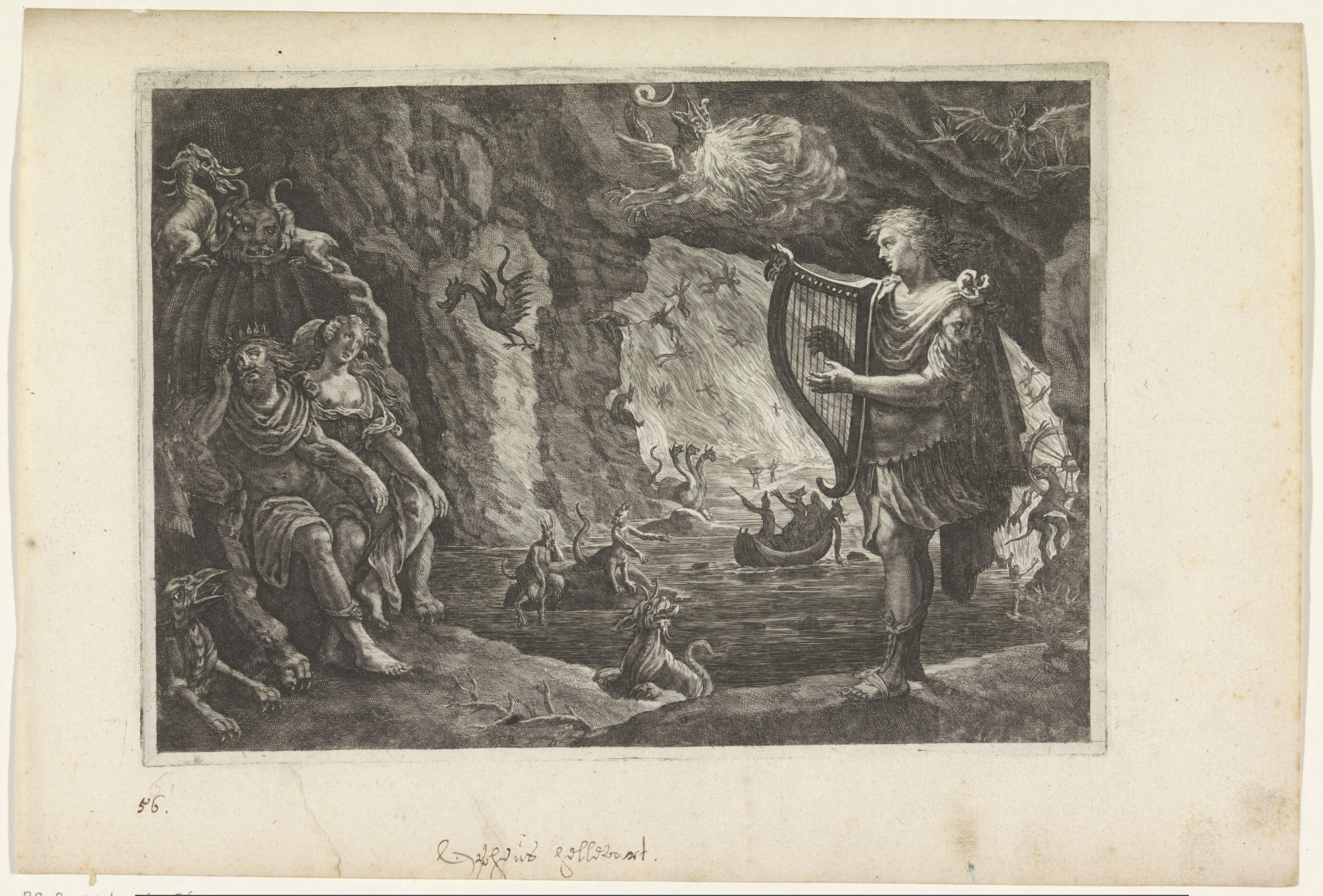
Jacob van Swanenburg (Leiden 1571-1638 Utrecht), generally known as the first teacher of Rembrandt, is among those Dutch artists who worked abroad and in the Netherlands. He specialised in underworld scenes, of which four are in public museums and considered the core and standard of his work (fig. 1).1 A fifth painting, Orpheus in the Underworld, which is lost but known from a print, is attributed to Jacob and the focus of this essay (fig. 2).2 Jacob’s brothers Willem and Claesz, were also artists, following their father, Isaac Claesz van Swanenburg (1537-1614), who had a successful career as burgomaster and artist in Leiden.3 About 1590, Jacob traveled through Hamburg, Venice, and Florence; settling in Naples c. 1596, he married and finally returned to Leiden with his wife and three children in January 1618.
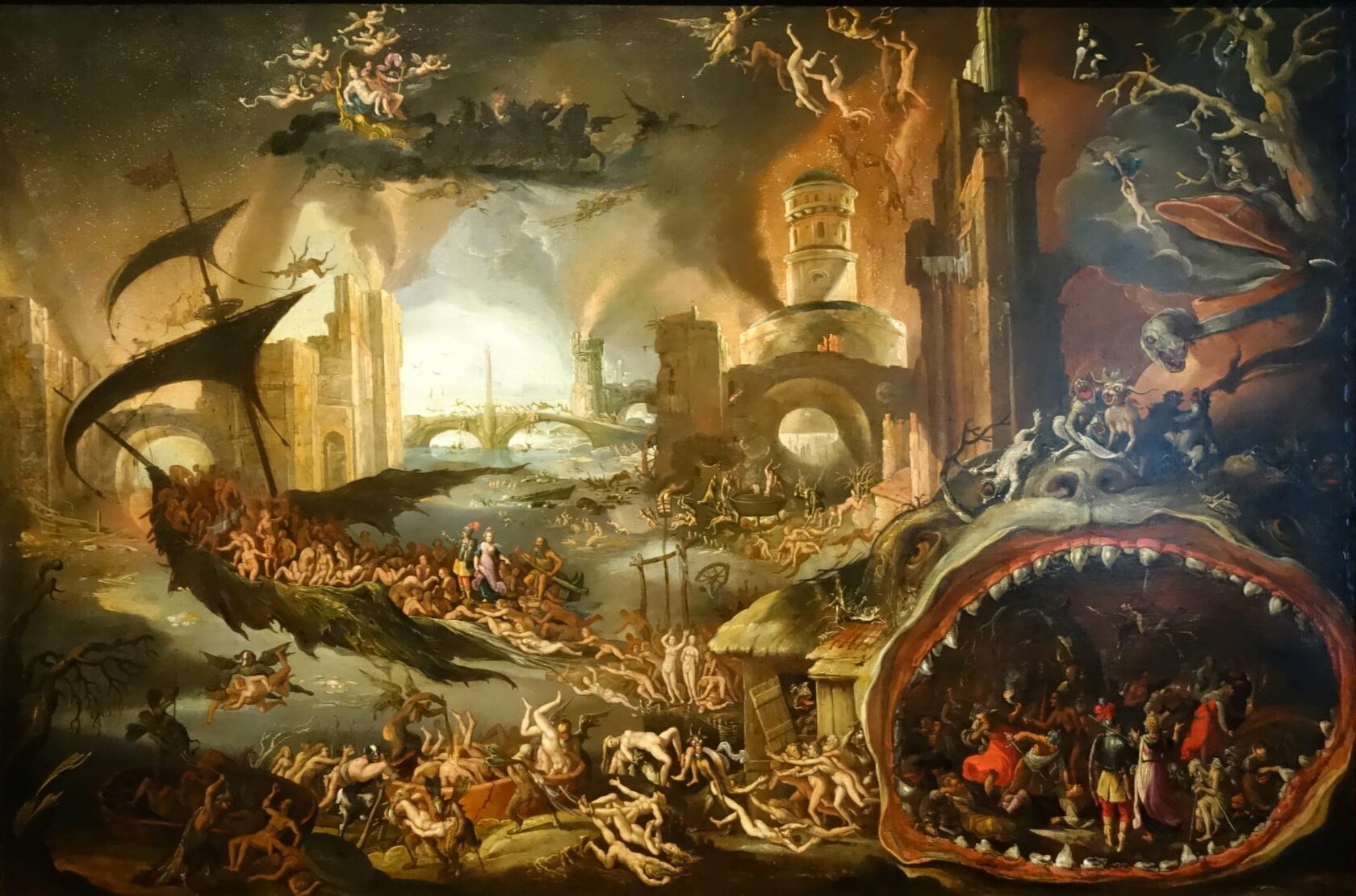 |  |
The Orpheus was certainly painted during Jacob’s Leiden years. We may suppose that the four core hellish scenes were also painted after his return from Italy, as two are on hardwood, most likely indicating a north European origin of support. A chronology for his hellish works is difficult to propose, as none are dated. The four core scenes are extremely similar in their paint application and motifs of hell mouth, serpents, devils, nudes, tortures, and ruins. Circumstantial evidence indicates that many of these motifs appeared in his Neapolitan imagery before 1603, as they were adapted without much alteration by two artists in Italy; they found the hell mouth, ruins, silhouetted figures on a bridge, and tortures especially appealing, convenient, and worth emulating.4 Jacob van Swanenburg was appreciated for this imagery while in Italy, and identified, with it during his later years in Leiden.
The Amsterdam doctor Jan Sysmus noted in his diary that these hellish scenes were admired: ‘’Swanenburg in Leiden, in Hellish ghostly scenes, beautiful’’.5 In his diary, written between 1669 and 1678, Sysmus listed artists whose works he had seen and briefly characterized their imagery. His term spoken may be loosely translated as apparitions or ghosts, and refers to the category spookerij, indicating infernal compositions.6 Jacob van Swanenburg’s underworld paintings are mentioned in inventories in Leiden, Delft, and The Hague.7
The Orpheus engraving was made for an edition of Ovid’s Metamorphoses planned by the publishing enterprise of Crispijn de Passe I (c. 1565-1637), his daughter Magdalena (c. 1600-1638), and his son Crispijn de Passe II (1594-1670).8 The project went through several phases, and only in 1677 was it finalized under the direction of the Brussels publisher François Foppens, who added the Latin text, Pierre du Ryer’s French translation and commentary, and plates by various printmakers.9 This folio volume contained 124 prints, of which 90 were by the De Passe workshop with a few by other artists added by Crispijn II, and others added later for the publication. By c. 1660, proofs were in circulation. A set was owned by Michiel Hinloopen.10 On the Orpheus engraving, Hinloopen wrote in pen ‘56’ for the order in which he kept the impressions, and the title Orpheus hellevaert. The print is possibly by Magdalena.11
Jacob portrayed Orpheus playing the lyre for Pluto and Proserpina, who are enthroned in a scalloped niche. Orpheus has descended to retrieve his bride Eurydice, who was killed by a venomous snake (Ovid, Metamorphoses, 10:1-85). Pluto agrees to release Eurydice to Orpheus, who is instructed not to look at her during their ascent to earth. But Orpheus glances back at Eurydice as they depart, and so she cannot return with him. Flying demons, fantastic creatures, and tortures are similar to those in the four core paintings.12 The print shows Jacob’s interest in Pluto and Proserpina, who are included aloft in a chariot surveying their realm in three of these core paintings.13 The Orpheus print includes a fire-breathing hybrid creature flying at the centre and rough, rocky arches which evoke the grottoes around Naples.
Most of the models for the De Passe Ovidian edition are paintings already made, and their choice depended on the availability for the appropriate subjects; when such images were not easily accessible, Crispijn II adapted compositions from Antonio Tempesta’s 1606 Metamorphoses and several Italian images known in print. Some prints are after artists with ties to Utrecht where the De Passe workshop was based from 1611-1637; these include Gerrit van Honthorst, Abraham Bloemaert, Joachim Wtewael, Cornelis van Poelenburgh, and Roeland Savery. The Van Swanenburg family had relatives in Utrecht. Through his younger brother Joost, Jacob became related to the Van Veen and Bloemaert families; he died in Utrecht, which suggests professional or familial obligations at the time.14 His presence in Utrecht may have brought him into contact with the De Passe workshop. Other prints were sourced from artists associated with Amsterdam where Crispijn II lived from 1639-1670.
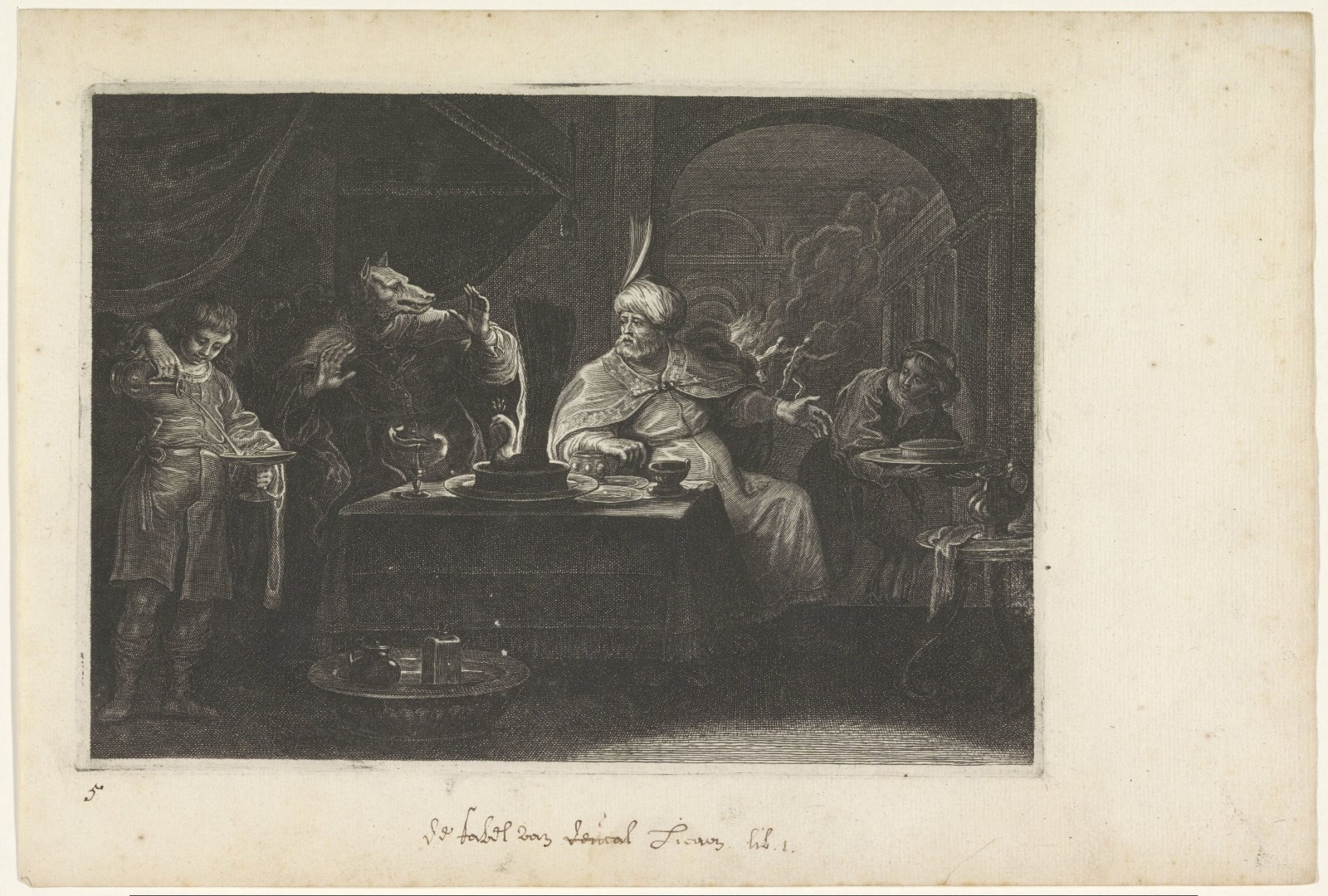
Attributed to Pieter Lastman is the episode of Lycaon and Jupiter (Ovid, Metamorphoses, 1:199-243) (fig. 3).15 The cruel king of Arcadia, Lycaon was jealous of the adoration given to the visiting Jupiter by his own subjects and planned to kill the sleeping god in the night after inviting him to dinner. When Lycaon served Jupiter the human meat of a prisoner, the god turned the king into a wolf as punishment and set ablaze his household. The main figures of Jupiter and Lycaon at table are flanked by a boy pouring wine and a serving maid. A hallway opens to the courtyard, where two figures flee in terror from flames. As a crowded architectural night scene, Lycaon and Jupiter seems atypical in Lastman’s oeuvre, but, with its inclusion of a central pair of figures in dramatic confrontation, it is comparable to his other compositions.16
Here, Jupiter is not the physically powerful ruler of the gods as he appears elsewhere in Lastman’s work, but a turbaned and robed official, resembling a king from ancient history.17 Circumstances of the narrative help explain his appearance. Jupiter calmly recounts the episode to the gathered gods after having come to earth in human form intending to punish Lycaon for his barbarousness. Gesturing toward the meat platter, held by the maid, Jupiter emphasizes his restraint by causing only Lycaon’s household to go up in flames rather than punishing the whole community.
Although no related design for the Jupiter and Lycaon associated with Lastman is known, his authorship is strengthened and even confirmed by the inscription on an early proof at Wolfegg Castle examined by Jaco Rutgers.18 Inscribed in ink are the names of the inventor and printmaker: ‘’Lasman in /Petrus de balli fe.’’ The Antwerp engraver Pieter de Bailliu (1613-1660) worked on the Galleria Giustiniani project in Rome with Reynier Persijn from January 1635 to January 1637. Upon his return to Antwerp, he engraved the Jupiter and Lycaon before 1660, but he is not otherwise associated with the De Passe Ovid project. The Wolfegg print cabinet was assembled between 1650 and 1667 by Maximilian Willibald of Waldburg-Wolfegg (1604-1667), military leader and governor of the Upper Palatinate for the Electorate of Bavaria. The Wolfegg impression of Lycaon and Jupiter indicates that proof sheets were in circulation before 1667, by which time the Wolfegg cabinet was complete.19 The Antwerp publisher and engraver Joannes Meyssens helped form the Wolfegg cabinet, and would have been well informed about the material he assembled. The inscription on the proof may be by Meyssens, or even by De Bailliu himself.
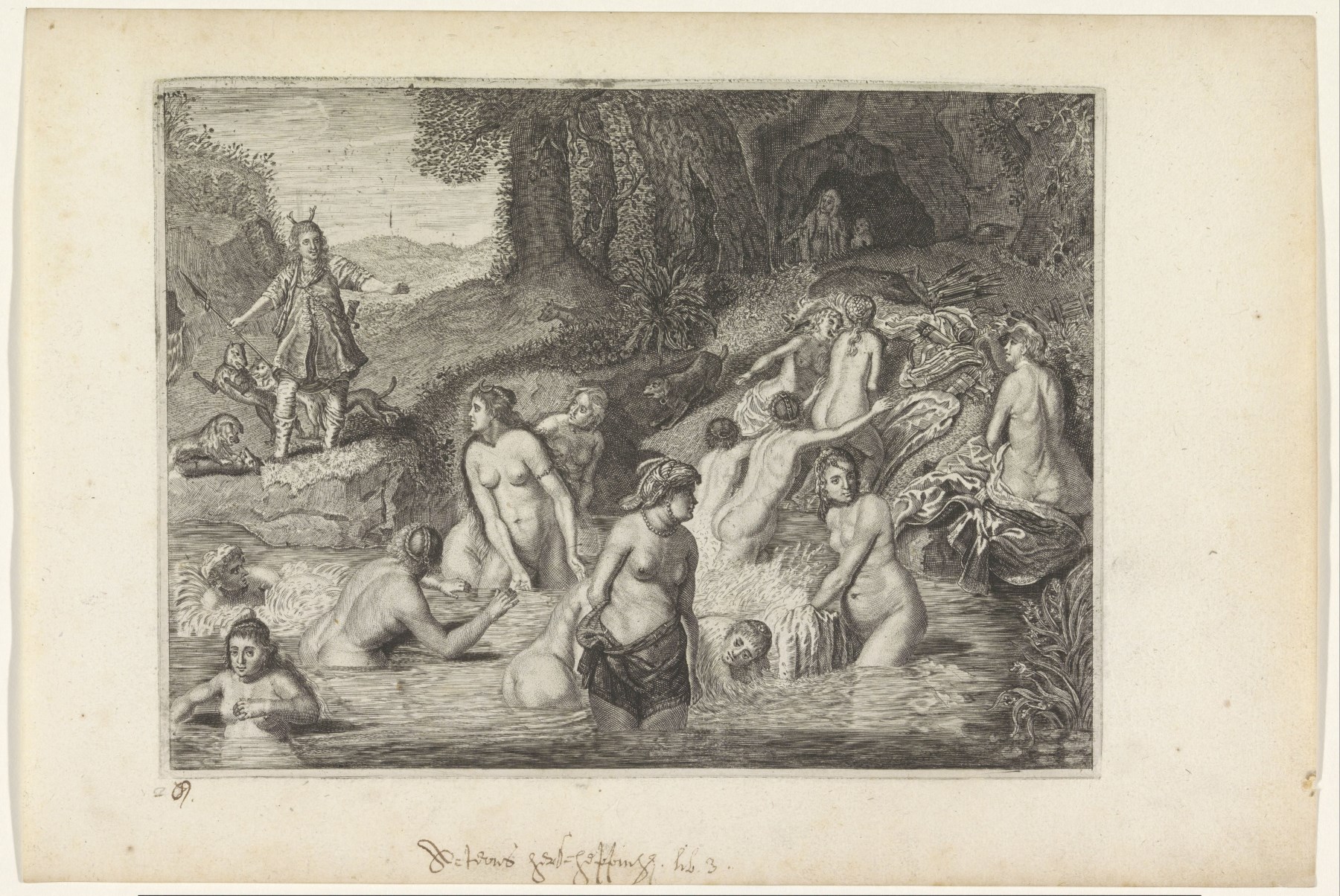
For the episode of Diana and Actaeon, Crispijn II adapted Rembrandt’s painting Diana and Actaeon with Callisto and Nymphs (fig. 4).20 The painting combines two separate episodes: Callisto’s pregnancy discovered by the nymphs (Ovid, Metamorphoses, 2:461-445) and Diana spraying water on Actaeon (Ovid, Metamorphoses, 3:165-205). The print takes the central action of Diana spraying water upon Actaeon from Rembrandt’s painting and includes the seated nymph at the far right as a framing element. For the episode of Diana and Callisto, a composition from the circle of Cornelis van Poelenburch was used, possibly by Dirck van der Lisse or Abraham van Cuylenborch.
Based in Amsterdam 1639-1670, Crispijn II lived on the Rozengracht, an area of artists including David and Philips Lingelbach, Meindert Hobbema, Adam Pynacker, Ludolf Bakhuizen, and Jan Abrahamsz Beerstraten. We may suppose that Rembrandt was familiar with the neighborhood before he moved there in 1658 and speculate that he may have had contact with Crispijn II; we may imagine that a conversation about Rembrandt’s Diana and Actaeon with Callisto and Nymphs occurred which led to the use of that composition for the series.
Significantly for Jacob van Swanenburg, Orpheus in the Underworld places him in the grand Ovidian series initiated by the De Passe workshop, and in the company of his most successful and prominent contemporaries. In this publication, the two teachers of Rembrandt make an appearance along with their famous pupil. Perhaps Van Swanenburg may be considered as an artist worthy of attention, rather than merely Rembrandt’s first teacher.
For help with research for this article, I warmly and appreciatively thank Tania De Nile, Kate Harper, Lisanne den Hartog, Kennedy Harwood, Sylvia Hickman, Jaco Rutgers, Natasha Seaman, Tico Seifert, Nicolette Sluijter-Seiffert, and, for their help at the Fondation Custodia, Juliette Parmentier-Courreau and Ben Pelloud.
- These four underworld paintings are considered his core oeuvre: The Sibyl shows Aeneas the Underworld (Charon’s Boat), c. 1620, panel, 93.5 x 124 cm, Museum De Lakenhal, Leiden, S 251; Aeneas taken by the Sibyl to the Underworld, c. 1620, canvas, 101.5 x 150 cm. Musée Royal des Beaux-Arts, Brussels, inv. no. 10241; Aeneas and Sibilla in the Underworld (Charon’s boat), c. 1620, canvas, 101 x 140 cm. National Museum in Gdansk, Gdansk, inv. no. 1936-7-4-2; Charon’s Boat with the Hellmouth and Seven Sins, c. 1620, panel, 28 x 88 cm. Rijksmuseum, Amsterdam, inv. no. SK-A-730. For Van Swanenburg’s hellish scenes, which include several others on the art market or in private collections, see Tania De Nile, “Rethinking Swanenburg: The Rise and Fortune of New Iconographies of the ‘Hell’ in Italy and the Northern Netherlands”, in Marije Osnabrugge ed., Questioning Pictorial Genres in Dutch Seventeenth-Century Definitions, Artistic Practices, Market & Society, Turnhout, 2021, pp. 291-309; and Tania De Nile, Fantasmagori. Streghe, demoni e tentazioni nell’arte fiamminga e olandese del Seicento, Rome 2023, pp. 204-214.
- The Orpheus has been listed without attribution in print catalogues, and linked to Jacob van Swanenburg in two publications. M. D. Henkel, “Nederlandsche Ovidius-Illustraties van de 15e tot de 18e eeuw”, Oud Holland 39 (1921), pp. 149-187, esp. p. 170, attributed the engraving to Magdalena de Passe and the composition to Jacob in pl. 17; and Jan van der Waals, De Prentschat van Michiel Hinloopen (1619-1708), The Hague/ Amsterdam 1988, pp. 82 and 85, credited Jacob based on comparison to his hellish paintings.
- R. E. O. Ekkart, Isaac Claesz. van Swanenburg, 1537-1614. Leids schilder en burgemeester, Zwolle 1998.
- By 1603, Baldasar Corenzio incorporated these motifs in his frescoes in two Neapolitan churches, Santa Maria la Nova and Santa Maria delle Parete, Liveri; see De Nile, ‘Rethinking Swanenburg’ (see note 1), pp. 305-306, and Tania De Nile, ‘Un ‘Inferno’ su carta agli Uffizi. Intorno a uno studio inedito di Belisario Corenzio perh Santa Maria la Nova’, Horti Hesperidum 11: 2 (2021), pp. 173-201. In his frescoes of 1615 in Santi Eusebio e Vittoria, Peglio, Lombardy, Giovanni Maria Mauro della Rovere did the same; Tania De Nile presented Mauro’s Peglio frescoes at the Historians of Netherlandish Art Conference, Cambridge UK, July 12, 2024: ‘When the North met the south: the fortunate case of the nordic Hellmouth in the Italian frescoes of the Counter-Reformation’.
- “Swanenburch te Leyde, in Helse spoken moy”: Abraham Bredius, “Het Schildersregister van Jan Sysmus, Stads-Doctor van Amsterdam”, Oud Holland 9 (1891), pp. 137-149, esp. p. 147.
- For this category, see De Nile, Fantasmagorie, passim (see note 1).
- Inventories with hellish scenes include these: 1624/12/01, inventory Michiel Corn. Wijtland’s widow, Leiden; 1640, Pietersz. van den Bosch sale, Leiden; 1640, inventory Jan Jansz. Orlers, Leiden; 17 September 1659, inventory Catherina Willems van Thoornvliet, Dirck Segersz van Campen’s widow, Leiden; 15 September 1666, inventory Jan Maire, Leiden; 1666, inventory Henric Bugge van Ring and Aeltge Henricx van Swieten, Leiden; 20 April 1673, inventory Maria Elandts, Laurens Borsman’s widow, The Hague; 27 April 1692, inventory Geertruijt Brasfer, Johan van der Chijs’s widow, Delft; see De Nile, “Rethinking Swanenburg” (see note 1), p. 308, note 69.
- For this project, see Ilya Veldman, Crispijn de Passe and his progeny (1564-1670): a century of print production, trans. Michael Hoyle, Rotterdam 2001, pp. 287-290; Lisanne den Hartog, “Crispijn (II) and Magdalena de Passe’s Metamorphoses Series: A comparative study in printmaking”, MA Thesis, University of Amsterdam, 2023.
- Pierre Du Ryer tr., Les metamorphoses d’Ovide, en latin et françois, divisées en XV. livres, avec de nouvelles explications historiques, Brussels 1677.
- Van der Waals, “Prentschat” (see note 2), pp. 79-102.
- The Orpheus is in Du Ryer, Les metamorphoses (see note 9), p. 309. The print is by Magdalena de Passe according to Henkel, “Nederlandsche Ovidius” (see note 2), p. 170; Den Hartog, Crispijn (II) and Magdalena de Passe’s Metamorphoses Series (see note 8), p. 77. It is attributed to Magdalena with a question mark by Van de Waals, in “Prentschat” (see note 2), p. 85; and the Rijksmuseum. Veldman does not group it with other prints by Magdalena, apparently attributing it to Crispijn de Passe II, in Crispijn de Passe (see note 8), pp. 287-290. If by Magdalena, the print would have been made before 1634, the year she married and ceased engraving.
- In various forms, these are generic to hell scenes, and also appear in other renditions of Orpheus in the underworld, as in Pieter van der Borcht’s illustration, Ovid, Metamorphoses Expositae, Antwerp, 1591, pp. 240-241.
- These three are in Gdansk, Brussels and Leiden.
- Joost van Swanenburg (1577-1620) married Elisabeth van Veen, the niece of Otto van Veen. Her brother Simon van Veen Jr. married Divera van der Eem (c.1682); Divera’s sister Margaretha married Hendrick Bloemaert on October 1, 1631. In this way, the Bloemaert, Van Veen and Van Swanenburg families became related. R. E. O. Ekkart, “Familiekroniek van Heemskerck en van Swanenburg (2)”, Jaarboek Centraal Bureau voor Genealogie 33 (1979), pp. 44-75, esp. p. 70; M. G. Roethlisberger and M. J. Bok, Abraham Bloemaert and his sons, paintings and prints, 2 vols., Doornspijk,1993, vol. 2, pp. 590, 659-660.
- Van der Waals, “Prentschat” (see note 2), p. 83; Du Ryer, Les metamorphoses (see note 9), p. 14.
- These include Jupiter, Juno and Io, 1618, panel, 54.3 x 77.8 cm, London, National Gallery, inv. no. NG 6272; Bacchus and Ariadne, 1628, panel, 60 x 87 cm, Stockholm, University Art Collection, inv. no. 278, and two paintings of David and Uriah, 1611, oak, 51.1 x 61.3 cm, Detroit, Detroit Institute of Arts, inv. no. 60.63; 1619, panel, 42.8 x 63.3 cm. New York, The Leiden Collection, inv. no. PL-100.
- Comparable to Jupiter are Lastman’s figures of Ahasuerus in the Feast of Esther, 1619, oak, 52 x 78 cm, Warsaw, National Museum, inv. no. M.Ob.558 MNW and David in David and Jonathan, 1620, panel, 40 x 59 cm. Moscow, Pushkin Museum; Jan Lievens’ Ahasuerus in the Feast of Esther, c. 1625, canvas, 130.8 x 163.8 cm, Raleigh NC, North Carolina Museum of Art, inv. no. 52.9.55, and Jan Tengnagel’s Cambyses in the Judgement of Cambyses, 1619, canvas, 111 x 151 cm, The Hague, private collection.
- Jaco Rutgers and Tico Seifert generously shared their knowledge of this print with me, and this analysis of Lastman and Bailliu is gratefully indebted to Jaco.
- Several sets of proofs must have been in circulation. One group of proof impressions was recently acquired by the Rijksmuseum (inv. nos. RP-P-2013-10-1 to 13), with contemporary inscriptions indicating the title and occasionally the engraver or inventor.
- Rembrandt, Diana and Actaeon with Callisto and Nymphs, 1634, canvas, 73.5 x 93.5 cm. Anholt, Museum Wasserburg. The print Diana and Actaeon appears in Du Ryer, Les metamorphoses (see note 9), p. 83. Two painted copies are known that omit the Callisto scene, but in specific details both differ from the De Passe print; J. Bruyn et al., A Corpus of Rembrandt Paintings, 6 vols., The Hague 1982-2015, vol. 2, pp. 493-494, gives information: Emil Goldschmidt collection; sale, Berlin 27 April 1909, no. 55; and Wolverhampton, Wolverhampton Art Gallery.