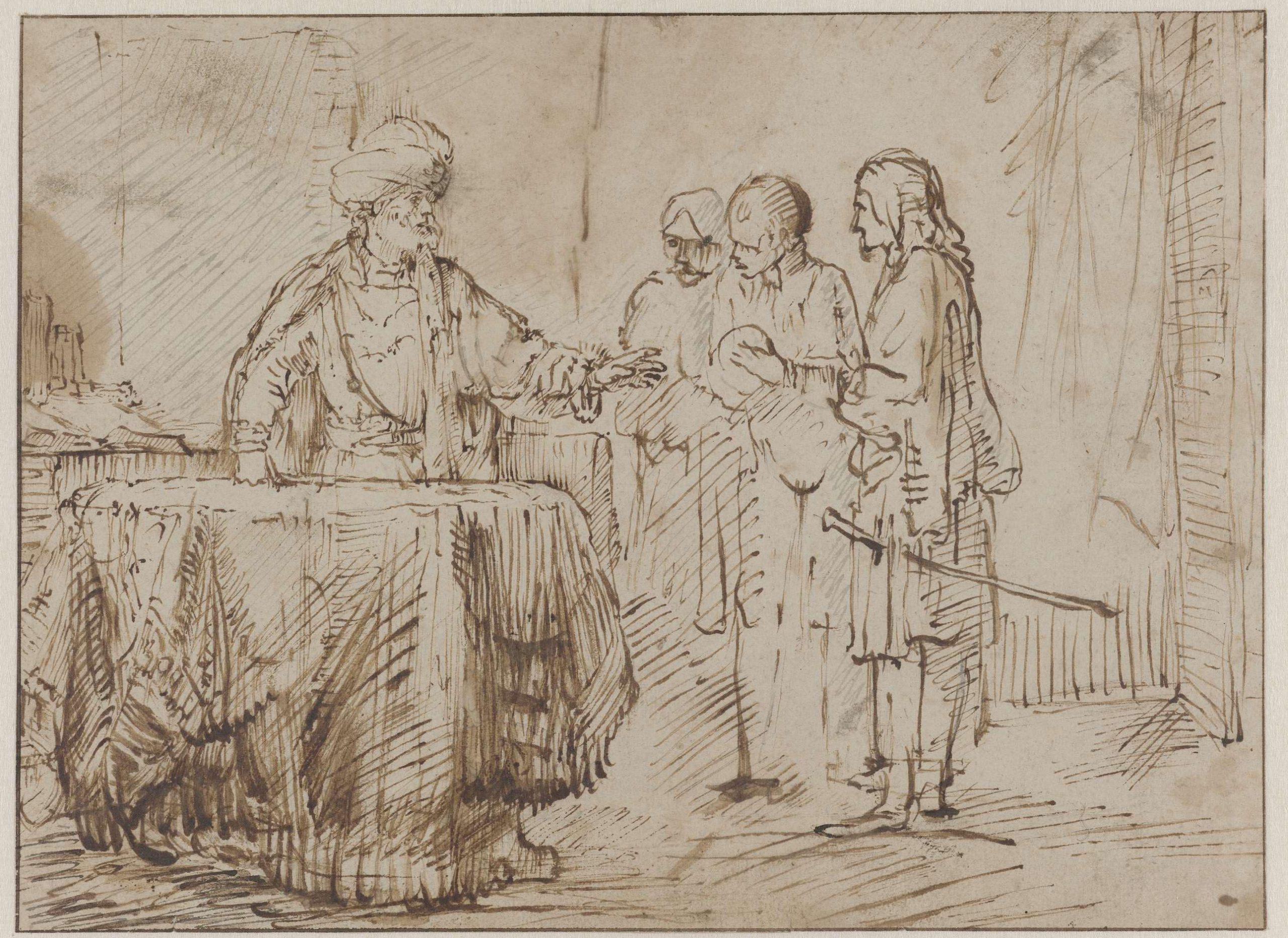
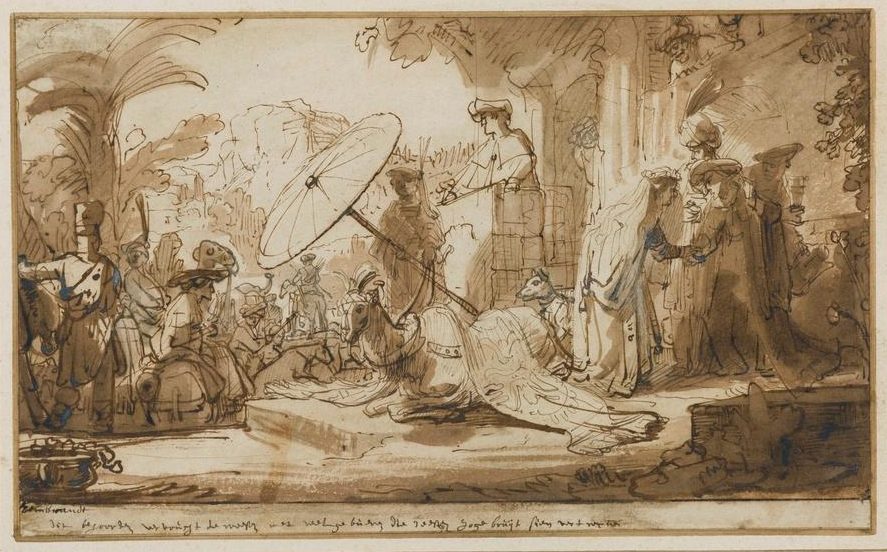
In the undisputed hand of Rembrandt Harmensz van Rijn, the intriguing inscription that appears beneath the drawing of an Old Testament scene, The Departure of Rebecca, c. 1637, has generated various studies (fig. 1).1 The rarity of the artist’s annotations, in general, has served to intensify scholarly interest in them. Discussions of the inscription have examined its relationship to the drawing’s attribution, the artist’s teaching methods, and his instructional intent. This study posits that the inscription’s specific wording raises additional significant questions, which have yet to be considered. Written in ink different from that of the drawing, Rembrandt’s directive reads: “This should contain the figures of many neighbours who witness the departure of the noble bride.”2 In another hand, “Rembrandt” appears just above the inscription. The master’s critique emphasises the importance of having many “gebueren” (neighbours) in attendance at the housefront of Rebecca’s parents as she departs for her marriage to Isaac, even while the related biblical text lacks any reference to such persons.3 This study considers the significance of Rembrandt’s specific instructions to include neighbours, rather than generic figures, “who witness the departure of the noble bride.” Gary Schwartz also noted that the Old Testament story does not allude to neighbours, and he accounted for Rembrandt’s artistic licence by concluding the artist wished to approximate everyday experience.4 Schwartz, however, did not elaborate further on his observation. Rembrandt’s instructions to add many neighbours in the drawing of Rebecca’s departure from her home did, in fact, result in a scene that resembled everyday life for a seventeenth-century Dutch viewer. I argue that neighbours’ well-embedded social practices—in particular, gatherings on domestic stoops and engagement with each other’s nuptial rituals—account for the artistic licence taken by Rembrandt with the biblical text. In the drawing, both the inclusion of neighbours at the housefront and their interest in the procession leading Rebecca to her marriage would have evoked in viewers their own, comparable experiences as neighbours. Similarly in some other biblical works, as Amy Golahny has shown, Rembrandt melded reality that he had observed or experienced with imagined history.5 Contemporary with The Departure of Rebecca, Rembrandt’s black chalk drawing A Blind Beggar with a Boy and a Dog (private collection), for example, showcases figures he observed in daily life that he later incorporated in the biblical etchings such as The Hundred Guilder Print, c. 1647–1649 (B.074), and The Blind Tobit, 1651 (B.042), and which also appear in some students’ drawings.6 Like most of his urban contemporaries, Rembrandt belonged to self-determined and robust neighbourhood organizations (gebuyrten) in Leiden and Amsterdam. The written regulations (buurtbrieven) of such official organizations typically mandated membership of all who lived within the respective unit’s geographical footprint.7 Many official gebuyrten decrees, as well as unofficial expectations, relied on neighbours’ familiarity with each other’s daily affairs. Residents frequently shared news and gossip on domestic stoops, and at housefront windows and open doors to maintain the collective honour of their neighbourhood. Communal conviviality helped to construct and reinforce the neighbourhoods’ shared goals of brotherhood, friendship, and unity.8 Typically, neighbours also observed or attended various social gatherings, including before, during, and after the marriage of fellow residents. I argue that the expectation among neighbours to keep abreast of news and gossip shared informally on front stoops, and to participate in celebratory occasions, including nuptial festivities, informed the assumptions, advice, and wording of Rembrandt’s inscription beneath the drawing The Departure of Rebecca. The various Old Testament events described in Genesis 24 that led to the marriage of Isaac and Rebecca appear in numerous seventeenth-century Dutch paintings, prints, and drawings, including those by Rembrandt and his pupils.9 The specific scene in The Departure of Rebecca captures the realization of instructions initially given by Abraham to his servant Eliezer to find a wife for the patriarch’s son, Isaac. With camels and gifts, Eliezer left Abraham and embarked on his mission. As evening fell, he approached a well where he foretold that if a woman agreed to share her water with him and his camels, she would be Isaac’s future wife. In time, Rebecca fulfilled the servant’s request.10 Eliezer revealed his objective to Rebecca’s brother and father, who, along with Rebecca, happily agreed to the marriage. Subsequently, Rebecca and her companions climbed onto camels and followed Eliezer on his return journey to join Isaac. In the drawing, several figures assemble on or near the domestic threshold of Rebecca’s parents, or peer out from the housefront’s doorway and open windows. Since some of the figures overlap the drawn details of the window and door, their addition may postdate Rembrandt’s inscribed instructions.11 A man—presumably Rebecca’s brother or father—overlooks the scene from the low balcony attached to the façade. Seen at an oblique angle, the domestic structure fills most of the right side of the composition. The home’s expansive stoop extends into the foreground, parallels the bottom edge of the composition, and readily affords the viewer, as neighbour, close visual and spatial engagement with the event. On the right, Rebecca bids farewell to her mother. The additional individuals gather behind them. A camel kneels on the stoop ready for Rebecca’s journey. Behind the docile animal, a standing man holds a large open umbrella at an angle. On the left, a retinue of people on foot and on horseback begins to take its leave. After the Old Testament’s account of Rebecca’s departure, which the scene in the drawing anticipates, the text describes the subsequent journey through the countryside to meet Isaac, who took her as his wife. Studies of Rembrandt’s inscription have addressed the relevance of the artist’s instructions for the drawing’s inconclusive attribution to either the master himself or to one of his pupils.12 The latter include Salomon Koninck or a Koninck group; perhaps Govert Flinck; and Gerbrand van den Eeckhout.13 One scholar has argued that Rembrandt wrote the comment on his own drawing in order to provide a model as a correction to a pupil’s image.14 However, Rembrandt rarely inscribed his own drawings and unlikely with self-criticism.15 Instead, as several scholars have convincingly concluded, the master’s inscription appears on a student’s drawing about that work, rather than on his own drawing.16 Such studio instruction by Rembrandt was long-lived. Under the master’s tutelage, the painter Samuel van Hoogstraten learned from comparable corrections and recommended such artistic training in his Introduction to the Academy of Painting, or the Visible World, 1678.17 Further discussions of Rembrandt’s inscription—like analyses of his other written comments on, and corrections of, students’ drawings—have assessed the master’s artistic instructions vis-à-vis the scene’s compositional and narrative elements.18 Although the inscription evokes art theory’s concern for the appropriate number of figures in a text-based story, art theory does not account for Rembrandt’s explicit call for neighbours, rather than generic figures.19 To the observations that Rembrandt’s instructions addressed compositional and iconographic elements of the scene, I add discussion of significant Dutch social practices, which, I contend, the master evoked in his specific call for the depiction of neighbours. The social network, social exchange, and social control inherent in seventeenth-century Dutch neighbourhoods provide a rich interpretive context, which further illuminates the significance of Rembrandt’s inscription on the drawing.
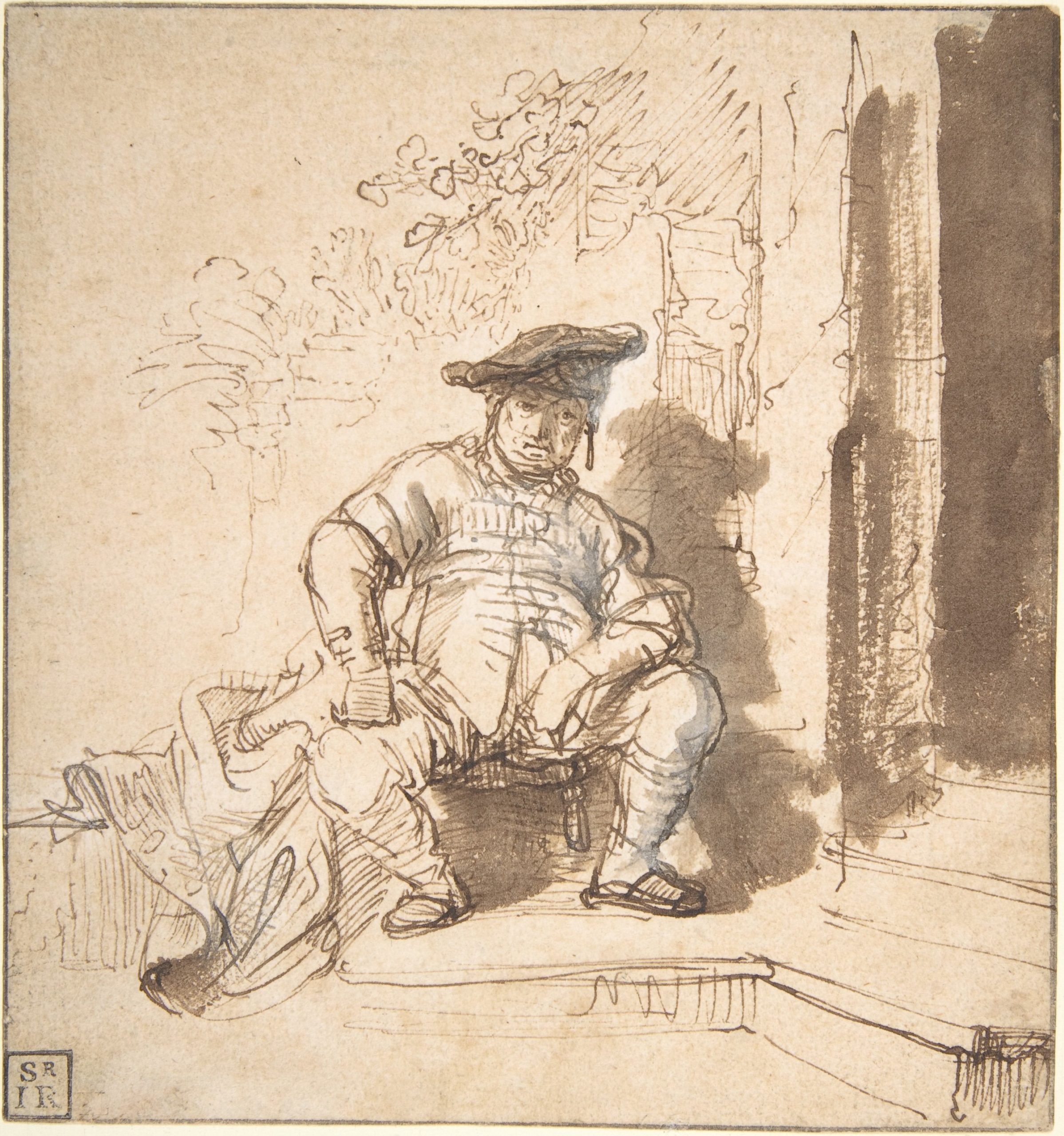
Rembrandt and Neighbourhood Culture The artist would have been intimately familiar with the social practices, social network, and social exchange of neighbourhoods, which constituted a primary organizing unit of social control in everyday relations. Small in footprint, Dutch neighbourhoods were typically circumscribed by the borders of only one or two streets or one side of a canal, and adjacent alleys. Membership typically included all residents living within the small community’s geographical parameters: men and women; natives and immigrants; and diverse socioeconomic classes, trades, and religions.20 Neighbours selected a governing board from among themselves consisting of various administrators. They oversaw neighbourhood meetings; played conciliatory and mediatory roles to protect order and quiet; ensured the rights, responsibilities, and honour of residents; and enforced the binding regulations, which did not warrant the intervention of civic authorities.21 Neighbourhood organizations resulted from a desire for calm, stability, camaraderie, and the preservation of individual and communal honour. The most compelling goal of seventeenth-century Dutch neighbourhood organizations centred around harmonious shared experience. Attendance at various informal gatherings as well as official social events fostered a sense of community. To maintain a neighbourhood’s mores and reinforce convivial relations, regulations required residents to participate in each other’s lives and stay abreast of good and bad news through daily interaction of all kinds, including conversation and gossip.22 At housefront thresholds, stoops, and windows, much as we see in The Departure of Rebecca, neighbours kept aware of communal news of large and little consequence. They also intervened as witnesses to social infractions and negotiated resolutions to conflicts. Rembrandt was certainly familiar with the official regulations, unofficial expectations, social values, and experiences of neighbourhood life. In Leiden, where he was born in 1606, his family lived in the Pelikaanshoek (Pelican Corner) neighbourhood.23 Prominent administrative roles held by Rembrandt’s father and brother in their neighbourhood organization would have provided the artist even greater familiarity with the social control characteristic of gebuyrten. While the young Rembrandt still lived in Leiden, his father Harmen Gerritsz van Rijn, a miller, served as chairman (heer) of the family’s neighbourhood. From 1643 until his death in 1652, Rembrandt’s brother, Adriaen Harmensz van Rijn, served as heer of the same Leiden neighbourhood organization.24 The various drawings by Rembrandt that evince his familiarity with neighbourhood life at the intersection of home and street are close in date to The Departure of Rebecca, c. 1637. The subjects and compositions of the drawings pictorially educe the ebb and flow of neighbourhood social exchange before a housefront, as Rembrandt’s inscription similarly called for in the Old Testament scene. A resident either sits on a domestic stoop or peers out from an open window or half-open Dutch door. The figures’ positions and their gazes invite neighbourhood encounters.
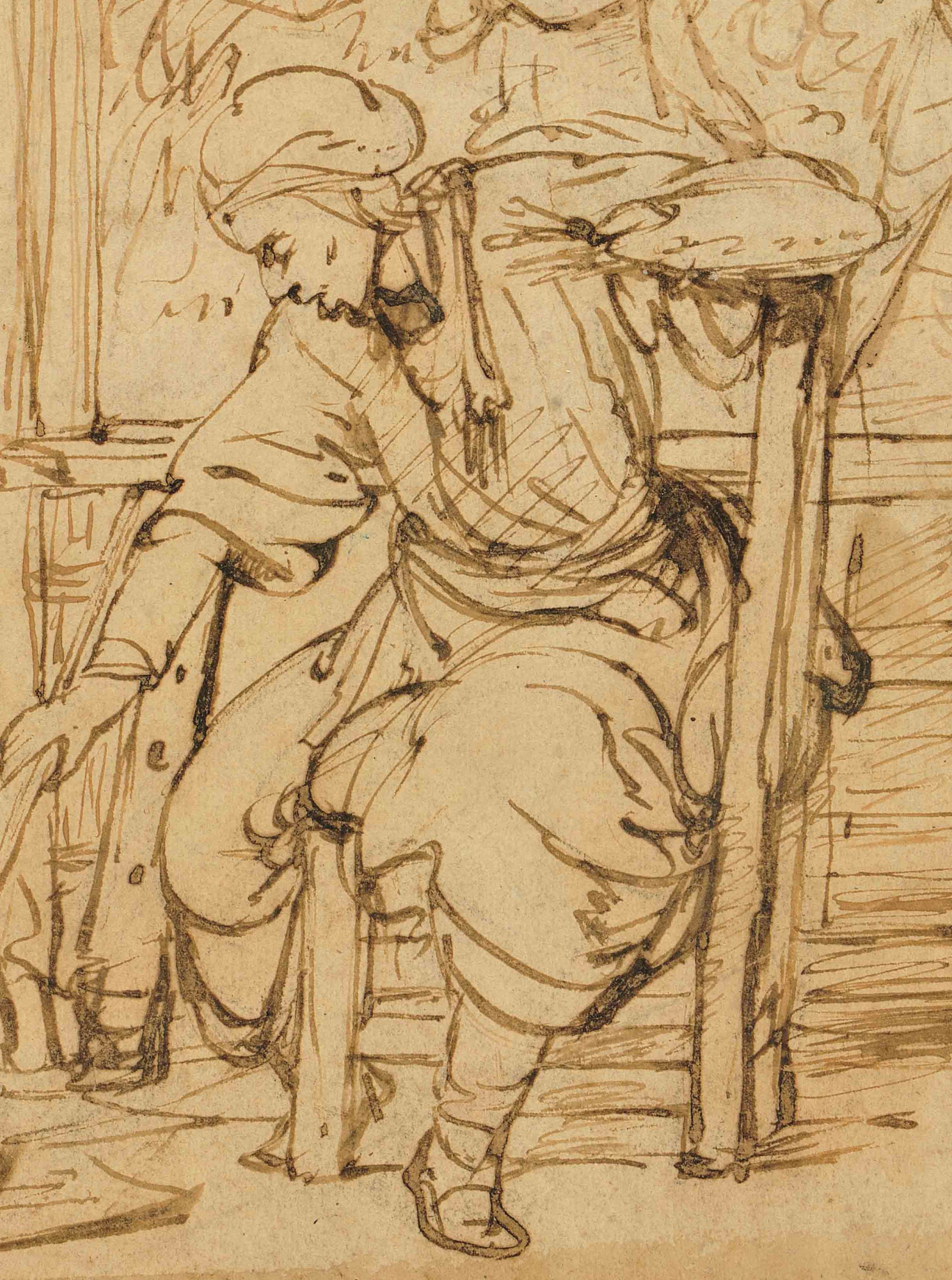
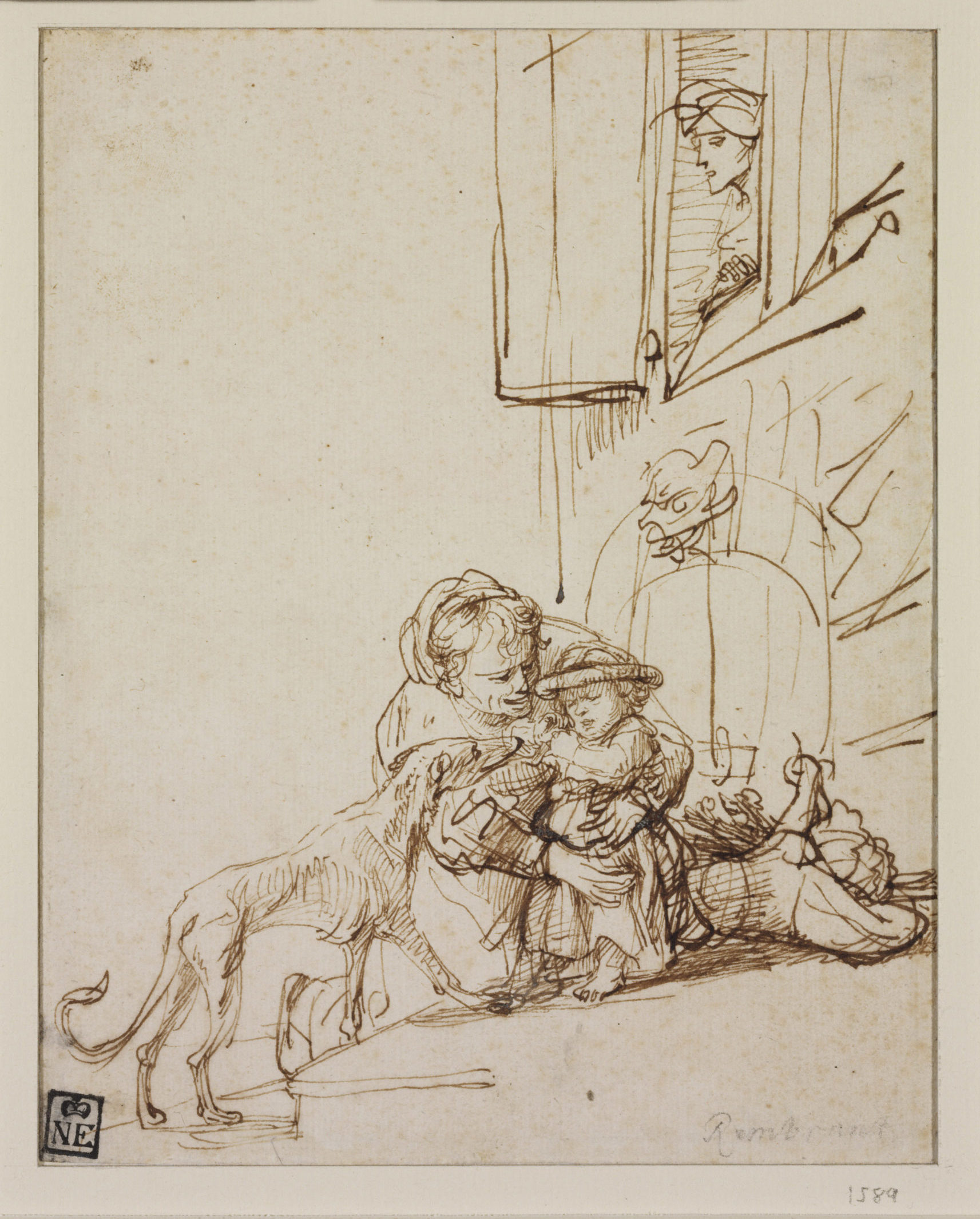
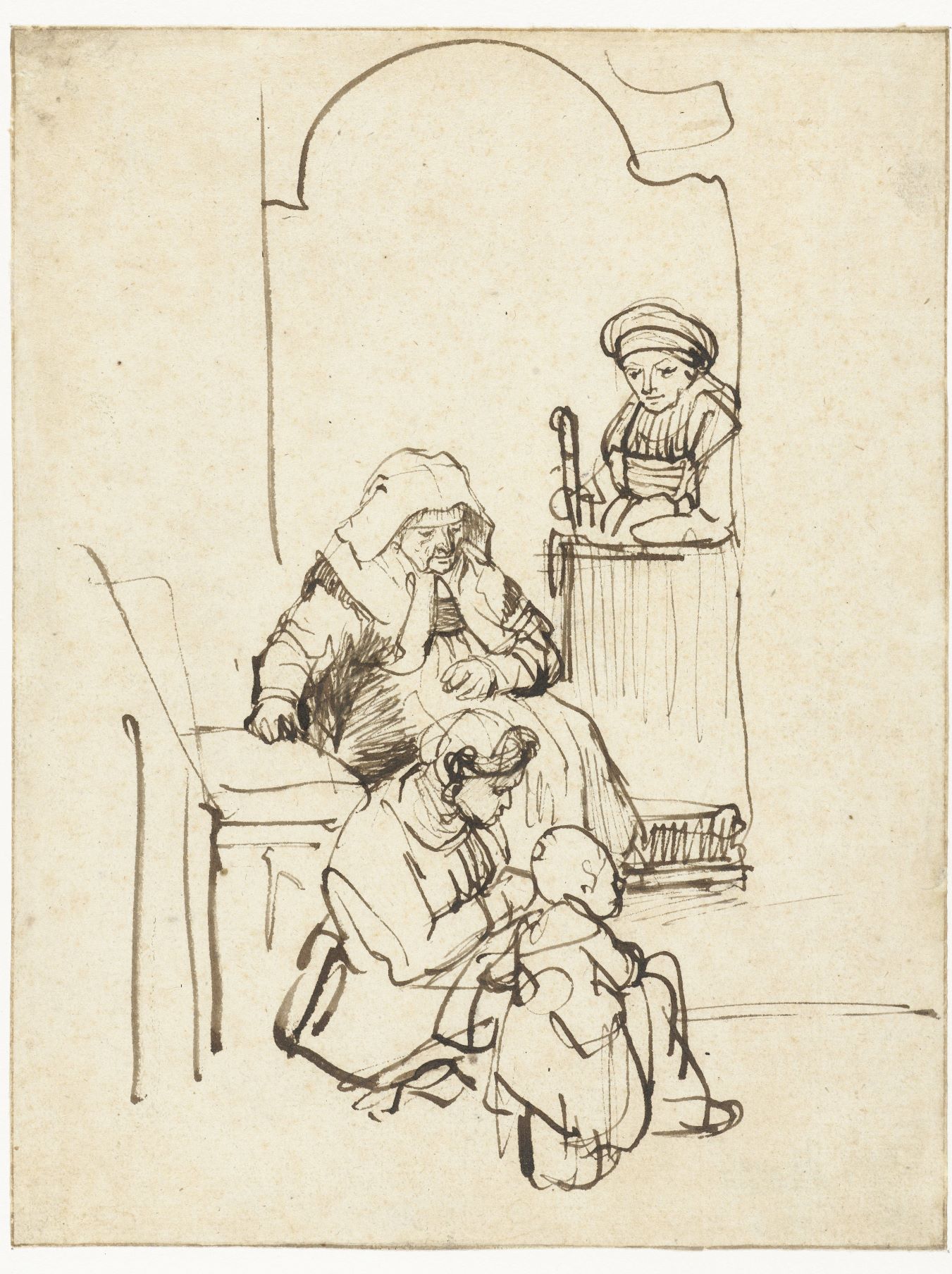
In Seated Man Wearing a Flat Cap, c. 1635–1640, for example, a resting figure on his stoop gazes directly out at the viewer as passerby/neighbour (fig. 2). Woman Holding a Child Frightened by a Dog, on the Doorstep of a House, c. 1635–1636, pictures a woman leaning out of a housefront window surveying the scene below (fig. 3). On the top step, a smiling mother kneels and embraces a frightened toddler, while a carefree dog edges close. In Three Women and a Child by a Door, c. 1645, a female figure behind a half-open Dutch door leans on the ledge of the bottom half and watches two women and a child, seated below on the stoop and step (fig. 4).
Such scenes attest to the good cheer and engagement essential to shared goals of friendship, brotherhood, and unity, which neighbours enjoyed on domestic front stoops, steps, and in the adjacent street. Rembrandt also called for such neighbourly engagement in the scene of Rebecca’s departure from the front stoop of her parents’ house. A century and a half later, in 1773, Jan le Francq de Berkheij, a professor of natural history at Leiden University, published his short description of that city—Rembrandt’s hometown—in which he described neighbourly gatherings at housefronts. A very old custom of sociability [gezelligheid] occurs on summer evenings when various neighbours, after eating, come together outside the front door, usually in the street, on the bench, or in the house’s front room [voorhuis], and treat each other to a cup of coffee or beer, [a custom] which they refer to as “benching” [banken], and [which] usually lasts until eleven o’clock or later.25 The long-lived, gezellig custom among Leiden neighbours, who gathered socially “outside the front door, usually in the street, on the bench, or in the house’s front room,” was also enjoyed in other Dutch cities.
Rembrandt’s instructions to depict “many neighbours who witness the departure of the noble bride” also allude to the commonplace attendance by neighbours at each other’s marital events. Their presence at an array of such occasions would have informed Rembrandt’s inscription. While seventeenth-century Dutch neighbours often observed or joined celebratory events in honour of a betrothed or newly married couple, the bride and groom (or their parents), in turn, fulfilled a widespread regulation to honour their neighbourhood at the time of a wedding. An example of such a decree was published on 24 March 1593, by the city fathers of Leiden—Rembrandt’s hometown.26 The 1593 General Regulation included “Article 6. Marriages,” which remained in effect in Leiden throughout the seventeenth century. The ruling declared that He who marries off a son or daughter, or himself marries—whether one stays in the neighbourhood; whether one leaves for another neighbourhood—is obliged to make a respectable contribution to the neighbourhood where he lives according to his own discretion, civility, and the state of his marriage.27 A “respectable contribution” referred to one that was monetary and made to the neighbourhood’s cash box, which funded communal enterprises, such as the annual neighbourhood feast.28 Such reciprocity of significant engagement and support by neighbours on behalf of a newly betrothed couple amongst them, on the one hand, and by a newly married couple or their parents on behalf of their neighbourhood, on the other hand, further illuminates Rembrandt’s call for the inclusion of neighbours in The Departure of Rebecca. By Dutch tradition, when an engaged couple departed from the bride’s home to be married, neighbours and other interested observers gathered on her household stoop and in the adjacent street. Among all Dutch marriage customs involving neighbours, this ritualised step in the nuptial narrative most closely parallels details and circumstances in The Departure of Rebecca. Similarities between the custom and the drawing include the bride’s departure from her home for the wedding ceremony; the domestic threshold setting; and the array of bystanders and onlookers, including neighbours, whose depiction Rembrandt called for in the scene. The drawing, however, does not replicate that ritualised step in the contemporary nuptial narrative. Consistent with the biblical account, Rebecca’s future groom, Isaac, who remained at some distance away, does not accompany her as she departs from her home.
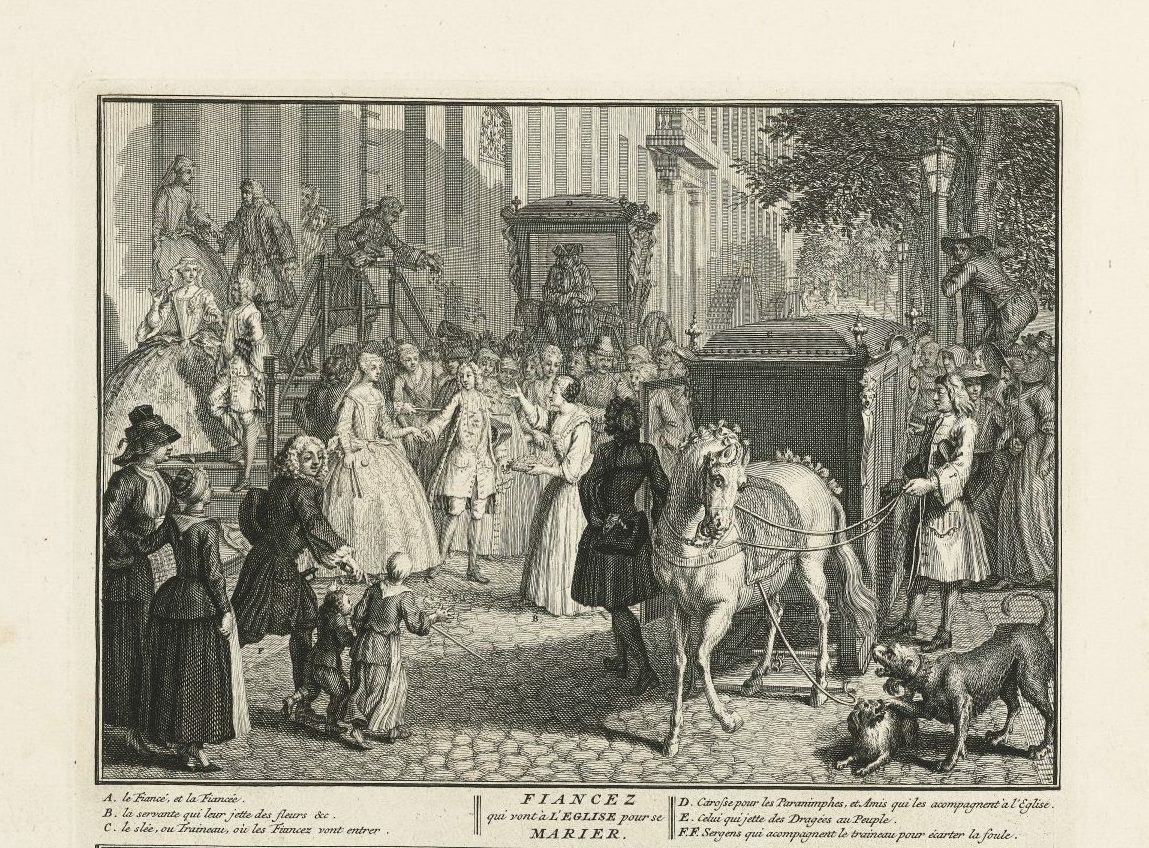
The specific Dutch ritual of the bride’s departure from her home was documented in an etched and engraved print, Bride and Bridegroom on Their Way to the Church/ Dutch Reformed Church Marriage Ceremony, 1730, by Bernard Picart (working in Amsterdam beginning in 1711) (fig. 5).29 An engaged couple leaves the bride’s home for their Dutch Reformed church wedding.30 Although impressions of Picart’s print sold individually, the artist also reproduced the image in his five-volume publication Cérémonies et coutumes religieuses de tous les peuples du monde (Ceremonies and religious customs of all the people of the world).31 In the Netherlandish edition of Picart’s volumes, the Dutch text that expounds upon the print Bride and Bridegroom on Their Way to the Church/ Dutch Reformed Church Marriage Ceremony references neighbours who watch the couple’s departure from the bride’s home. Notably, this passage corresponds to the instructions that Rembrandt inscribed under the drawing in which Rebecca leaves her parents’ house. The text in Picart’s publication advises that “the full splendour of the future spouses can be seen by all of the neighbours and the crowd of people, who approach from all sides of the house.”32 In Picart’s print, numerous figures, including neighbours, in everyday dress stand in the left foreground, the right middle ground, and in the background and they happily observe the departure of the engaged couple.33 On the right, a small boy has climbed a tree to get a better view. In the middle distance, a woman—perhaps late for the occasion—runs across a bridge in the direction of the foreground gathering. After a seventeenth-century Dutch wedding ceremony, a second traditional procession composed of the bride, her neighbours, and friends travelled together to meet the groom. The bride and celebrants made their way to the groom at his house or an inn, where elaborate wedding festivities typically took place.34 Although the scene in The Departure of Rebecca marks an earlier moment in a nuptial narrative, neighbours figure prominently in both Rembrandt’s call for their inclusion in the drawing and in their actual participation in the second type of Dutch wedding procession.
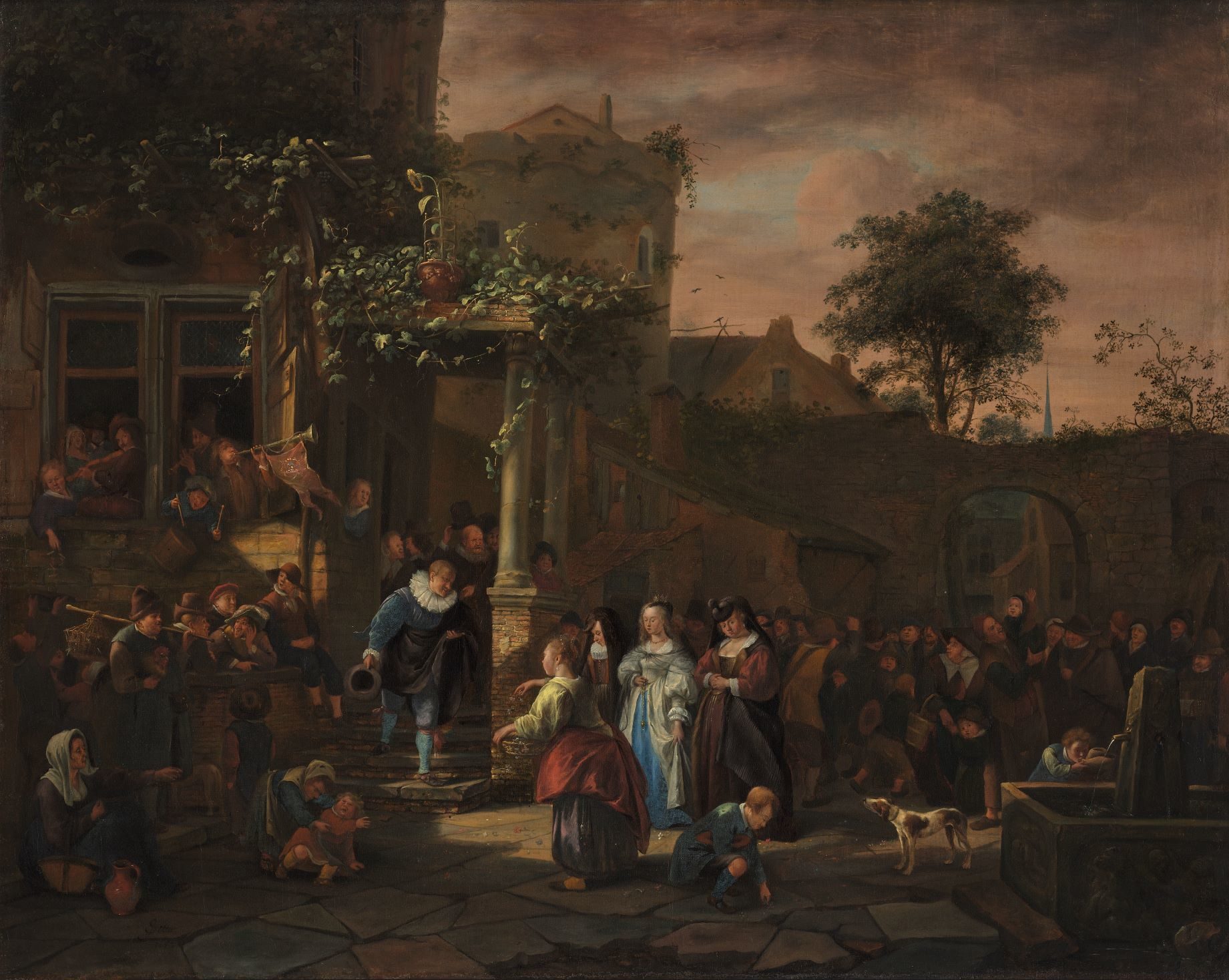
Jan Steen’s The Village Wedding, 1653, depicts the post-wedding parade of celebrants led by the bride (fig. 6). The groom descends the steps to greet his approaching wife, who is accompanied in the procession by family members, neighbours, and friends. As noted by Petra van Boheemen, in Steen’s scene “half the neighbourhood has run out to be present at the meeting” of the couple.35 Other seventeenth-century Dutch marriage customs also manifest the widespread engagement of neighbours in wedding-related events. Such traditions further contextualise the social practices invoked by Rembrandt’s instructions to include neighbours in the drawing of Rebecca’s departure to join her future groom. Elaborate celebratory meals occurred before, as well as after Dutch marriage ceremonies. Like family and friends, neighbours often received formal invitations to attend them.36 Sometime between 1590 and 1595, the Englishman Fynes Moryson noted in his journal of travels through the northern Netherlands that on the third day after a typical wedding ceremony, the couple invited their “neighbours and ordinary freundes” for “supper and dauncing.” His comments appear midst his more detailed observations about Dutch marriage celebrations.37 Preparations for engagement and wedding festivities began days in advance, included special food and drink, and often a dinner or banquet.38
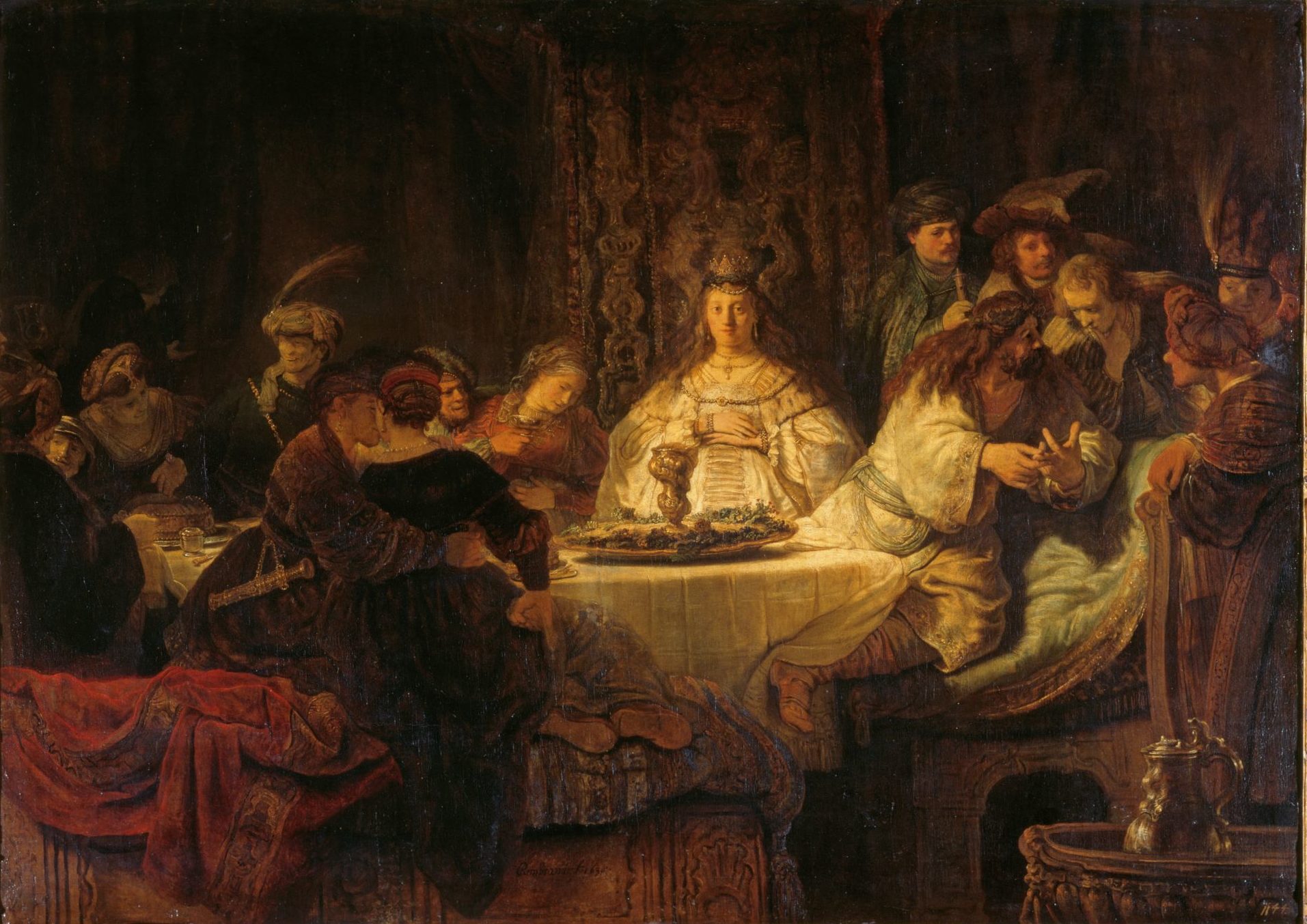
Several Old Testament pictures by Rembrandt and his contemporaries showcase wedding banquets with numerous guests.39 Viewers may have assumed the revellers included neighbours in a melding of lived experience with imagined history. Close in date to The Departure of Rebecca, c. 1637, Rembrandt’s painting The Wedding of Samson, 1638, stages several celebrants at the Old Testament meal (fig. 7). In comments on the painting four years later, a Leiden observer noted a similar blending of lived Dutch customs with the imagined biblical past. In his Lof der Schilder-konst (Praise of Painting), 1642, Philips Angel observed: “since all the guests are not concerned with one and the same matter, [Rembrandt] showed others making merry, not listening to [Samson’s] riddle, but holding up a glass of wine and laughing. Others were kissing—in short, it was a merry wedding feast . . . the actions were of the kind found in our modern wedding feasts.”40
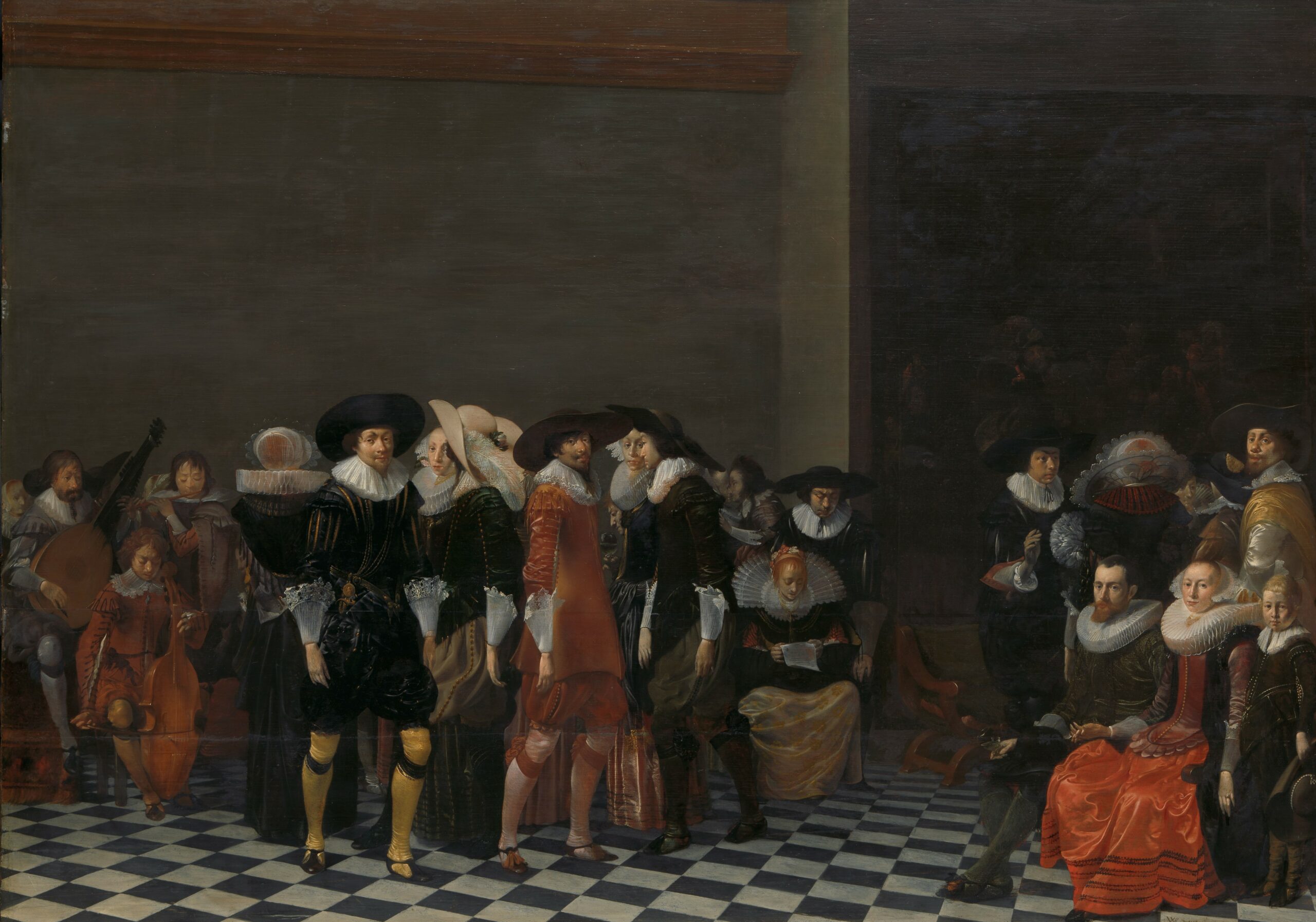
In addition to paintings of Old Testament wedding festivities, Dutch portraits of newly married couples place them midst their nuptial celebrations. Presumably, the wide range of guests included neighbours. Willem Cornelisz Duyster’s Wedding Feast, long known as “The Wedding of Adriaen Ploos van Amstel and Agnes van Bijler, 1616,” c. 1625, exemplifies such a celebration with numerous participants (fig. 8). Since the average size of an urban, Dutch nuclear family consisted of approximately three and three-quarter persons, including two children, but rarely extended family members, the large number of celebrants in Duyster’s painting suggests they include neighbours.41 Gatherings on domestic stoops as well as nuptial customs that neighbours shared provide a revealing context in which to elucidate Rembrandt’s inscription: “This should contain the figures of many neighbours who witness the departure of the noble bride.” Like other occasions staged in genre imagery, Old Testament scenes, and portraiture, The Departure of Rebecca includes engaged neighbours. Although Rembrandt’s biblical imagery has long been admired for its universal themes, the evocation of neighbourhood social practices in his inscription demonstrates that lived reality also informed his conception of the past. As a member himself of Leiden and Amsterdam neighbourhoods, Rembrandt valued the rich texture of neighbourly relationships in his own art and in that of his pupils. Linda Stone-Ferrier is a professor of seventeenth-century Dutch and Flemish art in the Kress Foundation Department of Art History at the University of Kansas. Her book, The Little Street: The Neighborhood in Seventeenth-Century Dutch Art and Culture, was published in August 2022 by Yale University Press. |
- Much of the previous literature cites the drawing as The Departure of Rebecca from Her Parents’ House. The Staatsgalerie, Stuttgart, which owns the drawing, adopted the shorter title (https://www.staatsgalerie.de/en/html).
- “dit behoorde vervoucht te weesen me[t] veel gebueren die deese hoge bruijt sien vertrek[k]en”: Peter Schatborn, “The Core Group of Rembrandt Drawings, I: Overview,” Master Drawings 49 (2011), p. 320.
- According to the Woordenboek der Nederlandsche Taal, “geburen” may mean “figures” or “bystanders,” as two scholars interpreted the word in Rembrandt’s inscription: (https://gtb.ivdnt.org/iWDB/search?actie=article&wdb=WNT&id=M017638.re.1&lemma=geburen&domein=0&conc=true). For “figures,” see: Volker Manuth, in: Rembrandt: A Genius and His Impact, exh. cat. Canberra, Australian National Gallery; Melbourne, National Gallery of Victoria, 1997, p. 270, cat. no. 53. For “bystanders,” see: Marieke de Winkel, Fashion and Fancy: Dress and Meaning in Rembrandt’s Paintings, Amsterdam 2006, pp. 214–215). However, in the full context of Rembrandt’s inscription and the drawing’s iconography, “geburen” most strongly refers to neighbours, as translated for example by Gary Schwartz and Peter Schatborn. See: Gary Schwartz, The Rembrandt Book, New York 2006, p. 107, fig. 195; Schatborn, “Core” (see note 2), p. 320.
- Schwartz, Rembrandt (see note 3), p. 107.
- Amy Golahny, “Rembrandt and ‘Everyday Life’: the Fusion of Genre and History,” in: Genre Imagery in Early Modern Northern Europe: New Perspectives, London 2016, pp. 174, 177.
- The Rembrandt drawing (130 x 185 mm) was sold at Christie’s (London) on 3 July 2012, lot. 50, sale 5688. Golahny, “Rembrandt” (see note 5), pp. 170–174, figs. 7.5–9.
- Herman Roodenburg, “Naar een etnografie van de vroegmoderne stad: de ‘gebuyrten’ in Leiden en Den Haag,” in: Cultuur en maatschappij in Nederland 1500–1850. Een historisch-antropologisch perspectief, Meppel 1992, p. 233.
- For a discussion of neighbourhoods’ goals, see: Herman Roodenburg, “’Freundschaft’, ‘Brüderlichkeit’ und ‘Einigkeit’: Städtische Nachbarschaften im Westen der Republik,” in: Ausbreitung bürgerlicher Kultur in den Niederlanden und Nordwestdeutschland, Münster 1991, pp. 11, 12, 21; Gabrielle Dorren, “Communities within the Community: Aspects of Neighbourhood in Seventeenth-Century Haarlem,” Urban History 25 (1998), pp. 180, 188.
- See, for example, Rembrandt’s drawings Benesch 491, 503, 566, 988 and his painting Portrait of a Couple as Isaac and Rebecca, c. 1665–1669 (oil on canvas, 121.5 x 166.5 cm, Amsterdam, Rijksmuseum).
- All Biblical translations from: The New English Bible with the Apocrypha, New York 1971.
- Schatborn, “Core” (see note 2), p. 320.
- The Staatsgalerie Stuttgart attributes the inscription to Rembrandt and the drawing to either Rembrandt or Gerbrand van den Eeckhout. Hans Martin Kaulbach, Curator of German and Netherlandish Prints and Drawings before 1800, Graphische Sammlung, Staatsgalerie Stuttgart, email message to the author, 25 April 2018.
- For Koninck see for example: Horst Gerson, Philips Koninck; ein beitrag zur Erforschung der holländischen Malerei des XVII. Jahrhunderts, Berlin 1936, p. 174, Z.LXV. For Flinck: Wilhelm Reinhold Valentiner, Rembrandt: des Meisters Handzeichnungen, Stuttgart 1933, part 2, p. 247. For Van den Eeckhout: Martin Royalton-Kisch, Drawings by Rembrandt and His Circle in the British Museum, exh. cat., London, British Museum 1992, p. 202, cat. no. 97; Holm Bevers, “Drawing in Rembrandt’s Workshop,” in: Drawings by Rembrandt and His Pupils: Telling the Difference, exh. cat., Los Angeles, J. Paul Getty Museum 2009, p. 27; Schatborn, “Core” (see note 2), pp. 320, 322, note 38. For an argument against the Van den Eeckhout attribution, see: Eric Jan Sluijter and Nicolette Sluijter-Seijffert, “Rembrandt’s Pupils? The Attribution of Early Drawings to Gerbrand van den Eeckhout and Jan Victors,” in: Connoisseurship Essays in Honour of Fred G. Meijer, Leiden 2020, pp. 289–296.
- Werner Sumowski, Drawings of the Rembrandt School, New York 1979–1992, vol. 3, p. 1734, 806xx; Bevers, “Drawing” (see note 13), pp. 27, notes 97–98.
- Seymour Slive, Rembrandt Drawings, Los Angeles 2009, p. 215; Schatborn, “Core” (see note 2), p. 320; Bevers, “Drawing” (see note 13), p. 2.
- Cornelis Hofstede de Groot and Bob Haak, Rembrandt Zeichnungen, Köln 1974, p. 13; Manuth, Rembrandt (see note 3), p. 270, cat. no. 53.
- Samuel van Hoogstraten, De Inleyding tot de hooge schoole der schilderkunst anders de zichtbaere werelt, Rotterdam 1678, p. 192. Bevers, “Drawing” (see note 13), p. 25, notes 86–87.
- Bevers, “Drawing” (see note 13), pp. 25–27, 187, 189–90; Schatborn, “Core” (see note 2), p. 320.
- Bevers, “Drawing” (see note 13), p. 27.
- Roodenburg, “Naar” (see note 7), pp. 222–224; Dorren, “Communities” (see note 8), p. 177; Llewellyn Bogaers, “Geleund over de onderdeur: Doorkijkjes in het Utrechtse buurtleven van de vroege middeleeuwen tot in de zeventiende eeuw,” in: Bijdragen en mededelingen betreffende de geschiedenis der Nederlanden 112 (1997), pp. 349, 357, 359.
- Roodenburg, “Naar” (see note 7), pp. 224, 233–234; Bogaers, “Geleund” (see note 20), pp. 340–342, 348.
- Catherina Lis and Hugo Soly, “Neighborhood Social Change in Western European Cities,” International Review of Social History 38 (1993), p. 5.
- Kees Walle, Buurthouden. De geschiedenis van burengebruiken en buurtorganisaties in Leiden (14e–19e eeuw), Leiden 2005, pp. 75, 306.
- Regionaal Archief Leiden (RAL); Stadsarchief (SA) II inv.nr. 1216, f. 149 and RAL SA II inv.nr. 1217, f. 10 vso; cited in: Walle, Buurthouden (see note 23), p. 231, note 77.
- Jan le Francq van Berkheij, Natuurlyke historie van Holland, 12 parts in 9 vols., Amsterdam 1769–1811, vol. 3, part 2, pp. 1045–1046; Roodenburg, “Naar” (see note 7), p. 225.
- RAL; SA II inv.nr. 16; Aflezingboek F, f. 58 vso; cited in: Walle, Buurthouden (see note 23), pp. 43, 227, notes 141, 270.
- Algemene Verordening, n.p.; cited in: Walle, Buurthouden (see note 23), pp. 46, 275.
- Roodenburg, “’Freundschaft’” (see note 8), p. 15; Bogaers, “Geleund” (see note 20), p. 349.
- Ilja Veldman and Lynne Richards, “Familiar Customs and Exotic Rituals: Picart’s Illustrations for Cérémonies et coutumes religieuses de tous les peuples,” Simiolus: Netherlandish quarterly for the history of art, vol. 33 (2007/2008), p. 94.
- Picart’s widow explained that “the prints of the Reformed congregation were drawn from life and are very accurate.” Bernard Picart and Anne Vincent, Impostures innocentes ou recueil d’estampes d’après divers peintres illustres . . . etc. gravées par Bernard Picart avec son éloge historique et le catalogue de ses ouvrages, Amsterdam 1734, p. 9; Veldman and Richards, “Familiar” (see note 29), p. 99, note 20.
- Veldman and Richards, “Familiar” (see note 29), p. 97.
- Bernard Picart, Cérémonies et coutumes religieuses de tous les peuples du monde, Amsterdam 1723–1743, p. 345.
- As Petra van Boheemen noted, the “interest of the neighbourhood is visible” in Picart’s print. Petra van Boheemen et al., Kent, en versint, eer datje mint: vrijen en trouwen, 1500–1800, Apeldoorn, Historisch Museum Marialust; Zwolle 1989, p. 170.
- Van Boheemen, Kent (see note 33), pp. 170–172; H. Perry Chapman, Jan Steen, Painter and Storyteller, exh. cat., Washington, DC, National Gallery of Art; Amsterdam, Rijksmuseum 1996, pp. 116–118 note 1, cat. no. 6.
- Van Boheemen, Kent (see note 33), p. 170.
- Irma Thoen, Strategic Affection? Gift Exchange in Seventeenth-Century Holland, Amsterdam 2007, p. 106.
- Fynes Moryson and Charles Hughes, Shakespeare’s Europe. Unpublished Chapters of Fynes Moryson’s Itinerary Being a Survey of the Condition of Europe at the End of the 16th Century, London 1903, pp. 379–380.
- A. Lynn Martin, Alcohol, Sex, and Gender in Late Medieval and Early Modern Europe, New York 2001, pp. 52–53; Thoen, Strategic (see note 36), p. 105.
- See, for example, Jan Steen’s The Wedding of Tobias and Sarah, c. 1667–1668, oil on canvas, 131 x 172 cm, Braunschweig, Herzog Anton Ulrich-Museum; Chapman, Jan Steen (see note 34), pp. 203–205, cat. no. 32.
- Philips Angel, Lof der schilder-konst, Leyden 1642, p. 48. Translation from: Philips Angel, Michael Hoyle, and Hessel Miedema, “Philips Angel, Praise of Painting,” Simiolus, Netherlandish Quarterly for the History of Art 24 (1996), p. 246.
- A. M. van der Woude, “Variations in Size and Structure of the Household in the United Provinces of the Netherlands in the Seventeenth and Eighteenth Centuries,” in: Household and Family in Past Time: Comparative Studies in the Size and Structure of the Domestic Group over the Last Three Centuries in England, France, Serbia, Japan and Colonial North America, with Further Materials from Western Europe, Cambridge 1972, p. 315.