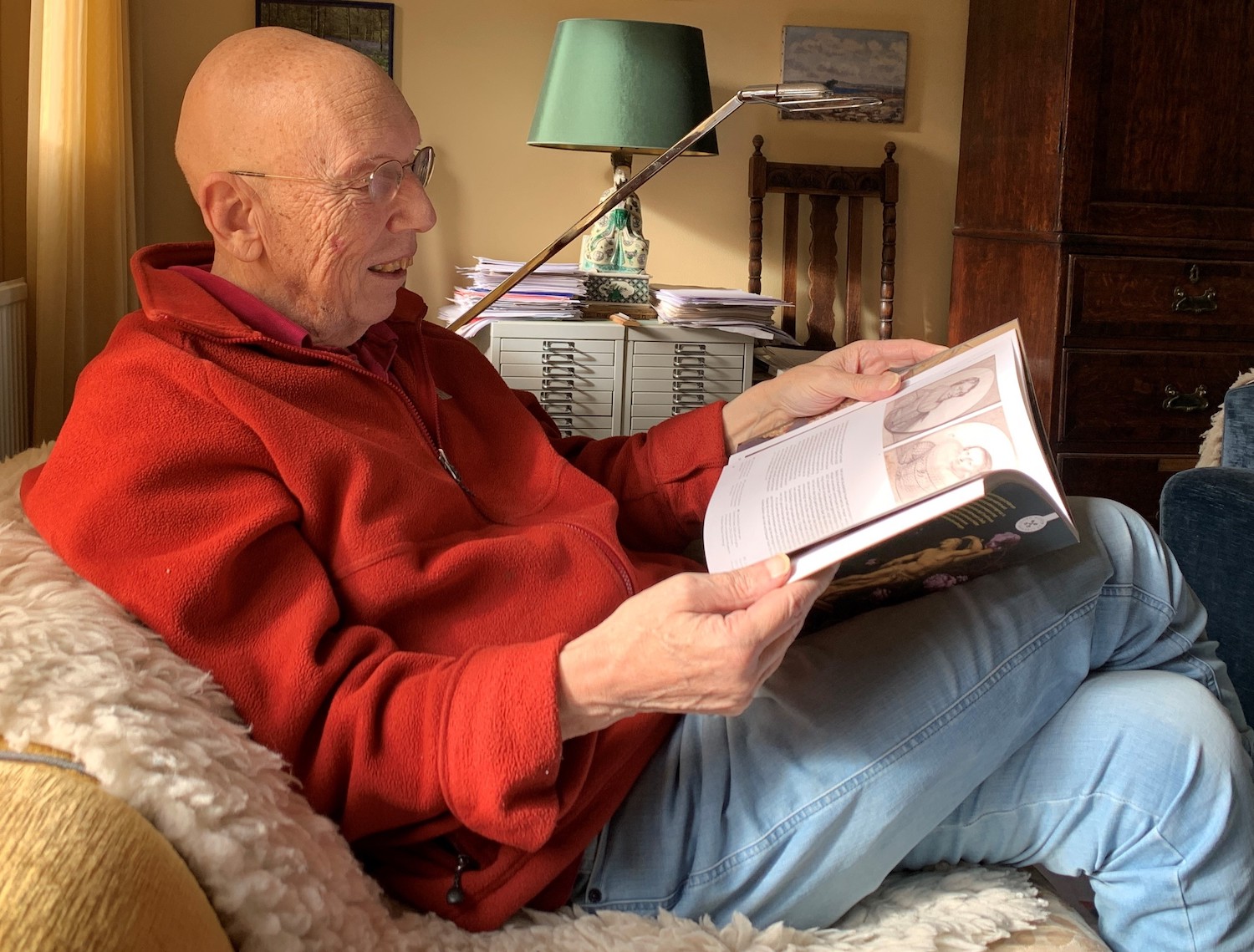
With the passing of Sébastien Abraham Corneille Dudok van Heel on 20 January 2025 at the age of 86, we have lost a distinguished archivist, historian and art historian, and a distinct voice and colourful character within the field of Rembrandt studies. Bas, as he was known to his family, friends and colleagues, was a free and independent spirit, sharp-minded and outspoken, with an infectious sense of humour. His home was always open to family and friends as well as to colleagues from around the world; he was an exceptionally generous host.
When it came to scholarship, Bas was uncompromising, some might even say stubborn. Facts to him were essential for any kind of research, and disregard for them was unacceptable. Bas presented his views with great conviction and could be impatient and unforgiving in academic discourse. At the same time, sitting in the corner of his sofa by the window overlooking the Prinsengracht, and in his last home the Reguliersgracht, Bas was generous with his time and loved to share his own findings, his phenomenal knowledge, and his opinions. Many will fondly remember his unique way of talking about Amsterdamers of past centuries as if they were neighbours. Bas connected easily with younger generations, despite never having operated a computer or a smart phone. His writings revolved around sixteenth- and seventeenth-century Amsterdam, its art and people and their place in history and society, long before ‘contextualising’ became a buzzword.
Born in Bergen-op-Zoom and raised in Amersfoort, Bas moved to Amsterdam after a brief stint as an assistant teacher; the city remained his home for the rest of his life. From 1969, he was employed by the City Archives Amsterdam (then called Gemeentearchief). Bas soon passed the oral exam required to read history at the University of Amsterdam (as he did not have the relevant secondary school qualifications); he graduated in 1979. Aged 63, he took early retirement from the Archives. Bas was proud that he overcame subsequent challenges and obtained his PhD in art history at Radboud University in Nijmegen in 2006.
Bas’s interest in Rembrandt developed at the Archives under the tutelage of the eminent scholar of Amsterdam, Isabella H. van Eeghen (1913-1996). It is probably fair to say that Bas initially took inspiration more from documents relating to Rembrandt than the artist’s works. His visit to the paintings section of the vast exhibition at the Rijksmuseum in 1956, celebrating the 350th anniversary of Rembrandt’s birth left him far from impressed. The 18-year-old was deeply disappointed by what he recalled decades later vividly as the “poepkleuren” (poo colours) of most paintings on display. The 300th anniversary of Rembrandt’s death in 1969 provided him with a first occasion to publish, unleashing a steady stream of articles and essays, many devoted to the artist’s life and work, over the following 50 years.
With his groundbreaking Rembrandt biography for the catalogue of the memorable exhibition in Berlin, Amsterdam and London (1991-1992), Bas reshaped the understanding of the artist. A thorough analysis of the Rembrandt documents (to the publication of which, in 1979, he had contributed significantly) placed the artist firmly in his artistic and social environment. He included pioneering maps of Amsterdam, pinpointing the homes of the artist, colleagues, patrons and collectors, visualising his essential social networks. He also threw more light on Rembrandt’s often questionable behaviour towards contemporaries, including his partner Geertje Dircx. Bas elaborated on the latter aspect in the biography for the exhibition catalogue Rembrandt’s Women (Edinburgh and London 2001), an essay that was also published separately by the Rembrandt House Museum.
His PhD thesis, De jonge Rembrandt onder tijdgenoten (The Young Rembrandt among Contemporaries, 2006), based on seminal, revised and enlarged articles, contains a wealth of information, including on artists such as Pieter Lastman and his circle. It places Rembrandt and his art in the context of the religious confrontations of the 1620s and 1630s. Bas continued to elaborate upon themes of this book, for example on Hendrick Uylenburgh’s workshop and its significance for portraiture in Amsterdam, exploring Rembrandt’s role, and suggesting an intriguing cameo appearance of Frans Hals, in 1633. He summarised the fruits of this research in his last publication on Rembrandt, for the exhibition catalogue Rembrandt and Amsterdam Portraiture 1590-1670 (Madrid 2020).
While this latter essay is available in English, most of Bas’s articles appeared in Dutch, in periodicals such as Maandblad and Jaarboek van het Genootschap Amstelodamum, Kroniek van het Rembrandthuis, Jaarboek van het Centraal Bureau voor Genealogie and De Nederlandsche Leeuw. It is to be hoped that his PhD thesis and a selection of his ground-breaking articles will be made accessible in English in the future, to benefit international Rembrandt research.
Many will remember Bas as an outstanding Rembrandt scholar, but he was a prolific author on a wide range of subjects and artists, from Jacob Cornelisz to Frans Hals and Jacob de Wit, and from the history of collecting to that of the full-length portrait in Amsterdam, among others.
However, his magnum opus is Van Amsterdamse burgers tot Europese aristocraten (From Amsterdam Burghers to European Aristocrats), a multi-volume monument to his decades-long research in the archives. It explores an early 15th-century Amsterdam couple and the three branches of their family. Their patrician descendants for centuries dominated the economy, politics and culture, at first in Amsterdam, subsequently expanding across the Dutch Republic, its colonies, and beyond. The books contain a staggering wealth of information and will remain immensely useful to historians, genealogists, heraldists, and social as well as art historians. The first two volumes were published in 2008, followed by volumes IV to VI in 2024, together covering two of the three branches of the family. Volume III, containing the essays accompanying the latter volumes, was finished shortly before Bas died and a group of dedicated friends and colleagues is working towards its publication in the near future.
Suffering from poor eyesight since childhood, Bas never rode a bicycle – highly unusual in the Netherlands – but walked whenever possible. Building on this fitness, he took to bodybuilding in his early eighties. And, as was characteristic of him, he did so systematically and with enormous discipline, and thus also with the desired, visible results – of which he was very proud. It was this extraordinary strength of mind and body that allowed him to complete his magnum opus during the final two years of his life, even while suffering from terminal cancer.
Bas Dudok van Heel will live on through his profound scholarship, and in our memories. Many of us have not only lost a special colleague but also a dear friend.
Christian Tico Seifert
Senior Curator (Northern European Art), National Galleries of Scotland, Edinburgh