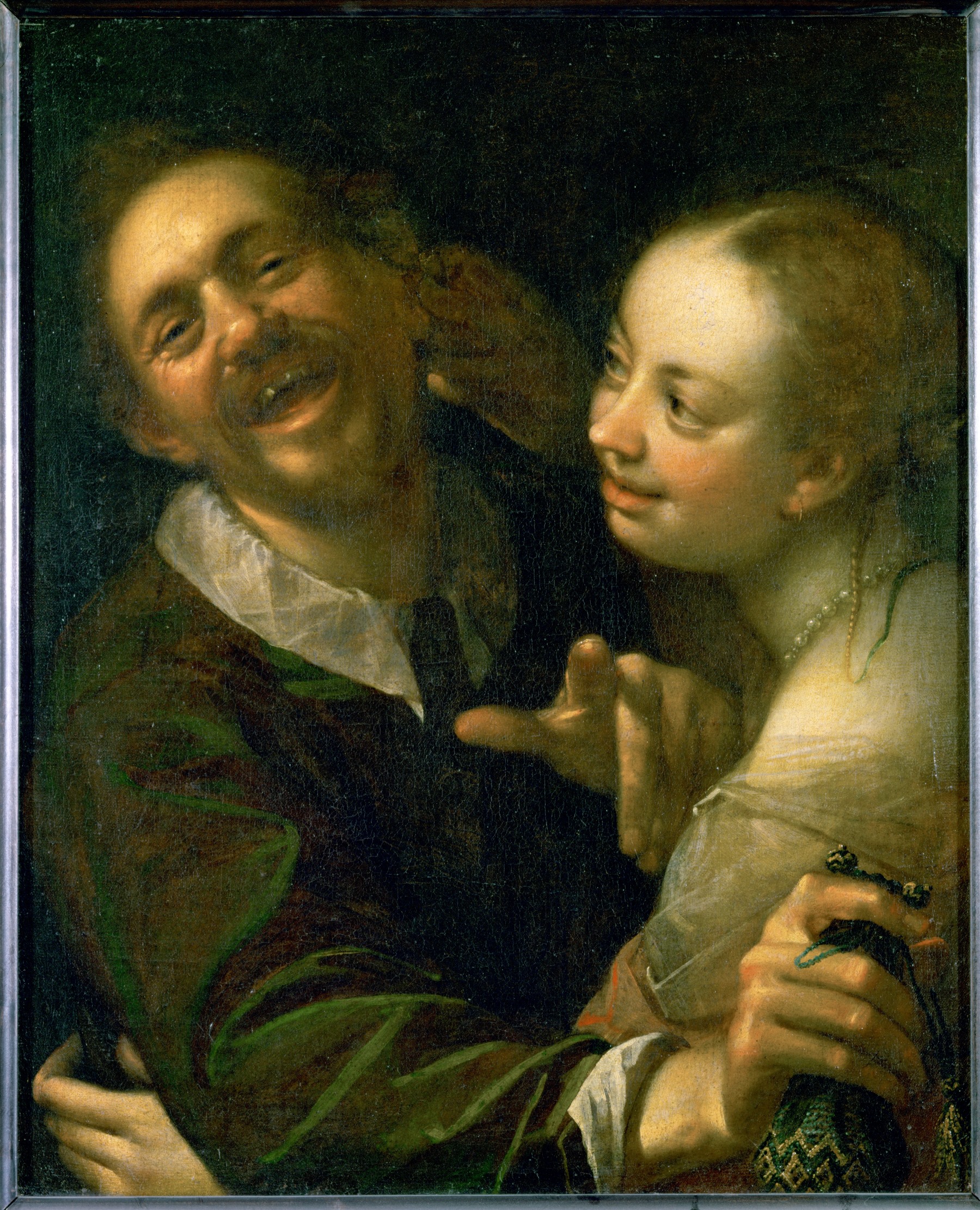
All of us who have followed Stephanie Dickey’s distinguished career know that it would be reductive to describe her simply as a ‘Rembrandt scholar’, notwithstanding the many valuable contributions she has made to the study of this preeminent artist. For Stephanie’s impressive scholarly output over the years has encompassed a wide variety of topics that extend well beyond Rembrandt and his artistic followers. One essay of hers caught my attention quite some time ago: ‘Strategies of Self-Portraiture from Hans von Aachen to Rembrandt’, published as part of the proceedings of the international conference, Hans von Aachen in Context, held in Prague in 2010. Admittedly, the title of Stephanie’s contribution includes Rembrandt’s name, but her main focus here is upon Von Aachen (1552-1615), particularly what she terms his ‘transgressive self-portraits’ (fig. 1).1 In illustrating what is best described as raucous behaviour, these comical and entertaining pictures purposely violate contemporary conventions of gentlemanly and artistic propriety, as expounded by such art theorists as Karel van Mander.2 Their appearances deceive, however, because they served various purposes, inter alia, to demonstrate stylistic flexibility and painterly virtuosity, and to attract prospective patrons – and, hence, to promote artistic enterprise.3
Stephanie outlines the critical early role that Von Aachen played in the development of what has come to be known as artist-as-rogue self-portraits.4 She goes on to discuss the precedents he established for later examples by Rembrandt van Rijn, namely his well-known Self Portrait with Saskia in a Tavern (Dresden, Gemäldegalerie), and Jan Steen’s Self-Portrait as a Lutenist (Madrid, Museo Thyssen-Bornemisza).5 Stephanie concludes her contribution by exploring an intriguing link between these self-portraits and early modern concepts of masculinity and its performance among young men. Thus, she reasons, ‘the transgressive self-portrait should arise as an experiment undertaken by youthful male artists’.6
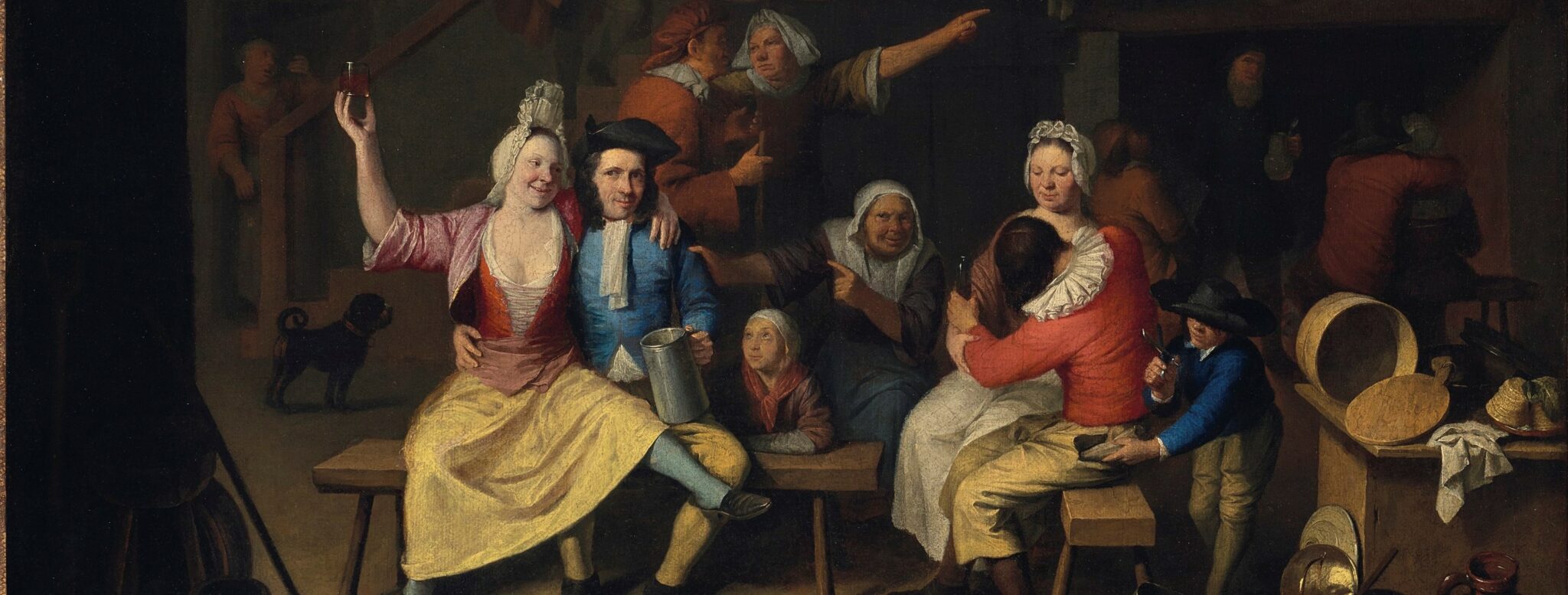
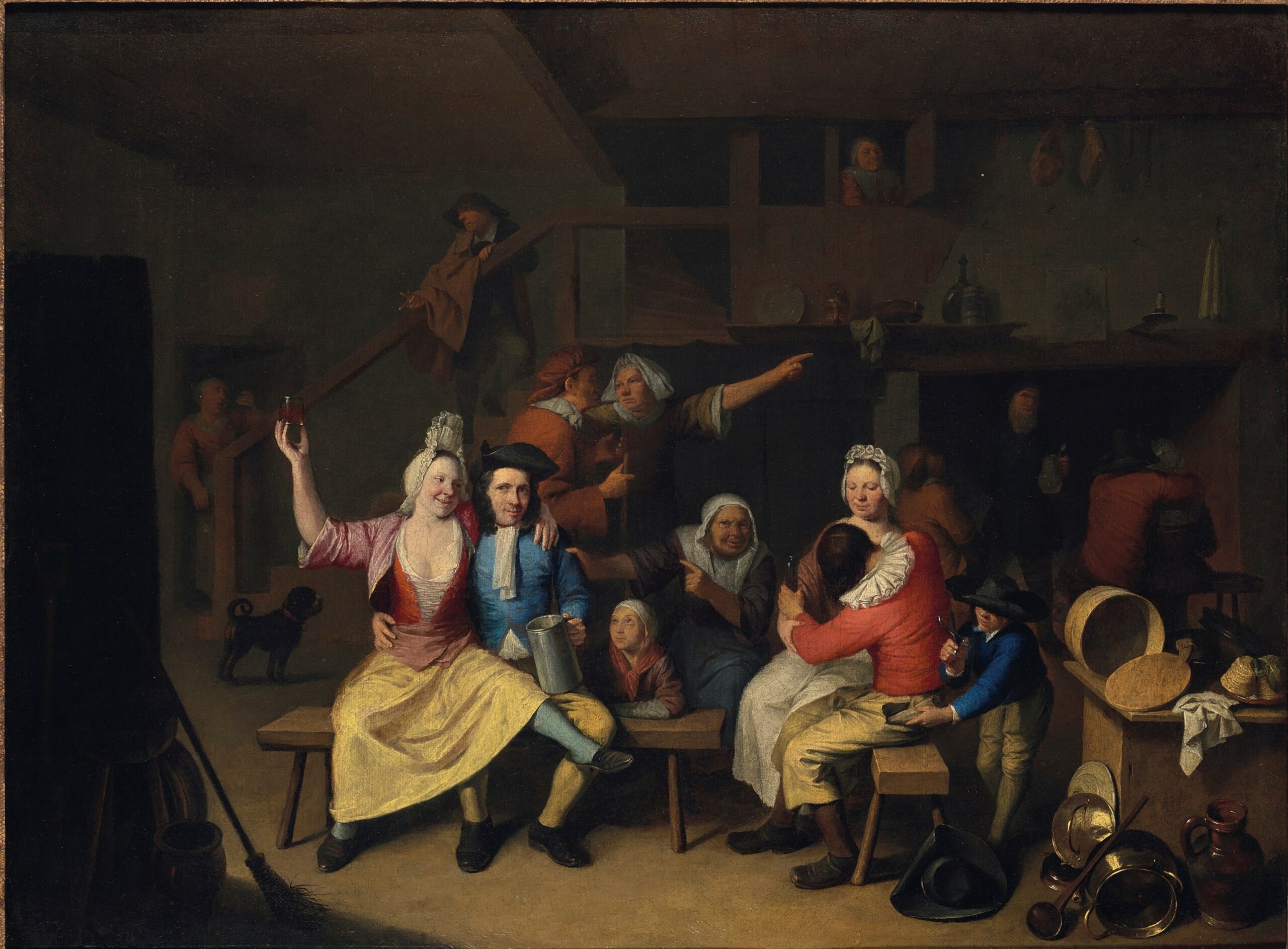
Stephanie’s informative essay reminded me immediately of a picture that she and I have discussed in the past. In this case, however, the painting — unlike the examples considered in her article — dates from the late seventeenth century and was executed by a now obscure, painter: Nicolaes van Haeften (c. 1663–1715), A Tavern Scene, signed and dated 1696 (fig. 2).7
Van Haeften is no Hans von Aachen and certainly no Rembrandt, but his work is still fascinating. It is only in recent years that he has finally attracted well-deserved attention. As it turns out, this artist is an ancestor of the prominent old-master art dealer, Johnny van Haeften, who staged the first-ever Nicolaes van Haeften show at his former gallery on Duke Street in London during the summer of 2012: A Long-Neglected Master: Nicolaes van Haeften. At the core of this exhibition were the twenty-six assorted paintings and prints by the artist that his art-dealing descendent owns. Twenty-six is an impressive number because only thirty paintings and some forty-eight prints by the artist are known today.
Two years after the London exhibition, Fred Meijer published the first and, to date, only study of Van Haeften, in the form of a short article that appeared in a Festschrift.8 Despite consisting of only an eight-page text, Meijer’s article was groundbreaking in that it presented an informative survey of the artist’s life and career. The peripatetic Van Haeften was born in 1663 in the town of Gorinchem in the south-east of the Dutch Republic. Seven years later, in 1670, he moved with his parents to the city of Rotterdam. Van Haeften most likely received his artistic training there, presumably during the late 1670s. The heyday of Rotterdam’s artistic prominence lay between the years 1630 and 1670; in other words, it was already on the wane when Van Haeften began to prepare for his career.9 There were still a decent number of active painters in the town, many of whom specialised in genre paintings depicting peasants, which would become our master’s main subject matter.
The impact of seventeenth-century Flemish genre painting was also significant for Van Haeften’s future career. Rotterdam’s proximity to the Southern or Spanish Netherlands virtually guaranteed the relocation of Flemish painters, who decades earlier had helped to swell the numbers of resident artists, to this Dutch city. Moreover, the influence of such Flemish masters as Adriaen Brouwer and David Teniers the Younger would be keenly felt.10 Rotterdam thus developed a reputation for peasant imagery painted in the circle of the so-called ‘Dutch Teniers Group’, including, among others, Pieter de Bloot and Cornelis Saftleven.11 Saftleven was still alive when Van Haeften began his apprenticeship and, incidentally, both men had been born in Gorinchem. Regardless, we do not know where or with whom Van Haeften studied. Meijer has called attention to the similarities between Van Haeften’s art and that of Pieter Jacobsz Duyfhuysen.12 The latter died in 1677 when our artist was just fourteen years of age, but perhaps he received some rudimentary tutelage from that older master.
In 1690, when he was twenty-six or twenty-seven, Van Haeften moved to Antwerp, the principal centre for Flemish painting in the Spanish Netherlands. While his name is not found in the records of the Antwerp painters’ guild, one of his etchings thankfully provides evidence of his sojourn there because it is inscribed, ‘the first of my life in Antwerp’.13 No doubt, the impact of Flemish genre painting upon his work and that of his Rotterdam colleagues induced this move. Even so, Van Haeften was not finished traveling. In 1694 or 1695, he resettled permanently in Paris, working in the French capital until his death in 1715.14 In essence then, he is a Dutch painter merely by birth, because he practiced a Flemish style of painting primarily in the service of the Antwerp and Paris art markets.
Returning to the painting under consideration here, one can easily detect the artist’s appropriations of Brouwer’s well-known stylistic and iconographic prototypes. These include the box-like construction of the interior space with a peeping figure, in this instance, a taciturn old woman peering out of an upper-floor window, observing the boisterous shenanigans unfolding in the room below her. Van Haeften must have been particularly impressed with what might be termed the ‘psychological nuances’ that Brouwer explores through the ingenious facial and body language of his figures. A Tavern Scene is particularly masterful in its transient facial expressions, which serve so well to capture the rowdy atmosphere of this transgressive space. The foreground figures, all arrayed on two wooden benches, are wonderfully rendered with individualised faces, including the grinning, dishevelled prostitute, who leans against her similarly inebriated client.15 This man’s hat is askew; he holds an immense tankard in hand, while gazing directly at the viewer. Just to the right of this pair, an elderly woman points at the drunkard and, with a scowl, likewise addresses the viewer. In between them, a wistful young girl is deftly portrayed. Van Haeften has captured the innocence of childhood, as this girl stares in wonder at the dissolute adults seated beside her. Moving further to the right in the foreground, we encounter another prostitute who looks down dispassionately at a drunken, hatless man whose face is buried in her cleavage. Just below this pair, a boy, likely the woman’s accomplice, relieves her unfortunate client of some sort of object, perhaps his purse.
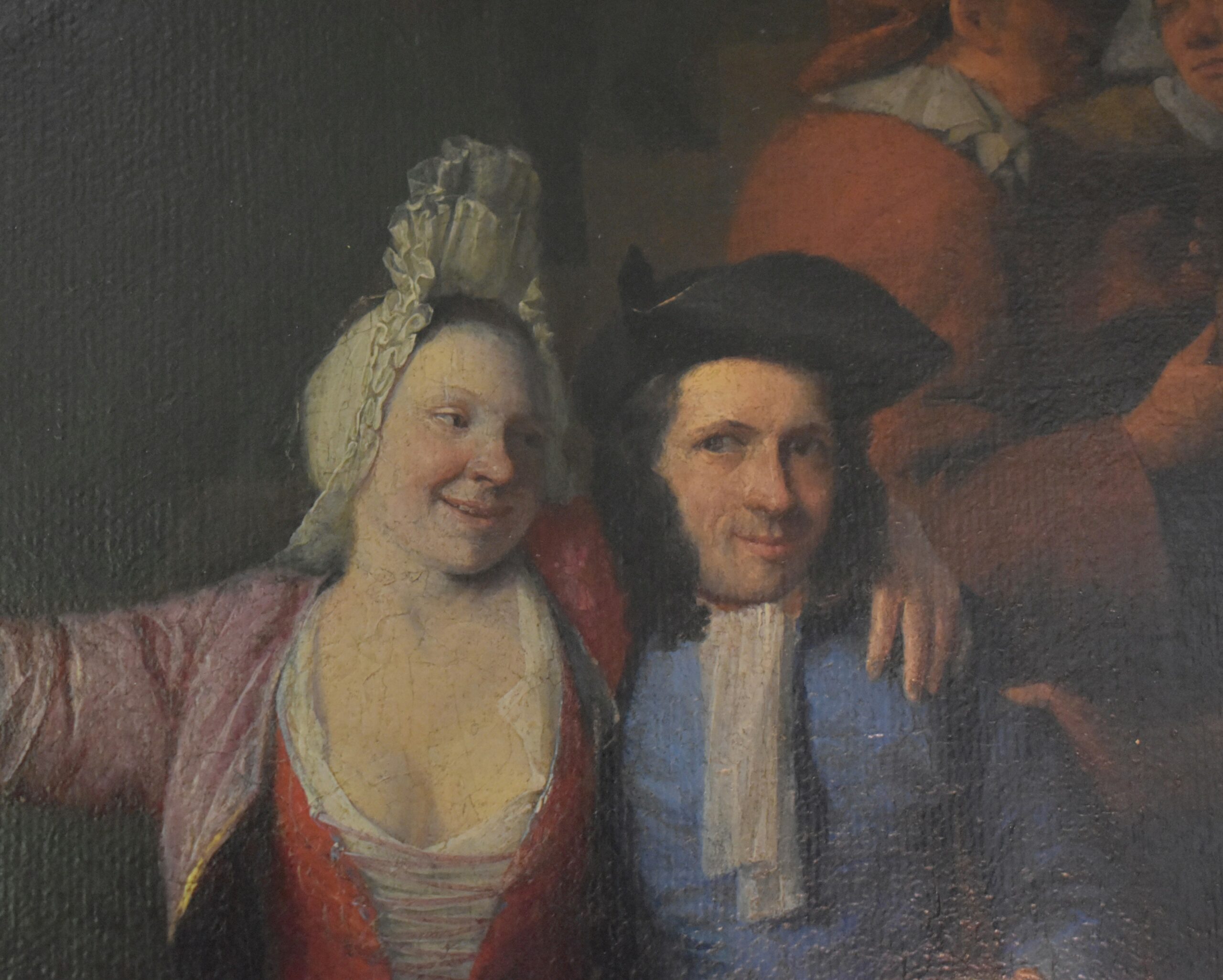
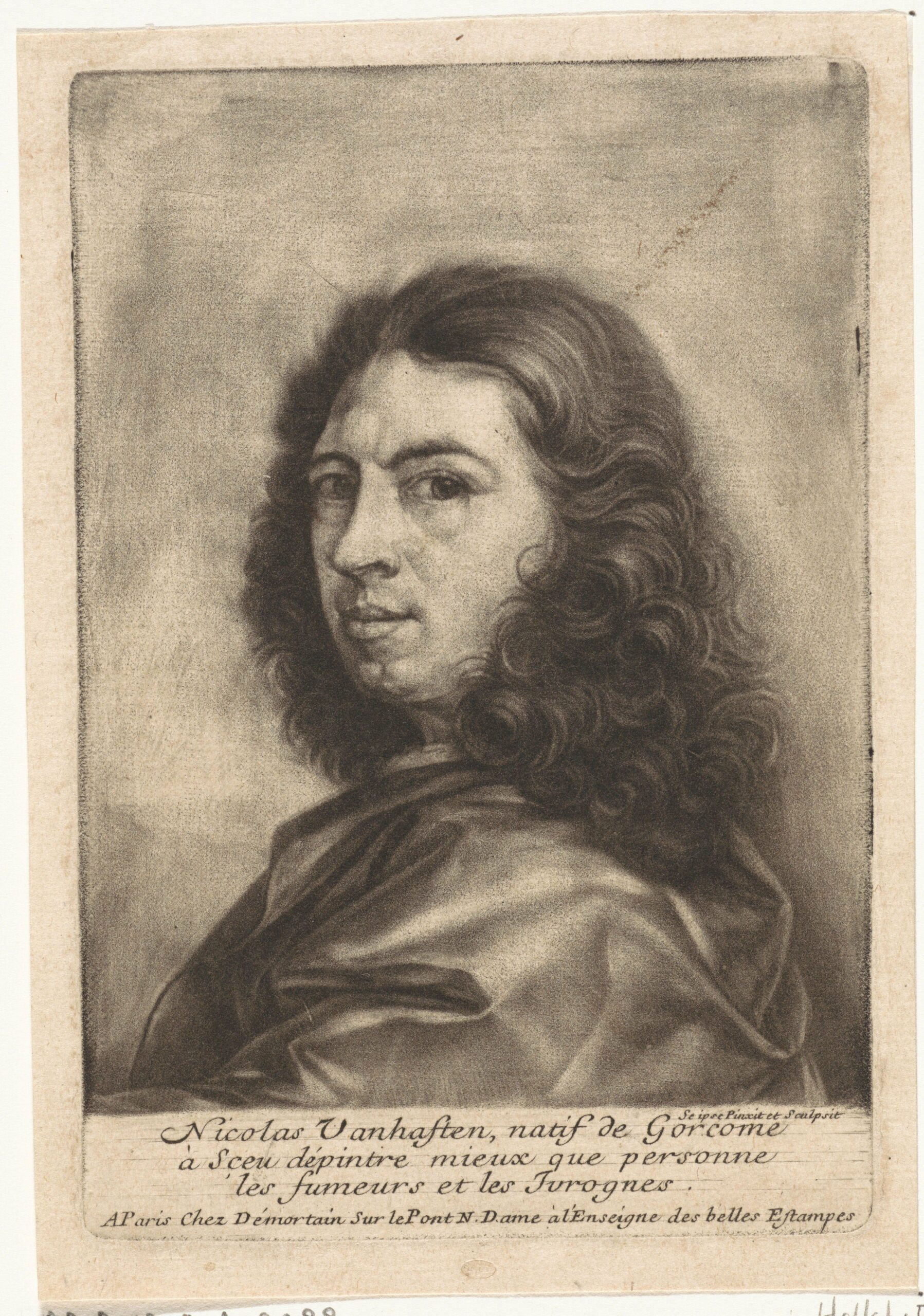
What has hitherto escaped notice is that the drunkard seated in the foreground is, in fact, a self-portrait of the artist. This is easily confirmed by comparing his face to that of his undated Self-Portrait mezzotint and engraving that was likely executed in the 1690s, so potentially concurrent with the canvas (figs. 3-4).16 Regardless of the Tavern Scene’s comparatively late date of creation, it participates in the artist-as-rogue self-portrait tradition whose early manifestations Stephanie so skilfully explored in her Von Aachen article. By engaging the viewer and carefully positioning himself just off-centre in this rambunctious tavern scene, Van Haeften declares his virtuosic command of rowdy, boisterous subject matter while implying, in a most entertaining fashion, his full participation in such disreputable goings-on.
Van Haeften’s specialty, low life subject matter, was appreciated in the Dutch Republic, but perhaps more so in Antwerp given that city’s longstanding pictorial traditions for showing peasants and other riffraff in art. This probably induced his move there in 1690. But by the late seventeenth century, the market for genre painting in Antwerp had experienced a decline in tandem with that of the city’s overall artistic and economic fortunes.17 While Van Haeften had probably encountered less competition there from rival painters, he did quit Antwerp, as we have seen, for Paris, around 1694-95. Perhaps the declining commercial possibilities in Antwerp, given its lacklustre economy, persuaded him to move on to one of Europe’s largest cities, where he could seek his fame and fortune. There, he could produce pictures with distinctly Netherlandish subject matter such as A Tavern Scene, which served to promote his artistic prowess and secure for him ample financial rewards.
Further light can be shed on this when one surveys the state of French painting around that time. During the late seventeenth century, it was dominated by the Royal Academy of Painting and Sculpture. Nearly all the major French painters of the day were trained at the academy and held memberships there, which was their principal means of securing commissions. With an aesthetic grounded in classical antiquity and Renaissance art, painters privileged the portrayal of Bible stories, mythology and ancient history since these were considered the most estimable subjects in art. Nevertheless, there existed in Paris a market for pictures of low-life subjects painted in a Flemish manner, regardless of the nationalities of their creators. The Parisian centre for this imagery was the Pont Notre-Dame and its surrounding neighbourhood, with most practitioners having memberships in the Académie de Saint-Luc.18
It is noteworthy that the business of the publisher and printer of Van Haeften’s portrait was located on this very same bridge (see fig. 4). This portrait print was therefore issued at the Parisian heart of this commercial enterprise associated with the production and distribution of ‘Flemish’ imagery. This neighbourhood was thus part of the lively market for both Dutch and Flemish art in Paris, fostered by foreign artists living there, but aided, in part, by the activities of professional art dealers.19
Van Haeften died in 1715, in the very same year as France’s longest serving monarch, the Sun King, Louis XIV (ruled 1643-1715). In the last years of that king’s reign, there was a general relaxing of artistic and aesthetic standards, which only accelerated following his death.20 This paved the way for artists such as Jean Antoine Watteau, whose wide-ranging, often Flemish-inspired genre paintings included bawdy portrayals of country folk.21 The market for low-life painting in early eighteenth-century France was never large, but it is nevertheless conceivable that Van Haeften played some role in its formation, even if it was only a minor one. In the end, Van Haeften emerges as a well-travelled artist who resided in three countries during his career. This fact and the multiple sources and subjects of his art suggest that Dutch seventeenth-century genre painting was neither a purely isolated phenomenon nor an exclusively Dutch one.22
- Stephanie S. Dickey, ‘Strategies of Self-Portraiture from Hans von Aachen to Rembrandt’, in: Lubomír Konečný and Štěpán Vácha, eds., Hans von Aachen in Context: Proceedings of the International Conference, Prague 22-25 September 2010, Prague 2012, pp. 72-81.
- Dickey, ‘Strategies of Self-Portraiture’ (see note 1), pp. 74-75, 77-78.
- Dickey, ‘Strategies of Self-Portraiture’ (see note 1), pp. 76-78.
- For the artist-as-rogue in seventeenth-century Dutch and Flemish art, see Ingrid A. Cartwright, ‘Hoe schilder hoe wilder: Dissolute Self-Portraits in Seventeenth-Century Dutch and Flemish Art’, PhD dissertation, University of Maryland, College Park 2007, http://hdl.handle.net/1903/7720.
- Dickey, ‘Strategies of Self-Portraiture’ (see note 1), pp. 76-78.
- Dickey, ‘Strategies of Self-Portraiture’ (see note 1), p. 80.
- Van Haeften’s painting, now in a private collection, was acquired by its present owner at the anonymous sale, Paris (Christie’s), 15 September 2020, lot 53. It was shown in the exhibition Da hverdagen stjal billedet – i Holland og Danmark, Nivå: Nivaagaards Malerisamling, 28 January-16 June 2024.
- Fred G. Meijer, ‘Nicolaes van Haeften, Prints and Paintings’, in: Edwin Buijsen et al., eds., Kunst op papier in de achttiende eeuw; Liber Amicorum aangeboden aan Charles Dumas ter gelegenheid van zijn 65ste verjaardag, Zoetermeer 2014, pp. 142-153. The following remarks are heavily indebted to Meijer’s publication. He briefly discusses the painting under consideration here on p. 147
- For a survey of painting in seventeenth-century Rotterdam, see Nora Schadee, ed., Rotterdamse meesters uit de Gouden Eeuw, exh. cat. Rotterdam: Historisch Museum Rotterdam, 1994.
- For Teniers, see Margret Klinge and Dietmar Lüdke, eds., David Teniers der Jüngere 1610-1690: Alltag und Vergnügen in Flandern, exh. cat. Karlsruhe: Staatliche Kunsthalle Karlsruhe, 2005. For Brouwer, see Katrien Lichtert, ed., Adriaen Brouwer: Master of Emotions. Between Rubens and Rembrandt, exh. cat. Oudenaarde: MOU – Museum van Oudenaarde en de Vlaamse Ardennen, 2018.
- For Saftleven, see Wolfgang Schulz, Cornelis Saftleven 1607-1681: Leben und Werke. Mit einem kritischen Katalog der Gemälde und Zeichnungen, Berlin and New York 1978.
- Meijer, ‘Nicolaes van Haeften’ (see note 8), p. 142. For Duyfhuysen, see Willem L. van de Watering, ‘Pieter Duyfhuysen (1608-1677): een reconstructie van het oeuvre van een vergeten Rotterdamse schilder van boereninterieurs’, in: Henning Bock and Thomas W. Gaehtgens, eds., Holländische Genremalerei im 17. Jahrhundert: Symposium Berlin 1984, Jahrbuch Preussischer Kulturbesitz, Sonderband 4, Berlin 1987, pp. 357-383.
- See Meijer, ‘Nicolaes van Haeften’ (see note 8), pp. 145-146, fig. 4, ‘het eersten van mijn leven tot antwerpen’.
- Stephanie Levert, ‘Étrangers, mais habitués en cette ville de Paris‘: Les artistes néerlandais à Paris (1550-1700). Une prosopographie, PhD dissertation, Utrecht University 2017, vol. 2, dossier prosopographique, s.v., Van Haeften, points out that Van Haeften returned to Antwerp at least once, in 1700, so possibly at other times as well.
- On prostitution and its imagery in seventeenth-century Dutch art, see Lotte van de Pol, ‘The Whore, the Bawd, and the Artist: The Reality and Imagery of Seventeenth-Century Dutch Prostitution’, Journal of Historians of Netherlandish Art 2 (2010), no. 1-2, https://doi.org/10.5092/jhna.2010.2.1.3; Lotte van de Pol, The Burgher and the Whore: Prostitution in Early Modern Amsterdam, Oxford 2011. For the iconography of tavern, brothel and Prodigal Son, see Konrad Renger, Lockere Gesellschaft: Zur Ikonographie des Verlorenen Sohnes und von Wirtshausszenen in der niederländischen Malerei, Berlin 1970. For prostitution in fifteenth and sixteenth-century German and Netherlandish art, see the recent study by Frank Schmidt, Prostitution im Bild: zur visuellen Konstruktion von Bordelldarstellungen in der frühen Neuzeit, Regensburg 2025. A comparable study of this scope on prostitution in seventeenth-century Dutch art is still lacking.
- This print (fig. 4), bears the address of the Paris publisher Gilles de Mortain, and includes an inscription recording the artist’s native city. More significantly, it lists smokers and drinkers as the specialities in which he excelled, just like Brouwer before him: ‘Nicolas Vanhaeften, natif de Gorcome / à Sçeu dépintre mieux que personne / les fumeurs et les Ivrognes’. Meijer, ‘Nicolaes van Haeften’ (see note 8), p.151 note 2, transcribes the last word as ‘Turognes’, which he translates as tronies, which is not correct; the old French word for drunkards is ivrognes. Von Aachen’s picture, and for that matter, Rembrandt’s as well, feature the artists’ wives playing the roles of their painted companions; both works are often said to portray the Prodigal Son in a tavern. It is tempting to recognize the facial features of Van Haeften’s wife, Marie Michelle de Vuoll, in the foreground prostitute in his Tavern Scene, but this cannot be ascertained because there is no known portrayal of her.
- For overviews of Antwerp’s economic and artistic fortunes, see Herman van der Wee and Jan Materné, ‘Antwerp as a World Market in the Sixteenth and Seventeenth Centuries’, in: Jan van der Stock, ed., Antwerp, Story of a Metropolis: 16th-17th Century, exh. cat. Antwerp: Hessenhuis, 1993, pp. 19-31; and Arnout Balis, ‘Antwerp, Foster-Mother of the Arts: Its Contribution to the Artistic Culture in Europe in the Seventeenth Century’, in: Van der Stock, Antwerp, pp. 115-127.
- See Guillaume Glorieux, ‘Les peintres-marchands du pont Notre-Dame: une production organisée de tableaux ‘flamands’ pour Lille et sa région’, in: Sophie Raux, ed., Collectionner dans les Flandres et la France du Nord au XVIIIe siècle, Villeneuve d’Ascq 2005, pp. 139–145; Mickaël Szanto, ‘The Pont Notre-Dame, Heart of the Picture Trade in France (16th–18th Centuries)’, in: Neil De Marchi and Sophie Raux, eds., Moving Pictures. Intra-European Trade in Images, 16th–18th Centuries, Turnhout 2014, pp. 77–91. My thanks to Jochem van Eijsden for his insights in this regard.
- For Dutch and Flemish artists living in Paris, see Levert, Étrangers (see note 14). Documentation of the dealings of Paris-based art dealers with Dutch and Flemish painters survives; see, for example, Neil De Marchi and Hans J. Van Miegroet, ‘Novelty and Fashion Circuits in the Mid-Seventeenth-Century Antwerp-Paris Art Trade’, Journal of Medieval and Early Modern Studies 28 (1998), pp. 201-246; and Wayne Franits, Godefridus Schalcken: A Late 17th-Century Dutch Painter in Pursuit of Fame and Fortune, London 2023, p. 55.
- See Jay Caplan, In the King’s Wake: Post-Absolutist Culture in France, Chicago and London 1999; and Julie Anne Plax, Watteau and the Cultural Politics of Eighteenth-Century France, Cambridge and New York 2000. See also the literature cited in note 21 below.
- M. Crawford Volk, Rubenism, Bell Gallery, Brown University (Providence, RI, 1975), pp. 109-145; Oliver T. Banks, Watteau and the North: Studies in the Dutch and Flemish Baroque Influence on French Rococo Painting, New York and London 1977; François Moureau, ‘Watteau in His Time’, in: Margaret Morgan Grasselli and Pierre Rosenberg, Watteau 1684-1721, exh. cat. Washington: National Gallery of Art, 1984, pp. 469-506; Donald Posner, Antoine Watteau, Ithaca 1984, pp. 12-107; and Hervé Oursel et al., Au temps de Watteau, Fragonard et Chardin: Les Pays-Bas et les peintres français du XVIIIe siècle, exh. cat. Lille: Musée des Beaux-Arts, 1985. See also the literature cited in note 20 above.
- See Karolien De Clippel, ‘Two Sides of the Same Coin? Genre Painting in the North and South during the Sixteenth and Seventeenth Centuries’, Simiolus 32 (2006), no. 1, pp. 17-34; Krista De Jonge, Rudi Ekkart and Tom Verschaffel, with Karolien De Clippel, ‘La fracture entre les Pays-Bas du Nord et les Pays-Bas du Sud’, Perspective (2011), no. 2, pp. 627-640, https://doi.org/10.4000/perspective.697; and Karolien De Clippel and Filip Vermeylen, ‘In Search of Netherlandish Art: Cultural Transmission and Artistic Exchanges in the Low Countries, an Introduction’, De Zeventiende Eeuw 31 (2015), no. 1, pp. 2-17. The last is the introduction to a special issue of the journal devoted to cultural transmission and artistic exchange, mainly between the northern and southern Low Countries.