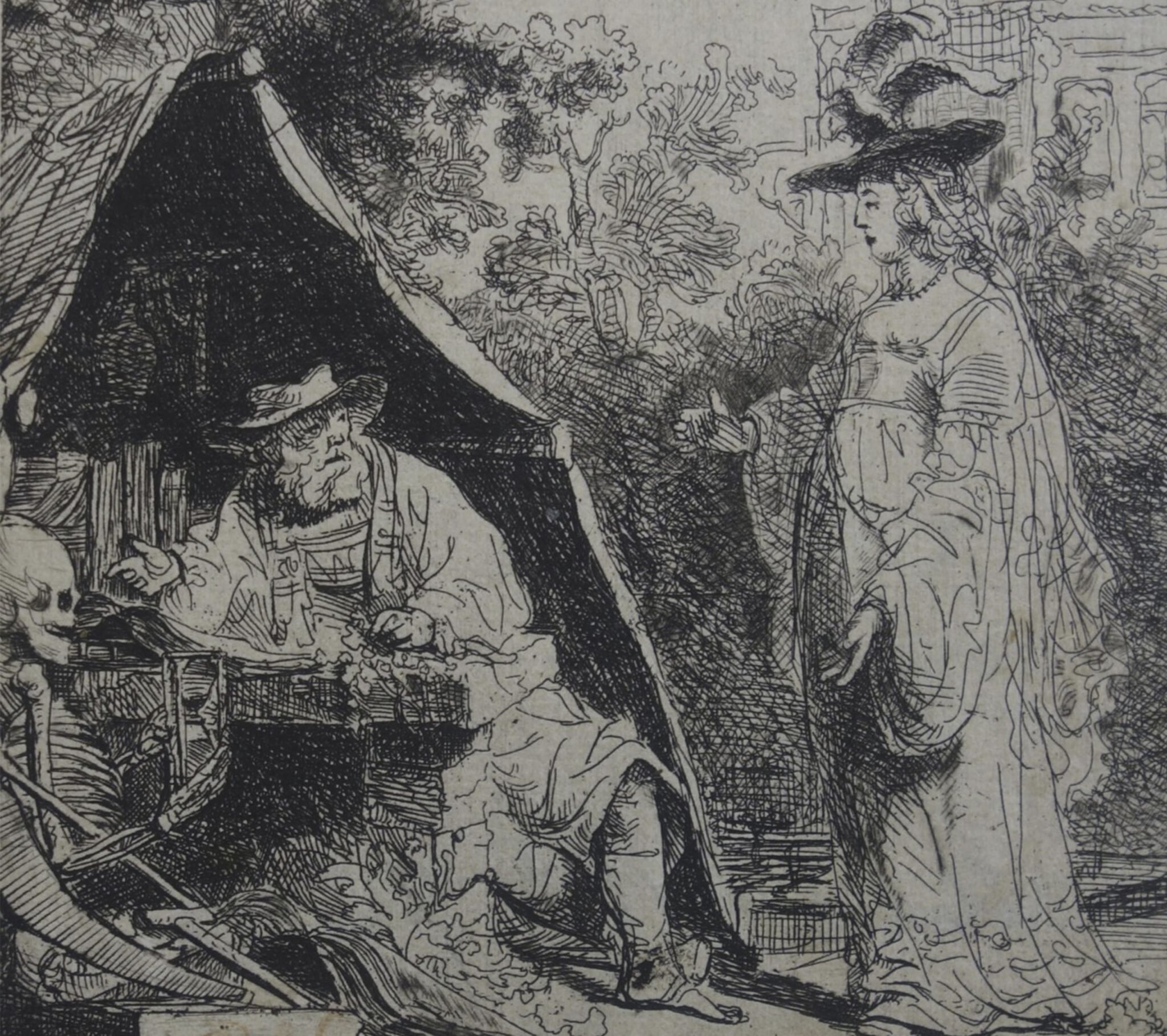
The Rembrandt pupil Ferdinand Bol is known primarily for his paintings, being one of the most sought-after portraitists in Amsterdam from the mid-1650s through the 1660s, who also received extremely prestigious public commissions from the City of Amsterdam and The Admiralty through the 1660s.1 Print scholars and enthusiasts know him as one of only a few of Rembrandt’s pupils who also etched, leaving us with approximately 20 prints. One of his earliest efforts in the medium is the etching known as The Hour of Death (fig. 1). New research into its publication as a book illustration changes its place in Bol’s earliest period as a printmaker, and its relationship to his early paintings as well.2
It has been commonly thought that Bol made this etching as an illustration for Jan Krul’s (1601/2 – 1646) Pampiere Wereld, first published in 1644.3 This book was a compilation of some of Krul’s writings. Bol’s etching was added to one of the texts in the book, a moral dialogue called Den Christelyken Hovelingh.4However, this was not the earliest publication of this text. It had already appeared separately in Amsterdam, in 1642, with Bol’s etching included after the title page.5 It was in its fourth state, and was subsequently modified again for inclusion in the Pampiere Wereld.
The new terminus ante quem of 1642 places The Hour of Death among the group of Bol’s earliest datable prints. These include the Old Man with Flowing Beard and Velvet Cap (H.9), and Portrait of an Officer (H.12), both of 1642. The majority of Bol’s prints (approximately thirteen or fourteen of approximately twenty) seems to have been made in the years 1641/2-1645, evidently a period of substantial interest in the medium in the years immediately after Bol had left Rembrandt’s studio.6 His departure is marked by his earliest signed and dated painting, Gideon’s Sacrifice (Museum Catharijneconvent, Utrecht), of 1640.7
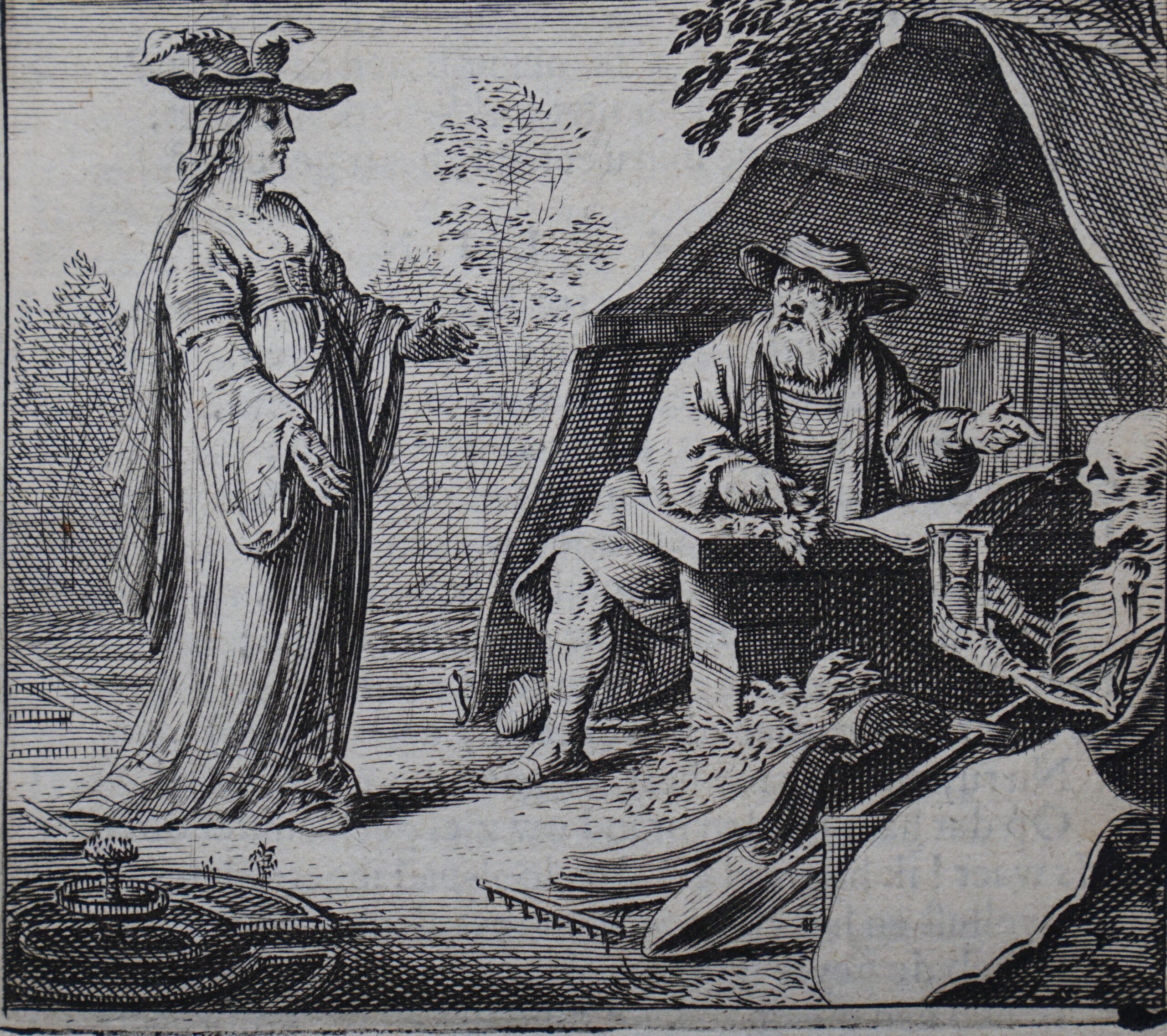
Copies of this first edition of Krul’s Den Christelyken Hovelingh of 1642, incorporating Bol’s print as the frontispiece, are extremely rare. It is likely that it was published in a very limited edition by the author himself.8 Krul himself also likely published the Pampiere Wereld in 1644, in a lavish folio edition.9 Around the same time he also published an octavo edition, but without giving the publisher, location, or date. The date of 1644 does however appear with an excerpt of the privilege inside, and on the title page of the play Theodorus and Dianira (on p. 297).10 The same printer, Jan Jacobsz Schipper, produced both editions, but did not include Bol’s etching in the smaller format, instead replacing it with an anonymous copy, one which has not been described previously (fig. 2).11 Only seven of the 94 illustration plates of the folio edition of 1644 were of a size such that they would fit in the smaller octavo edition (16.9 x 10.4 cm) of 1644-1645. Of these seven, all appeared in the latter volume except for Bol’s etching, although it would have been small enough (13.3 x 9.0 cm), likely because the lower price of the edition would not have justified the wear of the fine etching plate. It was likely a financial calculation in what were difficult economic times for Krul.12 Krul’s text appeared in yet another volume of his works, in 1650, again without Bol’s print. Other earlier and later editions of that volume contain neither Krul’s Den Christelyken Hovelingh, nor Bol’s print.13 A later edition of the 1644 anthology, containing a previously unidentified later state of the original Hour of Death, appeared in Amsterdam in 1681, this time in quarto format.14
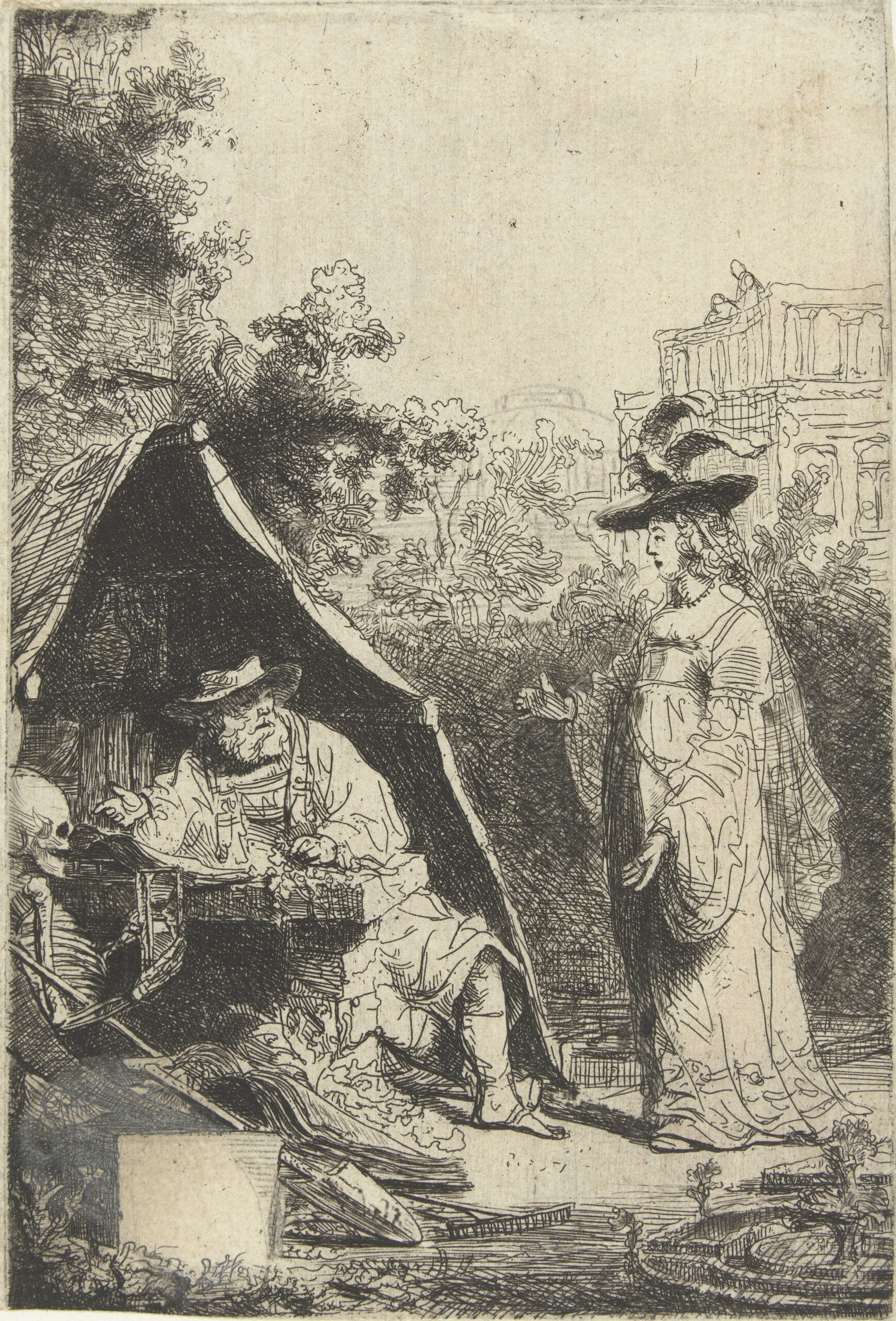
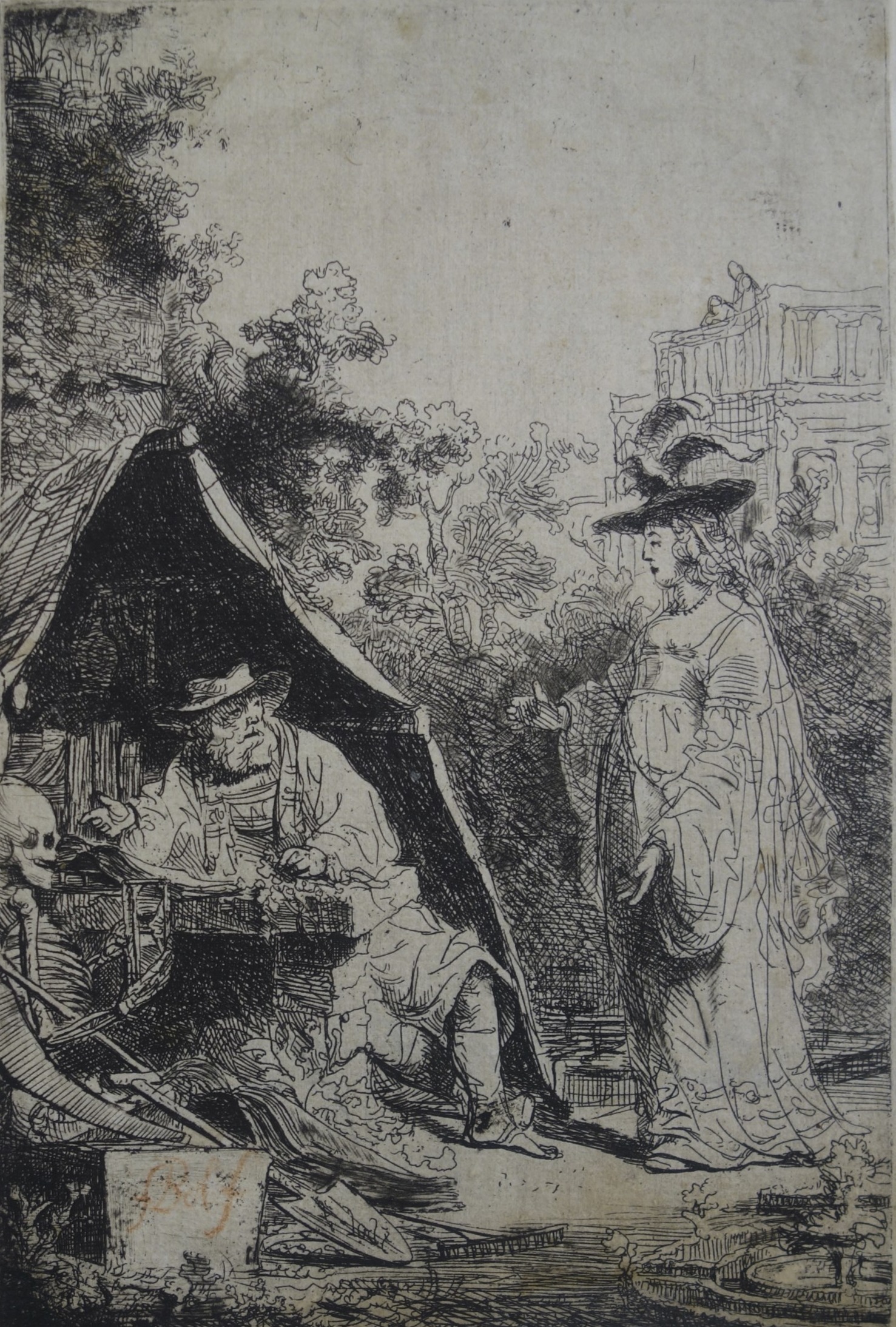
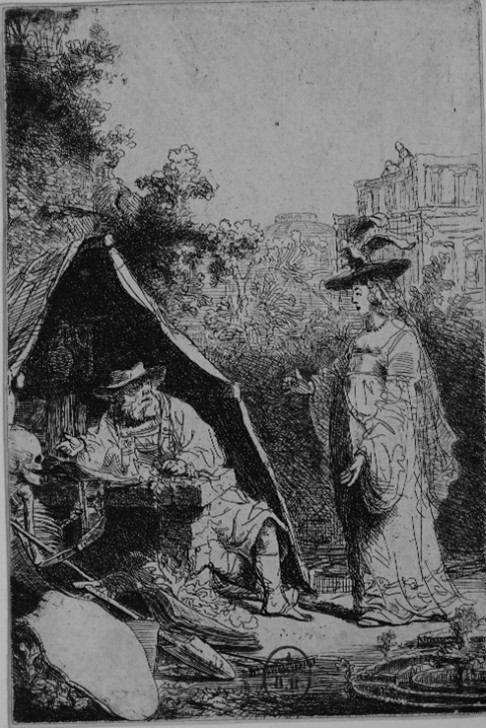
In the process of arriving at the frontispiece for Den Christelyken Hovelingh, Bol went through at least three known proof states of the plate, printed in very low numbers and remaining extremely rare. The composition was already largely laid out in the first state, known only from an impression in the Albertina (DG 72373) (fig 1.). It is a touched proof, with Bol’s name added in red chalk to the blank square that appears to be the end of a coffin, to the lower left (fig. 3). Bol’s signature can be seen etched on the blade of the spade, in reverse, so this appears to have been a proposal for a change. His signature on the end of the coffin was not however included in the second state, even though in the second state his name on the spade is partially erased. The second state has substantial changes to the plate.15 The need arose to include a Latin text, for which the space at the end of the coffin was too small (see below). An outline of a cartouche is visible in retouching in white body colour, of the unique impression of the second state (Rijksmuseum, Amsterdam [RP-P-OB-189]), stretching out beyond the small confines of this space.
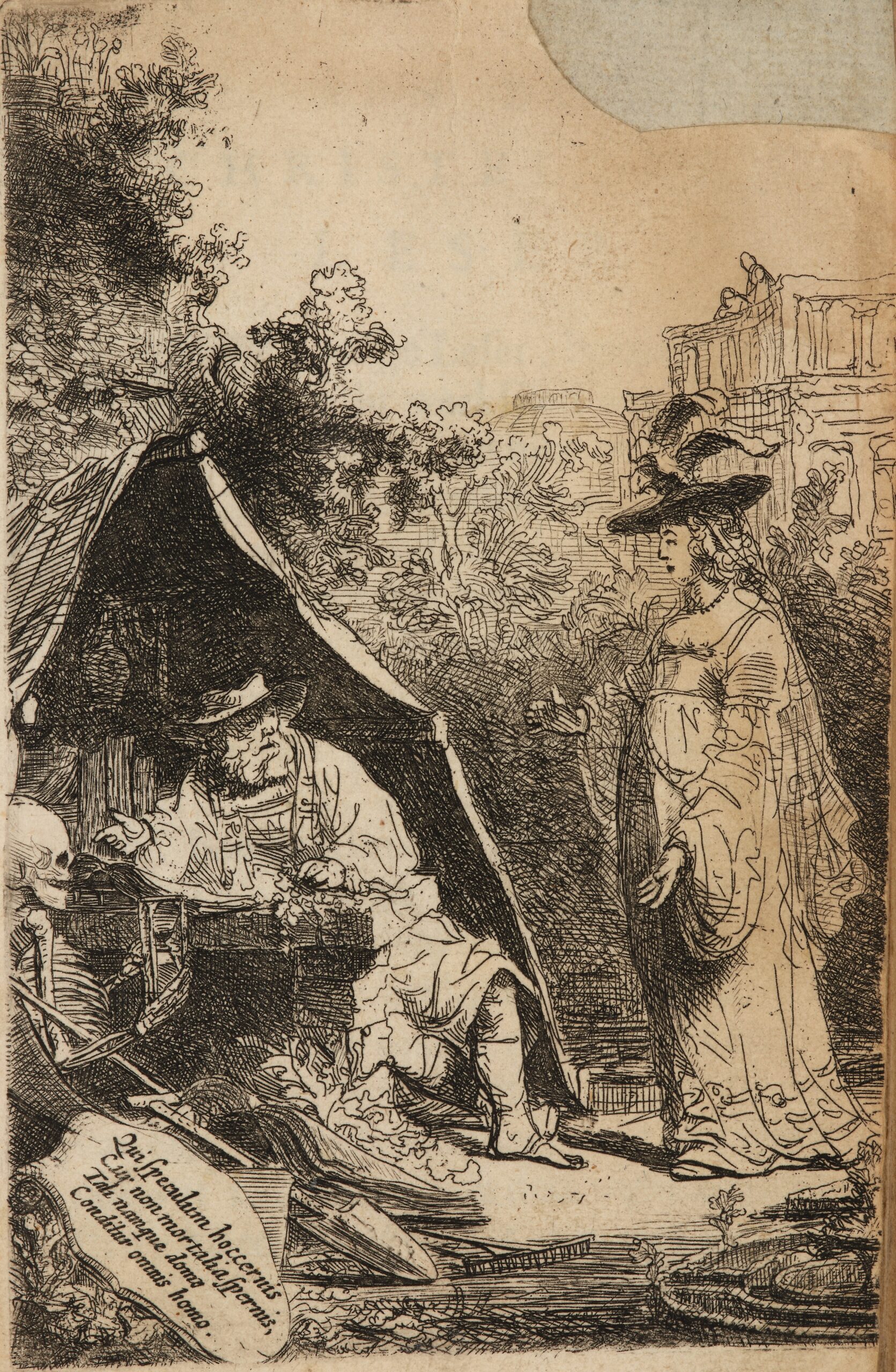
Bol proceeded to plan further changes in this proof, which appear in the third state, of which only two impressions are known (Paris [Reserve Cb-13(A, 37)-Boite Ecu]; and Munich [1921-16]; fig. 4). He incorporated the cartouche for the Latin inscription, but left the lettering to be added, likely by a specialized letter engraver.16 This occurred in the fourth state, which was used for the initial publication of Den Christelyken Hovelingh in 1642 (fig. 5).
 |  |
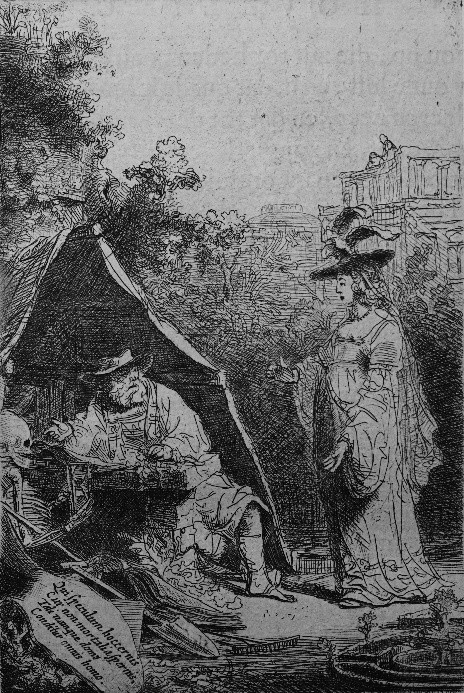
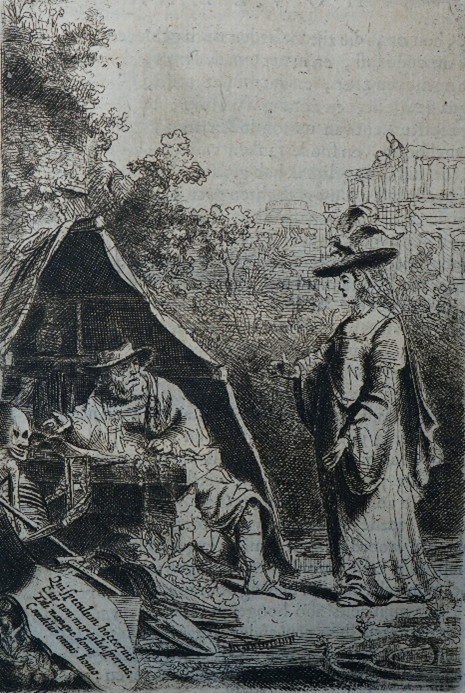
With each of the following publications of the print, the plate was altered. The fifth state incorporates changes to the background, addition of details, and reworking, and was included in the 1644 edition of Krul’s book (fig. 6).17 A critical review of the hand suggests that, contrary to previous assumptions, Bol was no longer involved. This very obviously applies to the crude reworkings of the sixth state, included in the 1681 volume (fig. 7).18 The print was undoubtedly commissioned by Krul, who may have known Rembrandt.19 Krul may have been aware, as well, of Rembrandt’s etching known as The Ship of Fortune, of 1633 [B. 111, NH 123] as it had appeared one year later in the publication of Elias Herckmans’s narrative poem: Der Zee-Vaert lof Handelende vande gedenckwaerdighste Zee [‘In Praise of Sea-Faring’], (Amsterdam, 1634). By the early 1640s, Bol had also developed literary connections. Van Sloten has recently convincingly proposed20 that a Bol painting in the Rembrandthuis Museum, Amsterdam, Shepherdess in a Landscape, which she dates to 1640, is associated with a play by Soet (1610-1674), Clorinde en Dambise.21 The play was both published and performed (in May and June) in Amsterdam in 1640.22 It seems likely that Krul would have known of the play and perhaps the painting.
 |  |
Krul was asking Bol to illustrate a text that he had not yet published, and which he had to share with him. In its introduction, Krul described it as an allegory; it is about a wise courtier (the man in the tent, who has left the Court) who is a reformed sinner and sought to reform the ways of the courtly courtesan sinner (the woman, Florentina). Wijngaards23 concluded that for the portrayal of Florentina, Krul referred to the 1539 treatise decrying court life,24 by the Spanish bishop and writer Antonio de Guevara (c. 1480-1545), which was well-known in The Netherlands at that time. Bol echoed the general composition of one of Rembrandt’s recent etchings, Death Appearing to the Wedded Couple, 1639 (B.109, NH 174), also with a moral message, which he saw take shape during his time in the studio. This was much the same as Bol did with other prints from this period, for instance his Holy Family in a Dark Room of 1643, (H.4) emulating Saint Jerome in a Dark Chamber, 1642, (NH 212) and Bol’s self-portrait, Portrait of an Officer (H.12). In following his master, Bol was wisely cautious in rendering restrained emotions and expressing the action mainly through gestures: the man’s pointing is the theme of Krul’s work, and the woman stretching out her arms suggests that she responds to the man’s urgings.
In Krul’s text, the “Christian Courtier”, stresses to Florentina (and the reader) that one should reject sin now, while the opportunity exists, before death intervenes. Bol places his skeleton off to the edge of the print, not centrally, and depicts it only partially. The hourglass, the scythe, the coffin, and the spade complete the Vanitas reference.25 However, it may not have been clear enough for Krul. Bol modified his design of the first state, very likely at his request, by including a cartouche for the addition of a written note in the Latin text in the fourth state, that expressed Krul’s theme specifically and explicitly: translated as “You who see this image, why do you not reject mortal things, For in such a home every man is buried”.26
Bol’s etching known as The Hour of Death would be his only commissioned print. It was created several years earlier than thought, in 1642 or perhaps even 1641.27 Six states can be identified, the first three ascribed to Bol; in addition, four copy prints are known now. With the alterations from state to state, at the behest of the patron, Bol demonstrated the pliability that later served him well as a painter. Bol effectively graphically represented Krul’s written theme that sin should be rejected now.
Acknowledgements
This article is dedicated to Ger Luijten. The author is grateful to him for his suggestion and encouragement for writing this article. The author gives special thanks to David de Witt, who provided an extraordinary quality and quantity of editorial assistance; to Jaco Rutgers for his expert review of early drafts of the manuscript, and for his numerous contributions and advice; and to Leonore van Sloten for her review of the manuscript and comments. The author also expresses his appreciation to the many curators and their staffs at numerous museums and collections for their invaluable, kind assistance.
- Rudi Ekkart, ‘Govert Flinck and Ferdinand Bol: The Portraits’, in: Ferdinand Bol and Govert Flinck: Rembrandt’s Master Pupils, Zwolle, 2018, p. 158; Eric Jan Sluijter, ‘Out of Rembrandt’s Shadow: Govert Flinck and Ferdinand Bol as History Painters’, pp. 129-131.
- The etchings by Ferdinand Bol in this article are cited by the Hollstein number, in: F.W.H. Hollstein: Dutch and Flemish Etchings Engravings and Woodcuts, Amsterdam 1950, Vol. 3. pp. 15-35. However, the states noted here are updated, as anticipated in the forthcoming New Hollstein volume.
- The first one to point this out was Pierre Yver: Supplement au catalogue raisonné de M. M. Gersaint, Helle & Glomy: de toutes les pieces qui forment l’oeuvre de Rembrandt. Amsterdam 1756, pp. 39-40, no.108, although he referred to the third, 1681 edition of the book. The etching is already present in the first, 1644 edition, published in Amsterdam.
- Den Christelyken Hovelingh has been commonly described as a play, but it is written as a poetic dialogue. If it was meant to be a play and/or if it was ever staged is not known to me. It is not listed as having been staged from 1637 to 1772: see Creative Amsterdam. An E-Humanities Perspective. Onstage. Online Datasystem of Theatre in Amsterdam from the Golden Age to the present: https://www.vondel.humanities.uva.nl/onstage/plays (accessed 7 July 2024). The title page of the 1642 volume indicates ‘Den Christelyk Hovelingh’. However, the headers on all pages of that volume use the spelling ‘Christelyken’, as do subsequent authors and libraries. See Jan Harmensz. Krul: Den Christelyk Hovelingh, Amsterdam 1642.
- This appears to have been first noted in N.C.H. Wijngaards.: Jan Harmens Krul: zijn leven, zijn werk en zijn betekenis, Zwolle, 1964, and is also described in: H.C. van Bemmel: Bibliografie van de werken van Jan Hermans Krul, Amsterdam, 1984.
- David de Witt and Leonore van Sloten, ‘Ferdinand Bol: Rembrandt’s Disciple’ in: Bol and Flinck (note 1), p. 48; and: Leonore van Sloten, ‘Ferdinand Bol, the Etcher’, in: Bol and Flinck (note 1), p. 207; and Sophia Thomassen, ‘Timeline’, in: Bol and Flinck, 2018 (note 1), p. 11.
- De Witt and Van Sloten, Bol, 2018 (note 6); Robert Schillemans: Bijbelschilderkunst rond Rembrandt, Utrecht 1989, pp. 31-34.
- Wijngaards, Krul, 1964 (note 5); Van Bemmel, Bibliographie, 1984 (note 5). I have been able to trace only thee copies: Library of the University of Amsterdam (2780 C 51), Royal Library, Den Haag, (KB: 3 C 20:10), and Noord-Hollands Archief, Haarlem (Oude Boekerij: 88 A 16). The copy in Den Haag lacks the page (A2) with Bol’s print.
- Wijngaards, Krul, 1964 (note 5); Van Bemmel, Bibliographie, 1984 (note 5).
- The 1644 edition (J.H. Krul: Pampiere Wereld, First edition. Amsterdam1644) is a folio edition measuring 302 x 190 mm; the 1681 edition (J.H. Krul: Pampiere Wereld, 3rd edition. Amsterdam, the widow of van Jan Jacobsz Schipper) is in quarto, measuring 216 mm x 170 mm. and the 1644-45 edition (J.H. Krul: Pampiere Wereld, 2nd edition, Amsterdam) is in octavo, measuring 169 x 104 mm. Book and library catalogues commonly ascribe c.1650 as the date for the latter, but the source of this attribution is not clear, and it is in error. See also Van Bemmel, Bibliographie (note 5).
- Van Bemmel, Bibliographie (note 5); The anonymous copy is in reverse, by an unknown hand, is neither signed nor dated, measures 85 x 74.5 mm, is of the same theme and general composition, but is artistically distinctly different. The shield is blank in this copy of Bol’s etching. I have not found any impressions of this copy that were not part of the printed book. I have identified three other distinct copies after Bol’s print, for a total of four, rather than the single copy identified by Hollstein (note 2).
- In 1644 and again in 1645 Krul obtained two successive loans, with the second providing funds to pay off the first, to permit him to publish the first two editions of Pampiere Wereld. Krul gave successively each lender volumes of the work, the patent rights and ‘some’ copper plates for the period of the loan. It is not clear if the plates included Bol’s etching. See Wijngaards, Krul, 1964 (note 5); Van Bemmel, Bibliographie, 1984 (note 5).
- Jan Harmensz. Krul: Minne-Spiegel ter Deughden, Amsterdam 1650-51, J. H. Krul: Minne-Spiegel ter Deughden, Amsterdam; J. H. Krul: Minne-Spiegel ter Deughden, Joost Hartgers, Amsterdam, 1640; J. H. Krul: Minne-Spiegel ter Deughden, Michiel de Groot, Amsterdam, 1662; Jan Harmensz. Krul: Minne-Spiegel ter Deughden, Amsterdam, 1669-72.
- Hollstein gives only four states; more recently, George C. Kenney lists five, albeit described differently than the six here. See George C. Kenney: The Illustrated Bartsch, vol. 51. Supplement: Netherlandish Artists. Ferdinand Bol. New York 2017, p. 73, no. 18.
- In addition to the partial burnishing out of Bol’s name on the blade of the spade in the second state, lines are added partially obscuring the remaining portion of the signature; additional background work is added in several places; there is some work added on the scythe, table, book and the skull of the skeleton; and some additional work on the woman’s headdress/cape (fig. 2). The unique impression of this state is touched with black chalk and lead white, including the addition of a domed building in the distant background, horizontal lines below and to the left of the domed building, and the outline of a blank shield (or cartouche) covering the left part of the end of the coffin. Kenney also mentioned this state, but mistakenly describes the building in the background as a state difference. See: Kenney, Bol, 2017 (note 14). Only two other Bol prints have retouchings by the artist that appeared in the subsequent state: The Philosopher, H.6ii, 1643 (Amsterdam, RP-P-BI-1994); and The Young man Wearing a Plumed Cap, H.14i, 1642 (London, 1921,1008.21; and Dresden, A41073). The retouchings for H.6ii and H.14i appear in the plates for the next state of their respective prints. It is interesting to note that all retouched impressions were done in approximately the same period, and that the retouchings for H.6 and H.14 are very small in comparison to the significant retouchings for H.18. It is possible that this is a reflection of Bol’s satisfying his client’s wishes. Retouchings of impressions of other Bol prints are not judged to have been by his hand.
- My thanks to Jaco Rutgers for this suggestion
- The fifth state has added substantial additional background work and some work to the woman’s dress, and a bit on the shield, and the skull of the skeleton.
- The sixth, and final, state has added rather crude extensive reworking consisting of regular patterns of cross-hatching using the burin, for instance on the back of the skull, the inside of the tent, and the clothes of the female courtier. See fig 6.
- It had long been thought that Rembrandt painted his portrait in 1633. However, more recently, this has been called into question by Ernst van de Watering, A Corpus of Rembrandt Paintings, vol. 6: Rembrandt’s Paintings Revisited, Dordrecht 2017, p. 526, no. 91. There were also family connections; see M. Louttit: ‘The Romantic Dress of Saskia van Ulenborch: Its Pastoral and Theatrical Associations’, The Burlington Magazine 115 (1973), pp. 317-326.
- Leonore van Sloten, ‘Ferdinand Bol in de voetsporen van Rembrandt: Twee herontdekte schilderijen’, in: Rudie van Leeuwen, Lilian Ruhe, and David de Witt, eds, Not Always Rembrandt; 37 studies in Baroque art. Turnhout, Belgium 2023, pp. 20-31.
- Jan Soet, Soets Clorinde en Dambise, Amsterdam 1640.
- University of Amsterdam: Creative Amsterdam. An E-Humanities Perspective. Onstage. Online Datasystem of Theatre in Amsterdam from the Golden Age to the present. https://www.vondel.humanities.uva.nl/onstage/plays/359 (accessed 7 July 2024).
- N.C.H. Wijngaards, (note 5).
- Antonio de Guevara: Menosprecio de corte y alabanza de aldea. Valladolid 1539.
- See: S. Oosterwijk, ‘Morbid morality. The Danse macabre motif in Dutch art of the Golden Age’, in: Ilona Hans-Collas et al. (eds.), Mort n’espargne ne petit ne grant [Texte imprimé] : études autour de la mort et de ses représentations : actes du XVIIIe Congrès international de l’association Danses macabres d’Europe, Paris, 19-23 mars 2019, Paris 2019, pp. 174-195.
- Translation: Linda Stone-Ferrier: ‘Ferdinand Bol: The Hour of Death’, in: Dutch Prints of Daily Life: Mirrors of Life or Masks of Morals? Lawrence, Kansas: The Spencer Museum of Art of The University of Kansas, 1983, pp. 144-146, credits Oliver C. Phillips, Classics Department, University Of Kansas, for the translation.
- There is no Bol print dated earlier than H.18, although he may have created one, Abraham’s Sacrifice (H.1), when working in Rembrandt’s studio; however, this is uncertain, as it is not dated.