Slide left
Slide right
Museum Het Rembrandthuis
Jodenbreestraat 4
1011 NK Amsterdam
The Netherlands
T +31 20 520 0400
E museum@ museumrembrandthuis.nl

Press Inquiries: press-office@museumrembrandthuis.nl
Museum het Rembrandthuis
Close backdrop
Home > Rembrandt > Rembrandt and Amsterdam > Rembrandt`s Amsterdam
Print

Rembrandt`s Amsterdam

The Waag
In the fifteenth century the Waag was a city gate. It was absorbed into the city and converted into a weighing-house when Amsterdam expanded. A number of guilds met on the top floor, the artists’ guild among them. On two occasions Rembrandt painted group portraits for the guild of surgeons in the form of ‘anatomy lessons’.
Anyone who joined a guild received two medallions: a membership medallion and a funeral medallion. The first was taken home; the funeral medallion was kept in the Waag. When a member of the guild died, all the members were officially informed by the guild servant. He also handed each member their personal funeral medallion, which had to be surrendered again at the funeral of the deceased as proof of presence and as a mark of condolence. If a member was not able to be present in person, his wife could come in his stead. Non-attendance risked a fine (three stuivers). It was checked on the basis of the medallions handed in.
Rembrandt's funeral medallionIt is quite extraordinary that Rembrandt’s medallion has survived. The fact that his name is spelt 'Rembrant' is not surprising. Even he did not always spell his own name the same way. 'Hermans' indicates that Rembrandt’s father’s name was Harmen, or Hermanus; at first Rembrandt often used his full name – Rembrandt Harmenszoon van Rijn. The 'S' stands for 'schilder' – the Dutch word for painter.
Rembrandt's funeral medallionThe three empty escutcheons on the back refer to the three trades originally united in the guild – the painters, the sculptors and the glass-cutters. Above the three escutcheons there is the date 1634. The reason Rembrandt did not become a member of the guild until 1634 may have to do with the fact that a man had to have been registered as burgher of the city for a least a year before he was admitted to the guild.

Portrait of Johannes Uytenbogaert 1635
Johannes Uytenbogaert |1635| Ets, droge naald en burijn, staat V (B 279)This etching by Rembrandt is of the Dutch minister Johannes Uytenbogaert (1557 – 1644). Uytenbogaert was one of the leaders of the Remonstrant movement. This moderate religious strand was opposed by the orthodox Calvinists, who were supported by Prince Maurice. Persecution forced Uytenbogaert to flee to Antwerp, but he was able to return when Frederick Henry came to power in 1625. This was Rembrandt’s first official commission for an etched portrait. The print was intended for a small circle of Uytenbogaert’s admirers and fellow believers. The print bears an inscription: a poem in Latin by Hugo Grotius, in which he honours Uytenbogaert. Grotius was the most important political leader of the Remonstrant movement and a friend of Uytenbogaert’s. Rembrandt had painted Uytenbogaert’s portrait two years earlier.

Sketch Sheet of Studies of Saskia and an Etching Plate
Five studies of Saskia and one of an older woman 1636 Coper plate (B 365)Rembrandt made this etching two years after he and Saskia were married. It is a sketch sheet containing five portrait studies of Rembrandt’s wife Saskia and, upper left, a portrait of an older woman. The heads and the clothes were built up with very fine lines that have been only lightly etched. The etching looks very much like the study drawings Rembrandt sketched in pen and ink, where we often see the same person more than once, portrayed from different sides. The copper etching plate from which this print was made is still completely undamaged, unlike the majority of Rembrandt’s surviving etching plates, which were often ‘retouched’ by later publishers in the eighteenth and nineteenth centuries in order to disguise wear and tear in new impressions. They were not always too careful: lines were often added for no reason and sometimes the subject was actually altered. In 1916 this plate was coated with lacquer so that no more prints could be made from it. The Rembrandt House Museum was able to purchase the plate in 1993.

Houtkopersgracht 25: The House of Ephraim Bueno
Vlooyenburg – now Waterlooplein – was home to many Jewish families, immigrants who had fled from Portugal or Spain. The Portuguese doctor, Ephraim Bueno, lived at number 25 Houtkopersgracht. Bueno (1599-1665) was a Portuguese Jew, and a doctor, poet and translator of Spanish. He was one of the backers and clients of Menasseh ben Israel’s printing business. Menasseh lived opposite Rembrandt. Rembrandt began by making a preliminary study of Bueno in oils, half-length. He then based this etching on the painted study, expanding the composition on all sides. Bueno is shown from the knees up with his hand resting on a banister. He wears a cape slung over his left shoulder.

The Oude Kerk
Nowadays the Oude Kerk stands in the heart of the red light district. The history of this venerable building goes back to the mid-thirteenth century, when Amsterdam was a small settlement near the dam in the River Amstel. It was originally a Catholic church dedicated to St Nicholas. When a second church was built on Dam Square in the early 1400s, the first church became known as the Oude Kerk – the old church. After the Alteration in 1578, when a Protestant coup deposed Amsterdam’s Catholic administration, the church was used by the Protestants. Rembrandt and Saskia went to this church to have their banns read. Saskia was buried there in 1642, only twenty-nine years old. Twenty years later Rembrandt’s financial difficulties forced him to sell Saskia's grave. Cornelia, the daughter of Rembrandt and his mistress Hendrickje, was baptized there on 30 0ctober 1654.

Self-Portrait with Saskia
Self-portrait with Saskia 1636 Etching, state III (B 19)In this double portrait of 1636 Rembrandt portrayed himself as he sat drawing. The shadow over his face is so cleverly rendered that variations between black and grey can be seen even within it. In the background he portrayed Saskia, whom he had married two years previously, on 22 June 1634, in the little Friesian village of Sint Annaparochie. On 10 June of that same year Rembrandt and Saskia had given notice of their intended marriage in the Oude Kerk.

The Town Hall (Royal Palace) in Dam Square
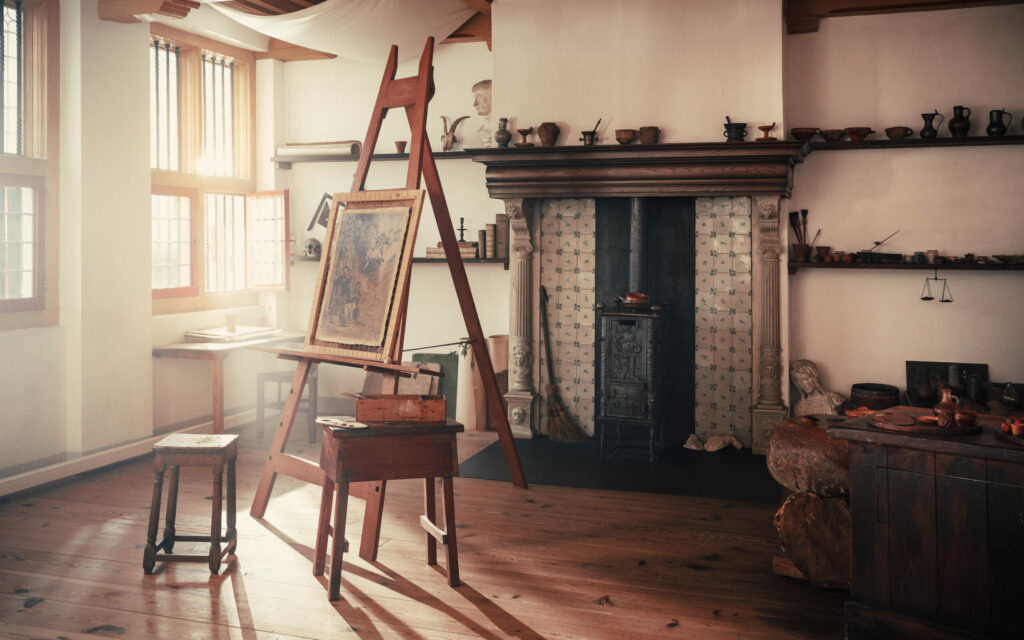
the old town hall of Amsterdam, when it had burnt down, seen from the Waag, |1652|The palace was originally built as a town hall in the seventeenth century. The first stone was laid in 1648, the year a peace treaty was signed with Spain. The architect was Jacob van Campen. The Antwerp master Artus Quellien was engaged for the carvings and sculptures. Most of the pictures in the interior were painted by Ferdinand Bol and Govert Flinck, both pupils of Rembrandt. When Flinck died suddenly, Rembrandt was asked to paint a large picture. His painting, The Conspiracy of Julius Civilis, was not well received so he removed it. Rembrandt had dealings with the town hall again when was declared bankrupt, because the office of the 'Desolate Boedelkamer', the body that dealt with bankruptcy proceedings, was housed there. On 6 July 1652 the old Amsterdam town hall was devastated by fire. The medieval building stood in Dam Square, just in front of the spot where the new town hall was being built. The cause of the fire is unknown, but it spread so fast that little could be saved. All that was left was a smoking ruin. The tower did remain standing, but was in imminent danger of collapse. Rembrandt made a drawing of it three days after the fire and before the ruin of the old town hall was pulled down. He stood next to the Waag, which was situated in Dam Square until 1808. He noted on his drawing, ‘vand waech afte sien stats huis van Amsterdam/ doent afgebrandt was/ den 9 Julij 1652/ Rembrandt van rijn’, (the old town hall of Amsterdam, when it had burnt down, seen from the Waag, 9 July 1652, Rembrandt van Rijn). The rooms in Rembrandt’s house were reconstructed and refurnished with seventeenth-century furniture and works of art based on the inventory of Rembrandt’s household effects drawn up in 1656 after he went bankrupt. The ‘Kunst Caemer’, or art cabinet, where Rembrandt kept his collection of expensive and rare objects now looks as if Rembrandt could walk into it again at any moment. Objects like those we can see on the shelves are listed in the inventory, among them two globes, busts of Roman emperors and Greek philosophers, and all sorts of exotic shells and coral.

Rembrandtplein
Statue on the Rembrandt squareIn the seventeenth century the present Rembrandtplein was a market for dairy produce and poultry and was called the 'Botermarkt' – butter market. In 1852 a statue of Rembrandt by Loius Royer was erected on the edge of the square. The statue was moved to the centre of the square in 1876 and the square was renamed the Rembrandtplein.

Celebration of the 300th Anniversary of Rembrandt’s Birth
In 1906 the three hundredth anniversary of Rembrandt’s birth was celebrated on a grand scale in Leiden and Amsterdam with exhibitions, performances, costumed processions and even a parade of flowers and fireworks. On 16 July, the day after Rembrandt’s birthday, there was a special gala night in the Stadsschouwburg in Amsterdam with poetry readings, plays and music especially composed for the occasion. The composers were Alphons Diepenbrock, Bernard Zweers, Johan Wagenaar and Willem Mengelberg, the conductor of the Concertgebouw Orchestra. Mengelberg had composed music to accompany nineteen of Rembrandt’s biblical etchings. The first etching was Abraham and the Three Holy Men (B 29) and the last was The Death of the Virgin (B 99). As his composition, with its Mahlerian influences, was performed, glass slides of the twelve etchings were projected on to a large white canvas – an idea conceived by the writer, painter and graphic artist Jan Veth. In the celebration year, Amsterdam City Council purchased the sadly neglected Rembrandt House in the Jodenbreestraat and transferred ownership to a special trust, which commissioned the architect K.P.C de Bazel to restore the building. The driving force behind this rescue operation was Jozef Israëls, the leading light of the Hague School, who felt he was inspired by Rembrandt in his own art. Meetings were held and wreaths were laid at Rembrandt’s statue in the Rembrandtplein and in the Westerkerk where Rembrandt had been buried. In the satirical newspaper De Ware Jacob of 14 July 1906 (price 15 cents), verses and prints poked fun at the commercialization of Rembrandt ('Rembrandt tobacco' and 'Rembrandt sausage') and at the high and mighty who were now thrusting themselves into the limelight even though they had never previously given any indication of a love of Rembrandt’s art. One print of these distinguished gentlemen laying a wreath at Rembrandt’s statue was captioned with Rembrandt’s thoughts on the matter: ‘These people honour me with their lips, but their hearts, fortunately, have nothing to do with me.’

The Corner of Marnixstraat and Passeerdersstraat ‘De kleine Stinkmolen’
The windmill 1641 Etching, only state (B 233)Today the St Bernard old people’s home stands at the corner of Marnixstraat and Passeerdersstraat. In the seventeenth century it was the location of the Passeerder bulwark, later renamed the Osdorp bulwark. It was one of the nineteen fortifications in the city wall. This section of Amsterdam’s ring of defences had been completed between 1611 and 1613. Precisely on that spot stood a mill that Rembrandt depicted on two occasions, once in a drawing and once in an etching. ‘De kleine Stinkmolen’ (The Little Stink Mill) was situated on what is now the corner of Marnixstraat and Nieuwe Passeerdersstraat. The mill belonged to the chamois leather workers’ guild and was used to soften tanned leather by treating it with cod liver oil. The mill probably owed its name to the unpleasant smell it produced. In this type of mill – known as a smock mill – the cap could be turned with the aid of a tail pole and a capstan wheel. Rembrandt – himself a miller’s son – pictured the parts in recognizable detail. In the seventeenth century someone wrote a note on the back of this print, mistakenly identifying the mill as one that had been owned by Rembrandt’s grandfather.

Diemerdijk
The Breestraat, the street in which Rembrandt lived for so long, ended at the sea dyke that protected Amsterdam and Amstelland from the waters of the IJ and the Zuiderzee. This dyke was called the Sint Anthonisdijk; as you could walk along it to Diemen it was also called the Diemer Zeedijk, or just the Diemerdijk. Rembrandt must often have walked along it. He certainly sketched there a great deal. This etching shows the actual situation in mirror image. We are looking east from the dyke; on the right we can see the Zuiderzee and on the left the low-lying farmsteads. Rembrandt took great pains to achieve the painterly effect of sunlight and shadows on the little copse of trees. In the foreground a man carries two buckets on a yoke over his shoulders. Beside him skips a happy dog. In the second state of the print Rembrandt added a couple of imaginary hills. Perhaps he thought the real landscape was not interesting enough.

Montelbaanstoren
The Montelbaanstoren |1644-1645| Pen and pencil in brownThe tower at number 2 Oude Schans was built in 1516 as a defence tower, but by the seventeenth century it was being used simply as a warehouse. In 1606 the building was topped with an ornamental steeple in Renaissance style to a design by Hendrick de Keyser, and a clock and a peal of bells were installed in the tower. Four years later the tower showed signs of serious subsidence and had to be pulled upright with cables. The foundations, which originally consisted of cut peat, were reinforced with a circle of bricks. At one time there was a bridge close to Rembrandt’s house, opposite the present number 33 Oudeschans. He made this drawing of the Montelbaanstoren on that spot. In the drawing we can see the harbour master’s house, built on piles, in front of the tower. Rembrandt omitted the wooden spire. He evidently thought the sturdy shape of the old tower was more beautiful.

The Omval
The Omval in the River Amstel 1645 Etching and drypoint; state II (B 209)The Omval was a piece of land situated on a bend in the River Amstel. In Rembrandt’s time this was an area of countryside where many Amsterdammers went for a pleasant day out. The Omval was originally a spit of land between the Watergraafsmeer, which was drained in 1629, and a bulge near the bend in the Amstel. This bulge was called the Windrak. The Omval itself was named after the ruins of a house that once stood there. Rembrandt shows us a view of the Omval. A man wearing a broad-brimmed hat stands on the Amsteldijk. Above his shoulder is the entrance to the ring canal around the Watergraafsmeer and one of the mills used to pump the water out of the polder. On the far right we can see the dark mouth of a brick culvert. Sailing boats lie moored near some houses. A group of people are being rowed along the Amstel in a boat with a canopy. The main feature of the etching, however, is a gnarled willow. A couple is hidden in the shadow of the tree. The boy is putting a garland of flowers on the girl’s head. Today, Amsterdam’s tallest building – the Rembrandt Tower – stands on the site of the Omval. Looming up beside Amstel Station, the tower is 135 metres high and can be seen from a considerable distance by day and night.